English





![Calf Roping in Rodeo: Rules of Tie-Down vs. Breakaway Roping – [Discipline Guide]](/wp-content/uploads/2026/01/tie-down-roping-discipline-guide.jpg)
Calf roping is a fast-paced rodeo discipline that is focused on timing, coordination, and precision between horse and rider. Its roots trace back to practical ranch work, where cowboys needed to restrain young cattle for branding, veterinary care, or transport.
Over time, roping evolved into a sport, retaining many of its original techniques while adapting to a competitive environment. Today, calf roping is a core event at professional rodeos across North America and enjoys growing participation among youth and amateur riders.
Calf roping is divided into two main types. Tie-down roping involves catching a calf, bringing it to a stop, then dismounting to tie its legs. Breakaway roping uses a rope that releases once the calf is caught, emphasizing speed and accuracy without restraining the calf.
Read on to learn more about calf roping, including its historical development, governing bodies, event structure, welfare considerations, and training approaches.
Calf Roping in Rodeo
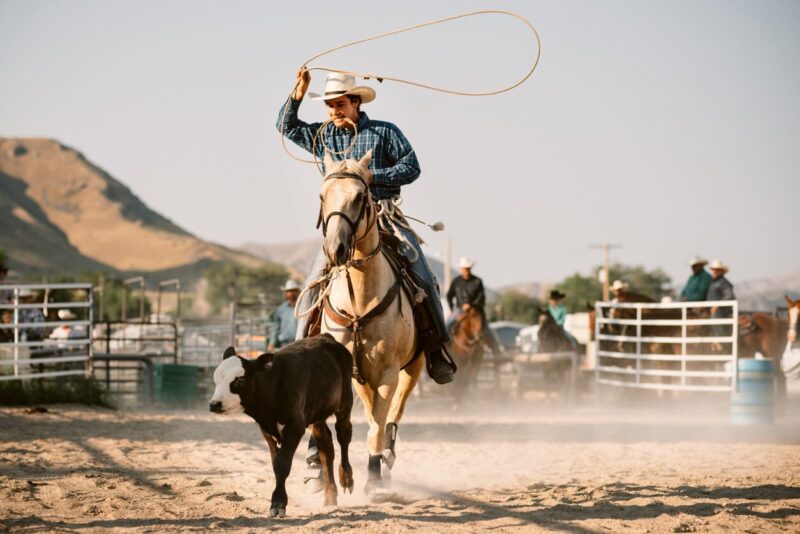
Calf roping is a timed rodeo event in which a mounted rider catches a moving calf with a lasso. The sport is contested in two main formats:
- Tie-down roping: The rider ropes the calf from horseback, dismounts, and moves to secure the animal. If the calf remains standing, it is brought to the ground before the rider ties three of its legs using a short rope called a piggin’ string. The run is considered complete if the tie holds for six seconds after the rider remounts and slackens the rope. [1]
- Breakaway roping: A variation in which the rider ropes the calf from horseback without dismounting. The rope is secured to the saddle horn with a light breakaway string and flag. When the calf reaches the end of the rope, the string breaks, releasing the rope and stopping the clock. [2]
Speed, precision, and timing are central to both forms of calf roping. Riders must control their horses, deliver accurate rope throws, and (in tie-down events) complete the tie efficiently to achieve a competitive time.
Over time, animal welfare considerations related to calf handling during the tie have influenced how tie-down roping is regulated. In response, governing bodies have established rules addressing proper handling techniques, minimum calf weight requirements, and on-site veterinary oversight. [3][4]
Tie-down roping remains a central event in professional rodeo, testing traditional cowboy skills within a timed, competitive format.
Horses are trained to anticipate the calf’s movement, break quickly from the box, and stop hard once the rope lands, ensuring their rider can complete the task without delay.
Successful roping reflects a combination of traditional ranching techniques and competitive athleticism, contributing to the event’s continued presence in modern rodeo.
History of Calf Roping
Calf roping’s origins lie in the working practices of cattle ranches across the American West.
Before the invention of modern veterinary tools and livestock management equipment, cowboys used ropes to catch and immobilize calves for branding, castration, vaccination, or medical treatment. Quick, accurate roping was a common skill used in daily ranch life.
These skills turned competitive in the late nineteenth and early twentieth centuries, when cowboys began gathering at fairs, stock shows, and early rodeos to test their skills against one another. Events mirrored everyday ranch work, with tie-down roping emerging early as a distinct discipline. [5]
As rodeo associations formed, rules and scoring systems were standardized, shaping the structure used in modern competition.
As rodeo’s popularity grew, roping events were incorporated into major competitions such as Cheyenne Frontier Days and the Calgary Stampede. By the mid-1900s, tie-down roping had become a well-established fixture of the professional rodeo circuit. [5]
Breakaway roping later developed as a less physically demanding format and an event that broadened participation, especially among female competitors.
Longstanding inclusion at junior and amateur levels later expanded to top-tier professional rodeos through the Women’s Professional Rodeo Association (WPRA) and select Professional Rodeo Cowboys Association (PRCA) sanctioned events, increasing visibility within the sport. [6]
What's your top priority with your horse's health?

Enter your email to receive your store credit
Sport Organizations
Calf roping is governed and promoted by several major rodeo organizations, each with a role in establishing rules, hosting competitions, and supporting athlete development.
Specific organizations include: [7][8][9][10][11]
- Professional Rodeo Cowboys Association: Serves as the main sanctioning body for professional rodeo in North America. It governs tie-down roping at major rodeos and the National Finals Rodeo (NFR), the sport’s premier championship event. The PRCA enforces strict rules on horse welfare, calf handling, and barrier infractions to ensure fairness and animal safety.
- Women’s Professional Rodeo Association: The leading body for female rodeo athletes has played a central role in advancing breakaway roping by advocating for its inclusion in major rodeo events and helping establish it as a high-profile discipline with equal prize money to similar events with male participants.
- Collegiate Organizations: At the youth and amateur level, organizations such as the National High School Rodeo Association (NHSRA) and the National Intercollegiate Rodeo Association (NIRA) support calf roping events, helping young athletes develop their skills and compete on a national scale.
- Other Local Associations: Smaller regional associations, including state and provincial rodeo circuits, host local tie-down and breakaway competitions. These grassroots systems support rider development and strengthen community engagement.
International rodeo bodies that recognize roping events include: [12][13][14]
- Canadian Professional Rodeo Association: Governs roping events in Canada, including those held at the Calgary Stampede.
- Australian Professional Rodeo Association (APRA): The Australian organization oversees events and adapts rules to reflect local conditions and welfare protocols. Competitions include both tie-down and breakaway roping within a broader campdrafting and rodeo culture.
- New Zealand Rodeo Cowboys Association (NZRCA): Regulates rodeo events in New Zealand, including calf roping, emphasizing compliance with animal welfare laws and alignment with public expectations and ethical standards.
Together, these organizations define how calf roping is structured and regulated. Through education initiatives, sponsorship programs, and consistent rule enforcement, they work to preserve traditional practices while adapting to changing expectations around animal welfare, gender inclusion, and professional standards.
Calf Roping in Rodeo Competition
Modern calf roping is practiced in two distinct forms: tie-down roping and breakaway roping.
While both share the same foundational skills — speed, precision, and coordination between horse and rider — they differ in execution and impact.
Tie-Down Roping
Tie-down roping is the original form of calf roping and requires the execution of a series of coordinated steps under time pressure.
First, the rider breaks from the box and attempts to loop the calf with a lasso from horseback, then ties the rope off on the saddle horn. The horse stops and holds the rope taut without over-pulling, preventing escape while keeping the calf from dragging across the ground. [1][4]
After roping the calf, the rider dismounts, approaches the calf, and ties three of its legs together using a short rope known as a piggin’ string. The tie must hold for six seconds, with the rider remounting their horse and taking slack out of the rope to signal the end of the run. [1][4]
Tie-down roping places high physical and mental demands on both horse and rider. Horses must sprint explosively from the box, stop quickly, and remain steady while their rider completes the tie. Riders must deliver an accurate rope loop, clear the saddle efficiently, and bring the calf to the ground in a controlled manner.
Breakaway Roping
Breakaway roping is a less physically demanding variation of calf roping that evolved from the tie-down format. It was initially introduced to expand opportunities for female competitors and has since gained broader recognition within mainstream rodeo competition. [6] It is now featured at top-tier rodeos, with professional women ropers competing at elite levels, including the National Finals Breakaway Roping.
In this event, the rider ropes the calf from horseback without dismounting or tying. The rope is secured to their saddle horn with a string and flag. When the calf reaches the end of the rope (pulling it tight) the breakaway connection snaps, releasing the rope and signaling the end of the run. [4]
Calves in breakaway roping are not handled or restrained, which has contributed to broader acceptance among animal welfare advocates. The event also involves fewer steps for the rider, making it more accessible as an entry point for youth and amateur competitors.
Though the event is shorter and less physically intense, it still demands a high level of athleticism and training. Horses are prepared in much the same way as tie-down horses, learning to break cleanly from the box, adjust speed with the calf, and stop sharply once the catch is made.
Competition Rules & Scoring
Calf roping competitions operate under standardized rules designed to promote consistency, safety, and fair competition across events. While specific details may vary by organization, the underlying principles are largely consistent throughout the world.
Before a run begins, the horse and rider wait in a roping box beside a chute holding the calf, positioned behind a barrier line. The calf is given a head start, and the clock begins when the rider leaves the box. Breaking the barrier early results in a 10-second penalty. [4]
Both calf roping variations are judged solely on time, with no scoring for style or form. Invalid catches, overly rough handling, or an escaped calf result in disqualification. [4] The margin for error is razor-thin, and a single mistake can cost the round.
Calf Roping Horses
Horses used in calf roping competitions are selected for speed, responsiveness, and trainability, along with the temperament to manage noise, pressure, and the physical demands of rapid acceleration and abrupt stops. [15]
In tie-down roping, horses must also work the rope by maintaining steady tension without dragging the calf. This demands balance, strength, and patience, along with the ability to stand quietly during the tie and respond to minimal cues as the rider dismounts and remounts. [15]
Most roping horses are Quarter Horses or Quarter Horse crosses. Their compact, muscular build, cow sense, and rapid acceleration make them ideal for sprinting from the box, rating a calf, and stopping powerfully when the rope lands.
While the physical demands are generally lower in breakaway roping than in tie-down roping, horses in either event still require high levels of responsiveness, confidence, and agility. Even a brief delay in stopping can determine the outcome of a competitive run.
Training for Roping Horses
Training a reliable roping horse can take years. Success in the arena depends on athleticism, precise timing, steady focus, and a consistent working partnership.
Roping practice typically begins on the ground, with riders working on stationary dummies to develop lasso accuracy, arm strength, and muscle memory. Training often progresses to use of mechanical dummies, followed by roping sleds pulled by ATVs or horses to simulate cattle movement in a controlled environment. [15][16]
Horsemanship skills are equally important. Riders must control their horse’s position, speed, and stopping response while maintaining focus on the calf and rope. At advanced levels, ropers often work with professional coaches to refine their timing, positioning, and overall run strategy. [15][16]
Training horses for roping begins with groundwork and desensitization. Young horses are gradually introduced to cattle, the rope, the barrier, and the tie-down rope or breakaway string. Each element is added in stages to support confidence, responsiveness, and consistent performance. [16]
Successful training programs balance repetition with rest. Horses and riders both benefit from cross-training, conditioning, and recovery periods to stay mentally fresh and physically sound.

Equipment Used in Calf Roping
Both tie-down and breakaway roping depend on specialized equipment intended to support speed, control, and precision. While much of the core gear is shared between the two events, certain equipment requirements differ based on the demands and structure of each format.
In tie-down roping, equipment includes a standard neck rope for catching the calf and a short tying rope known as a piggin’ string. Western style roping saddles are designed for stability and quick dismounts, with sturdy horns, secure rigging, and responsive tack selected to support rapid transitions during a run.
Breakaway roping uses a similar lasso, but the rope is secured to the saddle horn with a breakaway string and a small flag. Breakaway saddles and tack emphasize a secure horn and consistent release rather than equipment designed for dismounting or tying. [8]
Welfare in Calf Roping
Animal welfare is a central concern in calf roping, and plays an increasingly prominent role in rules, training practices, and public perception of the sport.
Both tie-down and breakaway roping events involve live target animals, requiring balance between competitive performance and humane treatment. Professional rodeo organizations regulate calf health, handling practices, and participation standards to address these concerns. [3]
In tie-down roping, welfare considerations primarily relate to calf handling, including stress during the catch, the risk of falls, and strain to the calf’s limbs during stopping and tying.
To mitigate these risks, the PRCA and comparable organizations enforce handling standards and assess penalties for rough actions, such as jerking a calf off its feet. If a calf is injured during a run, it is removed from competition and receives immediate veterinary care. [3][17]
Calves are required to meet minimum weight standards to reduce injury risk during roping. Animals are examined before competition for signs of illness or prior injury to ensure they are fit to participate.
Limits are also placed on how often a calf can be used within an event or day to help manage their fatigue and stress. [3][4]
Breakaway roping has gained popularity in part due to its lower physical impact on calves. Because the rope releases and the calf continues running, there is no physical restraint or handling involved.
As a result, many organizations and animal welfare advocates view breakaway roping as a lower-risk alternative that preserves the core elements of roping while limiting potential harm.
Rodeo committees and stock contractors are required to provide safe arenas, appropriate footing, and consistent animal management practices. Judges and veterinarians are present at sanctioned events to monitor compliance and address animal welfare concerns as they arise. [3][4][17]
Roping equipment is designed with safety in mind. Ropes are often smoothed or padded, and tie-downs structured to minimize discomfort for target animals.
As public expectations continue to shift, the rodeo industry responds with ongoing adaptation. Welfare audits, educational initiatives, and the growing prominence of breakaway roping reflect efforts to preserve the sport’s cultural foundations while placing greater emphasis on animal well-being.
Frequently Asked Questions
Here are some frequently asked questions about calf roping in rodeos:
Calf roping in rodeos is a timed event where a mounted rider catches a running calf with a lasso under controlled rules. Depending on the event type, the rider either dismounts and restrains the calf or releases it once the rope breaks away. Speed, accuracy, and coordination between horse and rider determine success.
The difference between tie-down and breakaway roping lies in what happens after the calf is roped. Tie-down roping requires the rider to dismount and tie three of the calf's legs, with the tie holding for six seconds. Breakaway roping ends as soon as the rope breaks from the saddle horn, with no dismount or physical restraint.
Calf roping safety is managed through strict welfare rules enforced by rodeo organizations. These include minimum calf weights, limits on the number of runs per animal, proper arena footing, and on-site veterinary oversight. Breakaway roping is considered lower risk because calves are not tied or handled, while tie-down roping follows additional handling regulations to reduce injury and stress.
Equipment needed to start calf roping includes a well-fitted saddle, a rope designed for roping events, and appropriate tack for speed and control. Tie-down roping also requires a piggin' string for tying the calf's legs, while breakaway roping uses a breakaway string and flag attached to the saddle horn. Reliable equipment supports safety, timing, and communication between horse and rider.
Calf roping horses are selected for speed, responsiveness, and the ability to stop quickly and work the rope. Most competitors use American Quarter Horses or Quarter Horse crosses because of their strong hindquarters, quick acceleration, and calm temperament under pressure. Successful roping horses are trained to break sharply from the box, rate the calf’s speed, stop smoothly once the rope lands, and remain steady while the rider completes the run.
Summary
Calf roping is a rodeo discipline that developed from practical ranch work and has since evolved into a regulated competitive sport. Modern formats balance performance, tradition, and growing attention to animal welfare.
- Calf roping includes both tie-down and breakaway events, each emphasizing timing, coordination, and horsemanship
- Competitive rules are set and enforced by major rodeo organizations to promote consistency and fairness
- Horse and rider athleticism play a central role, with training focusing on responsiveness, speed, and control
- Animal welfare standards have become increasingly important, shaping equipment choices, rules, and handling practices
- Breakaway roping has expanded participation and visibility while preserving the discipline’s working-ranch roots
References
- Tie-Down Roping 101: Everything You Need to Know. Silver Spurs Rodeo.
- Breakaway Roping 101. The Breakaway Roping Journal.
- Livestock Welfare Rules. PRCA Sports News. 2026.
- Professional Rodeo Cowboys Association 2025 Rulebook. PRCA. 2024.
- Early Rodeos in the Extreme Sports Tradition. National Cowboy & Western Heritage Museum.
- Cabe. C., The Big Breakaway: The Rise Of Breakaway Roping. Cowboys and Indians Magazine. 2024.
- About The PRCA. PRCA Sports News. 2024.
- About the WPRA (With Board Members). WPRA. 2024.
- Whitehead. F., Let 'er Buck: Gender and Animal History in Twentieth-Century American Rodeo. The University of Arizona. 2021.
- History . National Intercollegiate Rodeo Association. 2014.
- About. National High School Rodeo Association. 2025.
- About. Canadian Pro Rodeo Association. 2025.
- The New Zealand Rodeo Cowboys Association. NZRCA. 2026.
- APRA HISTORY. Australian Pro Rodeo Association. 2026.
- Tie-Down Roping Fundamentals. CalfRoping.com. 2022.
- 10 Tips for Training Rope Horses. American Quarter Horse Association. 2019.
- Animal Care and Protection (Code of Practice about Rodeos) Amendment Regulation 2021. Australian Animal Care and Protection Act. 2021.