English
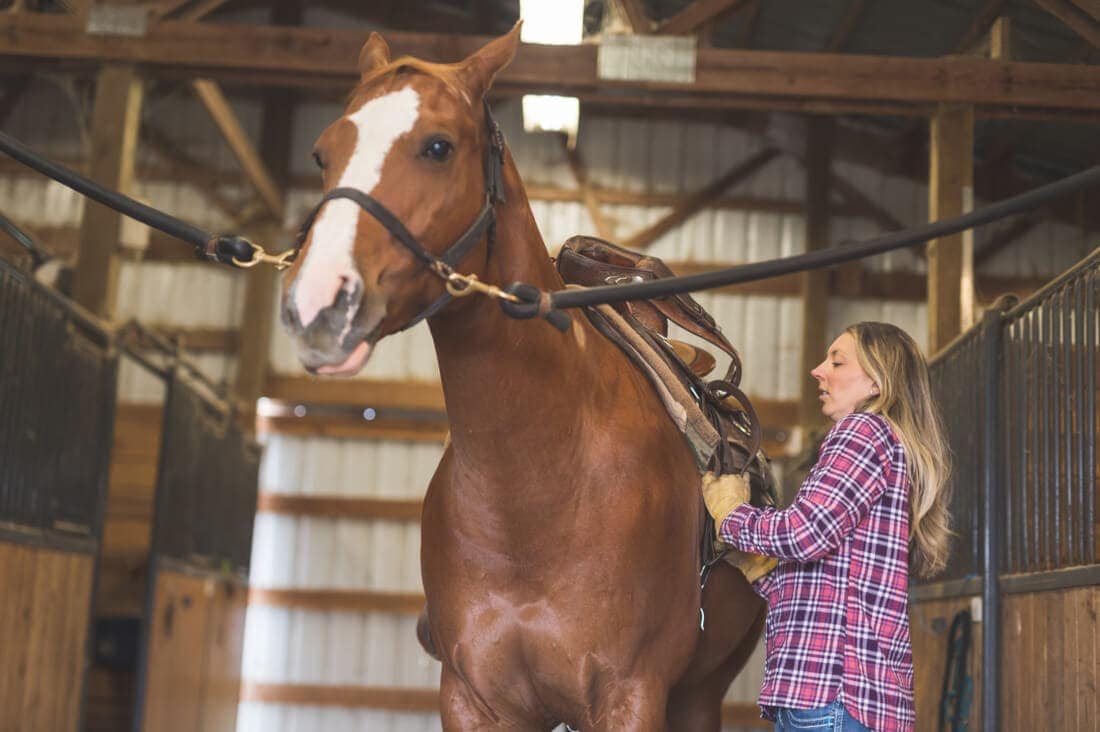
Cross ties are a key handling tool in equine management, providing a practical way to keep horses still during grooming, tacking, farriery and veterinary care. When used properly, cross ties can improve safety and efficiency while helping horses learn to stand calmly.
While cross ties are common in most horse operations, improper installation or inadequate training can lead to serious risks, including poll injuries and panic responses. Horses that experience fear or physical discomfort while cross-tied may become resistant, head-shy, or anxious, increasing the chance of accidents.
Understanding how horses perceive restraint and how to introduce cross ties gradually is essential to ensure both safety and welfare.
Read on to learn everything you need to know about how cross ties work, their advantages, potential risks, and how to use them safely and effectively with your horse.
Cross Ties & Equine Handling
Cross-tying is a common and practical tool used for positioning and restraining horses safely during routine tasks including:
A cross tie apparatus consists of two adjustable leads or straps, typically made from elastic, nylon, or rope, with clips that attach to the horse’s halter from both sides. The opposite ends are fixed to solid posts, walls, or metal rings on either side of a grooming bay, wash stall, or barn aisle.
When attached, cross ties keep the horse standing in the center of the space, restricting side-to-side, forward or backward motion. This setup helps maintain control and creates a defined area for grooming, farrier work, veterinary care, or saddling. It also provides the handler with clear access to both sides of the horse. [1][2]
Cross-tying systems come in various designs and materials, each suited to particular barn environments and handling needs. Using the optimal setup for your use case and facility makes a big difference in safety, horse comfort, and workflow.
Benefits of Using Cross Ties
When used correctly, cross ties offer advantages for both horses and handlers by promoting calm behavior, increasing safety, and streamlining everyday barn routines. In well-managed environments, cross ties can help standardize handling procedures, improve time management, and reduce stress during care tasks.
These benefits make cross ties a valuable tool in both professional facilities and private barns.
Improved Efficiency
Cross ties help keep a horse standing squarely in one place, minimizing unnecessary movement. When a horse is centered between two ties, it’s easier for the handler to work on both sides of the body without constantly repositioning the animal. This makes tasks like grooming, clipping, bandaging, hoof picking, and tacking up more efficient.
Since the horse’s movements are restricted in a safe and controlled manner, handlers can focus on the job at hand. This is especially beneficial in busy barns or during peak activity times. [2]
Enhanced Safety
Cross ties can greatly reduce the risk of accidents during handling. By limiting the horse’s ability to swing their hindquarters, turn abruptly, or step laterally, cross ties help minimize the chance of a sudden kick or other dangerous behavior. This added control creates a safer environment for handlers and others nearby.
Cross ties are especially useful during veterinary or farrier visits, when close contact with sensitive areas can lead to evasive reactions. A well-tied horse is easier to examine, treat, or trim, reducing the likelihood of injury to professionals.
Cross-Functional Training
With consistent handling and positive reinforcement, cross ties can help teach horses to stand quietly and calmly. This important skill has applications across the horse’s life, not just at their home barn.
Horses who learn to relax in cross ties are often easier to manage in other restrained settings, like trailers or examination stocks.
Space Optimization
Cross ties allow barns to maximize available space by creating defined grooming or work areas even in narrow aisles or corners. Multiple horses can be tied and managed at once, streamlining barn operations.
What's your top priority with your horse's health?

What's your top priority with your horse's health?
Risks of Cross Ties
While cross ties are highly dependable and useful for daily horse care, they also come with risks. Improper installation, unsuitable equipment, or use with untrained horses can lead to dangerous situations. Awareness of these hazards is essential for keeping horses and handlers safe.
Pullback Accidents
A major risk with cross ties is a pullback incident, where a horse tries to flee while restrained. This sudden force places intense pressure on the poll, the highly sensitive area at the junction between the skull and the first cervical vertebra.
When a horse pulls back and cannot escape, panic often escalates, increasing the risk of injury to the poll, neck, and surrounding soft tissues.
The poll is a dense hub of small, finely tuned muscles, ligaments, nerves, and a fluid-filled bursa that allows for the precise movement. This anatomical feature is fundamental to the horse’s balance, self-carriage, and communication with the rider’s hands. [3][4][5]
Since these structures are delicate and highly innervated, they are particularly vulnerable to the extreme forces generated during a pullback. The aftermath of a pullback incident can range from subtle to severe. [3][4][5]
Potential outcomes include: [3][4][5]
- Poll strain and soft tissue injury: Particularly to the nuchal ligament, occipitohyoid and splenius muscles, and the atlanto-occipital joint
- Restricted range of motion in the poll: May lead to compensatory tension along the neck, back, and hindquarters
- Swelling or damage to the poll bursa: Can result in long-term discomfort and visible deformity (e.g., a pronounced bulge behind the ears)
- Fractures: Of the occipital bone, or cervical vertebrae in extreme cases
- Secondary musculoskeletal issues: Including temporomandibular joint (TMJ) dysfunction, thoracic sling tension, and altered stride mechanics
- Behavioral fallout: Such as head shyness, reluctance to be bridled or touched, resistance to contact under saddle, or refusal to be caught
Not all damage appears immediately. In some horses, the consequences of a pullback episode may surface days or months later. A sudden change in work ethic, discomfort with haltering, or unexplained back pain may trace back to an unresolved poll injury.
Horses may begin to associate cross ties with discomfort or fear, leading to anxiety or repeated incidents.
Pullbacks & Learned Helplessness
Horses that experience repeated hard tying and pullbacks without relief may develop learned helplessness, while those who successfully break free during pullbacks might become hypervigilant and resistant to handling. Both responses indicate unresolved trauma – either from feeling trapped without escape or from the physical pain of past incidents.
After a pullback, the horse should be checked for swelling or asymmetry at the poll and neck. Even if no injury is visible, veterinary evaluation is advised. Temporary avoidance of cross ties and a return to basic tying skills may be needed to rebuild confidence.
Panic Responses
Horses are prey animals, and being restrained between two fixed points can feel threatening to them. In a standard tie, the horse can turn slightly, lower their head, or take a step back to self-soothe. In cross ties, that freedom is removed depending on how tightly the cross ties are adjusted.
If a horse feels trapped, they may react by trying to escape. Horses with a history of trauma, abuse, or poor desensitization training are particularly at risk of panicking in cross ties.
Improper Installation
Even calm horses can get hurt if the cross tie hardware fails. Loose bolts, degraded wood, or tie rings mounted too high, too low, or on unstable surfaces can give way under pressure. If a horse pulls back or shifts suddenly, poor installation can lead to falls, broken equipment, or an escaped horse, putting others at risk.
Careful planning, proper materials, and routine maintenance are key to safe cross tie use.
Training & Cross Ties
To use cross ties safely, it’s important to understand how horses perceive the world. Equine anatomy and behavior play a central role in how a horse responds to restraint, and why improper use of cross ties can lead to fear, injury, or long-term behavioral issues.
During cross-tying, it’s important to consider the following influences on equine behavior: [5][6][7][8]
- Prey instincts: Horses instinctively flee in response to fear. When a horse perceives a threat but is restrained, they may panic and try to escape, risking injury. While horses do not instinctively fight when cornered, their behavior can become unpredictable when flight is not an option.
- Field of vision: The horse’s eye position provides a broad field of view that has consistent blind spots. Sudden movements in a horse’s blind spot can startle them, especially when restrained.
- Hearing sensitivity: As prey animals, horses have highly developed hearing that can detect high-pitched or distant sounds that humans may not notice. In a cross tie setup, where the horse is restricted and has little ability to investigate or flee from a perceived threat, sensory overload can escalate quickly into a panic reaction.
- Anatomy: The poll and neck are extremely sensitive and directly affected by pressure from cross ties. Sudden jerks or resistance can result in soft tissue strain, spinal misalignment, or even fractures.
Basics of Training
As with any equine skill, training your horse to tolerate cross ties requires understanding how horses learn. Effective cross tie use starts with thoughtful, gradual training after the horse learns to yield to pressure and stand quietly while tied with a single lead rope.
Horses in cross ties benefit greatly from a quiet, familiar environment where the handler remains calm, patient, and encouraging, using positive reinforcement to reward standing still. It is also helpful to keep sessions short and low-stress, with regular breaks and plenty of praise.
The process of introducing young horses to cross ties may take several weeks. For older horses with a history of fear or pullback, retraining may require insight from a professional equine behaviorist and alternative restraint methods.
Cross tie training depends on having a trusting relationship between horse and handler. When horses understand what’s expected and feel comfortable in their environment, they’re far less likely to panic. Investing time in this process significantly improves safety, both for the horse and their caregivers.
Cross Tying Horses: Best Practices at a Glance
| DO | DON’T |
|---|---|
| Use breakaway halters | Use rope halters in cross ties |
| Use cross ties with quick release snaps | Use cross ties with difficult clips |
| Supervise horses at all times | Leave a tied horse unattended |
| Train patiently before use | Force or rush nervous horses |
| Install proper safety hardware | Tie to boards or temporary hooks |
| Monitor for wear and tear | Ignore signs of distress |
How to Cross-Tie Your Horse
A safe cross tie setup starts with the right equipment, proper installation, and appropriate training. Elements such as tie height, placement, halter type, and handler behavior all play a role in reducing risk and ensuring the horse’s comfort and security.
Important considerations for cross-tying a horse include: [9][10]
- Tie ring height: Tie rings should be at the horse’s withers, which allows for a neutral head position. Ties should permit limited head movement but be short enough to discourage swinging or turning.
- Installation hardware: Tie rings should be fixed securely into solid wood beams or posts, not boards, drywall, or temporary structures.
- Breakaway features: For safety, each tie should include a breakaway feature to prevent serious injury.
- Material: Use safe lead materials like nylon. Bungee cross ties can stretch unexpectedly or snap back, risking injury. Chain cross ties can be dangerous if the horse shakes their head.
- Attachment point: Clip cross ties to rings on the noseband of the halter, not cheek rings. If a cross tie on the cheek ring snaps, the horse’s eye may be hit.
- Quick-release snaps: Use quick-release snaps for easy emergency release.
- Mental preparation: Only introduce cross ties after the horse is comfortable standing tied with a single lead rope. This teaches the horse to yield to pressure and builds confidence under restraint. Start gradually and reward the horse for calm behavior.

Step-by-Step Guide: Cross-Tying a Horse Safely
Cross-tying a horse safely requires both preparation and calm, confident handling. Follow these steps to ensure a positive experience for both horse and handler:
- Lead the horse into position: Stand the horse squarely in the grooming area, facing forward between the anchor points.
- Clip the first tie: Attach one cross tie to the noseband ring of the halter.
- Assess the horse’s response. Make sure the horse remains relaxed before attaching the second tie. If the horse shows signs of stress, pause and allow time to settle.
- Attach the second tie: Clip the other cross tie to the opposite side of the halter. Leave just enough slack for the horse to hold a natural head position without swinging or turning excessively.
- Monitor the horse: Do not walk away while the horse is in cross ties. Supervision is important in case of panic or equipment failure.
- Release one tie at a time: When finished, unclip one side at a time, keeping the horse relaxed throughout the process.
With the right setup and consistent training, cross ties can become a safe, reliable part of your daily care routine, supporting both horse welfare and handler safety.
Frequently Asked Questions
Here are some frequently asked questions about cross-tying horses:
Cross-tying a horse means securing the horse with two ties attached to opposite sides of the halter. Each tie connects to a fixed anchor point, usually in a grooming bay, wash stall, or barn aisle. This setup keeps the horse centered and limits side-to-side, forward, and backward movement during grooming, tacking, farrier work, or veterinary care.
Cross ties work by holding a horse between two anchor points with one tie clipped to each side of the halter. This limits how much the horse can swing, turn, step sideways, or back away. A properly adjusted setup still allows a natural head position, while giving the handler safe access to both sides of the horse.
Cross ties can be safe for horses when the setup, equipment, and training are appropriate. Safety depends on secure anchor points, breakaway features, quick-release snaps, proper tie height, and constant supervision. Cross ties are not ideal for every horse, especially those with a history of panic, pullback accidents, or fear while restrained.
Horses that panic, pull back, or have not learned to stand tied quietly may not be good candidates for cross ties. Young, anxious, poorly handled, or previously traumatized horses need gradual preparation before cross-tying. Horses with unresolved poll, neck, or behavioral issues may also need alternative restraint methods or professional support before using cross ties.
Training a horse to stand in cross ties should begin after the horse is comfortable standing tied with a single lead rope. Start in a quiet, familiar area, attach one tie first, and reward calm behavior. Keep early sessions short and low-stress. Gradually build confidence before attaching both ties and using them during longer care tasks.
Safe cross-tying equipment includes a breakaway halter, quick-release snaps, durable ties, and secure anchor hardware fixed into solid posts or beams. Tie rings should sit around the horse’s wither height to support a neutral head position. Cross ties should attach to the halter’s noseband rings, not the cheek rings, to reduce injury risk.
Unsafe cross tie equipment includes rope halters, chain ties, weak clips, temporary hooks, and hardware attached to unstable boards or walls. Bungee cross ties can also be risky because they may stretch unexpectedly or snap back. Equipment without breakaway or quick-release features can make a panic incident more dangerous for both horse and handler.
Horses may pull back in cross ties when they feel trapped, startled, uncomfortable, or unable to escape pressure. Since horses are prey animals, sudden sounds, movement in blind spots, pain, or past negative experiences can trigger panic. Once a horse pulls against fixed restraint, pressure on the poll and neck can escalate the fear response.
A pullback in cross ties can injure the poll, neck, soft tissues, ligaments, muscles, and nearby joints. Serious cases may involve swelling, restricted poll movement, bursa damage, fractures, or longer-term musculoskeletal compensation. Some horses also become head-shy, resistant to bridling, difficult to catch, or anxious about being tied after a frightening incident.
Cross ties attach to the noseband rings of the halter rather than the cheek rings. Noseband attachment helps keep the pull more balanced and reduces the chance of a broken or released tie snapping toward the horse’s eye. A breakaway halter and quick-release snaps add important safety layers during routine handling.
A horse should never be left unattended in cross ties, even for a short time. Panic, slipping, equipment failure, or sudden noise can create a dangerous situation within seconds. Supervision allows the handler to respond quickly, release the horse if needed, and prevent a minor scare from becoming a serious injury.
Summary
Cross ties are a widely used restraint method in horse management, offering practical benefits when used thoughtfully and safely. However, improper training or setup can lead to physical and behavioral risks for the horse.
- Cross ties help improve safety, efficiency, and grooming consistency in the barn.
- It's important to always include breakaway features and quick-release snaps in cross tie systems.
- Improper use can cause poll injuries, panic responses, or long-term behavioral issues.
- Horses must be gradually trained to accept cross ties using positive reinforcement.
- Never leave a horse unattended while cross-tied.
- Proper installation and handler awareness are essential for safe use.
References
- Sheldon. C. C. et al. Animal Restraint for Veterinary Professional. Second edition. Elsevier.
- Shiers. J. Grooming Horses: A Complete Illustrated Guide. Guilford, Conn. : Knack. 2009.
- Boakes. V. Poll Injuries from Pulling Back. Aitken Saddlery. 2024.
- Sweeney. B. The Effects of Your Horse Pulling Back. Triskele therapies. 2024.
- Higgins. G. and Martin. S. Posture and Performance, Principles of Training Horses from the Anatomical Perspective. Kenilworth Press. 2016.
- Hill. C. How to Think like a Horse: The Essential Handbook for Understanding Why Horses Do What They Do. Storey Pub, North Adams, MA. 2006.
- Vision in the Equine. Iowa State University Extension and Outreach. 2025.
- The Horse’s Ears and Hearing. Iowa State University Extension and Outreach. 2025.
- Richard. D. M. and Malinowski. K. Tying Horses Safely. Rutgers Cooperative Extension. 1988.
- Harris. S. E. Grooming to Win: How to Groom, Trim, Braid, and Prepare Your Horse for Show. Turner Publishing Company. 1991.