English
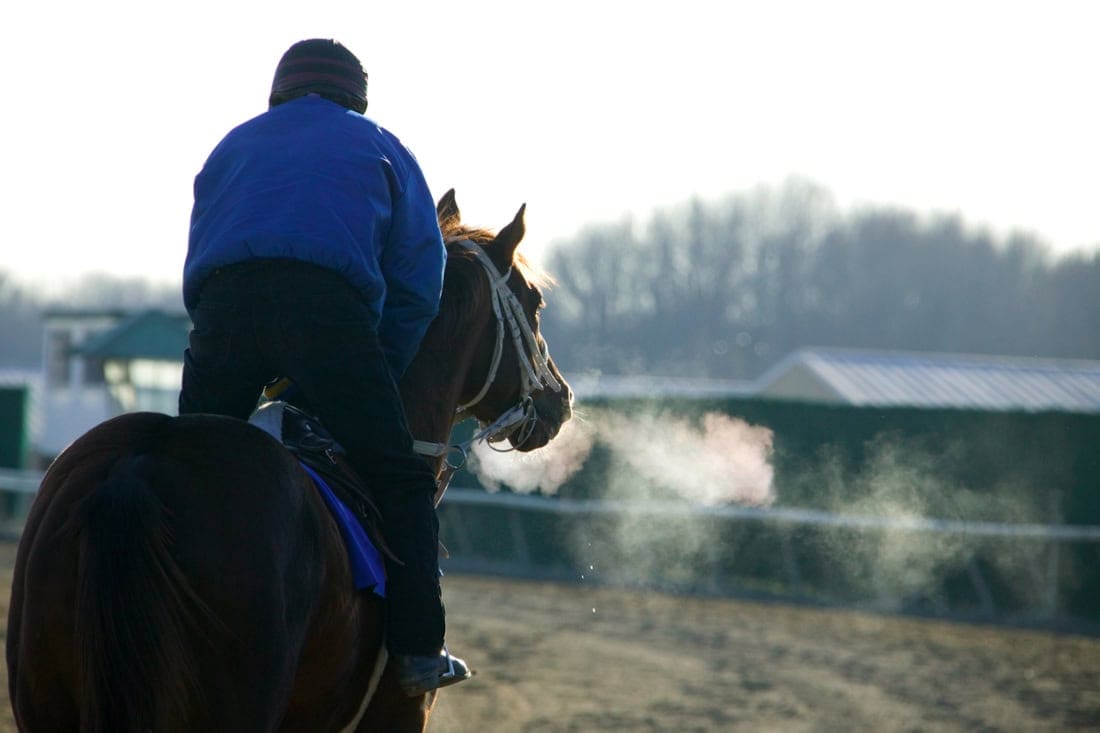
Purchasing an off-the-track Thoroughbred (OTTB) can be a rewarding experience, whether you’re looking for a competition partner, a pleasure horse, or a prospect to retrain for a new discipline.
Once retired from the racetrack, OTTBs bring a unique set of qualities that make them excellent competitors in a variety of disciplines. With their athleticism, intelligence, and adaptability, OTTBs are proving themselves as a valuable alternative to traditional show breeds.
Several organizations offer retraining incentives to encourage the adoption and successful second careers of retired racehorses. These programs often provide financial assistance, training support, and recognition for riders who retrain OTTBs.
If you’re considering transitioning from warmbloods or exploring new opportunities beyond breed shows, purchasing an OTTB as your next competition horse can offer numerous benefits. In this article, we explore why an OTTB could be your next champion and how these incredible horses are making their mark in competitive equestrian sports.
Retired Thoroughbreds
Since the early 1700’s, Thoroughbreds have been bred specifically for their incredible athleticism, speed and stamina, dominating the world of horse racing. But when their racing careers end, many of these elite athletes have untapped potential for second careers in sport and pleasure riding.
Riders have countless horse breeds to consider when searching for a new competition partner. Some individuals focus on breed-specific features and conformation in hopes of taking home ribbons from popular breed shows, such as the prestigious Quarter Horse Congress or Warmblood-exclusive events. These shows offer enticing incentives like cash prizes, saddles, and national recognition.
Other individuals prioritize finding a horse capable of excelling in the competition ring and advancing through the levels in their chosen discipline.
Despite their capabilities, retired Thoroughbreds are often overlooked in favor of traditional sport horse breeds. However, growing retraining programs and incentive initiatives are making it easier than ever for riders to transition Off-the-track Thoroughbreds (OTTBs) into successful second careers.
Riders interested in leveling up across many disciplines are increasingly considering OTTBs when looking at new equine partners.
Breed History
In the late 1600’s and early 1700’s, three stallions – Godolphin Arabian, Byerley Turk, and Darley Arabian – were fundamental in developing English horses. These horses became known as the foundation stallions for the Thoroughbred breed. [1]
When crossed with English mares, the offspring of these horses first became known as the “thro-bred.” With their remarkable ability to maintain high speeds over long distances, these first Thoroughbreds were optimal racehorses from the beginning of the breed. [1]
Thoroughbred Characteristics
Today, Thoroughbreds range in height from 15.2 to 17 hands. Thoroughbreds typically have a lean build, high withers, a deep chest and girth, and a long, light neck compared to other breeds. They also have well-muscled shoulders and long, clean legs with pronounced tendons that help improve stride length and soundness. Thoroughbreds typically have strongly muscled upper hind legs, with a long thigh bone and wide hip angle for power.
Most Thoroughbreds have some kind of racing career, and many start competing at a very young age. [2] Thoroughbreds typically begin racing at age two or three, and on average, race until age four or five.
This means when they retire from their racing career, they are still young enough to retrain in other disciplines. [3] While Thoroughbreds were bred to run races, their natural athleticism and breed characteristics make them suitable for many disciplines.
Most equestrians and horse enthusiasts associate Thoroughbreds with racing, but OTTBs have proven their versatility and athleticism across other sports. As more riders are investing time in these legends of the track, many have become Grand Prix show jumpers, five-star eventers, competitive barrel racers, and high-end hunters. [2]
What's your top priority with your horse's health?

Enter your email to receive your store credit
Famous OTTB Competition Horses
OTTB’s have found incredible success in their new careers in a number of riding disciplines. Some have become champions at the highest levels of their new discipline — with some even competing in the Olympics.
Blackfoot Mystery
Blackfoot Mystery is the off-track Thoroughbred that Boyd Martin rode at the 2016 Olympic Games in Brazil. In recent years, he has become a legendary OTTB in the upper-level eventing world. Blackfoot Mystery was bred by John O’Meara in Kentucky and had just three starts on the track before retiring from racing. [4]
Martin and Blackfoot Mystery only had a brief partnership before placing sixth during the CCI4*-L 2015 Dutta Corp. at Fair Hill International in Maryland. The following spring, they also finished sixth at the iconic CCI5*, now known as Land Rover Kentucky Three-Day Event. [4]
They were later chosen for the U.S. team at the 2016 Olympics, where they finished 16th with a clear cross-country jumping round. [4]
Touch of Class
Touch of Class is regarded as one of show jumping’s greatest Thoroughbred mares of all time and is an inductee into the Show Jumping Hall of Fame.
Originally registered with the Jockey Club under the name Stillaspil, this off-the-track Thoroughbred had an unsuccessful racing career, with six starts and no wins, before retiring. [5] However, she went on to incredible success in the jumper ring.
By the end of her show jumping career, Touch of Class had won six Grand Prix titles, placed second or third in 14 other Grand Prix finals, and secured numerous Nations Cup wins. [5]
Purchasing OTTBs
Purchasing an off-the-track Thoroughbred can be a rewarding and cost-effective way to find your next riding companion or competition partner.
Some horse owners purchase a horse in hopes they will be competitive in the show ring — especially shows that offer large prizes and money to its winners.
Many owners and riders purchase purebred horses to enter breed shows, which are known for offering significant prize money for its champions. For example, at the 2024 American Quarter Horse Association World Championship show, over $3 million USD in prize money and prizes was awarded. [6]
For English disciplines, such as hunters or show jumping, many people seek out breeds such as warmbloods that are specifically bred to perform competitively in their discipline.
English sport horses typically have significant Thoroughbred blood in their pedigrees to increase athleticism and keep them from becoming too “heavy” or draft-like. [7] While warmbloods have dominated the English disciplines for decades, acquiring well-bred horses also comes with a high price tag.
OTTBs offer a significantly more affordable alternative for many low- or mid-level competitive riders. The adoption or purchase fees for an OTTB range from hundreds to a few thousand dollars or more. Conformation, soundness, level of training, and who they are being purchased from contribute to the price tag for an OTTB. [2]
How to Buy an OTTB
There are many avenues to find recently retired Thoroughbreds looking for new homes. It’s essential to carefully vet any OTTB you’re considering and research any related programs and the seller involved thoroughly.
One popular option is to purchase OTTB’s through reputable non-profit adoption and aftercare organizations. Some of these organizations handle adoptions directly, while others facilitate the process for potential buyers. [8]
Some popular OTTB adoption organizations include: [8]
- New Vocations Racehorse Adoption Program
- Communication Alliance to Network Thoroughbred Ex-Racehorses (CANTER)
- ReRun Thoroughbred Aftercare
Certain organizations, like the Thoroughbred Aftercare Alliance and the Thoroughbred Adoption and Retirement Association, inspect and accredit many Thoroughbred aftercare organizations and can be used as another resource for locating OTTB’s for purchase. However, it’s important to note that not all non-profits are eligible for accreditation. This does not mean they are poorly run- some are simply too small to have dedicated facilities for aftercare. [8]
There are also for-profit businesses where you can purchase OTTBs. These ventures typically sell horses directly off-track and are likely to receive a small commission from the sale. Sometimes, resellers purchase the OTTB and begin training them off-track before selling the horse for profit. [8]
How Much Does an OTTB Cost?
In recent years, the demand for OTTB’s has increased thanks to the numerous incentive programs and growing recognition of their value as versatile equine athletes.
The cost of an OTTB ranges according to factors such as the horse’s:
- Age
- Gender
- Conformation
- Height
- Behavior concerns, like stereotypies
- Injuries (current or old)
- Training received since the track
On average, purchase prices range from $1,500 to $7,500 USD. However, there are OTTBs listed outside this range depending on the factors listed above. [9]
Pre-purchase Exams
Pre-purchase exams (PPE) are an important part of purchasing any horse — including OTTBs.
Since these young Thoroughbreds have typically had a full career as a racehorse, a PPE is critical to ensure the horse is in a satisfactory condition. A particular focus of this assessment is evaluating if the horse is in suitable condition for the intended workload of their second career.
Pre-purchase exams commonly include: [10]
- Comprehensive physical examination
- Movement evaluation
- Flexion tests
- Radiographs (X-Ray) and blood tests
- Upper airway scope
OTTB Retraining Incentives
Since most Thoroughbreds retire from the track at a relatively young age, breed stewardship organizations have introduced programs to help these equine athletes transition into new careers. By offering incentives to prospective owners, these groups ensure retired racehorses find new homes.
The Jockey Club Thoroughbred Incentive Program
The Thoroughbred Incentive Program (TIP) was created by the Jockey Club to encourage purchase and retraining of Thoroughbreds after their racing or breeding career ended.
TIP is best known for its incentives for competition OTTBs. However, it also offers incentives for OTTBs as recreational horses, young riders, and even Thoroughbreds in non-competitive second careers.
Many horse shows across the country now include TIP classes. Eligible Thoroughbreds participating in these shows compete for ribbons, awards, and thousands of dollars in prize money simply for being a registered Thoroughbred. [11]
TIP even has its own Championship Horse Show which includes 42 different divisions. The 2024 TIP show boasted $84,500 USD in money and other prizes. The event features a wide variety of riding disciplines, including: [11]
- Hunter/Jumper
- English Pleasure
- Combined Test
- Dressage
- Western Dressage
- Western Pleasure
- Ranch Riding
- Competitive Trail
- In Hand
You can learn more about obtaining a TIP number and Thoroughbred eligibility on the Thoroughbred Incentive Program website.
The Thoroughbred Makeover
The Thoroughbred Makeover and National Symposium attracts hundreds of horses each year to its competition held at the iconic Kentucky Horse Park.
The event was created by The Retired Racehorse Project, a 501(c)3 charitable organization, to showcase the trainability and talent of off-track Thoroughbreds. The event features a competition to inspire trainers who are considering retraining an OTTB, while the symposium offers education on care and management for those interested in adding an OTTB to their herd. [12]
The Thoroughbred Makeover is now the largest Thoroughbred retraining competition in the world for recently retired ex-racehorses. Professional and amateur riders and trainers compete in a variety of riding and non-riding disciplines.
At the end of the several days of preliminary rounds at the competition, ten discipline champions compete for over $100,000 USD in prize money. [12]
Eligibility requirements are in place to ensure that OTTBs are competing with horses of similar experience and capability. For example, in the 2025 event horses must have had less than 15 rides in the new discipline or have started training after December 1, 2024. [12]
For those who wish to sell their retrained OTTB at the end of the competition, the “Makeover Marketplace” is a way for attendees and competitors to buy, sell, or adopt these horses. The average reported makeover graduate sale price is over $10,000 USD. [12]
The T.I.P. Barrel Racing Championships is also held during the Thoroughbred Makeover competition.
TAKE2 Thoroughbred League
TAKE2 Thoroughbred League is geared toward riders who plan to compete at rated shows in the hunter or jumper divisions.
The initiative was founded by the TAKE2 Second Career Thoroughbred Program. It was created to promote second careers for retired racehorses, offering incentives to its members. Points can be earned by members in the rated Thoroughbred divisions, no matter how many riders enter the classes. [13]
TAKE2 members can compete in USEF-rated Thoroughbred Hunter and Jumper Divisions with awards, prize money, and eligibility for the $20,000 USD TAKE2 Hunter and Jumper Finals. [13]
The TAKE2 Thoroughbred League typically hosts year-end Finals, offering about $10,000 USD in prize money for each TAKE2 Hunter and Jumper Division. In addition, a total of $15,500 USD in year-end high-score awards are also allocated to the top 10 TAKE2 Thoroughbred League Hunters and Jumpers. [13]
TAKE2 High-Score Hunter and Jumper trainers can each receive $1,000 USD and a TAKE2 jacket. The trainers of the reserve High-Score Champions are awarded $250 USD each. In addition, there is a $1,000 USD bonus for the High-Score Amateur Rider and a $500 USD bonus for the High-Score Junior Rider in each division. [13]
League Membership is currently only $50 USD per year.
New Vocations Annual All-Thoroughbred Charity Horse Show
Another Thoroughbred-only show that offers prize money is the New Vocations Annual All-Thoroughbred Charity Horse Show. This show also offers a wide variety of riding discipline classes.
New Vocations Racehorse Adoption Program is the oldest and largest racehorse adoption program in the country, adopting out more than 600 retired racehorses a year. [14]
The New Vocations All-Thoroughbred Charity Horse Show raises proceeds at each year’s event. All proceeds from the competition are donated to New Vocations’ efforts to retrain, rehab, and rehome retiring racehorses.
However, thanks to sponsors, competitors can also win prize money and other prizes. Payouts depend on the class, and certain classes have higher payouts, such as the $500 USD Jumper Stake. [15]

Transitioning An OTTB to a New Home & Career
New OTTB owners should be prepared to support their horse through a transition period as they come home from the track. Each OTTB is unique, and their response to a changing environment is influenced by multiple factors, including whether they were adopted directly from the track or spent time in an aftercare organization.
Either way, OTTBs need a gentle, gradual introduction to their new barn, diet, turnout, and training regimen.
What to Expect
Like any other breed, Thoroughbreds coming off the track have ranging temperaments and personalities. With that being said, there are some trends in OTTB behavior that are worth considering.
The lifestyle at the track is intense, demanding, and extremely fast-paced. After growing up in this environment, many OTTBs are excitable in anticipation of work, particularly when they are led out of their stall. [16]
Other common traits of recently retired Thoroughbreds from the track may include: [16]
- Circling around their handler when excited
- Avoiding right turns
- Avoiding backing up
- Cribbing
- Weaving
- Teeth grinding
- Wood chewing
With time, most of these stereotypic behaviors are expected to improve as the horse is retrained and gets accustomed to its new lifestyle.
While OTTBs are known for being “hot” and having stereotypies, they are also tolerant and well-conditioned to daily care tasks, including: [16]
- Grooming
- Hoof handling
- Trailer loading and hauling
- Having legs wrapped
- Bathing
- Standing for veterinarians and farriers
Depending on the situation the OTTB is coming from, it can take days or weeks to acclimate them to their new surroundings and routine. [17]
Patience and empathy are essential when you first bring home your OTTB, as they are adapting to a completely new way of life. To support your new OTTB, make a plan to introduce lifestyle changes slowly and with supervision, including:
- Turnout time
- Dietary changes
- Meeting new horses
- Training new skills
Many of these changes, such as increased turnout time, are unfamiliar and stressful for a transitioning OTTB. [17] Some horses may need a “letdown” period of weeks to months to adjust to their new routine and diet before beginning training for a second career. [19]
Retraining OTTBs
As you begin retraining the OTTB, the ultimate goal in the beginning stages is to keep the horse relaxed, happy, and help them understand the basics of their new job. [19]
Rhythm, consistency, and balance are the most important riding principles at the beginning as the horse is learning to be ridden differently than they’re used to during race training and competition. [19]
Each horse is unique, so the timeline of training them and getting them comfortable in their second career will be based on each individual horse. [19]
Nutrition
Proper nutrition is key to successfully transitioning Thoroughbreds from the racetrack into second careers.
Thoroughbreds are typically in racing shape when coming right from the track, meaning they are lean and muscular. Working racehorses are commonly fed high-grain diets to meet the demands of racing and intense training. [20]
Since Thoroughbreds are usually hard keepers, it’s common for new OTTB owners to continue feeding high starch, grain-based meals to meet calorie requirements. However, excess grain can contribute to digestive issues potentially leading to gastric ulcers, hindgut dysbiosis, and colic. [20] These digestive problems make body condition maintenance even more difficult for hard keepers.
Providing high-quality forage as the primary source of nutrients in your OTTB’s diet helps support the digestive system and maintain a healthy weight. [20] Aim to feed at least 1.5 – 2% of the horse’s body weight in forage daily.
A blend of grass and legume hay (e.g., alfalfa) helps meet your Thoroughbred’s energy and protein requirements. To ensure your horse’s nutritional needs are being met, obtain a forage analysis or refer to our guide on identifying forage quality and estimating its maturity.
If extra calories are needed beyond what forage provides, consider adding a fat supplement or a low-starch, high-fiber feed. These options supply additional energy while avoiding the excessive hydrolyzable carbohydrates (HC) often found in traditional racing feeds. [20] Gradually incorporate any new concentrates over 7–14 days to allow the horse’s gut microbiome time to adjust.
Once you’ve met your OTTB’s energy requirements, ensure they receive adequate levels of vitamins, minerals, and amino acids to prevent deficiencies.
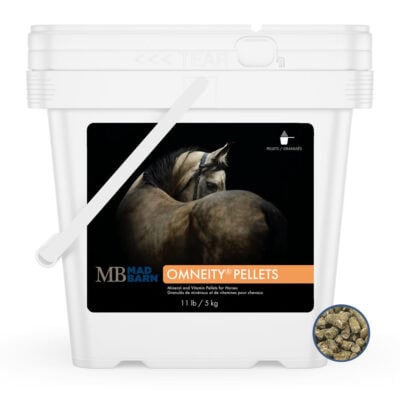
Mad Barn’s Omneity® is a comprehensive vitamin and mineral supplement formulated to deliver the optimal balance of nutrients, supporting muscle function and overall health in Thoroughbreds.
Transitioning an OTTB’s diet
Recently retired racehorses usually require an updated diet as their energy expenditure changes significantly when leaving the track. Typically, racehorses are fed large, grain-based meals to meet the energy needs of their high-intensity training and racing workload. [20]
However, a transition to a forage-based diet that matches their new activity level will likely be necessary once they are in their new home. [20] It’s vital this new feeding regimen is done gradually to avoid issues like digestive upset or weight loss during this transition. [20]
If you are unsure how to transition your OTTB to a forage-based diet, consider working with a qualified equine nutritionist who can create an individual diet tailored to your horse’s unique needs.
Frequently Asked Questions
Here are some frequently asked questions about retraining incentives for off-the-track Thoroughbreds:
An OTTB is a Thoroughbred horse that was bred and trained for racing but has since retired from the track. These horses are often young, athletic, and versatile, making them excellent candidates for second careers in various equestrian disciplines. [2]
OTTBs are affordable, highly athletic, and versatile. They have excelled in a wide range of disciplines, including show jumping, eventing, barrel racing, and dressage, with some even competing at Olympic levels. [2]
OTTBs are typically more affordable than other competition breeds, with prices ranging from a few hundred to a few thousand dollars, depending on factors like soundness, conformation, and training level. [2]
Programs like the TIP Championships, Thoroughbred Makeover, and TAKE2 Thoroughbred League offer prize money, awards, and specialized classes for Thoroughbreds, providing great opportunities for competitive OTTB owners.
Summary
Purchasing an Off-the-track Thoroughbred offers a competitive and affordable alternative to traditional sport horse breeds for equestrians who want to attend horse shows.
- OTTBs boast remarkable versatility, athleticism, and have proven successful in ranging disciplines
- Programs like the Thoroughbred Incentive Program, the Thoroughbred Makeover, and the TAKE2 Thoroughbred League make it easier than ever to get involved with these retired racehorses
- For riders seeking their next competition partner and a rewarding project, an OTTB might just be the perfect fit
- Follow the steps in this guide on buying an OTTB, along with tips for transitioning and retraining, to ensure your next acquisition is a success.
References
- Bower, A.M., et al., The genetic origin and history of speed in the Thoroughbred racehorse. Nature Communications. 2012. View Summary
- What Is an OTTB?. Thoroughbred Aftercare Alliance. 2022.
- Life Cycle of a Thoroughbred.
- Berreth, Lindsay.Boyd Martin’s Olympic Mount Blackfoot Mystery Sold. The Chronicle of the Horse. 2020.
- Zunker, Esther.Looking back: Top class off-track Thoroughbreds of yesteryear. Gallop Magazine. 2015.
- Status - AQHA American Quarter Horse Association. 2024.
- Nolte, W., et al., Selection signatures in four German warmblood horse breeds: Tracing breeding history in the modern sport horse. PLoS ONE. 2019.
- DVM. J. S., How To OTTB-Shop. Retired Racehorse Project. 2022.
- Bentley. K., How Much Does an OTTB Cost?. Retired Racehorse Project. 2019.
- Prepurchase Exam Tips for OTTB Buyers – The Horse.
- Thoroughbred Incentive Program. The Jockey Club. 2025.
- The Thoroughbred Makeover. Retired Racehorse Project. 2025.
- About TAKE2. Take2 Second Career Thoroughbred Program Inc. 2025.
- New Vocations Racehorse Adoption Program. New Vocations.
- 21st Annual New Vocations All-Thoroughbred Charity Horse Show. New Vocations. 2024
- AAB. S. M. PhD, Certified, Common OTTB Behavior Traits. The Horse. 2015.
- Church. S., Getting to Know You. Retired Racehorse Project. 2020.
- Anderson. M., Stereotypic Behaviors. Retired Racehorse Project. 2018.
- Johnson. A., Re-Educating the OTTB. Retired Racehorse Project. 2018.
- Richards, N., et. al.,The effect of current grain feeding practices on hindgut starch fermentation and acidosis in the Australian racing Thoroughbred. Australian Veterinary Journal. 2006. View Summary