English



Quarter Horses dominate in the sports of reining and barrel racing, making them some of the most valuable performance horses in the world.
While ranch-bred Quarter Horses are renowned for their cow sense and rodeo prowess, racing Quarter Horses have been refined for speed and athletic ability with the help of Thoroughbred bloodlines. In fact, several influential Thoroughbred stallions contributed to the foundation of the Quarter Horse breed.
Notably, 18 Quarter Horse Hall of Fame inductees have significant Thoroughbred breeding in their pedigrees, and seven of them are completely Thoroughbred by blood. With this proven success, the popularity and influence of Thoroughbred blood on Quarter Horse lines is making a comeback in a variety of disciplines.
Read on to learn how the elegance, speed and stamina of Thoroughbreds have shaped the modern Appendix Quarter Horse and how the breed is developing further alongside some of the most popular equestrian sports today.
Thoroughbred Bloodlines & the Quarter Horse Breed History
Thoroughbreds have significantly impacted the bloodlines of the American Quarter Horse for generations.
While names like Storm Cat, Favorite Trick, Alydar, and Hennessy are well-known in the Thoroughbred racing world, they have also been influential in Quarter Horse Racing bloodlines.
While Thoroughbred ancestry is most evident in racing Quarter Horse lines, performance Quarter Horse bloodlines also have Thoroughbred blood to thank for the famous pedigrees we see today.
In particular, five Thoroughbred stallions were instrumental in establishing the modern Quarter Horse breed:
- Janus
- Sir Archy
- Azure Te
- Beduino
- Three Bars
Janus
Janus is one of the most famous Thoroughbred sires associated with the foundation of the Quarter Horse Breed. [1]
Janus was the grandson of the Godolphin Arabian, and was imported to America in 1752. He was later crossed with horses bred by the Chickasaw tribe to found the American Quarter Horse. [2]
While no portraits of this famous sire exist, the chestnut stallion was described as the most perfectly formed horse ever seen in Virginia. Janus stood at stud from 1772 – 1774, covering over 200 mares. [2]
Sir Archy
In the early 1800’s, the Thoroughbred stallion Sir Archy left his mark on the foundations of the Quarter Horse breed. His descendants have names that western riding enthusiasts immediately recognize, including Shiloh, the famous short-distance champion, and Steel Dust, another successful racehorse and sire. [3]
 Sir Archy
Sired by an imported stallion named Diomed, Sir Archy was foaled in 1805. His direct heir, Copper Bottom, is well-known even today. [3]
Azure Te
Azure Te’s very first crop of Quarter Horses placed two finalists in the 1971 All American Futurity. [4] It comes as no surprise that Azure Te’s bloodlines and other descendants have also had significant impact on the Quarter Horses we see today.
 Azure Te TB
Foaled in 1962, this bay stallion was sired by Nashville out of Blue One by Count Fleet. He had 26 starts with 10 wins during his racing career before he bowed a tendon and retired in 1966. [4]
Retirement might have taken Azure Te out of the limelight, but the stallion’s conformation, along with his speed, made him an even better stud than he was a racehorse. He was purchased by a syndicate managed by the general manager of Burnett Ranches. It was there he sired 842 starters from 1,085 foals in 18 crops of Quarter Horses. [4]
Beduino
Beduino is a legendary stallion, especially in the Quarter Horse racing world.
Bred in Mexico, he was a successful sprinter style racehorse but was not allowed to enter in any official Quarter Horse races because he was a Thoroughbred. However, his owner was sure if he won a Quarter Horse match race, that Quarter Horse breeders would want Beduino to breed with their speed horses. [5]
In 1974, Beduino was entered into the $100,000 winner-take-all match race in Mexico City and won. [5]
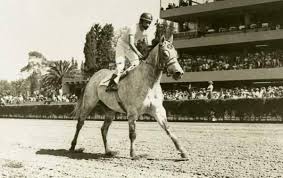 Beduino
This led to the successful stud career in the Quarter Horse world that his owner predicted. He sired 19 foal crops, which led to a total of 722 registered Quarter Horse foals. Of those, he produced: [5]
- 603 race starters
- 436 winners
- 80 stakes-placed horses
- 40 stakes winners
The cumulative earnings of those foals totaled USD $13,099,594. This placed him third on the money-earning sires list of Quarter racehorses, and as the leading Thoroughbred at that time. [5]
What's your top priority with your horse's health?

Enter your email to receive your store credit
Three Bars
Perhaps the most famous sire in Quarter Horse lineage, Three Bars got his name from his owners in the hope that he’d pay off like a winning slot machine.
However, this attractive chestnut colt bred on James W. Parrish’s farm in Midway, Kentucky, wasn’t a quarter horse — he was a Thoroughbred. [6]
His owners, Jack Goode, Ned Brent, and Bill Talbot, tried racing him as a two-year-old, but limb issues kept Three Bars from winning until age 3. Unfortunately, he had worse luck on the racetrack as a 3-year-old when he injured himself, spending most of 1944 in rehabilitation. He returned to competition later in the year, finishing the season with three wins out of four starts. [6]
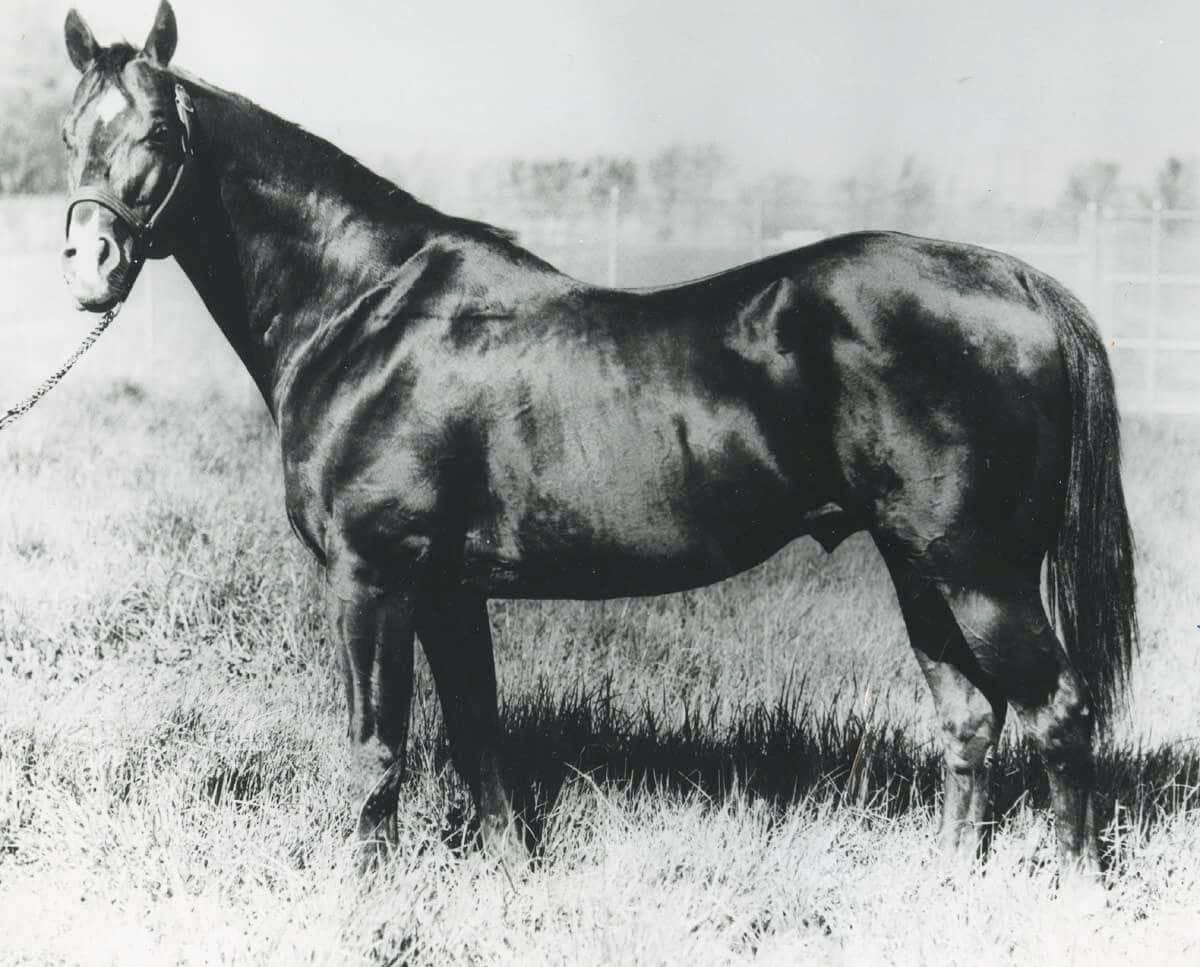 Three Bars
During a claiming race that same year, he was claimed, and ownership was transferred to Stan Snedigar and Toad Haggard for USD $2,000. His new owners decided Three Bars would be a great sire candidate for Quarter Horse mares, and he was hauled to Phoenix, Arizona. [6]
Sidney H. Vail heard about Three Bars, and traveled to Arizona to see if he wanted to purchase him for his own breeding purposes. Impressed with Three Bars, Vail bought him in 1945 for USD $10,000. [6]
This was just the start of a very successful sire career for Three Bars. By the late 1950’s, mare owners were lining up to breed to Three Bars despite his high stud fee and the limited space in his stud book. [6]
Walter Merrick was also impressed with Three Bars, leasing him for two years and later breeding his mares to him anytime he stood at stud. [6]
Merrick bred Three Bars to one of his mares named Lena Valenti. The cross between Three Bars and Lena Valenti produced a Thoroughbred named Lena’s Bar, who raced successfully against Quarter Horses.
Lena’s Bar was bred to Jet Deck, and the cross produced an AAAT stakes winner and American Quarter Horse Association (AQHA) Champion Jet Smooth. Merrick bred the mare back to Jet Deck, and foaled Easy Jet, winner of the 1969 All American Futurity race. [6]
Other famous American Quarter Horse prodigies of Three Bars include:
- Lightning Bar
- Sugar Bars
- Gay Bar King
- Barred
- Zippo Pat Bars
- Doc Bar
These Three Bars descendants have produced bloodlines that went on to compete successfully in a variety of riding disciplines outside of Quarter Horse racing. Even today, many American Quarter Horses are descendants of Three Bars and include the word “Bar” somewhere in their name as tribute.
Three Bars was inducted in the American Quarter Horse Hall of Fame in 1989. [6]
Appendix Quarter Horses
An Appendix horse is any cross between a registered Quarter Horse and a registered Thoroughbred.
In the early days of the American Quarter Horse Association (AQHA) registry, two types of Quarter Horse breeders clashed: those from the National Quarter Horse Breeders preferred a stockier conformation, while the American Quarter Racing Association breeders focused on speed and performance on the sprint track. [7]
The Quarter Horse racing breeders infused significant Thoroughbred blood into the breed, causing more rivalry within the organization. [7]
Despite tensions, the AQHA couldn’t deny the strong influence Thoroughbreds had historically in the breed’s lineage. Eventually, the organizations merged in 1949. The horses formerly registered with the American Quarter Racing and National Quarter Horse Breeders were now listed in the American Quarter Horse Association’s Appendix Registry. Any Thoroughbred and Quarter Horse crosses were also included in this now permanent registry. [8]
Today, any foal that comes from an AQHA registered sire or dam is automatically eligible for registration. If the foal has both an AQHA parent and a parent that is a registered Thoroughbred with The Jockey Club, they are eligible for full AQHA registration status. This is completed by obtaining a certain number of show-ring points, passing a conformation inspection after age 2, and attaining a Registry of Merit. [8]
Today, Appendix horses are seen in a variety of riding sports, but more commonly compete in English disciplines.

Thoroughbred vs. Quarter Horse Characteristics
Because of the significant heritage in the Quarter Horse breed from Thoroughbred bloodlines, the two breeds have a number of similarities. However, both breeds have also been shaped over the years with selective breeding, resulting in several key differences.
When comparing the appearance of Quarter Horses and Thoroughbreds, there are both similarities and significant differences in their conformation.
Conformation characteristics that are common in the Quarter Horse breed include: [1]
- Heavy muscular structure
- Stocky build
- Short stature
- Height of 14 to 16 hh on average
Thoroughbreds, on the other hand, typically have a lighter, leaner build when compared to the Quarter Horse:
- Longer legs and neck
- More pronounced withers
- Deeper chest and girth
- Height of 15.2 to 17 hh on average
Although both breeds typically have a shorter back and well-defined heads, they can display slight variations in coat colors unique to each breed. [2]
Both breeds can be racehorses, but Quarter Horses do better at sprinting, while Thoroughbreds dominate long-distance racing. [9]
Both Quarter Horses and Thoroughbreds benefit from attentive management, including feeding a balanced, forage-based diet. However, Quarter Horses, even those with significant Thoroughbred bloodlines, are typically “easy keepers“. Conversely, Thoroughbreds are typically “hard keepers” with a faster metabolism, making them light, lean, and fast on the racetrack. [2]
These differences in metabolic efficiency underscore the importance of selecting appropriate energy sources based on each horse’s activity level and regularly assessing body condition to maintain a healthy weight.
Thoroughbred Bloodlines in Quarter Horse Breeding
The American Quarter Horse is the most prominent breed for western performance disciplines such as reining, cow cutting, and barrel racing.
While there is still significant Thoroughbred blood found in racing and English-discipline Quarter Horse breeding programs, western performance Quarter Horse breeding had its own history and development. But recently, many breeders are returning to Thoroughbred sires to add new blood to their Quarter Horse breeding programs — even in the Western performance world. [7]
Quarter Horse breeders who are revisiting Thoroughbred bloodlines aim to refine their horses’ conformation by developing a clean throatlatch, a neck that ties in correctly, and shoulders proportionally narrower than the hind end. These features allow for freer movement, greater reach through the shoulder, and improved overall maneuverability. [7]
The aim of this conformation selection is to enhance athleticism and speed — something Thoroughbreds have been bred for over many generations. As a result, Quarter Horse breeders are crossing their “typiest” Quarter Horses with Thoroughbreds once again. [7]
However, these breeders’ primary objective is not necessarily to produce first-generation Appendix horses. Instead, they have a long-term vision of creating offspring that bring more speed, height, better stride reach, and stronger withers to future Quarter Horse generations. [7]
While many breeders are jumping on the bandwagon of introducing Thoroughbred blood back into Quarter Horse bloodlines, there are mixed opinions in the AQHA breeding community. However, more and more AQHA professionals are seeing the benefits of crossing with Thoroughbred lineage. [7]
Thoroughbred blood crossed with AQHA stock mares tends to bring a short back and cannon bones, deep girth, beautiful head, and overall compact build. These characteristics help create better speed, stamina, and handiness needed in ranching disciplines. This trend is also helping open up the overall gene pool for stock horses, which is beneficial to the breed. [7]
Thoroughbred Blood & Other Breeds
Thoroughbred blood has also long been utilized to refine English-discipline Warmblood breeding, such as those bred for show jumping and eventing. This helps prevent these breeds from becoming too “heavy” or draft-like.
Warmblood breeders, especially those geared toward the eventing discipline, place an emphasis on the percentage of Thoroughbred “blood” the horse has. A higher percentage of Thoroughbred blood is considered extremely desirable, as Thoroughbreds are known for their galloping stamina during the cross-country phase. [7]
When the dressage coefficient was removed several years ago, it made jumping clear in these two phases of eventing even more important to win. In fact, at this year’s 2024 Olympics, Thoroughbred blood ran deep in a significant portion of the top contenders. [10]
FischerChipmunk FRH, for example, is not only a prior winner at the iconic Kentucky five-star event, but this horse also helped rider Michael Jung bring home a gold medal for Germany. FischerChipmunk FRH is a Hanoverian with significant Thoroughbred bloodlines. His broodmare sire is the Thoroughbred stallion Heraldi, who is one of the most respected sport horse stallions of all time. [10]
Numerous other horses that competed in the 2024 Olympics, and that compete in a wide variety of disciplines across the country, have some Thoroughbred blood contributing to their athletic potential.
Frequently Asked Questions
Here are some frequently asked questions about Thoroughbred bloodlines in Quarter Horse pedigrees:
Thoroughbreds have had great impact on the bloodlines of American Quarter Horses, with stallions such as Janus, Sir Archy, and Three Bars significantly contributing to the breed. [1][3][6]
Yes, horses with Thoroughbred parents can be registered with the AQHA so long as the foal has a parent registered with the AQHA and also a parent that is a registered thoroughbred with the Jockey Club. [8]
Summary
The modern American Quarter Horse has been significantly influenced by Thoroughbred bloodlines, especially in Quarter Horse Racing.
- Some of the most decorated Quarter Horse racehorses in history have Thoroughbred blood
- Thoroughbreds have added speed and athleticism to the American Quarter Horse Breed
- Any Quarter Horse with one registered AQHA parent and one registered Thoroughbred parent is eligible to register with the AQHA
- Modern Quarter Horse breeders who focus on ranching horses have begun re-introducing Thoroughbred bloodlines to their pedigrees
References
- Paulick Report Staff, Crossing Over: Thoroughbred Bloodlines in Racing Quarter Horses. Paulick Report. 2014.
- Chamberlain, Richard. Janus. American Quarter Horse Association. 2022.
- American Quarter Horse. Breyer. 2021.
- Azure Te TB. American Quarter Horse Association. 2015.
- Beduino. American Quarter Horse Association. 2008.
- Three Bars. American Quarter Horse Association. 1989.
- Bentley. K., Bringing It Back. Retired Racehorse Project. 2023.
- Hedgpeth, Don. What Is an Appendix Quarter Horse?. American Quarter Horse Association. 2018.
- Nevills, Joe. Video: What’s The Difference Between A Thoroughbred And Quarter Horse Race?. Paulick Report | Latest news and commentary from the horse racing and equine world. 2024.
- Russo, Nicole. Thoroughbred Blood Still Courses through Top Contenders at Paris Olympics. Daily Racing Form. 2024.