English
Body Condition Scoring in Horses - Mad Barn - Vet Talk

Has your horse gained a few pounds recently? Or maybe they’ve struggled to maintain their weight? Now is the perfect time to learn how to body condition score your horse so that you can make informed decisions about their diet and management moving into Spring!
Body condition scoring is a standardized method of assessing a horse’s subcutaneous adipose tissue, or fat.
While body weight can be a helpful metric in monitoring your horse’s condition, it doesn’t necessarily tell you how much of that weight is actually stored fat. For example, a 14.2 hh pony that weighs 900 lb will have a wildly different body fat content than a 16.2 hh Thoroughbred weighing the same!
This is where body condition scoring comes in to provide an objective assessment of fat deposition.
The current method of body condition scoring was developed in the 1980s through research conducted by Dr. Ron Henneke.
Veterinarians and horse owners use the Henneke scale to body condition score horses. This 9-point grading scale assesses fat deposition in six key areas- along the neck or crest, along the withers, behind the shoulder, over the ribs, over the rump, and at the trailhead.
A 5 out of 9 body condition score (BCS) is considered ideal for most horses and ponies. Horses that score below a 5 are considered underweight, while horses that score above a 5 are considered overweight. There is an example of each body condition score in today’s presentation to help you visualize what the different scores look like.
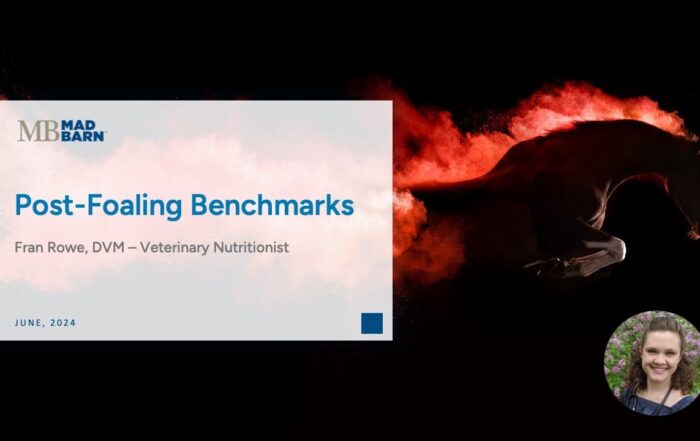
Tune in to Dr. Rowe’s presentation on body condition scoring your horse!
Henneke Body Condition Scoring Rubric Print-Out 👉 https://madbarn.com/wp-content/uploads/2021/07/Body-Condition-Scoring-Worksheet.pdf
Learn more about body condition scoring in horses 👉 https://madbarn.com/body-condition-scoring-your-horse/
Watch Jessica’s two-part video body condition scoring her horse, Ben
– Part 1 👉 https://www.tiktok.com/@madbarnequine/video/7324720599291530502
– Part 2 👉 https://www.tiktok.com/@madbarnequine/video/7324721690016058629
Have ideas for topics to cover or questions about your horse’s health? We would love to hear from you! Please send any questions or comments to vet@madbarn.com.
——————————
Mad Barn Academy is dedicated to supporting horse owners, handlers and practitioners through research, training and education.
Visit us to learn more at https://madbarn.com
You can also find Mad Barn at:
Instagram @madbarnequine
Facebook @madbarnequine
TikTok @madbarnequine
YouTube @madbarn
X (Twitter) @madbarnequine
Transcript:
[0:00]
Welcome back to Mad Barn Academy, and thanks for tuning in. For those of you who are new here today, we hope to earn your subscription. As always, we appreciate the ongoing support and feedback, so like and subscribe. I’m Dr. Fran Row, one of the veterinary nutritionists here at Mad Barn. While today’s topic will be short and sweet, don’t mistake that as meaning that it’s not important. Today, we’ll be covering body condition scoring. Has your horse gained a few extra pounds over the winter? Or maybe they’ve lost a few? Well, after today, you’ll be equipped with the tools you need to successfully assess your horse’s body condition. So let’s get started.
[0:35]
Body condition scoring is an important tool that every horse owner should know how to use. Maintaining your horse at an ideal body condition is imperative to their wellness, longevity, and performance. The method of body condition scoring we use today was developed by research performed by Dr. Henneke in the 1980s. Through his research, he designed a consistent method for evaluating a horse’s body condition by objectively measuring the amount of subcutaneous fat.
[1:08]
A horse’s body condition is assessed by evaluating six key areas of fat deposition: the neck or the crest, the withers, behind the shoulder, over the ribs, the rump, and at the tail head. At each of these locations, we assign an individual score, and then those scores are averaged to equal the total body condition score of the horse. The Henneke scale uses a nine-point grading system, with a score of five being recognized as ideal, which I’ve highlighted in green. Horses scoring below a five are underweight and lacking fat, while horses scoring above a five are overweight and carrying too much fat. This rubric gives a description of what each score looks like for each area of assessment, and I’ve included a link to this exact rubric in the description of this video, which you can print out and use to body condition score your own horse.
[2:05]
There are two types of horses for which an ideal body condition score is not a five: we’ll accept a four for performance horses like upper-level eventers, racehorses, endurance horses, etc., and we’ll accept a six for broodmares. Otherwise, the farther away from ideal that we get in either direction, the more urgent it is to intervene with dietary and management changes. Horses that are underweight can experience muscle wasting, weakness, poor performance, and inability to breed or carry a foal to term. And certainly, animals that are emaciated can suffer from multi-organ failure and die if their condition is severe enough. Conversely, horses that are overweight are at an increased risk of reproductive failure if over a six, joint disease, exercise intolerance, and additionally, obesity or regional adiposity is common in horses diagnosed with metabolic disease. For these horses, weight loss can improve their metabolic status, insulin sensitivity, and reduce their risk of laminitis.
[3:18]
So let’s go through an example of each of these body condition scores so that you can visualize what these horses look like. This is an example of a one out of nine: the spine, ribs, tail head, and points of the hip are all prominent, and the bone structure of the withers, shoulders, and neck are all easily visualized. Essentially, no fatty tissue can be palpated in any of the assessment areas.
[3:46]
This is an example of a two out of nine: there is slight fat coverage at the base of the spine, over the ribs, the tail head, and the points of the hip, but all these areas are still very prominent. The wither, shoulder, and neck structure are faintly visualized, and overall, very little fatty tissue can be palpated in any of the assessment areas.
[4:12]
This is an example of a three out of nine: there is fat buildup about halfway up the spine and slight fat coverage over the ribs and the points of the hip. The tail head is prominent, but individual vertebrae are not easily discernible. The withers, shoulders, and neck are accentuated but not noticeably bony.
[4:37]
This is an example of a four out of nine: there is a slight ridge along the back and a faint outline of the ribs. Tail head prominence will depend on the conformation of the horse, but fat can be felt around it. The points of the hip are no longer discernible, and the withers, shoulders, and neck are not obviously thin.
[5:01]
This is an example of a five out of nine, which is ideal: the back is flat with no crease or ridge, and the ribs are not easily seen but they are felt on palpation. Fat around the tail head is beginning to feel spongy, the withers appear rounded over the spine, and the shoulders and neck blend smoothly into the body.
[5:26]
This is an example of a six out of nine: there may be a slight crease down the back, and fat coverage over the ribs will now feel spongy. Fat around the tail head is soft, and fat is beginning to be deposited along the sides of the withers, behind the shoulder, and along the sides of the neck.
[5:47]
Here’s an example of a seven out of nine: there may be a crease down the back, and fat coverage over the ribs will feel spongy. Fat around the tail head is now soft, and there are fatty deposits that are discernible along the sides of the withers, behind the shoulder, and along the neck.
[6:05]
Here’s an example of an eight out of nine: there is a crease down the back, and it is now difficult to palpate the ribs at all. Fat around the tail head is very soft, and there are fatty deposits along the withers, behind the shoulder, and a noticeable thickening of the neck, particularly in the crest.
[6:27]
Lastly, we have an example of a nine out of nine: there is an overall loss of definition from region to region as you examine this horse. There is an obvious crease down the back, and fatty deposits are now evident in all the key areas of assessment.
[6:44]
Okay, so before you run out to the barn to put this new knowledge into practice, here are just a few things to consider. Firstly, body condition scoring isn’t just a visual assessment — it requires you to be hands-on. You have to put your hands on the horse and palpate these areas in order to get the most accurate score. Secondly, be mindful of personal bias. Studies show that horse owners are more likely to underestimate their horse’s body condition. My advice is to follow the rubric as closely as possible and to stay objective. Lastly, certain conformation, maybe lack of topline muscling or even a hay belly, can make scoring difficult. If you’re unsure how to score a particular area, make a note on your rubric and don’t be afraid to get a second opinion from someone like your vet, your farrier, or another experienced horse friend. Remember, we are averaging these scores over six areas, so don’t get too hung up on one particular spot.
[7:52]
Okay — references for today, and thanks for listening. I hope you found this quick presentation helpful and feel ready to go score your own horse. As I mentioned, there is a link to the body condition scoring rubric in the description of this video, as well as links to our blog article on body condition scoring and how-to videos posted by our nutritionist Jessica. So don’t forget to like and subscribe, and until next time, thanks.