

 English
Post-Foaling Benchmarks - Mad Barn - Vet Talk

You’ve waited nearly a year and the time has finally come… your mare has foaled!
While parturition (giving birth) is a major hurdle for both mom and baby, it’s only the first of many in the 24 hours post-foaling. There are several more hurdles that mare and foal must overcome to ensure that both are set-up for success and go on to live healthy lives.
The 1-2-3-4 Rule is a guide that horse-owners can use to remember the critical timepoints at which mare and foal should meet certain benchmarks in the immediate post-foaling period. This can help owners feel confident that things are progressing normally, or that an emergency visit from the veterinarian is needed.
1: Foal should be standing by 1 hour
2: Foal should be suckling by 2 hours
3: Mare should pass her placenta around 3 hours
4: Foal should pass meconium around 4 hours
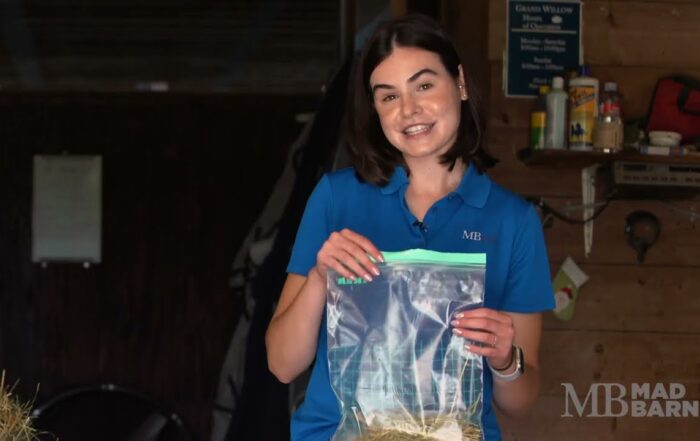
Join Dr. Fran Rowe, one of Mad Barn’s Veterinary Nutritionists, in learning more about these critical milestones for mom and baby, as well as other observations to make during this timeframe and when to call the vet.
Fortunately, most foalings are uneventful, and mare and foal meet their benchmarks as expected! For these foalings, a wellness exam by your veterinarian around 24 hours post partum is appropriate.
However, if any of these benchmarks are not met within the expected timeframe or you have concerns about your mare or foal, you should call your veterinarian for an emergency visit. Prompt intervention can make the difference between a healthy foal and one that does not survive.
Interested in learning more about foaling in horses? We have several blog articles online:
👉https://madbarn.com/signs-of-foaling-in-mares/
👉 https://madbarn.com/how-to-feed-a-growing-foal/
👉https://madbarn.com/colostrum-for-newborn-foals/
👉https://madbarn.com/igg-testing-in-foals/
Want to submit your horse’s diet for evaluation? Follow this link to get connected with an equine nutritionist:
👉 https://madbarn.com/analyze-diet/
Have ideas for topics to cover or questions about your horse’s health? We would love to hear from you! Please send any questions or comments to vet@madbarn.com
——————————
Mad Barn Academy is dedicated to supporting horse owners, handlers and practitioners through research, training, and education.
Visit us to learn more at https://madbarn.com
You can also find Mad Barn at:
Instagram @madbarnequine
Facebook @madbarnequine
TikTok @madbarnequine
YouTube @madbarn
X (Twitter) @madbarnequine
Transcript:
[0:00]
Hi everyone, I’m Dr. Fran Rowe, one of the veterinary nutritionists here at Mad Barn — and welcome back to Mad Barn Academy. If you’re new here, welcome! We hope to earn your subscription today. It’s foaling season — some of you may already have foals on the ground, while others are still waiting for your mare to foal — but I thought it would be a great time to review the post-foaling benchmarks every owner should know, as well as discuss some of the other things to watch for during that time between birth and the first vet visit. Let’s get started.
[0:40]
In the immediate post-foaling period, there are certain benchmarks both mom and baby should meet within a particular time frame. This is known as the 1-2-3 or the 1-2-3-4 rule, depending on who you talk to and how many time points you follow. Following these time points can help owners feel confident that things are progressing normally — or identify promptly when they’re not. Early identification is really important, and the 1-2-3-4 rule is meant to provide owners with a guideline to follow during this time.
[1:20]
Number one: foals should be standing within 1 hour of birth — specifically, standing independently by 1 hour. Providing some initial assistance is okay, but they should be able to get up and stay up on their own within that first hour. A foal unable to stand unassisted within this time frame is considered abnormal.
[1:54]
Number two: foals should be suckling within 2 hours of birth — able to latch, remain latched, and suckle independently by the 2-hour point. Again, providing some assistance to locate the udder and latch is okay, but a normal foal should have a strong drive to seek out the udder and will have a strong, almost ferocious, suckle if you offer them a finger. Nursing quickly after birth is critical — foals have minimal body reserves and are at real risk for dehydration and low blood sugar if they don’t get energy and calories from colostrum and milk soon after birth. It’s also essential they receive adequate colostrum within the first 12 hours to ensure proper transfer of immunity. Foals slow to stand or suckle are at higher risk for health issues, including failure of passive transfer of immunity.
[3:08]
Number three: the mare should pass her placenta around 3 hours postpartum. Many mares will pass the placenta around the time the foal begins suckling, due to the oxytocin boost that causes both milk let-down and uterine contractions. Do not pull on the fetal membranes — you risk tearing them and leaving pieces behind in the uterus. If the membranes are dragging, you can tie them up above hock level with baling twine. Once passed, save the placenta in a trash bag or muck bucket (away from wildlife or barn dogs) for your vet to examine. It’s important to ensure the entire placenta has passed — your vet will want to lay it out and check all the pieces. Retained fetal membranes beyond 4–6 hours are considered a medical emergency for the mare.
[4:33]
Number four: the foal should pass its meconium (first manure) around 4 hours of age. Meconium is sticky, dark, and not like normal manure. You may not see it in the stall, but you can check under the tail for evidence. Passing meconium is important — failure to do so can lead to meconium impaction, the most common type of colic in newborn foals. Foals straining to defecate should be given an enema — commonly a basic sodium phosphate enema (Fleet brand) from the drugstore, or a soapy water or warm lubricant enema. If you use a phosphate enema, do not give repeated doses; if further assistance is needed, your vet can use a different option. Around this time, you can also dip the foal’s umbilicus with a dilute chlorhexidine or Betadine solution to help keep it clean and prevent infection.
[6:21]
In addition to the 1-2-3-4 benchmarks, there are other important observations during the first 12–24 hours. Healthy foals are energetic and curious, lying down often but getting up equally often to nurse — about 4–6 times per hour. Watch for lethargy or dullness. Also, note time to first urination (usually within 9–10 hours) and check for any urine dripping from the umbilicus. Take note of any limb deformities like tendon contracture or laxity — fairly common in newborns. These may not require emergency attention if the foal is otherwise normal, but should be discussed with your vet at the post-foaling exam.
[7:58]
When should you call the vet? Most foalings are normal and both mare and foal meet their benchmarks. In these cases, a wellness exam should be done when the foal is 12–24 hours old — usually meaning you call your vet’s office the next morning to schedule. At this visit, your vet will examine both mare and foal, ask about these benchmarks, and recommend testing the foal’s IgG level to ensure adequate colostrum intake.
[8:49]
If things aren’t going right — if you have concerns or questions — call your vet immediately. Prompt intervention can mean the difference between life and death. Emergency vet visits before the 24-hour check are warranted for:
- Foal unable to stand or suckle (failure to meet benchmarks 1 and 2)
- Foal that is weak, lethargic, or behaving abnormally
- Foal straining to defecate despite an enema (failure to meet benchmark 4)
- Mare that does not pass her placenta (failure to meet benchmark 3)
- Mare acting colicky, uncomfortable, or aggressive toward the foal
[9:59]
Here are our references for today. Thank you so much for listening — I hope this video makes you feel more prepared to welcome your new foal into the world. Don’t forget to like and subscribe, and check out the other videos on our channel. I’ve included links in the description to resources on foaling, colostrum, and managing mares during lactation. Thanks again — until next time!

![Which Plants are Toxic to Your Horse [+ How to Spot Them]?](/wp-content/uploads/2024/05/maxresdefault-2-700x441.jpg)
![Ep. 6 – How Do Horses See the World – Mad About Horses [Podcast]](/wp-content/uploads/2023/11/maxresdefault-6-700x441.jpg)
![Ep. 22 – The Amazing Journey Every Newborn Foal Takes Into the World – Mad About Horses – [Podcast]](/wp-content/uploads/2024/01/maxresdefault-2-700x441.jpg)

![Feeding the Performance Horse with Scott Cieslar [OCTRA Horse Talk]](/wp-content/uploads/2021/03/Feeding-the-Performance-Horse-700x441.jpg)

![Ep. 4 – Domestication of the Horse: An Enduring Bond – Mad About Horses [Podcast]](/wp-content/uploads/2023/10/maxresdefault-700x441.jpg)
![Ep. 13 – Horses for Courses: Western Riding Performance Breeds – Mad About Horses – [Podcast]](/wp-content/uploads/2023/12/maxresdefault-4-700x441.jpg)















