English

Appaloosa horses are instantly recognizable by their distinctive spotted colouring. But there’s more to Appaloosas than their colourful coats. This breed’s rich history and adaptable disposition make it a favourite mount for riders who want to stand out in any arena.
This American breed descends from horses developed by the indigenous Nez Perce people in the Pacific Northwest. Pushed to the brink of vanishing due to breeding with other bloodlines, the modern Appaloosa exists today thanks to a concerted effort to preserve these spotted horses.
The Appaloosa’s ancestors carried warriors, women, children, and the elderly through rugged mountain terrain. Today, the traits that made these horses trusted battle mounts and beloved family members contribute to the Appaloosa’s popularity and versatility as an equine partner.
While selective breeding helped concentrate the genes responsible for spotted coat patterns in Appaloosas, the breed also carries genes associated with eye problems.
This article will discuss the origin, history, characteristics, health problems, and nutrient requirements of Appaloosa horses. Keep reading to learn what owners need to know about caring for and feeding Appaloosas.
Appaloosa Horse History
The history of the Appaloosa horse breed is deeply rooted in the indigenous cultures of the Pacific Northwest. Originally called the Palouse horse after the Palouse river running through Northern Idaho, Appaloosas have gained popularity throughout North America.
While modern selective breeding focuses on preserving the Appaloosa’s spotted coat patterns, colouring was likely only a secondary consideration during the early development of the breed.
Origin
Archeologists identified paintings of spotted horses in petroglyphs found in France that date back over 25,000 years. Chinese drawings from 500 BC and 14th-century Persian art also depict the same coat pattern. [1]
Genotype studies of pre-domestic horses reveal that the leopard coat phenotype in paleolithic paintings matched the genotype of local equine populations alive at the time. Research is ongoing into the ancestral origins of spotted horses in North America. [1]
Most historians believe that Appaloosas descend from Spanish horses imported to the Americas by conquistadors in the 1600s. The indigenous Nez Perce people domesticated the descendants of these horses in the early 1700s.
Raised in the canyons and mountains of the Pacific Northwest, selective breeding emphasized traits that allowed the Appaloosa to thrive living with humans in a challenging environment.
Historic Use
The Nez Perce used Appaloosas for war, transportation, and hunting. Their breeding programs aimed to produce intelligent, sure-footed horses with the stamina and bravery necessary for battle.
However, these horses also needed a gentle disposition to carry infants in cradleboards and live alongside playing children. Nez Perce people relied on the Appaloosa to move people and goods over long distances and rough terrain.
Nez Perce War
Warriors rode Appaloosas during the Nez Perce War of 1877 in resistance to the forced removal of indigenous people from their ancestral lands by the U.S. Government. After the initial armed conflict, the Nez Perce attempted to travel north and seek sanctuary in Canada. [2]
Led by Chief Joseph, the tribe embarked on a 1,350-mile journey to the border to avoid capture and forced placement on reservation lands. Accompanied by their dutiful Appaloosas, the Nez Perce eluded the US Cavalry until the final engagement 40 miles south of the border.
The US Army confiscated their horses, destroying or selling all of the Appaloosas. Farmers crossed the horses with drafts for farm work. While some escaped, most surviving horses assimilated to other breeds, and the Appaloosa bloodline almost disappeared forever.
After nearly 60 years of obscurity, the Appaloosa breed gained public attention in 1937 with a Western Horseman article by Francis D. Haines. The history professor had extensively researched the breed’s history and urged its preservation. [3]
Breed Registry
New interest in the breed led to the foundation of the Appaloosa Horse Club in 1938, which now serves as the official breed registry of the Appaloosa. The club used historical records to find and register foundation stock to preserve and standardize the breed. [4]
Decades of careful breeding brought the Appaloosa back from the brink. Today, the club continues to promote the breeding and ownership of Appaloosa horses. It maintains records for all registered Appaloosa horses in North America.
The club has a partially open studbook. All registered horses need at least one registered Appaloosa parent. Cross-bred Appaloosas are only eligible for registration if the non-Appaloosa parent belongs to an approved breed registry.
Approved breeds include Arabians, Thoroughbreds, and Quarter Horses. Owners of geldings and mares with Appaloosa characteristics and unknown parentage can apply for hardship registration to participate in ApHC programs. [4]
All registration applications require four current colour photographs depicting the horse’s colouring and markings. Horses must have an Appaloosa coat or characteristic markings for regular registration. Solid Appaloosas receive non-characteristic registration papers.
| Breed Summary | |
|---|---|
| Breed Name | Appaloosa |
| Also Known As | Palouse horse |
| Breed Type | Stock horse |
| Origin | United States (Pacific Northwest) |
| Breed Registry | Appaloosa Horse Club (ApHC) |
| Average Height | 14.2 – 16 hh |
| Average Weight | 950 – 1,100 lb (430 – 500 kg) |
| Common Coat Colors | Any base colour; leopard, blanket, snowflake, roan, solid, spotted patterns |
| Conformation | Straight lean head, prominent eye, pointed ears, well-muscled build, deep chest, sloping shoulders, well-rounded quarters, short straight back, straight sturdy legs, rounded hooves |
| Common Uses | Show, ranch, trail, pleasure, English and Western riding |
| Temperament | Versatile, trainable, patient, gentle, compliant |
| Best For | Beginner riders and families |
| Common Health Concerns | Equine recurrent uveitis, congenital stationary night blindness, conjunctivitis, sunburn, squamous cell carcinoma, HYPP |
| Lifespan | About 30 years |
| Price Range | $2,500 – $50,000 |
What's your top priority with your horse's health?

What's your top priority with your horse's health?
Appaloosa Breed Characteristics
The qualities that the Nez Perce bred into their horses centuries ago in the mountains of the Pacific Northwest now make the Appaloosa a treasured partner for modern equestrians.
While their unique coats make them stand out, their spots aren’t the only reason for their popularity.
Conformation
Modern Appaloosas often have a wide range of body types that reflect the different breeds that influenced their reemergence in the 20th century. The typical Appaloosa stands between 14.2 and 16 hands.
These horses generally have sturdy conformation and weigh between 950 and 1100 pounds. Original Appaloosas had a narrow body type that reflected their Spanish ancestry until the introduction of draft horse blood after 1877.
Some traditional Appaloosas also had convex facial profiles and sparse manes and tails. While some evidence suggests a possible genetic link between sparse hair growth and spotting patterns, modern breeding has moved Appaloosas towards fuller manes and tails. [5]
Modern breed standards created by the ApHC state that the ideal Appaloosa has a straight, lean head with a prominent eye and pointed ears. Horses should have well-muscled builds with deep chests, sloping shoulders, well-rounded quarters, and a short, straight back. [4]
The Appaloosa’s legs should appear straight and sturdy, with rounded hooves and a strongly supported fetlock. Regardless of lineage or colour, all Appaloosa breeding should prioritize soundness and longevity.
The Appaloosa’s spotted patterns and unique colouring are still the primary physical characteristic of the breed.
Appaloosa Colour Patterns
Appaloosas may have a base coat of any colour, including modifying types such as dilutes, duns, grays, or roans. These horses have a wide variety of spotting patterns and markings, with coat colour patterns ranging from completely solid to multi-spotted.
Common Appaloosa coat patterns include:
- Spots: White or dark spots anywhere on the body
- Snowflake: Dark body with white spots
- Leopard: White horse with dark spots
- Blanket: A white area covering the hips with or without spots
- Roan: Intermixed light and dark hairs
- Solid: No spots or roaning
Coat patterns can also change significantly throughout an Appaloosa’s lifetime, and no two horses have identical markings. But spots aren’t the only colour characteristics associated with the Appaloosa breed.
Secondary characteristics in Appaloosas include:
- Mottled skin around the nostrils, mouth, eyes, anus, and genitals
- Visible white sclera in one or both eyes
- Striated hooves with dark and light striping of the hoof wall
Solid-coloured Appaloosas must have one of the above characteristics for regular registration. All these colour patterns and characteristics are controlled by the leopard complex (LP) gene in Appaloosas, with different variations produced by modifying genes. [6]
Temperament
Most modern Appaloosas are known for their versatility, trainability, and work ethic. In addition, many have patient and gentle dispositions that make them suitable for beginner riders and families looking for an appropriate horse for their children.
Their compliant nature also make them enjoyable mounts for riders of all capabilities. But like all horses, individual personalities vary depending on breeding and handling.
For example, Appaloosas with Thoroughbred blood may have more energy and sensitivity than those with Quarter horse bloodlines.
Disciplines
Appaloosas may also have unique talents depending on their lineage. Still, their adaptable personalities allow them to succeed in several equestrian sports, and they are frequently used in both English and Western disciplines.
Appaloosas can excel as show, ranch, trail, and pleasure horses. They are a popular breed for horse owners who want to stand out amongst a crowd in any arena. They may be less suitable for high-level jumping or dressage than purpose-bred sport horses.

Appaloosa Horse Health
Unfortunately, the same genes responsible for the colourful coat patterns in Appaloosas can also significantly increase the risk of genetic diseases that affect vision and eye health. Other health problems in Appaloosas can vary based on their ancestry.
Genetic Diseases
The leopard complex coat pattern is associated with two genetically-linked conditions that can cause blindness in Appaloosas. These include equine recurrent uveitis and congenital stationary night blindness.
Equine Recurrent Uveitis (ERU)
ERU involves acute inflammation of the horse’s uveal tract, leading to catarrhal conjunctivitis. While the exact mechanism behind ERU is unclear, research shows that Appaloosas have a significantly greater risk of developing the disease than other horses.
Appaloosas with ERU may experience eye pain, light sensitivity, eye twitching, and abnormal tear production. ERU can lead to blindness if untreated during the acute phase, but horses may go years without clinical signs between episodes. [7]
Congenital Stationary Night Blindness (CSNB)
CSNB is an inherited disorder characterized by impaired eyesight in low-light environments. Affected horses have normal day vision but lack night vision. Appaloosas that are homozygous for the LP gene have an increased risk of developing the disease.
Night blindness is caused by improper signal transmission in the nerves between the eyes and the brain. Studies suggest that a mutation in a calcium ion channel gene associated with the leopard complex could contribute to this poor signal transmission in horses with CSNB. [8]
Health Problems
Appaloosas with pink skin around their eyes can also develop chronic inflammation and conjunctivitis. Pink skin is also more sensitive to sunburn, and owners may need to provide UV protection for their Appaloosas. This breed is also at risk of developing squamous cell carcinoma, a form of skin cancer.
Some Appaloosas have an increased risk of health problems inherited from other breeds. For example, some Appaloosas that descend from certain Quarter Horse bloodlines may carry the gene for Hyperkalemic Periodic Paralysis (HYPP).
The ApHC recommends that owners of Appaloosas with Quarter Horse ancestry consider testing their horses for this genetic muscle condition. Appaloosas with HYPP require specialized diets and management to control clinical signs of the disease. [9]
Care and Management
Appaloosas are generally hardy horses that can thrive in a variety of lifestyles. However, all horses need quality basic care that meets their physical and mental health needs. Working with qualified professionals to develop appropriate veterinary, farrier, and dental care plans is essential.
Constant access to shelter that provides shade allows Appaloosas with pink skin to escape from the sun. Consider turning out at night or using fly masks and sheets with UV protection if your Appaloosa struggles with photosensitivity.
Appaloosas with night blindness should not be turned out unsupervised overnight. Instead, owners should keep these horses in a safe, familiar, and well-lit location at night to decrease the risk of injury.
Appaloosa Horse Nutrition
Balanced nutrition is a vital aspect of your Appaloosa’s care and management. The best diet for your Appaloosa will depend on his lifestyle and bloodlines.
If your Appaloosa has specific health problems, nutritional management can provide additional support.
Weight Maintenance
The Palouse horses that lived with the Nez Perce likely had to adapt to a limited food supply during the harsh winters. As a result, many modern Appaloosa horses are easy keepers thanks to the traits they inherited from their spotted ancestors.
However, recent cross-breeding can contribute to differing metabolisms in modern Appaloosas. While Appaloosas with significant amounts of Quarter Horse blood may struggle with weight management, others from Thoroughbred bloodlines may be harder keepers.
Appaloosa owners should monitor their horse’s body weight and condition to determine what’s normal. Then, work with a veterinarian to determine if weight loss could be due to poor gut health or if insulin resistance may contribute to excess body condition.
Diet for a Mature Appaloosa in Light Work with Normal Body Condition
| Feed | Maintenance Diet |
|---|---|
| (Amount / Day) | |
| Mid-Quality hay (10% crude protein) | free-choice |
| Salt | 30 g (2 tbsps) |
| Omneity® Pellets | 200 g (2 scoops) |
| Diet Analysis | |
| Digestible Energy (% of Req) | 101% |
| Protein (% of Req) | 145% |
| NSC (% Diet) | 8.9% |
All Appaloosas should eat a forage-based diet. Providing free-choice hay helps support optimal digestive health, even if your Appaloosa is an easy keeper. Most Appaloosas do well on average-quality hay. If your Appaloosa needs to lose weight, opt for low-calorie hay and consider replacing some forage with straw.
The average 1000 lb (500 kg) Appaloosa needs a minimum of 15 pounds (6.8 kg) of hay daily. But this can vary depending on hay quality and your horse’s lifestyle. [10]
Learn more in our article on How Much Hay to Feed Your Horse and get help with choosing the best hay for your horse in our 7-Step Guide to Forage Selection.
The best way to determine the nutritional value of your horse’s forage is to obtain a hay analysis. Your forage report will provide detailed information on the carbohydrate, protein, energy and mineral content of your horse’s forage.
Additional Energy & Protein
If your Appaloosa is in heavy work, he may benefit from additional energy sources. However, high-starch diets that include large volumes of grains or sweet feeds can increase the risk of gut problems and metabolic dysfunction. [11]
Fat is an excellent alternative energy source to starch, and high-fat diets can help make your Appaloosa’s spotted coat shiny. Selecting an oil high in omega-3 fatty acids can also support normal inflammatory responses. [12] Low starch options also include soy hull pellets or a mash of 2 parts beet pulp and one part wheat bran, by dry weight.
Most equine diets provide more than enough protein to meet the needs of exercising horses. However, some horses may need additional protein supplied by alfalfa cubes, soybean meal, canola meal, flax meal, or a high-protein ration balancer. [13]
If your Appaloosa can’t eat alfalfa due to HYPP or photosensitivity, consider feeding an amino acid supplement such as Three Amigos to provide the top three limiting amino acids in the equine diet.
A comprehensive vitamin and mineral balancer supplement that provides amino acids, vitamins, and trace minerals commonly deficient in forage is often a better alternative to high-energy concentrates.
Feeding Recommendations
Horses need constant access to clean water to support hydration and gut motility. Adding salt to your horse’s ration can promote water intake and help meet sodium requirements. [10]
If your Appaloosa is an easy keeper, feeding hay in a slow feeder hay net can help slow consumption. Overweight horses can also be fed soaked hay to remove some of the non-structural carbohydrate content from the forage.
For Appaloosa horses that need additional energy from concentrates, splitting the daily ration into multiple small meals can help limit the risk of gut issues. [11]
Appaloosas with HYPP need a carefully formulated low-potassium diet to manage the disease. Many horse forages and feeds are naturally high in this mineral. Work with an equine nutritionist to develop a suitable nutrition plan.
Alfalfa is generally high in potassium and unsuitable for horses with HYPP. Furthermore, some research suggests Alfalfa can contribute to photosensitivity in horses. Owners should avoid feeding this forage to Appaloosas that struggle with photosensitive reactions. [14]
Nutritional Support
Nutritional supplements can help balance your Appaloosa’s diet and provide extra support for common concerns in the breed.
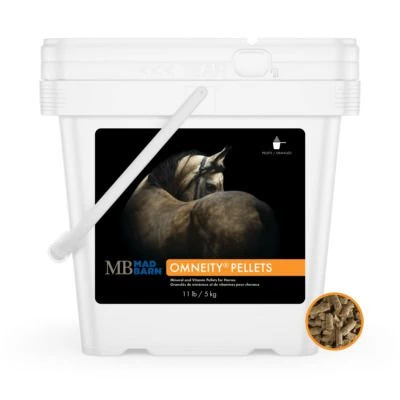
Appaloosas that eat forage-only diets need vitamin and mineral supplementation to avoid common nutrient deficiencies. Mad Barn’s Omneity® is a comprehensive vitamin and mineral supplement formulated to support hoof growth, coat quality, energy metabolism, immune status, gut health and more.
Omega-3 supplementation can help support Appaloosas with equine recurrent uveitis. Multiple equine studies show omega-3 fatty acids can modulate inflammatory responses, which may benefit horses with chronic inflammatory conditions. [13]
W-3 Oil from Mad Barn is a healthy fat supplement that provides high levels of DHA – an omega-3 fatty acid. DHA also supports joint health, respiratory health and optimal coat and skin health in Appaloosas so their spots can stand out. [12]
Even if your Appaloosa doesn’t have specific health concerns, you may be overlooking gaps in their diet that can adversely affect their overall health. Submit your horse’s diet for a free evaluation to see what’s missing.
Frequently Asked Questions
Here are some frequently asked questions about Appaloosa horses:
An Appaloosa horse is an American horse breed known for its distinctive spotted coat patterns, strong work ethic, and versatile, people-oriented nature. Appaloosa horses were developed from horses bred by the Nez Perce people of the Pacific Northwest, who selected their horses for stamina, intelligence, and reliability in difficult terrain. The breed nearly disappeared after the Nez Perce War, but preservation efforts in the 20th century helped re-establish it. Today, Appaloosa horses are valued for both their striking appearance and their usefulness as all-around riding horses.
Appaloosa horses are medium-sized, athletic horses with sturdy, well-muscled conformation. Most Appaloosa horses have a straight, refined head, a prominent eye, pointed ears, a deep chest, sloping shoulders, strong hindquarters, and a short, straight back. Their legs are expected to be straight and durable, with rounded hooves and good overall balance. Although body type can vary by bloodlines, good Appaloosa conformation emphasizes soundness, athletic ability, and long-term usefulness.
Appaloosa horses are set apart from other breeds by their spotted coat patterns and distinctive physical traits. In addition to coat patterns such as leopard, blanket, snowflake, and roan, many Appaloosa horses also have mottled skin, visible white sclera, and striped hooves. These features make the breed easy to recognize even when the coat pattern is subtle. Appaloosa horses are also known for their intelligence, endurance, and steady temperament, which adds to their appeal as versatile riding horses.
Appaloosa horses are generally known for having calm, willing, and intelligent temperaments. Many Appaloosa horses are patient and adaptable, which helps them suit a wide range of riders and disciplines. They often form strong bonds with their handlers and respond well to consistent training. Individual temperament can vary, however, and horses with more Thoroughbred influence may be more sensitive and energetic than those with stronger stock horse ancestry.
Appaloosa horses are prone to several health conditions, especially those linked to the leopard complex gene responsible for their characteristic coat patterns. These include equine recurrent uveitis, a painful eye disease that can lead to blindness, and congenital stationary night blindness, which affects vision in low light. Appaloosa horses with pink skin may also be more susceptible to photosensitivity, sunburn, and squamous cell carcinoma. In some bloodlines, horses with Quarter Horse ancestry may also carry HYPP, so careful breeding and genetic testing are important.
Appaloosa horses are used for trail riding, ranch work, pleasure riding, and a wide range of English and Western disciplines. The Nez Perce people once used Appaloosa horses for transportation, hunting, and warfare across rugged landscapes. Today, their trainable nature, athleticism, and practical build make them useful as family horses, show horses, and working horses. Their versatility is one of the main reasons Appaloosa horses remain popular.
Appaloosa horses can have almost any base coat color, including bay, black, chestnut, and roan, but the breed is best known for its distinctive coat patterns, such as snowflake, leopard, blanket, and roan patterns. Their markings can change over time, and no two Appaloosa horses have exactly the same pattern. Many Appaloosas also show mottled skin, visible white sclera, and striped hooves.
Most Appaloosa horses stand between 14.2 and 16 hands high. This moderate height makes Appaloosa horses practical for many riders and uses. Their size, combined with their sturdy and athletic build, suits them well for trail riding, ranch work, and general performance riding. Individual height can vary depending on bloodlines and overall type.
Adult Appaloosa horses typically weigh between 950 and 1,100 pounds (430 to 500 kg). Appaloosa horses with more stock horse influence may be heavier, while lighter-framed Appaloosas may fall at the lower end of the range. Because some Appaloosa horses are easy keepers, maintaining a careful diet is an important part of keeping a healthy body condition for this breed.
Appaloosa horses can be good for beginners when they are well-trained, calm, and matched appropriately to the rider. Many Appaloosa horses are gentle, willing, and dependable, which can make them suitable family horses and novice mounts. However, beginner suitability depends more on the individual horse’s training, temperament, and handling history than on breed alone.
Summary
Appaloosas are iconic American horses recognized for their spotted coats, intelligence, and adaptability. Originating from the Nez Perce tribe’s selective breeding, the breed was nearly lost but revived through preservation efforts in the 20th century.
- Known for distinctive leopard spotting, mottled skin, and striped hooves
- Modern Appaloosas show diverse conformation influenced by multiple breeds
- Linked leopard complex gene increases risk for eye diseases like ERU and CSNB
- Generally hardy and gentle but require UV protection for pink-skinned areas
- Best maintained on forage-based diets with balanced vitamins and minerals
- Omega-3 supplementation supports eye and coat health in genetically prone horses
References
- Pruvost, M. et al. Genotypes of predomestic horses match phenotypes painted in Paleolithic works of cave art. Anthropol. 2011. View Summary
- Wells, M. The Nez Perce and Their War.Pacific Northwest Quarterly. 1964.
- Daines, F. The Appaloosa, or Palouse Horse. Western Horseman. 1937.
- Appaloosa Horse Club. ApHC Official Handbook. 2023.
- Sponenberg, D. et al. The inheritance of the leopard complex of spotting patterns in horses. J Hered. 1980. View Summary
- Holl, H. et al. Variant in the RFWD3 gene associated with PATN1, a modifier of leopard complex spotting. Anim Genet. 2015. View Summary
- Rockwell, H. et al. Genetic investigation of equine recurrent uveitis in Appaloosa horses. Anim Genet. 2019. View Summary
- Bellone, R. et al. Differential Gene Expression of TRPM1, the Potential Cause of Congenital Stationary Night Blindness and Coat Spotting Patterns (LP) in the Appaloosa Horse (Equus caballus). Genetics. 2008.
- Rudolph, J. et al. Periodic paralysis in Quarter Horses: a sodium channel mutation disseminated by selective breeding. Nature Genet. 1992.
- National Research Council. Nutrient Requirements of Horses. National Academies Press. 2007.
- Metayer, N. et al. Meal size and starch content affect gastric emptying in horses. Equine Vet J. 2010. View Summary
- Hess, T. et al. Omega-3 fatty acid supplementation in horses. R Bras Zootec. 2014.
- Gibbs, P. et al. Concepts in Protein Digestion and Amino Acid Requirements of Young Horses. Prof Anim Scient. 2002.
- Puschner, B. et al. Alfalfa hay induced primary photosensitization in horses. Vet J. 2016. View Summary