English










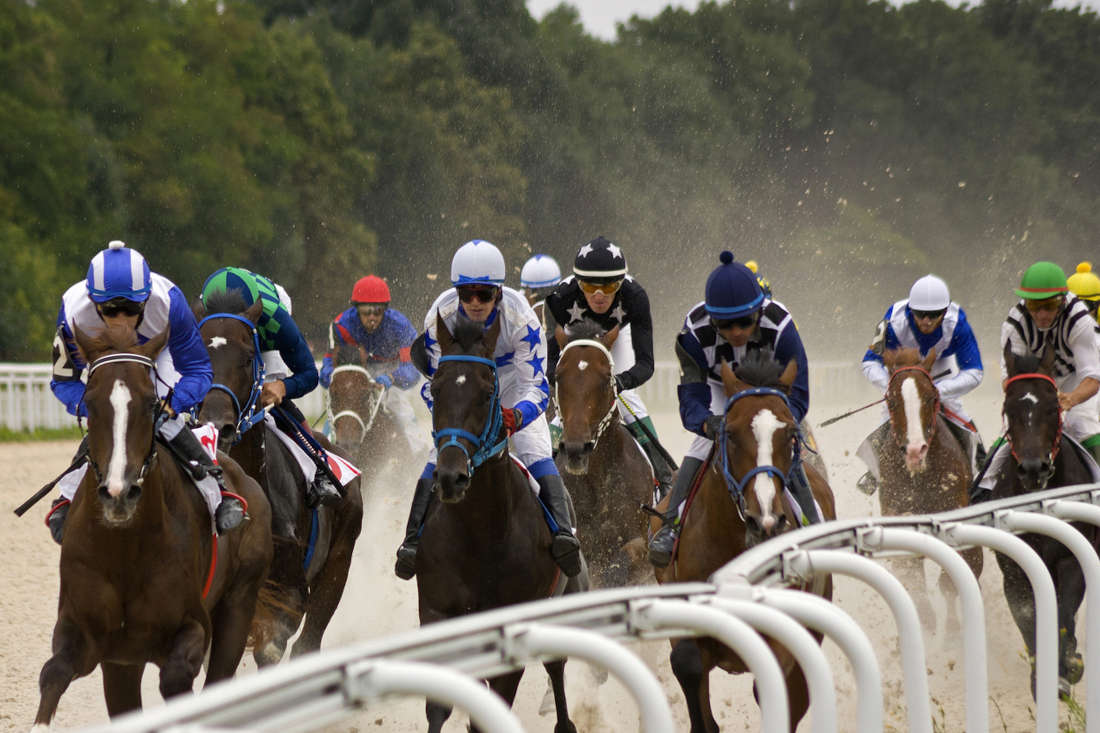
The Belmont Stakes is one of the most historic and demanding annual events in Thoroughbred racing. Established in 1867, it’s the oldest and final race in the American Triple Crown series.
Known as the “Test of the Champion,” the Belmont Stakes requires three-year-old Thoroughbreds to compete over one-and-a-half miles, a distance which is rarely run in modern American horse racing.
For more than 150 years, Thoroughbred champions have cemented their legacies on the sweeping turns of Belmont Park. The race not only determines Triple Crown champions but also highlights the stamina, conditioning, and management required for elite equine performance.
This guide explores the history of the Belmont Stakes, its evolving traditions, legendary winners, and the modern training and nutrition strategies that help prepare horses for racing’s ultimate test.
The Belmont Stakes
The Belmont Stakes is the final race of the American Triple Crown, following the Kentucky Derby and the Preakness Stakes. To win the Triple Crown, a three-year-old Thoroughbred must capture all three races within a five-week span, an achievement widely regarded as one of the most difficult in horse racing. [1]
The series begins with the Kentucky Derby at Churchill Downs, followed two weeks later by the Preakness Stakes at Pimlico Race Course. Three weeks after that, the Belmont Stakes brings the sequence to a close in New York.
By the time horses reach the Belmont, they have already competed in two high-intensity Grade 1 races against elite competition, often with limited recovery time between starts. [1]
This demanding schedule, combined with the Belmont’s longer distance, often determines whether a horse has the stamina, soundness, and mental composure required to complete the series. Many Derby winners never attempt the Belmont, and even fewer arrive with a chance to sweep all three races. [1]
When a horse enters the Belmont Stakes with Triple Crown hopes on the line, the race becomes one of the most anticipated events in the sport. [1]
Belmont Stakes at a Glance
- First run: 1867
- Location: Belmont Park, Elmont, New York
- Distance: 1 1/2 miles (12 furlongs)
- Race order: Final leg of the American Triple Crown
- Nickname: “Test of the Champion”
- Eligible horses: Three-year-old Thoroughbreds
Why the Belmont Stakes is Called the “Test of the Champion”
The Belmont Stakes earned the nickname “Test of the Champion” because it places unique physical and mental demands on three-year-old Thoroughbreds. At 1½ miles, the race is longer than most American dirt races contested by horses of this age, requiring exceptional stamina, efficiency, and pacing over a distance rarely run in modern racing.
The Belmont is also the final leg of the Triple Crown, following the Kentucky Derby and the Preakness Stakes. Horses that reach the Belmont after competing in both earlier races must perform at a high level after several weeks of intense competition against elite rivals.
Because of this combination of distance, timing, and competition, the Belmont Stakes often reveals which horses truly possess the endurance, soundness, and composure required to succeed at the highest level of Thoroughbred racing.
For those pursuing a Triple Crown sweep, the Belmont represents the final and most demanding hurdle in one of the sport’s greatest achievements.
How Horses Qualify for the Belmont Stakes
The Belmont Stakes is restricted to three-year-old Thoroughbred horses. Unlike some international races, the Belmont Stakes does not use a formal points-based qualification system.
Most horses that enter the Belmont Stakes qualify based on their performance in major spring races for three-year-olds, particularly the Kentucky Derby, the Preakness Stakes, and preparatory races such as the Peter Pan Stakes.
Because the race is limited to a relatively small field, trainers and owners typically decide whether to enter their horse based on the animal’s form, recovery from earlier races, and suitability for the Belmont’s demanding distance.
Many Belmont contenders have previously competed in one or both earlier Triple Crown races, although some horses skip the Derby or Preakness and target the Belmont specifically due to its longer distance and unique tactical demands.
Belmont Stakes Distance
The Belmont Stakes is traditionally run at a distance of 1½ miles (12 furlongs), making it the longest race in the American Triple Crown series. This distance has been the standard for most modern runnings of the race since 1926.
Because most American Thoroughbred races are run at shorter distances, the Belmont Stakes places an unusual emphasis on stamina. Many three-year-old racehorses rarely compete over distances longer than 1¼ miles during their careers.
Comparison to Other Triple Crown Races
The Belmont Stakes is significantly longer than the other two Triple Crown races:
- Kentucky Derby: 1 1/4 miles (10 furlongs)
- Preakness Stakes: 1 3/16 miles (9.5 furlongs)
- Belmont Stakes: 1 1/2 miles (12 furlongs)
This additional distance is one reason the Belmont is known as the “Test of the Champion.” Horses competing in the race must sustain speed and stamina over a longer distance than they encounter in most major American races.
Occasionally the distance has been shortened due to track logistics. For example, the Belmont Stakes was temporarily run at 1¼ miles when held at Saratoga Race Course during renovations to Belmont Park. [25]
Belmont Stakes Purse
The Belmont Stakes offers one of the largest prize purses in American horse racing. In recent years, the race has carried a total purse of approximately $2 million, with the winner receiving about $1.2 million. The remaining prize money is distributed among the other top finishers in the race. [24]
Although the Belmont Stakes is one of the most prestigious races in the sport, its purse is smaller than the Kentucky Derby, which currently offers a purse of about $5 million. The Preakness Stakes, the second leg of the Triple Crown, has a purse similar to the Belmont at roughly $2 million.
Prize money in the Belmont Stakes has increased dramatically over time. The first race in 1867 had a purse of only about $2,500, with the winner earning $1,850. As horse racing grew in popularity and commercial value, prize money steadily increased to reflect the race’s global prestige. [25]
What's your top priority with your horse's health?

Enter your email to receive your store credit
History of the Belmont Stakes Race
The Belmont Stakes was first run on June 19, 1867, at Jerome Park in the Bronx, New York, making it the oldest horse race in the American Triple Crown. The event was created to mirror the prestige of England’s top racing classics.
It was named after financier and diplomat August Belmont Sr. (1816–1890), a prominent banker, chairman of the Jockey Club, and one of the backers of Jerome Park Racetrack. [2][3]
The inaugural race, held on a Thursday, covered 1 5/8 miles and featured a $200 entry fee, with horses running clockwise in the English tradition. A filly named Ruthless won the first Belmont Stakes. [2][3]
Belmont Stakes Traditions & Evolution
Like many historic sporting events, the Belmont Stakes has evolved over time, though it still maintains traditions that connect the modern race to its 19th-century origins.
The race moved tracks several times before settling at its modern home. It was first held at Jerome Park from 1867 to 1889 until the property was condemned for the construction of the Jerome Park Reservoir. [2][3]
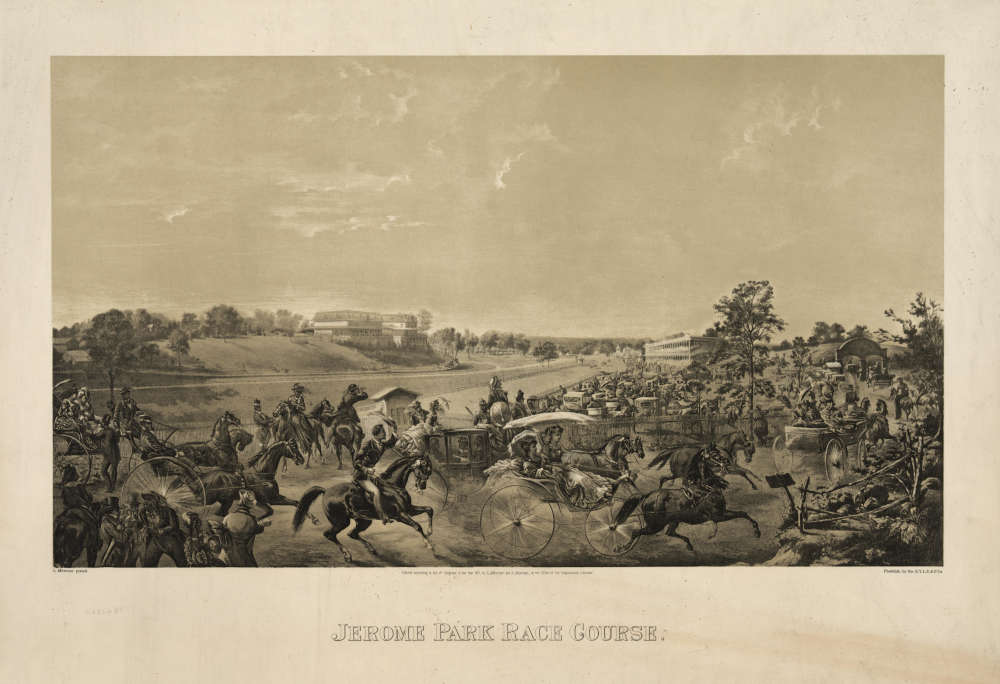 Rendering of Jerome Park
From 1890 to 1904, the Belmont Stakes was held at Morris Park Racecourse in the Bronx. The 1890 running was particularly unusual, as the Belmont and Preakness were contested on the same day at the same track due to financial instability at the Preakness’s original home, the Pimlico Race Course in Maryland. [2][3]
In 1905, the race moved to Belmont Park in Elmont, New York, when the new track opened under August Belmont Jr. [2][3]
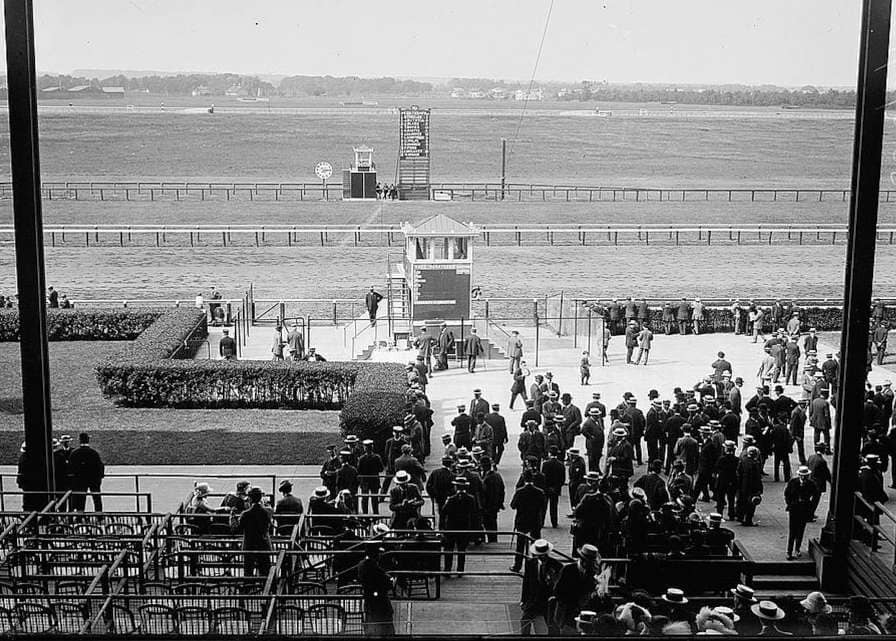 Belmont Race Course
In 2024, the Belmont Stakes was temporarily relocated to Saratoga Race Course while Belmont Park underwent major renovations, marking the first time in more than a century that the race was run outside of its namesake venue. [2][3]
The Belmont Stakes distance also changed frequently during its early years, ranging from 1 1/8 miles to 1 5/8 miles before the current 1 1/2-mile distance was standardized in 1926. The race also shifted from clockwise to counterclockwise in 1921, aligning with the counterclockwise direction typical of American racing. [2][3]
The race’s iconic trophy, the August Belmont Memorial Cup, was crafted by Tiffany & Co. and first presented in 1896. It became the permanent trophy and tradition for the Belmont Stakes in 1926 and features a sculpture of the 1869 winner, Fenian, on its lid. [2][3]
Belmont Stakes Records
Throughout its long history, the Belmont Stakes has produced several remarkable records that highlight the extraordinary performance of Thoroughbred racehorses. [9]
- Fastest Time: Secretariat (1973) – 2:24 for 1½ miles, still the fastest time in the race’s history.
- Largest Winning Margin: Secretariat (1973) – won by an astonishing 31 lengths.
- Most Wins by a Trainer: Woody Stephens – 5 consecutive victories from 1982 to 1986.
- Most Wins by an Owner: Belair Stud and James R. Keene – 6 victories each.
Secretariat’s 1973 performance is widely considered one of the greatest races in Thoroughbred history, as the colt not only won by a record margin but also set a world record time for the 1½-mile distance on dirt.
Legendary Belmont Stakes Winners
The Belmont Stakes has produced some of the most legendary racehorses in history. These horses helped define the race’s reputation as the ultimate test of stamina and class over the demanding 1 1/2-mile distance.
The race has also produced several notable records throughout its history. Trainer Woody Stephens holds the record for the most Belmont Stakes victories, winning the race five consecutive times from 1982 to 1986 with Conquistador Cielo, Caveat, Swale, Creme Fraiche, and Danzig Connection, an achievement that is unmatched in Triple Crown history. [5]
The record for most wins by an owner is shared by Belair Stud and James R. Keene, each with six victories. One of the race’s most memorable upsets occurred in 2002, when Sarava shocked the field at odds of 70–1, becoming the longest shot ever to win the Belmont Stakes. [5]
Historic Belmont Champions
Several early Belmont Stakes winners helped establish the race’s reputation as the ultimate test of stamina and class. Their victories shaped the legacy of the Triple Crown and cemented the Belmont Stakes as one of the most prestigious races in Thoroughbred history.
Notable winners from the earliest races include: [6][7][8]
- Man o’ War (1920): Won the Belmont Stakes by 20 lengths in a dominant performance that demonstrated his extraordinary speed and stamina. Although he did not compete in the Kentucky Derby, this victory helped establish Man o’ War as one of the greatest racehorses of all time.
- Gallant Fox (1930): Became the second horse to sweep the Triple Crown, helping elevate the prestige of the series and solidifying the Belmont Stakes as its defining final test.
- Omaha (1935): The son of Gallant Fox, Omaha later captured the Triple Crown himself, creating the only father–son duo to accomplish the feat in racing history.
Modern Era Belmont Legends
In the modern era, several Belmont Stakes winners have delivered some of the most memorable performances in Thoroughbred racing history, reinforcing the race’s reputation as the ultimate test of stamina.
More recent famous winners include: [9][10][11]
- Secretariat (1973): Produced one of the most iconic performances in horse racing history, setting a still-standing world record of 2:24 for 1 1/2 miles while winning the Belmont Stakes by an astonishing 31 lengths.
- Seattle Slew (1977): Became the first horse to win the Triple Crown while undefeated, sealing the achievement with a decisive four-length Belmont victory.
- Affirmed (1978): Completed the Triple Crown after a fierce rivalry with Alydar throughout the series, prevailing in a dramatic Belmont stretch duel.
- Risen Star (1988): Delivered one of the most dominant Belmont performances of the modern era, winning by 14 3/4 lengths with a powerful late surge.
- Easy Goer (1989): Recorded the second-fastest Belmont Stakes time in history while winning by eight lengths, earning his redemption after losing to his Kentucky Derby rival Sunday Silence.
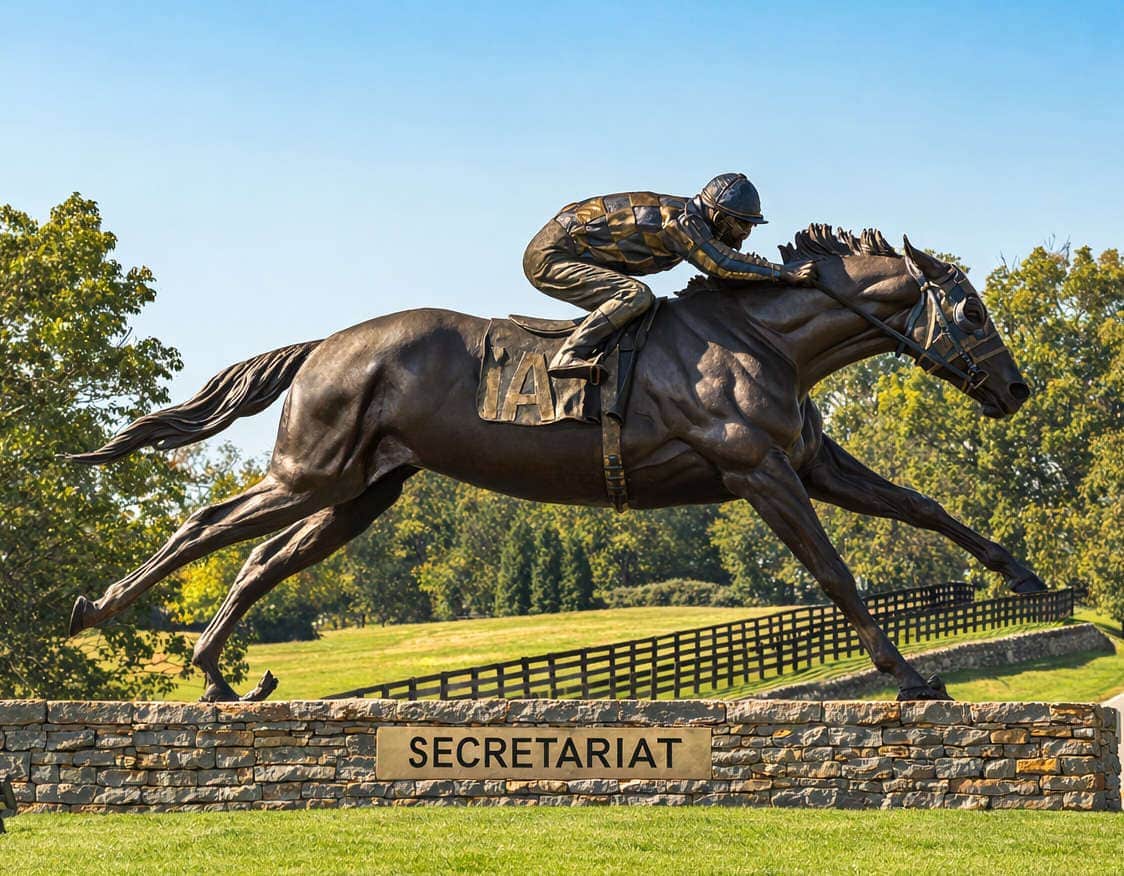 Statue of Secretariat
Modern Names in the Belmont Stakes
More recent Belmont Stakes winners continue to showcase the stamina and class required to succeed in one of horse racing’s most demanding races.
These winners include: [11][12][13][14][15][16][17][18]
- American Pharoah (2015): Ended a 37-year Triple Crown absence with a commanding Belmont Stakes victory that showcased his stamina and tactical speed. His win drew one of the largest Belmont crowds in decades and helped reignite mainstream interest in Thoroughbred racing.
- Justify (2018): Completed the Triple Crown while remaining undefeated, becoming the second horse after Seattle Slew to achieve that feat. He also broke a long-standing trend by winning the Triple Crown without racing as a two-year-old.
- Mo Donegal (2022): Closed from near the back of the field to win with a powerful late rally under jockey Irad Ortiz Jr.
- Arcangelo (2023): Delivered a breakthrough win and made history for trainer Jena Antonucci, the first woman to train a Triple Crown race winner.
- Sovereignty (2025): Captured the Belmont Stakes with a strong stretch run, surging past rivals in the final furlong to secure a decisive victory.

How Horses Prepare for the Belmont Stakes
Preparing a horse for the Belmont Stakes, especially for horses entering the final leg of a Triple Crown campaign, requires a unique approach to conditioning and management. At 1 1/2 miles, the Belmont is longer than most races American Thoroughbreds ever attempt, requiring exceptional physical and mental capabilities.
Trainers must carefully balance fitness, recovery, and targeted nutrition to ensure a horse can sustain speed over the demanding distance. [19]
Training & Conditioning
Historically, racehorse conditioning focused heavily on building endurance through long, steady gallops and frequent racing. Horses often trained with higher daily workloads and competed more regularly, which helped develop the aerobic capacity needed for classic-distance races.
These stamina-oriented programs reflected a time when longer races were more common, and horses were expected to maintain fitness through both training and racing. [19]
For example, 1946 Triple Crown winner Assault followed a demanding conditioning program typical of the era. His trainer, Max Hirsch, regularly galloped the colt long distances and worked him frequently, sometimes breezing on consecutive days and galloping out well past the finish line to build stamina for classic-distance races like the Belmont Stakes. [19]
Modern training programs take a more individualized and data-driven approach. Advances in exercise physiology, biomechanics, and monitoring technology now allow trainers to: [20]
- Evaluate workload
- Monitor heart rate
- Track stride patterns
- Detect early signs of fatigue or strain
As a result, many contemporary racehorses train with fewer intense workouts and greater emphasis on recovery, helping preserve soundness while still developing the endurance required for elite performance. [20][21]
Nutrition & Race Preparation
Feeding strategies for elite racehorses have evolved with advances in equine nutrition, exercise physiology, and performance management. Trainers and veterinarians now have a better understanding of how different energy sources support stamina, recovery, and digestive health in high-performance horses.
Because the Belmont Stakes is the final and longest race of the Triple Crown, horses entering this event must be carefully managed to support sustained energy, hydration, body condition, and recovery.
Nutrition is one part of that broader preparation, alongside conditioning, veterinary care, and day-to-day management.
Recovery Management
Veterinary care and recovery management have similarly improved strategies for supporting horses in strenuous sport. In earlier eras, trainers relied primarily on observation and experience to judge whether a horse had recovered between races.
Modern racehorses benefit from diagnostic imaging, preventative veterinary monitoring, and structured recovery protocols that help identify inflammation or musculoskeletal strain often before injuries develop. [21]
While modern technology, veterinary care, and nutrition have improved how horses are prepared for elite competition, the fundamental challenge of the Belmont Stakes remains unchanged.
Whether determining a Triple Crown champion or showcasing the next generation of elite Thoroughbreds, the Belmont Stakes continues to stand as racing’s ultimate test, one that has shaped the sport’s history and will continue to define greatness in horse racing.
Here are some frequently asked questions about the Belmont Stakes:
The Belmont Stakes is the third and final race of the American Triple Crown series, following the Kentucky Derby and the Preakness Stakes. First run in 1867, it is the oldest of the three races and is widely known as the “Test of the Champion” because it challenges three-year-old Thoroughbreds over a demanding 1 1/2-mile distance. [1][2]
The Belmont Stakes is traditionally held at Belmont Park in Elmont, New York. The racetrack is one of the largest Thoroughbred racing venues in the United States and is sometimes called “Big Sandy” because of its deep racing surface.
The Belmont Stakes is run over a distance of 1 1/2 miles (12 furlongs). This makes it the longest race in the Triple Crown series and one of the longest races contested by elite three-year-old Thoroughbreds in American racing. [1][2]
The Belmont Stakes is often considered the most demanding Triple Crown race because of its 1 1/2-mile distance. By comparison, the Kentucky Derby is 1 1/4 miles and the Preakness Stakes is 1 3/16 miles. As the final race in a five-week series, the Belmont tests a horse’s stamina, recovery, soundness, and mental composure. [1][2][3][4]
The Belmont Stakes earned this nickname because its 1 1/2-mile distance requires exceptional stamina from young Thoroughbreds. As the final leg of the Triple Crown, it often determines whether a horse can successfully complete one of the most difficult achievements in horse racing. [2][3][4]
The American Triple Crown consists of three races for three-year-old Thoroughbreds: the Kentucky Derby, the Preakness Stakes, and the Belmont Stakes. A horse that wins all three races in the same season earns the Triple Crown title.
Only a small number of horses have won all three races in the same year. Famous Triple Crown winners include Secretariat, Seattle Slew, American Pharoah, and Justify.
The Belmont Stakes offers a multimillion-dollar purse that is distributed among the top finishers. The exact prize money can vary by year depending on sponsorship and race conditions.
Preparing a horse for the Belmont Stakes requires careful attention to training, conditioning, nutrition, and recovery. Modern programs use individualized, data-driven methods to monitor workload, heart rate, stride patterns, and early signs of fatigue. Feeding strategies often emphasize forage-first diets with balanced concentrates, added fat, and targeted supplementation to support sustained energy and digestive health. [19][20][21][22][23]
Stamina is critical because the Belmont Stakes is longer than most American dirt races for three-year-olds. Horses must maintain speed and efficiency over 1 1/2 miles while recovering from earlier Triple Crown races, making endurance and conditioning key factors in success.
Summary
The Belmont Stakes is the oldest race in the American Triple Crown, first run in 1867, and it remains one of the most prestigious events in Thoroughbred racing.
- Known as the "Test of the Champion," the Belmont challenges three-year-old Thoroughbreds over 1 1/2 miles, making it the longest and most stamina-demanding race in the Triple Crown series
- The race has evolved through changes in location, distance, direction, and traditions while still preserving its historic importance in American racing
- The Belmont Stakes is the final leg of the Triple Crown in the Kentucky Derby
- Legendary winners such as Secretariat, Seattle Slew, Affirmed, American Pharoah, and Justify helped define the race's legacy through record-setting performances and Triple Crown victories
References
- Triple Crown. Kentucky Derby. 2026.
- History of the Belmont Stakes. The New York Racing Association. 2025.
- The History of Belmont Park. Belmont Stakes. 2017.
- The Test of the Champion. National Museum of Racing and Hall of Fame. 2026.
- All Past Winners of the Belmont Stakes. The New York Racing Association. 2025.
- Man o’ War. Kentucky Horse Park.
- Gallant Fox (KY). National Museum of Racing and Hall of Fame. 2026.
- Omaha (KY). National Museum of Racing and Hall of Fame. 2026.
- Secretariat (VA). National Museum of Racing and Hall of Fame. 2026.
- Ehalt, B. Risen Star: The Pride of Louisiana. America’s Best Racing. 2026.
- Easy Goer (KY). National Museum of Racing and Hall of Fame. 2026.
- American Pharoah (KY). National Museum of Racing and Hall of Fame. 2026.
- Ehalt. B. Tiz the Law Dominates Belmont Stakes to Launch 2020 Triple Crown. America’s Best Racing. 2020.
- King. B. Essential Quality Prevails in Belmont Stakes. BloodHorse. 2021.
- Bond, D. 2022 Belmont Stakes Results & Race Replay - Mo Donegal. OffTrackBetting. 2022.
- Pedulla. T. Arcangelo Proves Best in Belmont Stakes to Give Trainer Antonucci History-Making Win. America’s Best Racing. 2023.
- Reilly, K. Dornoch Holds off Mindframe in Belmont Stakes at Saratoga. Kentucky Derby. 2024.
- Hanson, V. Sovereignty Decisively Wins Belmont Stakes over Journalism. Kentucky Derby. 2025.
- Staff. P.R. A Different Era: Training Pattern for Triple Crown Winner Assault. Paulick Report. 2025.
- Morrice-West. A. V. et al. Association of Thoroughbred Racehorse Workloads and Rest Practices with Trainer Success. Animals. 2021.
- Williams. J. et al. The Role of Heart Rate Monitoring to Assess Workload during Maintenance Interval Training in National Hunt Racehorses. Journal of Veterinary Behavior. 2019.
- Martin. A. et al. Effect of High-Starch or High-Fibre Diets on the Energy Metabolism and Physical Performance of Horses during an 8-Week Training Period. Frontiers in Physiology. 2023.
- Richards, N. et al. The Effect of Current Grain Feeding Practices on Hindgut Starch Fermentation and Acidosis in the Australian Racing Thoroughbred. Australian Veterinary Journal. 2006.
- 2026 Belmont Stakes Racing Festival: Stakes Race Schedule. New York Racing Association. 2026.
- Belmont Stakes History. New York Racing Association. 2026.