English









English saddles are used across many equestrian disciplines, including dressage, show jumping, eventing, and hunter, with a lightweight design that allows close contact between rider and horse.
Unlike the Western saddle, which is built for comfort over long hours of work, the English saddle emphasizes a balanced and secure seat that enables clear communication with the horse through subtle aids.
Developed in Europe, the English saddle has been refined over centuries to suit the needs of different riding styles. Its structure highlights rider posture, balance, and flexibility, making it a versatile option for both competitive and recreational riders.
Keep reading to learn more about the history, construction, types, and fitting considerations for English saddles to help you choose the best option for your equestrian needs.
History of English Saddles for Horses
The English saddle traces its origins to medieval Europe, when horse tack was designed for knights and mounted combat. Early saddles emphasized stability, using high pommels and cantles to keep riders secure during battle. [1][2]
As horseback riding evolved from warfare to sport and leisure, saddle design adapted. Renaissance dressage and classical riding traditions brought a new emphasis on balance, posture, and elegance; principles that continue to define English saddles today. [2]
By the 18th and 19th centuries, English fox hunting and show jumping brought further refinements in saddle design. Saddles became lighter, more agile, and shaped to enhance close contact between rider and horse. [2]
Today, English riding encompasses diverse disciplines, each requiring specialized saddles optimized for balance, control, and communication. Whether for dressage, show jumping, or cross-country eventing, modern English saddles are engineered to enhance performance while ensuring the horse’s comfort and long-term soundness.
What's your top priority with your horse's health?

Enter your email to receive your store credit
Parts of an English Saddle
English saddles have changed considerably from earlier designs. The growth of equestrian sports in the 20th century encouraged ergonomic construction that improves both performance and rider comfort. [2]
Advancements such as adjustable gullets and lightweight materials led to saddles that are lighter, stronger, and more adaptable to the needs of both horses and riders.
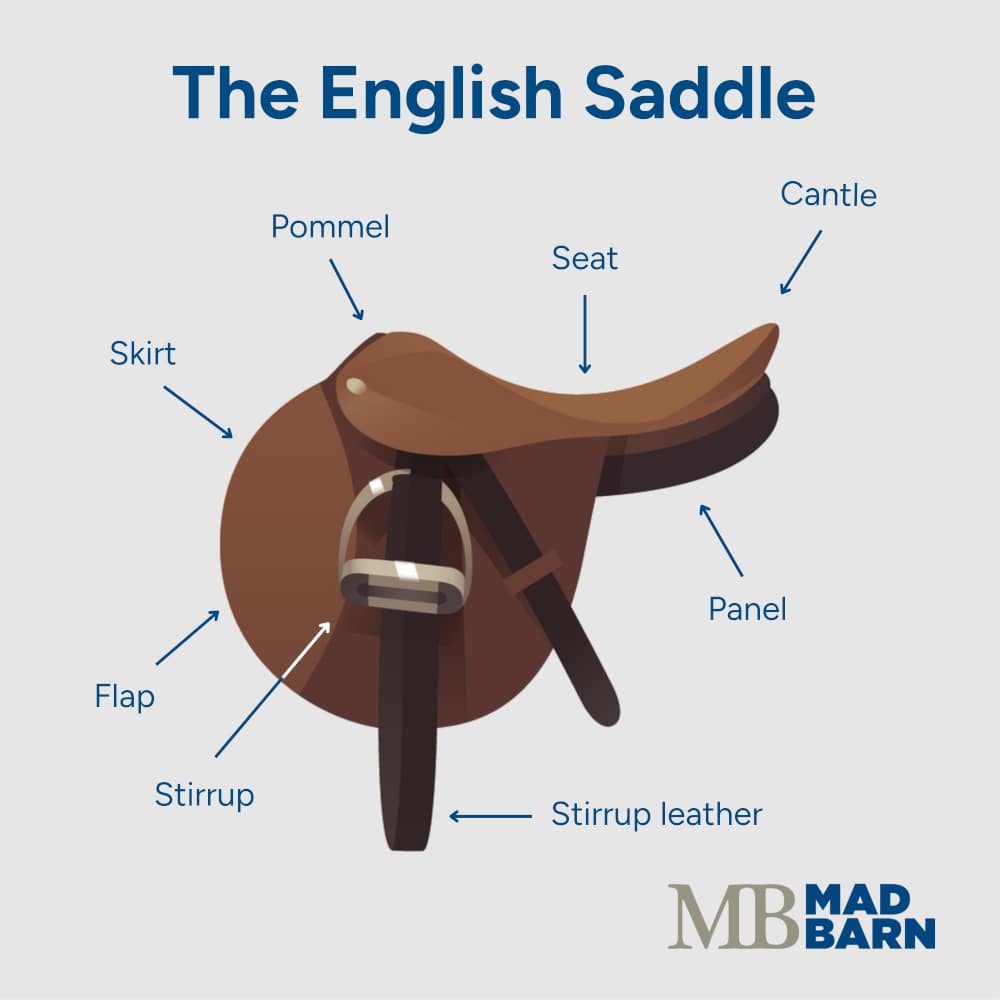
A number of key features influence the comfort and functionality of an English saddle, including: [3][4][5]
Tree
The tree is the backbone of English saddles. Tree width and angle determine how well a saddle suits an individual horse, directly affecting weight distribution and preventing pressure points.
Traditionally, saddle trees were crafted from laminated woods that flexed with the horse’s back. Today, many manufacturers use synthetic materials such as carbon fiber, producing designs that are lightweight, durable, and resistant to warping.
Seat
The seat refers to the rider’s sitting area, with features that influence comfort, balance, and discipline-specific needs.
Dressage models often use deep seats for maximum stability and support during precise movements, while jumping saddles favor a flatter seat that allows greater freedom over fences. Padding such as foam or wool enhances comfort, particularly during long rides and competitions.
Pommel
The pommel is the front of an English saddle, which supports the rider’s pelvis and ensures proper wither clearance to prevent rubbing or pinching.
Cantle
The cantle is the rear of the saddle, which provides back support and helps riders maintain balance. Dressage saddles often use higher cantles for added security, while jumping saddles feature lower cantles to allow quick position changes.
Panels
Panels are cushioned sections beneath a saddle that rest on the horse’s back. Panels are filled with flocking materials such as wool, foam, or air cushions to reduce pressure and ensure even weight distribution.
Wool-flocked designs are highly adjustable, allowing saddle fitters to make changes as a horse’s muscle condition develops, making them especially useful for growing or changing horses.
Flaps
Flaps protect the rider’s legs from the horse’s sides and provide a surface for applying riding aids, with length and angle varying by discipline.
Dressage saddles use long, straight flaps that support a longer leg position, while jumping saddles use forward-cut flaps that allow a shorter stirrup length. Many models also include padded knee rolls or thigh blocks for added leg support and stability.
Girth Straps
Also called billets, these strong leather straps secure the girth holding the saddle in place. Most English saddles include three billets on each side, allowing flexible girth placement for a snug, comfortable fit.
Ancillary Components
There are also key supportive elements of the English saddle which are sold separately, but are important to the basics of riding in an English saddle.
Ancillary components of English saddles include:
- Stirrups: Metal loops that support a rider’s feet and play a key role in balance and control.
- Stirrup leathers: Adjustable straps that let riders customize foot position according to their leg length and discipline.
Discipline-Specific Design Features
While the basic construction of English saddles is the same across different disciplines, there are a number of design features that vary depending on rider needs, including:
- Seat depth: Deep seats in dressage saddles provide a secure, supportive position for collected movements, while flat seats in jumping saddles allow quick adjustments over fences. Medium-depth seats in all-purpose saddles offer versatility for both flatwork and jumping.
- Panel padding: Affects how well a saddle distributes a rider’s weight. Adjustable flocking systems let saddle fitters fine-tune panel padding for an optimal fit as the horse’s topline changes over time.
- Flap length and angle: Dressage saddles feature long, straight flaps that support a long leg position, while jumping saddles have shorter, forward-cut flaps that accommodate a bent knee and shorter stirrup length.
- Adjustable gullet systems: Allow riders to change the width of the tree to fit different horses. This flexibility is especially useful for riders who work with multiple animals or horses who have changes in body condition throughout the year due to training, weight fluctuations, or age-related growth.
Types of English Saddles
English saddles are tailored to specific disciplines and riding styles, coming in a wide range of designs. Western saddles are built for long hours of ranch work, while English models emphasize close contact, precision, and flexibility. Selecting the right saddle is key to achieving comfort, balance, and performance in any discipline.
Dressage Saddle
Dressage saddles are built to support precise, controlled movements that define the discipline of dressage. Its deep seat provides maximum stability, helping riders maintain a balanced, upright position during complex maneuvers such as collected trots, pirouettes, and half-passes.
Long, straight flaps accommodate an extended leg position, aligning heel, hip, and shoulder vertically for optimal posture. Large knee blocks reinforce correct leg placement to reduce strain, while padded seats and panels improve comfort during extended training.
A close-contact design ensures clear communication between horse and rider through subtle leg and seat aids. [6][7]
Jumping Saddle
Jumping saddles are designed for speed, agility, and freedom of movement over fences. A flat or shallow seat allows the rider to adjust position quickly during approaches, take-offs, and landings, while forward-cut flaps accommodate a shorter stirrup length for a secure two-point or half-seat position. [6][7]
Streamlined panels and minimal padding enhance responsiveness, and knee rolls or thigh blocks provide extra security without limiting movement. This balance of support and flexibility helps riders stay stable during rapid changes in direction or elevation. [6][7]
All-Purpose Saddle
The all-purpose saddle, also called the general-purpose saddle, is built for versatility and works across flatwork, jumping, and hacking.
A moderate seat depth balances security with freedom, offering comfort for everyday riding while allowing flexibility for occasional dressage or jumping. [6][7]
Slightly forward-cut flaps support both long and short stirrup lengths, and panels provide reliable support without being overly specialized. This balanced design makes the all-purpose saddle especially popular among novice riders and those involved in multiple disciplines. [6][7]
Eventing Saddle
Eventing saddles are designed to meet the varied demands of three-day eventing, blending features of both dressage and jumping saddles. Secure seats provide stability during cross-country portions, while durable construction ensures the saddles withstand changing terrain and weather. This combination delivers the reliability and comfort needed for all phases of competition. [8]
Endurance Saddle
Endurance saddles are built for long-distance riding. Their lightweight construction reduces strain on horses during extended rides, while extra seat padding minimizes rider fatigue. [9]
Ergonomic designs often feature adjustable stirrup positions that let riders shift posture over long hours in the saddle. Multiple attachment points for gear such as water bottles, saddle bags, and emergency supplies make these saddles ideal for trail riding and endurance competitions, where self-sufficiency is essential. [9]

How to Choose an English Saddle
Selecting the right English saddle goes beyond aesthetics or brand. It is a crucial step for ensuring comfort, performance, and long-term soundness for both horse and rider.
A well-fitted saddle promotes balanced movement, prevents injury, and supports effective communication. Saddle fit should always be evaluated from two perspectives: fitting the horse and fitting the rider.
Fitting the Horse
Horse comfort under saddle is essential. An ill-fitting saddle can cause pain, behavioral issues, and long-term musculoskeletal damage.
Saddle fitters assess the following features to ensure a comfortable fit for the horse: [5][10][11]
- Back shape: Refers to how the tree follows the contours of the horse’s back. Avoid saddles that create bridging, where the middle lifts away from the back, as this concentrates weight at the front and rear.
- Wither clearance: There should be roughly 2 to 3 fingers’ width between the withers and pommel. Excess clearance often means the saddle is too narrow and may pinch, while too little clearance suggests it is too wide and may rest on the spine.
- Panel contact: Must be even along both sides of the spine without pinching or rocking. English saddles make this easier to evaluate, as daylight should be visible through the gullet from behind, showing balanced weight distribution.
- Tree width: Comes in options such as narrow, medium, wide, or extra wide. A tree that’s too narrow can pinch and cause soreness, while one that’s too wide can sit low, creating pressure on the spinal processes.
Saddle placement is just as important as fit. The saddle should sit just behind the shoulder blade to allow full range of motion. Saddles placed too far forward restrict movement, shift the rider’s balance, and increase strain on the forelimbs, which already carry 60–65% of the horse’s body weight. [5][10][11]
Over time, factors such as weight changes, age, and fitness level can affect saddle fit. Regular checks, especially after changes in condition or workload, are essential. Even sweat patterns after a ride are a useful indicator, as dry spots may signal pressure points or poor contact.
Fitting the Rider
While horse comfort is paramount, saddles must also support the rider in maintaining a balanced, effective position. A poor fit can cause discomfort, insecurity, and reduced effectiveness of aids.
Seat size typically ranges from 16″ to 18″ (40.5 to 45.5 cm). Selecting a size that matches the rider’s height and build is critical for balance and comfort.
An English saddle that fits both horse and rider promotes clear communication, balance, and comfort. When in doubt, consult a professional saddle fitter and test multiple saddles before committing to one.
Frequently Asked Questions
Here are some frequently asked questions about English saddles:
Check for even weight distribution, wither clearance, and freedom of shoulder movement. Dry spots under the saddle after riding may signal poor fit. The saddle should sit just behind the shoulder blade without rocking or pinching. Most importantly, the saddle needs to avoid the "no contact zone" which is the area located directly below and to either side of the withers, behind the shoulder blade's vertical movement, but not behind the scapula itself. This region is highly sensitive and should never bear pressure from the saddle tree points or panels.
Seat size usually ranges from 16" to 18" depending on the rider's height and build. A proper fit supports balance, comfort, and effective use of aids.
All-purpose saddles offer versatility, but discipline-specific models provide the best support for activities like dressage, jumping, eventing, or endurance riding.
Traditional leather offers durability and comfort, while synthetic leather and carbon fiber provide lightweight, low-maintenance alternatives suited for modern use.
Summary
English saddles reflect centuries of equestrian tradition, blending form and function to meet the demands of modern riding. Choosing the right saddle is important for comfort, communication, and performance.
- Types are designed for specific disciplines such as dressage, jumping, eventing, and endurance
- Construction includes components like the tree, panels, flaps, and girth straps, each affecting fit and function
- Fitting ensures comfort for horse and rider, promoting balance, preventing injury, and supporting effective communication
- Maintenance extends saddle life and preserves quality, requiring regular cleaning and professional checks
References
- Dawson. T. G. Late Medieval Developments in European Saddlery. Seats of Empire. 2024.
- Hendricks. A. Riding Through Time: The Fascinating History of the English Saddle. Adrienne Hendricks Saddlery. 2023.
- Navarra. K. A Guide to English Saddle Parts & Fit. Vita Flex Pro. 2023.
- Parts of an English Saddle. Evolution Equestrian Co. 2021.
- Ridgeway. K. Saddle Evaluation and Fitting. Manual of Clinical Procedures in the Horse. 1st ed. Wiley. 2017.
- Andrews. T. et al. Horse Reference Manual. 4-H Canada. 2015.
- Imboden. I. English Saddles. FEI Campus. 2025.
- Caryty. M. Understanding The Different Types of English Saddles. Thinline. 2023.
- Types of Endurance & Trail Saddles. Kentucky Horse Council. 2009.
- Evans. P. and Rood. K. A. Fitting the Western or English Saddle to the Horse. UtahState University Cooperative Extension. 2008.
- The Nine Points of Saddle Fit. Schleese. 2016.