English











![Equestrian Cross-Country Riding: History, Competition & Rules – [Discipline Guide]](/wp-content/uploads/2025/06/cross-country-horseback-riding-discipline-guide.jpg)
Cross-country riding is a demanding equestrian sport that tests the strength, agility, and partnership of horse and rider. Taking place over a course of varied terrain, fixed obstacles, and natural challenges, it combines the intensity of galloping across open fields with the technical demands of navigating jumps, banks, ditches, and water elements.
With deep roots in traditional fox hunting and military cavalry training, cross-country riding is a key component of modern-day eventing, alongside dressage and show jumping. Today, it remains a favorite phase for riders and spectators alike due to its fast pace and adventurous nature.
Standalone cross-country competitions have also gained popularity, offering riders additional opportunities to test their skills in this challenging discipline.
Read on to explore the history and evolution of cross-country riding, essential tack and safety equipment, and the Cross-Country Equestrian Association’s efforts to grow the sport.
Cross-Country Riding
Cross-country riding involves the rider guiding their horse over obstacles, jumping across the uneven terrain of a course. While most readily recognized as a phase of 3-day eventing, cross-country riding is also enjoyed casually and in standalone competitions. [1]
History
Cross-country riding originated from military endurance tests and fox hunting. In the 19th century, cavalry horses were tested over various challenging terrains to gauge their fitness and skill, and these tests often mimicked fox hunts. [2]
Fox hunting involves navigating natural and man-made obstacles found around the hunting zone, which can include a combination of: [3]
- Fences
- Hedges
- Stone walls
- Logs
- Water crossings
- Uneven ground
- Ditches
Cross-country riding combines the challenging terrain of historical military tests with non-uniform jump designs inspired by the fox hunts of the 15th century.
The modern sport of eventing consists of three phases, dressage, show jumping, and cross-country, which each test different aspects of the horse and rider partnership and contribute to a combined overall score.
Cross-country was incorporated into eventing due to its origins in cavalry training. The discipline began as a comprehensive fitness assessment for military horses and riders, evaluating their ability to navigate open terrain at speed, work together under pressure, and recover quickly after strenuous exertion. These skills mirrored those required in battle, making cross-country an ideal component of the test.
Given this, eventing as a discipline was initially restricted to members of the military who were amateur riders. Eventually, the sport took root in Britain when the first Badminton Horse Trials were held in 1949, established by the 10th Duke of Beaufort to help train riders for international competition. It became an Olympic sport in 1912 during the Stockholm Games. [2]
Today, cross-country remains a defining part of eventing competition, but it is not limited to the 3-day course. Many casual and schooling facilities and horse parks offer cross-country courses for equestrians to enjoy at their leisure. The discipline is also independently competitive, as the Cross-Country Equestrian Association (CCE) now hosts cross-country-only competitions. [4]
Sport Organizations
Cross-country riding has long been linked with the sport of eventing, traditionally serving as one of its three core phases alongside dressage and show jumping. Until recently, it was rare to see cross-country competition outside the eventing world. However, a small but dedicated movement, spearheaded by the Cross Country Equestrian Association (CCE), is working to establish cross-country as an independent discipline in its own right.
With a growing number of riders and supporters, the organization is carving out space for competitive cross-country to evolve beyond its roots and emerge as a standalone equestrian sport.
Eventing Sport Organizations
The sport organizations that govern eventing have played a crucial role in shaping competitive standards and formalizing rules for standalone cross-country. As cross-country continues to evolve as its own discipline, it will continue modeling its rules and regulations after international eventing standards.
United States Eventing Association (USEA)
Established in 1959 as the United States Combined Training Association, the United States Eventing Association (USEA) focuses exclusively on the sport of eventing within the US. It supports rider and horse safety, manages a calendar of recognized events, and promotes educational initiatives to develop the sport. [5]
USEA’s core mission is to support the growth of eventing by making it accessible, enjoyable, and safe for all participants—whether riders, trainers, or horse owners. [5]
Equestrian Canada (EC)
Equestrian Canada (EC) serves as the Canadian national body that governs equestrian sport. EC oversees domestic eventing competitions and is tasked with selecting and supporting Canadian equestrian teams at international events, including the Olympic Games. The organization works to uphold competition standards while fostering equestrian excellence across the country. [6]
Fédération Equestre Internationale (FEI)
Serving as the global authority for equestrian sport since 1921, the Fédération Equestre Internationale (FEI) is recognized by the International Olympic Committee. The FEI oversees the Olympic and World Equestrian Games, and is responsible for establishing uniform regulations across disciplines. [7]
The FEI sanctions seven distinct disciplines, four of which—eventing, jumping, dressage, and para-equestrian—are featured in the Olympic Games. The full list includes: [7]
United States Equestrian Federation (USEF)
Founded in 1917 under the name American Horse Shows Association, the United States Equestrian Federation (USEF) now functions as the national governing body for equestrian sport in the U.S. In addition to overseeing all FEI-recognized disciplines domestically, USEF also governs 11 unique national disciplines tailored to American equestrian traditions. [8]
These include:
- English Pleasure
- Carriage Pleasure Driving
- Hunter
- Saddle Seat
- Western Pleasure
- Western Dressage
What's your top priority with your horse's health?

What's your top priority with your horse's health?
Cross-Country Sport Organizations
Cross-country riding as a separate discipline is supported by newer associations, as the sport has only recently begun to establish itself as independent from eventing. The most recognized of these organizations is the Cross Country Equestrian Association.
The Cross-Country Equestrian Association
The Cross-Country Equestrian Association (CCE) oversees cross-country competitions in the US. Riders in CCE competitions ride over a set course of obstacles and score points for successfully jumping the obstacles. They can incur penalties for exceeding course time limits and for errors. The rider with the highest final score at the end of the competition wins. [8]
Like the cross-country phase of eventing, CCE competitions test the abilities of well-conditioned horses and rider capability. The setting, obstacles, courses, and length are similar to that of the cross-country phase of eventing.
Competition
Course layout, obstacle types, and rules vary in cross-country riding by competition level and organizer. Riders navigate a timed course filled with a variety of natural and constructed obstacles, and the competitive goal is to finish with the highest score. Each successful jump adds to the competitor’s score, while penalties are assessed for mistakes or going over the optimum time. [9]
CCE vs. Eventing
CCE competitions differ from the cross-country phase of eventing by making every obstacle optional. Riders can attempt an obstacle or pass it and ride to the next. No penalties are incurred for passing an obstacle, but no points are gained if the obstacle is not jumped. [10]
The CCE allows the horse and rider more flexibility than traditional eventing while traversing the course. Beyond skill and athletic ability, horsemanship and partnership are core values of the CCE. [9]
Another unique element of CCE competitions includes the addition of the Jump Off Ride (JOR), which is not found in the cross-country phase of eventing. The JOR is shorter and more intense than the Cross-Country Ride (CCR) stage of CCE competitions. [9]
In the JOR, the first segment starts in an arena with show-jumping type obstacles. The JOR may also include a gallop section without obstacles. Sometimes, the JOR course is partially run outdoors, but returns to the arena for an exciting finish to the competition. [9]
Obstacles
Each obstacle in a cross-country course, otherwise known as a “question,” tests how easily the horse and rider can navigate the course and the horse’s jumping ability.
Common obstacles include: [5][11]
- Water complexes
- Logs
- Triple bars (oxers)
- Tables (e.g., picnic, step)
- Roll tops
- Ramps (palisades)
- Benches
- Cabins
- Brush boxes
- Corners
Modern course safety measures and best practices include obstacles that have break-away devices and pins. Frangible pins and devices are a safety feature on cross-country obstacles that allow parts of the obstacle to collapse under force should the horse hit the jump. Breaking the obstacle limits the force of impact, reducing the risk of more serious injuries to both horse and rider. [12]
As of December 2023, the United States Eventing Association requires International Federation for Equestrian Sports-approved frangible devices at Training level and above. [12]

Course Design, Scoring & Penalties
Cross-country courses are designed for individual levels, with differing tailored distances, speed requirements, and optimum completion times. These levels range from Beginner Novice to Advanced. Each course is intended to test the horses’ current skills while preparing them for the next level of competition. [5]
A set of red and white boundary flags mark where the course time begins and ends. Each obstacle is also marked with red and white flags on either side of the jump. The competitor must always have the red flag on their right and the white flag on their left. [5]
Obstacles are also numbered, and some questions may be marked by letters to show that they are part of a combination of obstacles. The obstacle numbers have a specific color pattern indicating the level of difficulty. For example, Beginner Novice level jump signage has black numbers on a yellow background. [5]
Yellow directional markers are also used to help show riders the general direction they need to take to help them find their way around the course. [5]
Common penalties in cross-country riding include: [5]
- Refusals and run-outs: 20 points
- Exceeding optimum time: 0.4 point per second over the optimum time
- Triggering a frangible device: 11 points
- Missing a flag: 15 points
For refusals or run-outs, the first instance on course results in 20 penalty points while the second refusal or run out at the same obstacle results in 40 additional penalty points. If the horse refuses the obstacle a third time, the combination is eliminated. [5]
Sometimes an obstacle or question has one or more alternative obstacles that can be ridden instead. This is more common in the upper levels of eventing. Typically, these alternatives might present as an easier question but may require more time to complete.
No penalty is given for taking an alternate obstacle if it is completed correctly. However, if this choice results in exceeding the optimum time, time penalties are incurred. [13]
CCE Competition Levels
The level of competition for the horse and rider dictates the difficulty of the terrain and the height of the obstacles. Each level features progressively higher and wider obstacles. [14]
Recognized cross-country eventing levels and their corresponding obstacle heights are: [14]
- Starter: 2’3″
- Beginner Novice: 2’7″
- Novice: 2’11”
- Training: 3’3″
- Modified: 3’5″
- Preliminary: 3’7″
- Intermediate: 3’9″
- Advanced: 3’11”
Training & Preparation
Since cross-country riding requires immense endurance along with jumping ability, proper conditioning for both horse and rider are essential.
Gallop sets across natural or uneven terrain are a common part of cross-country training, along with training to jump over obstacles similar to those in competition. This helps riders develop pace and a sense of their speed per minute, which is essential to avoid speed faults in competition. [15][16]
Attending Hunter Paces is another great training method many riders use to prepare for cross-country. Hunter paces help build endurance and offer a similar style of cross-country obstacles that are optional to jump. [17]
Riders who are not able to train on cross-country type courses can use interval work to help improve horse and rider endurance. Interval work is particularly useful for improving the canter or gallop that horses must sustain on the course.
In addition, creating unique, stadium-jump style courses at your home barn can help simulate the feeling of riding cross-country obstacles. [18]
Special Equipment & Tack
Proper tack and safety gear are crucial for performance and horse and rider well being. From specialized saddles to protective vests, each item serves a specific purpose.
The Horse’s Tack
Although certain types of tack are commonly used for cross-country riding, requirements or restrictions may vary depending on the organization regulating the competition, such as the United States Eventing Association (USEA) and International Federation for Equestrian Sports (FEI). [18]
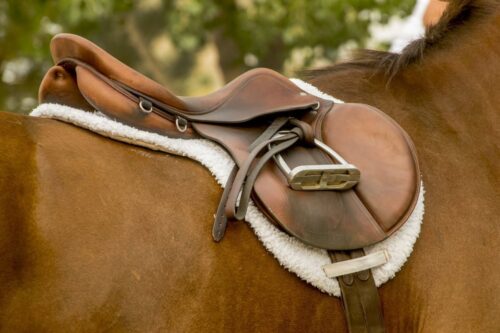
Common tack for cross-country riding includes: [18]
- English saddle
- Association-permitted English bit and bridle
- English saddle pads and half pads
- Running or Irish martingale with rein stops
- Breastplate
- Brushing boots
Riders competing in lower levels often use all-purpose or jumping saddles, while riders in upper levels may opt for saddles that are designed specifically for cross-country, such as Monoflap saddles. Cross-country-specific saddles are not mandatory for upper level competition, but many riders prefer them for their efficient design. [18]
Rider Attire & Safety Gear
Attire and gear for cross-country riders prioritize the rider’s safety. Common clothing and safety gear for riders includes: [19]
- A helmet meeting ASTM/SEI standards
- Medical armband or bracelet
- Breeches
- Tall boots or paddock boots with half chaps
- Riding gloves
- Cross-country stopwatch
- Safety vest or air vest
- Long- or short-sleeve shirt or polo
- Pinney number and holder
Most 3-day eventers wear their own personal colors during the cross-country phase, with many adding matching apparel to their horse’s tack. This is because the cross-country phase does not have a dress code outside of meeting mandatory equipment and safety rules.
Horses
Thoroughbred and thoroughbred crosses are most commonly ridden in the cross-country discipline. Cross-country riding is open to every breed, but the athletic ability required of the sport makes thoroughbreds an ideal pick.
Some breeds that are common in this sport are:
These breeds are most commonly crossed with thoroughbreds to improve their stamina and speed in cross-country riding.
Frequently Asked Questions
Here are some frequently asked questions about cross-country riding:
Cross-country riding is a phase of eventing that involves guiding a horse over solid obstacles across varied terrain. Unlike dressage or show jumping, it emphasizes speed, endurance, and navigating natural challenges like water, ditches, and logs. It is also enjoyed as a standalone sport outside of eventing competitions. [1]
Typical tack includes an English saddle, bit, and bridle, along with saddle pads, a martingale, breastplate, and brushing boots. Riders often wear ASTM/SEI-approved helmets, safety vests or air vests, tall boots, gloves, and a pinney number. Specific requirements can vary depending on the governing body like USEA or FEI. [18][19]
Frangible pins are safety mechanisms used in jump construction that cause parts of the obstacle to collapse under force if hit by a horse. This helps reduce the severity of accidents by minimizing the impact. As of December 2023, their use is mandated at Training level and above by the USEA. [12]
CCE competitions feature cross-country-only courses where each obstacle is optional. Riders gain points for successfully jumping obstacles and incur no penalties for skipping them, offering greater flexibility. CCE events also include unique elements like the Jump Off Ride (JOR), which is not found in traditional eventing. [9][10]
Summary
Cross-country riding is an equestrian discipline that blends endurance, technical precision, and a strong horse-rider partnership.
- Cross-country riding evolved from military endurance tests and fox hunting in England
- Cross-country riding makes up one arm of the 3-day eventing competition; it is currently in development as a standalone discipline
- Courses are designed with a variety of solid obstacles—such as water complexes, logs, and tables—meant to test agility and endurance
- Essential gear includes specialized tack like Monoflap saddles and brushing boots for the horse, and ASTM/SEI-certified helmets and safety vests for the rider
- Riders can train using gallop sets, interval work, and Hunter Paces to build stamina and familiarity with obstacles
References
- United States Equestrian Federation. 2024 USEF Eventing Rulebook. 2024.
- A History of Eventing. Fédération Équestre Internationale. 2018.
- Hastings, A. Fox Hunting: History and Change in a Mountain Sport. Appalachian J. 1997.
- Welcome. Cross Country Equestrian Association.
- USEA Staff. Rule Refresher: Understanding Cross-Country Obstacles. USEA : United States Eventing Association Inc. 2021.
- Eventing. Equestrian Canada. 2025.
- History. FEI. 2025.
- About Us. USEF. 2025.
- Cross Country Equestrian Competition. Cross Country Equestrian Association. 2025.
- Cross Country Equestrian (CCE) Competition Specifics. Cross Country Equestrian Association. 2025.
- Covey, H. Know Your Obstacles On A Cross-Country Course. Eventing Nation. 2020.
- Slagle, D. Rule Refresher: Frangible Essentials for Riders and Jump Judges. USEA : United States Eventing Association Inc. 2023.
- USEA Cross-Country Course Design Guidelines. USEA : United States Eventing Association Inc. 2025.
- Compete. Discover Eventing.
- Baker, S. Cross-Country Preparation In Your Arena. FEI.org. 2019.
- Kelley, C. Training Tips for the Long Format with Dr. Jennifer Miller. USEA : United States Eventing Association Inc. 2020.
- O'Connor, D., et al. Eventing: Intro to Cross-Country Riding. US Equestrian. 2017.
- Duffy, J. Rule Refresher: Saddlery. USEA : United States Eventing Association Inc. 2017.
- What Do I Wear. Discover Eventing.