

 English
Equine Diet Transition Calculator
Generate an optimized feeding transition schedule to protect your horse's gut health when making diet changes.
Enter your horse's current diet and any new feeds you plan to introduce, including the amount and unit for each feed. This tool will create a step-by-step schedule to help your horse gradually adjust to their updated feeding program. By the final day, your horse will be fully transitioned to their new diet.
| Feed Name | Unit | Current Diet | New Diet |
|---|
Disclaimer: The results of this Equine Diet Transition Calculator are for demonstration purposes only and depend on the accuracy of user-provided inputs. No guarantees, warranties, or assurances of appropriateness or specific outcomes are provided. For a personalized feeding program, consult a qualified equine nutritionist, obtain a forage analysis, and consider submitting your horse's information through our diet evaluation form.
How to Plan Safe Diet Transitions for your Horse
Minor dietary changes, like adding a standalone supplement or a small amount of a new feed, are usually easy for horses to handle. But significant changes involving forage changes or multiple feeds must be introduced slowly to reduce the risk of digestive upset.
Poorly managed transitions can lead to serious issues, from feed refusals to dangerous digestive problems such as colic. That’s why Mad Barn’s nutrition experts developed the Equine Diet Transition Calculator (EDTC), a simple tool to help you plan a smooth change to your horse’s diet.
When making major feed changes, equine nutritionists and veterinarians recommend having a clear diet transition plan. This plan minimizes risks and helps your horse adjust without gastrointestinal complications.
A diet transition plan is particularly important when:
- Buying or selling a horse
- Changing several feed components at once
- Making substantial changes to one or more feed components
- Switching to a new forage source or transitioning between hay and pasture
Use our tool to take the guesswork out of planning your horse’s diet transition, ensuring a successful adjustment.
How to Use the Equine Diet Transition Calculator
Mad Barn’s Equine Diet Transition Calculator (EDTC) plans your horse’s diet change and makes it easy to share with personnel at your facility. Just enter your horse’s current diet, the new diet, and the desired transition period.
The calculator then produces a clear, step-by-step schedule that shows exactly how much of each feed to provide during the transition.
Step 1: Adjust the timeframe
If you’re ready to create your transition plan, you might be asking: How long should the transition take?
The duration depends on several key factors, including:
- The types of feeds being transitioned
- The quantity of feed being changed
- Your horse’s overall digestive health
Keep these factors in mind as you plan the transition for each type of diet change.
Forages
The optimal transition period when making forage changes depends on how similar the current and new forages are in terms of nutrient content and maturity, and what proportion of the final diet is composed of forages.
In general, switching between two similar forages — such as two mid-maturity grass hays — requires a shorter transition period. In contrast, moving from a dissimilar forage, like transitioning from alfalfa hay to grass hay, typically needs a longer adjustment period to allow your horse’s digestive system and hindgut microbiome to adapt.
It’s especially important to transition onto spring pasture slowly after your horse has spent the winter primarily consuming preserved hay. Spring grasses often have rapid growth spurts that can lead to significant changes in nutrient profiles in a very short period.
Carefully regulating pasture access when spring grass is growing can help prevent issues like diarrhea, free fecal water syndrome, and laminitis.
Commercial feeds
The time required to transition between commercial feeds depends on how similar the current and new feeds are. For example, switching from one brand of senior feed to another usually takes less time because their nutrient profiles are similar. In contrast, moving from a senior feed to a performance feed, which have noticeably different nutritional compositions, typically requires a longer transition period.
Transitioning off of feed to a forage-based diet should also be done gradually to allow your horse’s digestive system time to adapt to the higher fiber content and lower energy density.
A practical guideline is that if you’re changing your horse’s feed intake by one pound or less per day, you can usually make the switch without a formal transition plan. However, for adjustments greater than one pound per day, it’s best to add, reduce, or replace one pound of grain every 3 to 5 days. This gradual approach gives your horse’s digestive system time to adapt, reducing the risk of digestive upset.
Supplements
Nutritional supplements for horses typically have a smaller serving size, making it easier to transition them in and out of the diet quickly. In many cases it’s possible to add or remove supplements without a formal diet transition schedule.
However, if a supplement substantially changes your horse’s nutrient intake, such as with the addition of a concentrated vitamin and mineral product, it’s best practice to make the change over the course of a week or so.
If your horse is a picky eater, it may also be necessary to transition more slowly to avoid refusals. Supplements are typically a concentrated source of nutrients, so it may take time for your horse to get used to the new smell of their meals, particularly if the supplement you’re adding makes up the bulk of their ration.
If your horse is sensitive to dietary changes, it’s best to stay cautious and add or remove supplements slowly. This will give your horse time to adapt and allow you to monitor for changes in their health and well being.
For specific recommendations on how long your horse’s diet transition should take, you can consult with an equine nutritionist to come up with a tailored plan that works for you and your horse.
Step 2: Input Feed Names
Now that you’ve set the optimal transition period for your horse’s diet change, the next step is to enter the names of the feeds in both the current and new diets into the calculator.
Use clear, familiar names that everyone involved in feeding your horses will recognize. It’s important that the names you input match those on the feed containers, so there’s no confusion when following the transition plan.
Step 3: Enter Feed Amounts
When inputting the amount of a feed, start by entering the current intake in the “Current Diet” column and the new amount you will be transitioning to in the “New Diet” column.
For instance, if you’re increasing your horse’s hay intake from 10 lb per day to 15 lb per day, you would enter “10 lb” under “Current Diet” and “15 lb” under “New Diet.”
If you’re introducing a feed that wasn’t previously part of your horse’s diet, input “0” in the “Current Diet” column. Similarly, if you’re removing a feed, input “0” in the “New Diet” column. This approach ensures the calculator accurately reflects your horse’s dietary changes and helps you create a smooth transition plan.
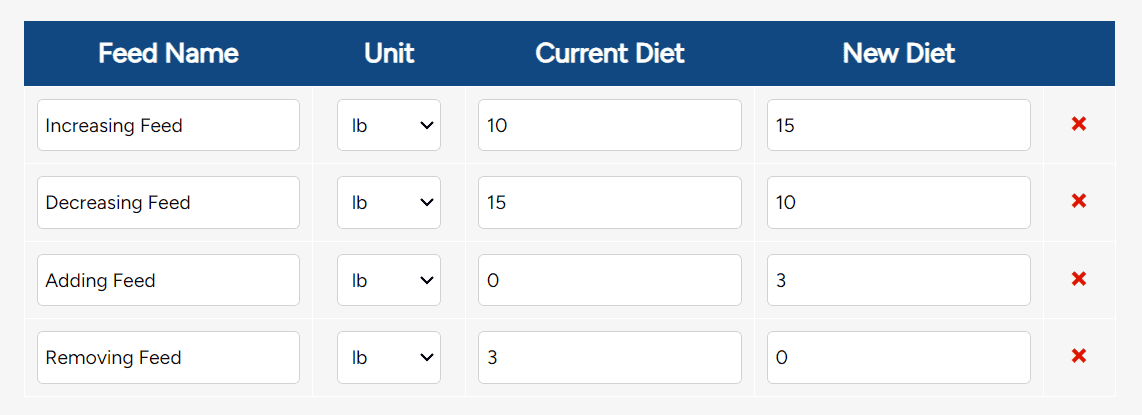 Example inputs for increasing, decreasing, adding, or removing feeds from the diet
Step 4: Check Units
There are several different units of measure available for you to use in the Equine Diet Transition Calculator. These include:
- Weight: Use units like lb (pounds), oz (ounces), kg (kilograms), and g (grams) for feeds and supplements that are weighed daily
- Volume: Use units like scoops, cups, tbsp (tablespoons), tsp (teaspoons), mL (milliliters), and oz (ounces) in cases where feeds are measured by volume rather than weight. For example, use ‘scoops’ if you are feeding a supplement that comes with a premeasured scoop in the bag
- Pasture time: While there are average estimates of the amount of pasture horses consume in an hour, it is quite difficult to determine the average hourly pasture intake for individual horses by weight. For this reason, we use hours to estimate the transition onto and off pasture
- Other: In some cases, feeds are fed based on more general or applicable units, like pumps of a liquid supplement that comes with a dosage pump, or flakes of hay if you are feeding a fixed amount of hay based on the average weight of each flake
If you don’t weigh your feed daily, consider calculating the unit you use for daily feeding, such as flakes of hay (based on the average weight of a flake), or scoops of feed (based on the average weight of a scoop of the feed).
For example, if you need to feed 20 lb of hay per day, you can use a handheld luggage scale and a hay net to weigh several flakes of hay and determine the average weight of each flake.
If each flake weighs roughly 5 lb, and you need to feed 20 lb of hay per day, then the final calculation is:
Similarly, if you need to feed 6 lb of a concentrate per day, you can use a handheld luggage scale and a feed bucket to weigh a scoop of feed and determine the weight of each scoop.
If each scoop weighs roughly 3 lb, and you need to feed 6 lb of feed per day, the final calculation is:
Step 5: Calculate & Save Your Plan
When you’re done entering your horse’s current and new diets, hit the “Calculate Transition” button. A schedule for your horse’s transition plan will populate below the calculator.
Check the plan to ensure it showing your original entries correctly, then click the “Print / Save as PDF” button below the transition table to save your plan. You can hang the printed plan in the feed room to use as a quick reference.
Implementation Tips
In practice, the transition table provided is a simple and easy tool to use. Here are some tips so you can put your diet transition plan into action successfully:
- Keep track: The schedule provides a timeline for the transition in days. Make note of the start dates of each transition diet on the page to keep your transition on schedule, particularly if other people are feeding your horse for you.
- Adjust for your facility: The values in the transition table are given to one decimal place in some cases. If your scale is not as precise, round up or down to a decimal place that your scale can accurately weigh.
Why Make Gradual Diet Transitions?
From coat quality and behavior to the gut microbiome and performance, diet changes impact the whole horse. Even short-term dietary changes can lead to observable systemic changes. [1]
Gradual transitions are crucial to minimize stress on the digestive system and ensure that nutrient delivery and energy utilization remain consistent during the adjustment period.
Digestive Health
Changes in the diet, whether forage or grain, lead to alternations in the hindgut microbiome. In other words, altering your horse’s diet can change the population of microbes in the hindgut, which are essential for breaking down fiber into usable energy and absorbing nutrients.
These changes tend to stabilize within a few days, which highlights how resilient the microbial population is. To maintain microbial health during transitions, it’s important to continue providing adequate forage. [2][3]
Changes in the microbial composition of the hindgut during large dietary transitions are often accompanied by fluctuations in hindgut pH, which may predispose horses to digestive issues like hindgut acidosis and laminitis. [4]
Abrupt, frequent, and poorly managed dietary changes may put horses at risk of digestive issues like colic. [5] By making smooth dietary transitions that support digestive health, you can significantly reduce the risk of life-threatening digestive disorders.
Metabolic Health
When the macronutrient composition of a horse’s diet changes significantly, metabolic adaptations occur to effectively process and use different nutrients.
For example, increasing fat in the diet triggers changes in digestive enzyme production and enhances the muscle’s ability to oxidize fat for energy. [6]
Dietary changes also lead to systemic changes such as alterations in acid-base balance. These changes can be both acute in response to eating a meal, as well as long-term as lasting adaptations to a new diet. [7]
Given the systemic metabolic changes that occur when adjusting the composition of the diet, it’s important to transition slowly to allow your horse’s system to adapt.
Palatability & Preferences
From a practical perspective, slow dietary changes reduce the risk of your horse refusing their feed due to an unexpected or unfamiliar new smell, composition, or texture.
Research shows horses demonstrate feed preferences according macronutrient composition, with one study showing they favor protein- and carbohydrate-rich diets over fat-rich diets. This preference was evident in short-term selection when they were given multiple options, and in overall consumption when fed a single diet for an extended period. [8]
This palatability preference extends to different forages as well, with horses showing a general preference for certain types of pasture and hay. These preferences can be observed between: [9][10][11][12][13][14]
- Different classes of hays, such as alfalfa versus grass hay
- Different types of pasture grasses
- Different types of grass hays
- Different types of legume hays
- Forages preserved by different methods, such as hay, haylage, or silage
Given that horses have fairly specific selection criteria for their meals, making slow transitions provides the best chance that your horse will willingly accept the necessary changes.
Forage Transitions
It’s commonly assumed that transitions between forages may not make as much of an impact as adding concentrate feeds, but forage changes often cause a significant shift in hindgut ecology, including the microbiome and moisture content of the digesta. To mitigate this, forage transitions should be made slowly and with care. [2]
Hay Transitions
Making hay transitions is a common occurrence in the equine world, whether it’s from one type of hay to another, or between different batches of hay. You may need to switch to new hay based on:
- Seasonal timing when new hay needs to be purchased
- Changes in your horse’s dietary requirements or workload
- Switching suppliers for better quality or availability
- Traveling or boarding at a new facility where different hay is provided
Transitioning between two different types of hay — such as from a grass hay to a legume hay — requires a slower adjustment period compared to switching between hays with similar nutrient profiles. Legume hays, like alfalfa, generally have higher protein and energy levels than grass hays, which means your horse’s digestive system and hindgut microbiome need extra time to adapt to these changes. In contrast, when moving between two similar grass hays, the nutrient differences are minimal, so a faster transition is usually acceptable.
Keep in mind, even if you’re transitioning between two very similar hays, there should still be an adaptation period. Due to differences in soil composition, growing conditions, harvest timing, drying methods, and storage conditions, each batch of hay can vary in several important ways, including nutrient content, pH, moisture, and other factors.
Allowing your horse time to adapt to these differences can prevent refusals and digestive upset. This transition period is especially important for horses with known digestive issues like Free Fecal Water Syndrome, chronic diarrhea, or a history of recurrent colic.
In some instances it can be difficult to transition between two types or batches of hay, such as when feeding from a round bale. To ease the change, introduce the new round bale before the current one is finished, and consider netting the horse’s favorite bale to slow consumption and allow for a gradual adjustment.
Ensure your horse is drinking enough water during a forage transition to support digestive function. Provide fresh, clean water and add at least 2 tablespoons of loose salt to their ration while providing free-choice loose salt. Increasing salt intake encourages your horse to drink more water.
Pasture Transitions
Transitioning on and off pasture is a common routine across North American horse farms where grass dies off in the winter and rebounds in the spring. It’s also not uncommon for horse owners’ management routines to change over the seasons, allowing for increased or reduced pasture access independent of the growing season.
For horses transitioning onto pasture from a hay-based diet, the transition must be slow and carefully managed. This is because the transition to pasture causes changes in digestive processes and the hindgut’s microbial populations. [3][15]
Pasture is also typically more nutrient-rich than hay, leading to increased nutrient intake. For this reason, it’s important to keep an eye on your horse’s body condition when introducing pasture to their diet.
If you notice your horse is gaining too much weight, you can use a muzzle while they are out to pasture. You can also consider adjusting other areas of their diet, such as:
- Reducing or removing concentrates
- Reducing the quality or quantity of hay they receive when they’re not on pasture
- Removing energy-dense supplements from their diet
In some cases, horses may continue gaining weight despite muzzling and other dietary adjustments. In these cases, it may be necessary to limit the amount of time your horse has access to pasture and house them on a dry lot with hay.
In addition to calorie considerations, the hydrolyzable carbohydrate (HC) content of pasture is typically higher than hay and can vary from during the course of a day and from day-to-day. This can make pasture a difficult source of forage to incorporate for horses with metabolic concerns such as insulin resistance.
If your horse has metabolic issues and is transitioning onto pasture, consult with your veterinarian and an equine nutritionist to determine the safest way to incorporate pasture into their diet.
When transitioning off pasture, it’s equally as important to consider the likely reduction in calorie and moisture content of the diet. Keep an eye on your horse’s body condition during this transition to ensure they are not losing body condition.
If your horse needs more calories in the absence of pasture, consider interventions like adding fat- or fiber-rich energy supplements, or incorporating more nutrient-dense hays like alfalfa into their diet.
Feed Transitions
The length of time required for feed transitions depends on both the degree of difference between the new and current feeds and any changes in the daily amount offered.
When switching between similar feeds, such as two ration balancers with nearly identical feeding rates and macronutrient profiles, the transition period can be relatively short.
The length of time required to transition from one feed to another may be longer if:
- The feeding rates are substantially different, such as from a complete feed to a ration balancer
- The macronutrient content is substantially different, such as from a maintenance feed to a performance feed
Major shifts in the nutrient composition of the diet, such as increasing the fat content, should be made slowly, as horses require time for their digestive and metabolic processes to adapt and properly process their new diet. [6]
Transitioning to a Higher Grain Diet
When transitioning a horse from a forage-based diet to one that incorporates grain, the overall nutritional composition of the diet can change significantly, especially when adding feed at the manufacturer’s full recommended feeding rate. [4][16] This makes it critical it essential to introduce the new feed gradually.
A common recommendation is to add or replace one pound of feed every 3 to 5 days to allow the digestive system to adjust. You can contact an equine nutritionist for help developing the best transition schedule for your horse’s new diet.
Transitioning to a Forage-Based Diet
Switching from a grain-based diet to one that is predominantly forage-based is generally less disruptive because it more closely mimics a horse’s natural grazing behavior. However, even when grain is removed, the change still alters the microbial balance in the hindgut, and so it should be made slowly.
Additionally, a slow transition helps ensure that there are no significant, unintended changes in the horse’s body condition, such as unexpected weight loss or gain. Keeping a close eye on your horse’s condition can prevent unexpected changes in body weight.
Seasonal or Temporary Diet Transitions
Although we aim to keep horses on a fairly consistent diet to support digestive health, there are several cases where temporary changes may be necessary to address health concerns or changing needs. These may include diets geared toward:
- Competition season
- Pregnancy and lactation
- Weaning and growth diets
- Lay-ups
- Weight loss
- Weight gain
- Stall rest
Even with temporary diet changes, a slow transition is still advisable. The duration of the transition for these temporary diets can vary significantly, largely depending on the nature of the planned diet change.
The timing of temporary changes is one of the biggest factors to consider. Planning changes in advance simplifies the process. Consider these starting points for dietary transitions if you know your horse’s diet will need adjustments in the future:
- Competition season: Begin making slow dietary transitions for the competition season in advance as your horse’s workload changes, rather than in response to less-than-ideal body condition. If your horse needs to lose condition at the end of the competition season, consider reducing their calorie intake before the end of the season to improve results.
- Pregnancy and lactation: Pregnant and lactating mares’ calorie and nutrient needs change as they progress through motherhood. The best way to support health for dam and foal is by having a plan in place early, and make the transition slowly to ensure their needs are met at each stage.
- Weaning: The transition to weaning can be eased using a creep feeding diet, as well as by implementing management strategies to ease the social transition and encourage the growing foal to consume their meals.
If you’re unsure of when, how, or how long to transition your horse to a new diet, contact a professional equine nutritionist for assistance in formulating the best transition plan for your horse.
References
- West. A. G. et al., Short‐term Diet Changes Revealed Using Stable Carbon Isotopes in Horse Tail‐hair. Functional Ecology. 2004.
- Fernandes. K. A. et al., Resilience of Faecal Microbiota in Stabled Thoroughbred Horses Following Abrupt Dietary Transition between Freshly Cut Pasture and Three Forage-Based Diets. Animals. MDPI. 2021.
- Fernandes. K. A. et al., Faecal Microbiota of Forage-Fed Horses in New Zealand and the Population Dynamics of Microbial Communities Following Dietary Change. PloS one. Public Library of Science San Francisco, USA. 2014.
- van den Berg. M. et al., Fecal pH and Microbial Populations in Thoroughbred Horses during Transition from Pasture to Concentrate Feeding. Journal of Equine Veterinary Science. Elsevier. 2013.
- Geor. R. J. et al., Equine Applied and Clinical Nutrition: Health, Welfare and Performance. Elsevier Health Sciences. 2013.
- Orme. C. E. et al., Metabolic Adaptation to a Fat-Supplemented Diet by the Thoroughbred Horse. British Journal of Nutrition. Cambridge University Press. 1997.
- Waller. A. et al., Effects of Diet, Feeding and Daily Variation on Acid–Base Balance in Horses. Equine and Comparative Exercise Physiology. Cambridge University Press. 2004.
- Redgate. S. E. et al., Dietary Experience Modifies Horses’ Feeding Behavior and Selection Patterns of Three Macronutrient Rich Diets. Journal of Animal Science. Oxford University Press. 2014.
- López. C. L. et al., Diet Selection and Performance of Horses Grazing on Different Heathland Types. animal. Cambridge University Press. 2017. View Summary
- Holzer. S. et al., Hay Preferences in Horses versus Selection by Their Owners. Livestock Science. Elsevier. 2022.
- Vasco. A. C. C. et al., Feeding Behavior and Preference of Horses Fed Rhizoma Peanut Hay. Journal of Veterinary Behavior. Elsevier. 2022.
- Allen. E. et al., Forage Nutritive Value and Preference of Cool‐season Grasses under Horse Grazing. Agronomy Journal. Wiley Online Library. 2013.
- Müller. C. E. and Udén. P., Preference of Horses for Grass Conserved as Hay, Haylage or Silage. Animal feed science and technology. Elsevier. 2007.
- LaCasha. P. A. et al., Voluntary Intake, Digestibility, and Subsequent Selection of Matua Bromegrass, Coastal Bermudagrass, and Alfalfa Hays by Yearling Horses. Journal of animal science. Oxford University Press. 1999.
- Fernandes. K. A. et al., Comparison of Gastrointestinal Transit Times in Stabled Thoroughbred Horses Fed Freshly Cut Pasture and Three Conserved Forage-Based Diets. Animal Production Science. CSIRO Publishing. 2021.
- Willard. J. G. et al., Effect of Diet on Cecal pH and Feeding Behavior of Horses. Journal of animal science. Oxford University Press. 1977. View Summary















