English








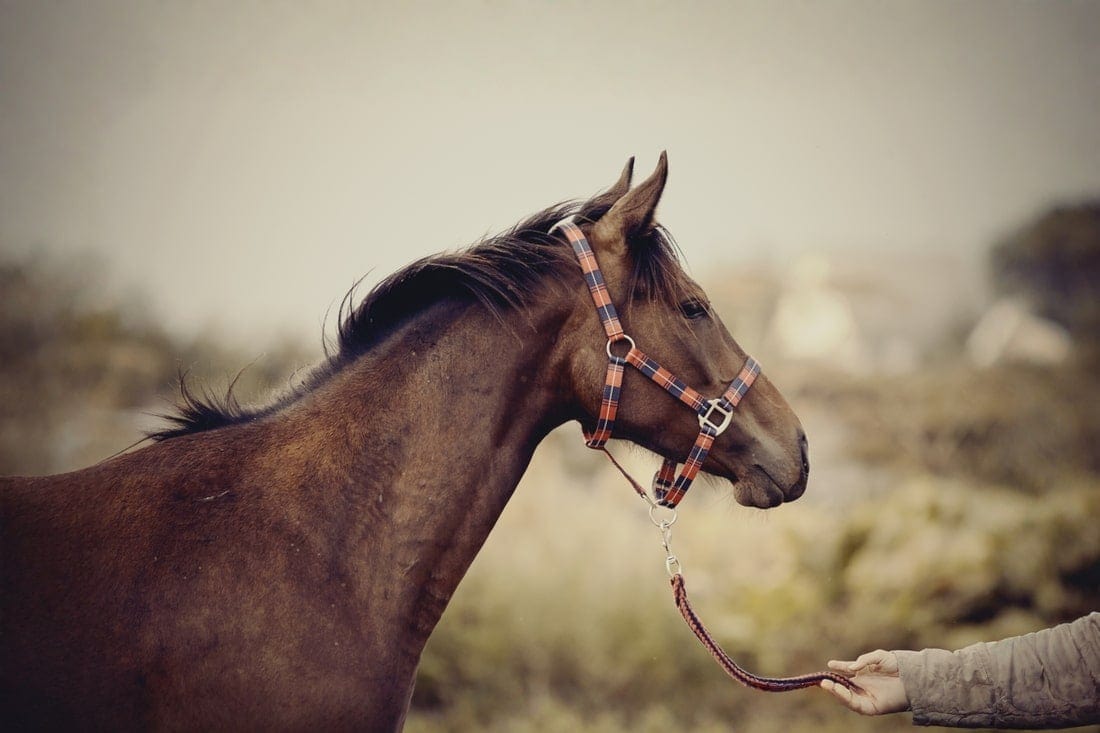
Halters are key pieces of equipment used to guide and secure horses safely from the ground. By applying light directional pressure to a horse’s head, handlers can influence direction and momentum during grooming, tying, loading, and other routine tasks.
Halters appear in every equine environment, from pleasure barns to competitive programs, with styles suited to each discipline’s preferences. Similar to bridles, halters are built from straps that sit around a horse’s poll, cheeks, and nose. Common materials include rope, nylon, and leather.
A properly adjusted halter stays centered on the horse’s head, minimizing rubbing and allowing handlers to deliver clear cues. Fit matters more than material or style since there is little practical difference among halter types, but a poor fit can create discomfort and increase the risk of injury.
With regular cleaning and inspection, halters remain a dependable tool for everyday handling. This overview outlines their construction and function, along with key safety considerations to keep in mind during use.
How Halters for Horses Work
Halters are pieces of tack worn on a horse’s head and muzzle, allowing handlers to guide movement from the ground by applying and releasing pressure.
When a lead rope is engaged, the halter shifts against specific points on the horse’s head, prompting the animal to follow or yield accordingly. This offers a clear way to communicate direction and intent without using a bit or acting on sensitive tissues inside the mouth. [1][2]
During early groundwork, halters provide the framework for introducing young horses to cues. They support lessons in yielding, standing quietly, and moving with a handler, all of which build confidence and responsiveness. [1][2]
As horses mature, halters transition from a training tool into a practical part of everyday handling. They enable controlled movement during routine tasks such as grooming, entering and exiting stalls, veterinary procedures, and farrier appointments.
They also offer a safe, stable connection point during tying and transport, when sudden movement or confined spaces increase injury risk. [1][2][3]
Halter Components
Halters are constructed of multiple straps and connecting hardware that distribute pressure, maintain alignment, and support reliable handling. Understanding how these components function makes it easier to adjust and use a halter effectively.
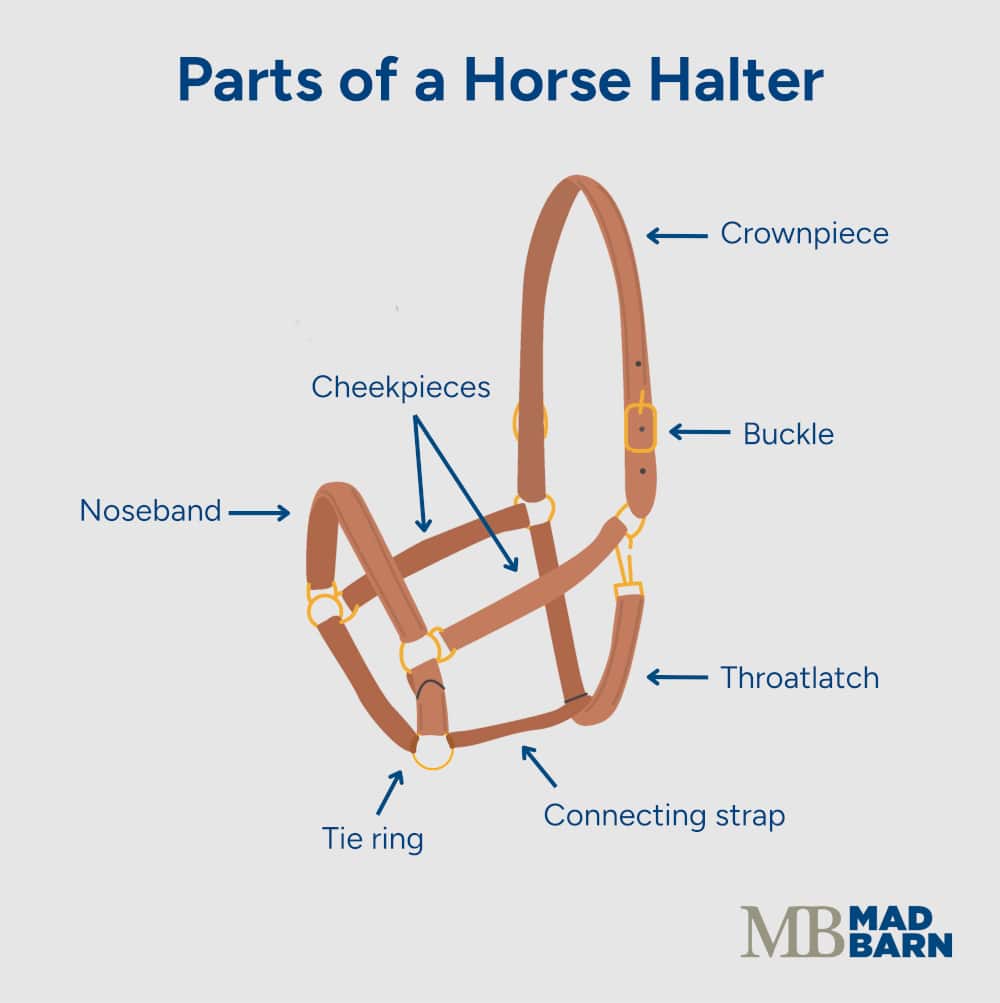
The basic components of most halters include:
- Crownpiece: Sits behind the horse’s ears and anchors the halter’s overall position. Crownpieces connect to cheekpieces and the throatlatch through metal rings, distributing pressure evenly. This piece can be adjusted with a buckle to ensure that the halter remains centered without sliding to either side.
- Cheekpieces: Run along both sides of the horse’s face, linking the crownpiece and throatlatch to the noseband. Their placement helps prevent twisting and ensures tension is spread consistently across the halter.
- Connecting Strap: Sits beneath a horse’s jaw, acting as a stabilizing support. Links the throatlatch to the noseband through the tie ring, preventing collapse or distortion when pressure is applied.
- Noseband: Encircles the horse’s nose and attaches to the cheekpieces and connecting strap. Provides the primary point of pressure during handling, influencing how a horse responds to guidance on the lead rope. Proper fit ensures the noseband remains effective without pinching or shifting during use.
- Throatlatch: Runs beneath the jaw along the natural curve of the throat, securing the halter against slipping. Connects to both sides of the crownpiece and joins the cheekpieces and connecting strap to create a complete frame. Its fit influences how well the halter stays in place during movement.
- Tie Ring: Sits at the bottom of the noseband and connects to the linking straps above it. This metal ring serves as the attachment point for lead ropes, shanks, or lunge lines during handling.
What's your top priority with your horse's health?

Enter your email to receive your store credit
Halter Size & Fit
Proper halter fit begins with selecting a size appropriate to the horse’s age and overall build, then adjusting the straps so the halter sits securely without causing discomfort. [2]
Ill-fitting halters can make leading cues unclear, making it harder for horses to understand directional signals from the handler. Poorly fit halters can also shift and rub across a horse’s face, or apply pressure in the wrong places, contributing to irritation and stress-related behaviors. [3]
Each part of a halter has a different effect on its balance, stability, and overall function during handling.
Table 1. How halter components influence fit [1] [2]
| Component | What it Controls | Fit Impact |
|---|---|---|
| Crownpiece buckle | Adjusts how high or low the noseband sits on the face. | Changes overall pressure distribution across the poll, cheeks, and nose. |
| Noseband | Stabilizes the muzzle area and supports the cheekpieces. | Influences how steadily the halter stays positioned during leading or tying. |
| Adjustable noseband and connecting straps | Allow the halter to conform more closely to facial structure. | Affects how evenly pressure spreads across the face. |
| Adjustable throatlatch | Controls how the halter sits beneath the jaw. | Affects freedom of movement when lowering or turning the head. |
How to Test Fit
A well-adjusted halter allows two stacked fingers between the noseband or connecting strap and the horse’s face. Metal buckles should also leave roughly two fingers’ clearance to prevent pinching or rubbing. [1]
Throatlatches typically require about four fingers’ space between the strap and the neck. When the horse lowers its head, the strap beneath the jaw should not press into the throat, indicating the throatlatch is set correctly. [1]
When fitting a halter, always attach a lead rope to the tie ring and hold it firmly to prevent the horse from stepping away. This helps to ensure that the process is safe and controlled. [4]
Common Mistakes
Poor halter fit often leads to difficulties that show in everyday handling. A noseband placed too high on a horse’s face can lead to irritation, whereas setting it too low risks slipping off or interfering with the horse’s breathing. [2]
Meanwhile, halters that are too tight may create pressure points that trigger discomfort or anxious behavior, while one that hangs too loose can shift, rub, and prompt persistent scratching at irritated areas. [3]
How to Use a Horse Halter
Different makes and models of halters may have slightly different designs, but the basic steps of putting one on your horse are the same in most contexts.
Follow these steps to place a halter: [4]
- Lift the crownpiece over the horse’s head
- Guide the throatlatch under the jaw
- Slide the noseband over the muzzle
- Align the cheekpieces and connecting strap
- Adjust the buckles to fit
When switching from a bridle to a halter after riding, buckle the halter loosely around the horse’s neck first to maintain control before removing the bridle. [4]
Halter Maintenance & Care
Proper halter care is essential for ensuring longevity and reliability. Halters can accumulate dirt, sweat, and moisture, especially with outdoor use, and regular cleaning is key to maintaining both appearance and functionality.
For leather halters, wipe with a damp cloth to remove dirt and sweat. For deeper cleaning, apply a leather conditioner to keep the material supple and prevent cracking.
Nylon and rope halters can be washed by hand or in a washing machine (in a mesh bag) to eliminate dirt, sweat, and other residues. Be sure to hang them to dry completely before storing to minimize odor build-up.
Storing Halters
Store halters in a dry, accessible location, ensuring they are completely dry before storage to prevent mildew or damage.
For emergency situations, such as fires or evacuations, it’s important to have clearly labeled halters and lead ropes readily available. Organizing this equipment in advance helps ensure quick access, allowing handlers to move horses safely and efficiently.
Keeping a spare halter and lead rope in the barn’s emergency first aid kit is also a practical precaution. [2][3]
Halter Uses & Benefits
Handlers use halters to control horses at close range, as holding the halter provides direct influence over a horse’s head. Lead ropes clipped to the halter’s tie ring extend that control through light pressure and guiding cues during handling. The same tie ring functions as an attachment point for securing horses to posts, rails, or other solid fixtures.
In training, halters and lead ropes provide a clear connection for teaching groundwork cues. They help horses learn to stand still for grooming and hoof care, as well as skills like stopping, backing up, and yielding to direction.
Lunge lines can also be attached to the halter when working horses in circles or other patterns, promoting calm, responsive behavior during training. [4]
Halters also play a role when presenting horses in-hand at shows, where both appearance and function are important. A clean, well-fitted halter helps judges assess the horse’s balance and overall presentation.
Choosing the right style for the discipline or type of show ensures a polished, professional look, while a worn or poorly adjusted halter can distract from the horse’s conformation and leave a less favorable impression. [4]
Halter Action & Severity
A halter’s action refers to how it applies pressure on a horse’s head when in use. [1] Halters typically make contact at a horse’s nose, chin or jaw, poll, and cheeks.
The placement and rigidity of the nosebands, knots, and side rings influence how quickly a halter engages, the amount of pressure it creates, and how easily pressure releases when slack is offered.
Rope halters use thinner material that concentrates pressure more narrowly, creating clearer- though potentially sharper- signals. Flat nylon and leather halters provide broader pressure distribution.
While these differences may affect how cues feel, horses generally respond similarly to both types, making either option suitable for most groundwork situations. [5]

Safety Considerations
Halters are essential for handling horses, but accidents can happen if they are not properly fitted or managed.
Risks range from minor annoyances, such as jewelry catching on halter straps, to a risk of serious injury resulting from improper fit. Proper adjustment and supervision are crucial to ensuring both horse and handler safety.
Leather halters, if left untreated, can shrink when exposed to moisture, causing discomfort and irritation. Conversely, halters that are too loose may shift or rub against a horse’s face, leading to irritation and itching.
This discomfort can lead to horses rubbing against objects or using their hooves to scratch their face, which may result in their halter catching on objects or hooves. Horses with caught halters risk injuring themselves as they struggle to free themselves, or if they fall.
To minimize these risks, halters should always be fitted correctly, and horses should never be left unattended while wearing them for extended periods of time.
For horses that must be left unsupervised, breakaway halters (with a twine breakaway strap) provide added protection by releasing under pressure. [3]
Frequently Asked Questions
Here are some frequently asked questions about halters for horses:
Halters are designed for groundwork rather than riding because they do not offer the control, precision, or stability that a bridle and bit provide. Mounted work generally relies on a bridle that distributes pressure more effectively and provides better communication between horse and rider.
A properly fitted halter should sit roughly two inches below the bony point of the cheek without sliding or restricting the horse's breathing. You should be able to slip two fingers under the noseband and connecting strap, and four fingers beneath the throatlatch to confirm comfort and security.
Halters are most commonly constructed from nylon, rope, or leather, and some styles include reinforced webbing for added durability. Hardware such as buckles and tie rings is typically made from smooth, heavy metal to withstand pressure and limit irritation against the horse's skin.
Leaving a halter on an unsupervised horse poses safety risks because the horse may snag the halter on fences, posts, or even a hoof. If a halter must remain on temporarily, breakaway options reduce danger, but removing the halter entirely is the safest choice for turnout or extended unsupervised periods.
Summary
Halters provide a means of safe, practical control for handling and leading horses from the ground. Good fit and proper use support comfort, prevent irritation, and reduce risk during training, tying, transport, and emergencies. Materials, design, and breakaway features influence safety, while calm handling helps avoid spooking or injury.
- Halters offer safe, direct control for groundwork, allowing handlers to guide direction and momentum without acting on sensitive mouth tissues
- Core components such as the crownpiece, cheekpieces, noseband, and throatlatch work together to stabilize the halter and distribute pressure evenly
- Correct sizing and adjustment prevent rubbing, unclear cues, pressure points, and entanglement, supporting clearer communication and horse comfort
- Breakaway designs, proper supervision, and routine inspection reduce injury risk during tying, turnout, emergencies, and other situations where horses may snag equipment
References
- Andrews. T. et al. Horse Reference Manual . 4H Alberta. 2015.
- The 4-H Horse Project. OSU Extension Service. 2024.
- Moffitt. D. 4AF-05MA: Basic Horse Safety Manual. Cooperative Extension Service. University of Kentucky. 1989.
- Swinker. A. M. and Cecil. C. 4-H Horse Project. MA1500F Member's Manual. Colorado State University Extension. 2018.
- McDonald. B. J. and Warren-Smith. A. A Preliminary investigation into the effectiveness of different halter types used on horses. ISES. 2008.