English

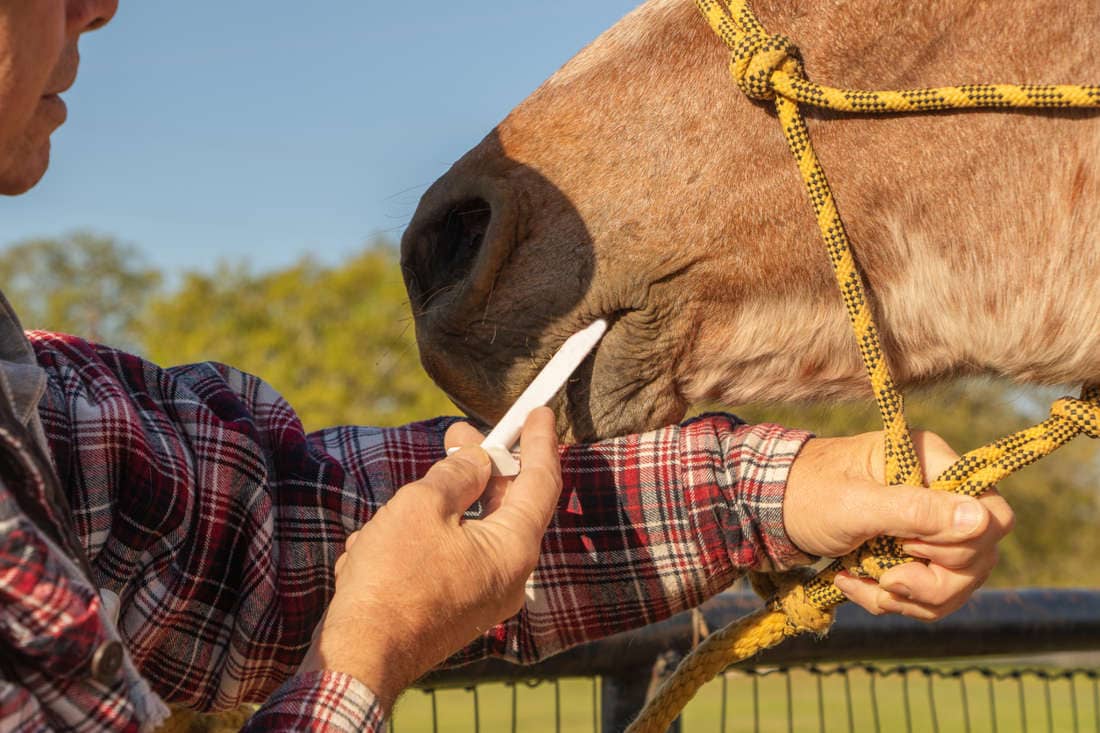
Administering oral medication is a routine part of horse care, but it isn’t always straightforward. Many treatments for conditions such as gastric ulcers, infections, respiratory disease, or parasite control are delivered as liquids, tablets, or powders.
While the instructions for these products often appear simple, horses tend to resist unfamiliar tastes, altered feed textures, or handling around the head, turning a simple task into a frustrating challenge.
Like other types of horse training, using forceful methods to administer medications are rarely safe or effective. Attempting to restrain or overpower a horse can increase stress and create negative associations that make future treatments more difficult.
Successful medication delivery depends on preparation, calm handling, and choosing the method that best suits the individual horse. This guide explains why horses refuse oral medication and provides practical strategies for administering liquids, tablets, and powders safely while ensuring the full prescribed dose is delivered.
Why Horses Refuse Medicine
Every owner is familiar with the challenge of giving oral medication to horses. Dropped pills, spit out liquid formulations, and outright refusals commonly make the experience stressful for horse and handler alike.
Before trying to decide if changing tactics might be more successful, it helps to understand why horses are resistant to taking medications in the first place.
Selective Feeding Behavior
Horses exhibit selective feeding behavior shaped by evolutionary pressures. As grazing prey animals, they have evolved to detect and avoid potentially toxic plants.
They use their highly developed senses of smell and taste to browse for safe plants while leaving undesirable forages behind. This sensory sensitivity makes them highly attuned to changes in taste, smell, and texture. [1]
Horses carry this adaptation to all feeding contexts, including domestic rations that are disguising medications. Even minor alterations in smell, flavor, texture or presentation of feed may be interpreted as unfamiliar and potentially unsafe, and the horse may leave the medication behind or refuse the feed altogether.
Negative Handling Experiences
A horse’s response to oral medication is often influenced by previous handling experiences.
Horses that have been restrained forcefully, startled during dosing, or experienced discomfort from equipment such as dosing syringes or balling guns may develop conditioned avoidance responses. Over time, the presence of medication equipment alone can become associated with these past experiences. [1][2][3]
Behaviors such as raising the head, tightening the lips, clamping the jaw, or stepping backward may occur before physical contact is made. These reactions are commonly interpreted as resistance but may actually reflect learned behavior responses that horses use to avoid negative experiences associated with pervious handling practices.
Pain or Underlying Medical Conditions
Sometimes horses refuse medications because they have undetected mouth pain. Dental disease, sharp enamel points, oral lesions, tongue injuries, or temporomandibular joint pain can make oral manipulation uncomfortable or painful.
In such cases, resistance may represent an attempt to avoid discomfort rather than a behavioral issue. [1][2][3]
A horse who has historically accepted medication but begins to show signs of resistance warrants careful reassessment. Sudden changes in behavior can serve as early indicators of an underlying medical issue and veterinary evaluation may be appropriate before attempting to modify training or handling techniques.
Stress
Horses are highly sensitive to changes in their physical and social environment, and stress has a measurable impact on appetite and feeding patterns. Stress can also heighten vigilance, increase reactivity, and reduce a horse’s willingness to cooperate with handling procedures. [4]
A horse experiencing social or environmental instability may be less tolerant of altered feed texture, unusual odors, or close contact around the head. Addressing underlying stressors often improves compliance more effectively than changing flavoring or dosing technique alone. [4][5]
What's your top priority with your horse's health?

Enter your email to receive your store credit
Preparation Tips for Giving Oral Medication to Horses
Taste, prior experiences, pain, and temperament are not always within a caregiver’s immediate control, but organization, timing, environment, and technique are.
Adequate preparation reduces unnecessary stress and increases the likelihood of a smooth administration process.
Key items to prepare before administering medications include:
- Desensitize the horse: Basic training for horses should include desensitization to routine medical handling and procedures. Introduce your horse to oral syringes and balling guns without medications as part of basic handling practice, and keep exposing them to these tools consistently so they are less sensitive overall.
- Read the label: Even when giving the same medication daily, it’s essential to read the label and verify you have the correct medication and dosage every time you administer a dose. Always follow the label instructions exactly and contact your veterinarian if you are unsure.
- Verify restrictions: Confirm you are able to administer the medication using your preferred method. For example, if the medication must be given on an empty stomach, then mixing it with feed is not a viable option. Work with your veterinarian if you need a specific type of formulation to succeed at dosing your horse.
- Gather supplies: Organize all equipment in advance to ensure the process is smooth and efficient. Equipment may include syringes, a balling gun, a measured feed portion, water, etc.
- Choose a quiet environment: Whenever possible, try to dose your horse in a calm, familiar place. Give them time to settle in before moving ahead with dosing.
Much like under saddle work, using clear cues, calm repetition, and consistency is more effective than force. If difficulties arise, consult your veterinarian to discuss alternative formulations or administration methods.
How to Give a Horse Liquid Medicine With a Syringe
Liquid medication delivered by oral syringe is one of the most reliable methods of ensuring a horse receives the full prescribed dose. Unlike feed-based approaches, syringe administration reduces uncertainty about intake.
When performed correctly, this method is efficient, precise, and generally well-tolerated. However, improper technique can lead to spitting, the risk of aspiration, or escalating resistance. Calm handling, correct positioning, and steady delivery are essential for success.
Supplies Needed
Before approaching the horse, all equipment should be prepared and within reach. This reduces delays and prevents unnecessary handling once the process begins. [6][7][8]
Essential supplies include:
- An oral dosing syringe
- The prescribed liquid medication
- A well-fitted halter and lead rope
- Clean water for rinsing if required
- Gloves if handling irritating or staining substances
The syringe should be checked in advance to ensure smooth plunger movement. The dose must be measured precisely according to veterinary instructions. Estimation or partial filling increases the risk of incorrect dosing.
If the horse is inexperienced or reactive, a competent assistant may be helpful, although calm, confident solo handling is often preferable to avoid crowding the head.
Step-by-Step Instructions
- Position the horse in a quiet area with minimal distractions. If the horse is particularly reactive, you may want to place them in cross-ties, but that can also increase the horse’s stress level and is generally discouraged for safety reasons.
- Stand at the side of the horse’s head, facing slightly toward the shoulder rather than directly in front.
- Hold the horse’s halter with your non-dominant hand. Hold the syringe in your dominant hand and gently insert the tip into the interdental space between the horse’s incisors and molars.
- Gently advance the syringe toward the back of the tongue, keeping movements controlled and deliberate.
- Depress the plunger slowly and steadily, keeping a steady hand on the halter. Avoid rapid delivery.
- Maintain the horse’s head in a neutral or slightly elevated position for several seconds to allow swallowing. Observe for swallowing movements before lowering the head fully.
Slow administration reduces the likelihood of dribbling or expulsion. Excessively elevating the head is unnecessary and may increase stress.
Common Mistakes to Avoid
Oral syringes are a mainstay in equine medicine, but even experienced handlers can make errors.
Try to avoid the following when dosing liquid medications:
- Inserting the syringe between the front teeth. This often results in the horse clamping down or throwing its head. The natural gap behind the incisors should always be used.
- Administering the medication too quickly. Rapid delivery overwhelms the swallowing reflex and increases the risk of the horse spitting out or allowing medication to spill from the mouth.
- Standing directly in front of the horse. This places the handler at risk if the horse tosses its head. Safe lateral positioning is essential.
What to Do if Your Horse Resists Syringes
Resistance to syringes frequently stems from previous negative experiences. Desensitization is often effective.
Using learning theory principles like combined reinforcement, may eventually help your horse understand the procedure and build trust with the handler. For example, an empty syringe may be introduced during grooming sessions while observing the horses behavioral responses.
When the horse demonstrates a desirable behavior (e.g., standing with their head and neck in a neutral position during syringe presentation), the handler can reinforce the behavior with a treat or scratch and remove the syringe from sight or physical contact.
Maintaining calm body language is critical. Horses are highly sensitive to tension in posture, breathing, and hand pressure. A structured, predictable routine reduces anxiety.
If resistance remains severe despite gradual retraining, veterinary consultation may be necessary to explore alternative formulations.
How to Give Pills to a Horse
Tablet medications are commonly prescribed for gastric conditions, metabolic disorders, pain management, and certain infections. Compared to liquid formulations, pills are stable, portable, and often easier to store. However, successful administration depends on correct technique and careful observation.
Placement, taste, and prior experience all influence whether the tablet is accepted or rejected. Before administering any pill, confirm the exact dose and clarify whether the medication may be crushed, dissolved, or must be given whole.
Monitoring the horse during and after administration is essential to ensure the full dose is delivered. [7][9]
Can Horses Swallow Pills Whole?
Horses are physically capable of swallowing pills whole. However, achieving this is challenging, and correct placement is critical. Tablets placed too far forward in the mouth are often chewed, dropped, or expelled.
To be swallowed successfully, the pill must be positioned toward the back of the tongue, where it can trigger a normal swallowing reflex.
Some horses accept whole tablets readily, particularly if they are accustomed to oral handling. Others may resist due to taste or texture. Large tablets or those with a strong odor are more likely to be rejected.
Always confirm with a veterinarian that the specific medication is suitable for whole administration, as some pills are designed to be altered while others must remain intact.
Ways to Administer Pills
The most appropriate method for giving pills to a horse depends on the horse’s temperament, appetite, and previous handling experiences. Below are the most common methods for administering solid oral medications.
Hidden in Treats or Feed
For horses with a strong appetite and minimal suspicion of altered feed, hiding pills can be effective. Tablets may be concealed in a small portion of soaked beet pulp, mash, applesauce, mashed banana, or a commercially designed medication treat. [9][10]
Moist carriers help mask taste and prevent tablets from rolling out of the feed. It can be helpful to begin with a small portion of feed instead of immediately mixing the pill into the full ration.
Offering a limited amount makes it easier to confirm that the entire dose has been consumed before additional unmedicated feed is provided. Close observation remains important, as some horses will selectively sort through their feed and may, if given the opportunity, leave the tablet behind. [9][10]
Using a Pill Popper
A pill popper or balling gun allows direct placement of the tablet at the back of the tongue. The device is inserted gently into the interdental space between the incisors and molars and maneuvered toward the rear of the mouth. [9][10]
Once positioned correctly, the plunger releases the tablet. After delivery, the horse’s head is held in a neutral position with the head extended for a few seconds to encourage swallowing.
Proper technique reduces the risk of the pill being expelled. Standing safely to the side of the head and working calmly improves compliance. [9][10]
Crushing Pills
Some tablets may be crushed and mixed into feed or dissolved in water, which can simplify administration. However, crushing tablets should only be considered if a veterinarian has confirmed that the medication can be safely altered.
While crushing and mixing a pill into feed or dissolving it in water may simplify administration, not all formulations are suitable for this approach.
Extended-release, coated, or specially engineered tablets rely on their intact structure to deliver the drug correctly. Altering them can reduce effectiveness, increase the risk of side effects, or irritate the mouth and gastrointestinal tract.
What to Do If Your Horse Spits the Pill Out
Spitting often reflects a technical or behavioral issue and incorrect placement too far forward in the mouth is a common cause.
If a horse spits out the tablet, the first step is to determine whether any part of the dose has already been swallowed. Careful observation is essential. Replace only the portion that was clearly expelled.
Repeating a full dose without confirming intake increases the risk of accidental overdose, particularly with drugs that have narrow safety margins or cumulative effects.
It’s important to remain calm if your horse is having difficulty taking medication. Resistance usually signals discomfort, confusion, taste aversion, or anxiety. Escalating pressure or using force can intensify avoidance and make ongoing use of medication even more challenging.
Work with your veterinarian if you are unable to ensure your horse is receiving all of their medication. There may be another underlying health issue contributing to discomfort, or your veterinarian may be able to offer an alternate formulation for the medication.
How to Get a Horse to Eat Powdered Medicine
Powdered medications are widely used in equine practice. They are easy to measure, convenient for long-term use, and often more economical than liquid alternatives. Despite these advantages, powdered formulations are frequently the most challenging to administer.
Powdered medication changes the sensory profile of feed. Many drugs have a naturally bitter taste or strong odor that horses detect immediately. Texture also plays a role. Fine powder may coat feed particles unevenly or settle at the bottom of the bucket. [7][10]
Horses commonly sort through their ration, consuming preferred components while leaving medicated residue behind. Dry feeds make powder more noticeable, increasing the likelihood of rejection. [7][10]
Successful administration requires understanding why powder is often rejected and applying deliberate mixing and monitoring strategies to ensure complete consumption.
Mix into Palatable Feed
Thorough mixing is essential. Powder should not be sprinkled loosely on top of dry feed. Instead, it should be incorporated into a moist base that binds particles evenly. Soaked beet pulp, dampened pellets, mash, or chaff lightly moistened with water can improve distribution.
Flavored carriers such as applesauce may help mask bitterness and improve acceptance. Molasses is sometimes used for this purpose, but it should be approached cautiously. In addition to increased sugar intake, molasses contains relatively high potassium levels and may interfere with absorption of certain medications. [9]
As with pills, use a small portion of feed to disguise the medication rather than a full ration. This allows the handler to confirm the medicated portion has been consumed before additional feed is offered.
Ensure the Full Dose is Consumed
Observation is important when feeding medication in a horse’s supplementary grain or ration. The handler should remain nearby while the horse eats the medicated portion to confirm that the entire dose is consumed.
After the horse finishes, inspect the bucket for any remaining residue along the bottom or sides. Powdered medications often settle and may appear as a fine layer if they are not fully eaten. If residue remains, adding a small amount of water to create a slurry and offering it again can help ensure the horse receives the complete dose.
Accurate dosing is especially important with antibiotics, anti-ulcer medications, and drugs requiring consistent blood levels. Partial consumption can compromise treatment effectiveness and, in some cases, contribute to drug resistance.

What to Do if Your Horse is Refusing Powdered Medication
If the horse repeatedly refuses powdered medication despite careful mixing, discuss options for alternative formulations with your veterinarian. Liquid versions, tablets, or compounded flavored preparations may be available.
In some cases, syringe administration provides more reliable delivery than feed-based methods. The goal is consistent, complete dosing delivered safely and with minimal stress. If refusal persists, reassessment of taste, technique, and overall management is warranted to protect both treatment outcomes and welfare.
Table 1. Pros and cons of different oral medication delivery methods for horses
| Medication Form | Pros | Cons |
|---|---|---|
| Liquid (Syringe) |
|
|
| Pills / Tablets |
|
|
| Powder |
|
|
What if My Horse Refuses All Medicine?
Occasionally, a horse resists all oral administration methods. Liquid is spat out, pills are expelled, and medicated feed is refused entirely. In these situations, the priority shifts from simply delivering the drug to understanding why refusal is occurring. Escalating pressure on the horse to cooperate rarely improves compliance and often intensifies resistance.
The first step is to rule out physical causes. Oral pain, dental abnormalities, sharp enamel points, tongue lesions, ulcers, or temporomandibular joint discomfort can make any manipulation of the mouth unpleasant. A veterinary examination may be necessary if resistance appears sudden or disproportionate.
Next, consider appetite and overall well being. Horses that are in pain, stressed, isolated, or have been recently transported may eat less than normal. Reduced feed intake alone can make medicated feed impractical. Addressing hydration, pain control, and environmental stressors may indirectly improve medication acceptance.
Behavioral history also plays a role. A horse that has experienced forceful restraint or repeated negative dosing attempts may associate medication equipment with discomfort. In such cases, desensitisation and gradual retraining may be required. Introducing equipment without medication, rewarding calm responses, and rebuilding predictability can restore trust over time.
If oral administration remains unreliable despite careful technique and environmental adjustments, alternative strategies should be discussed with a veterinarian. Injectable formulations, compounded flavoured preparations, or professional assistance may be appropriate. In some cases, short-term veterinary administration might be necessary to stabilize the horse while a long-term plan is developed.
Frequently Asked Questions
Here are some frequently asked questions about giving oral medication to horses:
The easiest method depends on the horse and the medication formulation. Liquid medications administered with an oral dosing syringe are often the most reliable way to ensure the full dose is delivered. However, some horses tolerate medication better when it is mixed with a small portion of feed or a flavored carrier. Your veterinarian can recommend the safest and most effective method based on the medication prescribed.
Tablets should only be crushed if a veterinarian confirms that the medication can be safely altered. Some drugs are formulated as coated or extended-release tablets that must remain intact to work properly. Crushing these medications may reduce effectiveness or increase the risk of irritation.
Moist, strongly flavored carriers often help mask the taste of medications. Common options include soaked beet pulp, applesauce, or a small portion of sweet feed. Offering a small amount of medicated feed first helps ensure the horse consumes the full dose before providing additional unmedicated feed. Molasses should be used with caution, as they are high in sugar and potassium, which can interact with some medications.
After administering medication with a syringe, observe the horse briefly to ensure the dose is swallowed and not spat out. When medication is mixed in feed, check the bucket after the horse finishes eating to confirm that no powder or residue remains along the bottom or sides.
Some horses may spit out or dribble medication if it is placed too far forward in the mouth. Position the syringe or pill popper in the gap between the front teeth and molars and aim the medication toward the back of the tongue. Holding the horse's head slightly elevated for a few seconds after dosing may encourage swallowing.
If a horse consistently refuses medicated feed, try reducing the portion size, improving mixing, or using a different carrier feed. If refusal continues, consult your veterinarian about alternative formulations such as liquid medications or tablets that can be administered with an oral syringe.
Dosing frequency depends on the medication and the condition being treated. Some medications are given once daily, while others may require multiple doses per day. Always follow the dosing schedule provided by your veterinarian to ensure the medication works as intended.
If a dose is missed, contact your veterinarian for guidance before giving additional medication. In many cases the next scheduled dose can be given as directed, but some medications require adjustments to maintain proper treatment.
Summary
Administering oral medication to horses can be challenging due to taste sensitivity, behavioral responses, and feed sorting. Proper preparation and technique help ensure safe, complete dosing.
- Horses commonly refuse medication because of bitter taste, unfamiliar odours, or altered feed texture
- Feed sorting behavior can lead to incomplete dosing when powdered medications settle or separate
- Liquid medication delivered by oral syringe is often the most precise and reliable method
- Correct positioning and slow administration help prevent spitting or medication loss
- Calm handling and consistent routines reduce stress and improve compliance
- Persistent refusal may indicate stress, oral pain, or negative associations with medication procedures
References
- Wnęk. M. et al. The Importance of Horses Senses in a Nutritional Context. Journal of Animal Science, Biology and Bioeconomy. 2025. doi: 10.24326/jasbb.2025.5578.
- Beaver. B. V. Equine Behavioral Medicine. Academic Press. 2019.
- Thaal. D. Cannot Give Oral Medications Or Pastes. Horse Side Vet Guide. 2019.
- Harrison. J. and Verwijs. R. Equine Stress. The British Horse Society. 2026.
- Bell. C. Behavioural Aspects of Common Equine Veterinary Issues. Vet Times. 2019.
- Giving Oral Medications. Cleary Lake Veterinary Hospital.
- Forney. B. D. Understanding Equine Medications. Eclipse Horse. 2002.
- How to Give Oral Medications. WMPEquine.com. 2010.
- Reeder. D. et al. AAEVT’s Equine Manual for Veterinary Technicians. John Wiley & Sons. 2009.
- Garfinkel. C. Giving Your Horse Oral Medication. Dr. Christi Garfinkel DVM. 2021.