English
![How to Choose the Best Mineral Supplement for Your Horse – [Buyer’s Guide]](/wp-content/uploads/2022/10/Best-Mineral-Supplement-for-Your-Horse.jpg)
Proper vitamin and mineral nutrition is critical to maintaining your horse’s health and well-being. But how do you ensure that your horse gets everything they need to balance their diet?
Horses on a forage-only diet universally have deficiencies in key minerals, most commonly sodium, copper, and zinc. Even if you provide your horse with a salt or mineral lick, the chances are that their diets will under-supply nutrients required for optimal health. This is why all horses need a source of vitamins and minerals to balance the diet.
Feeding a concentrated mineral supplement can benefit your horse through improved coat condition, stronger hooves, improved stamina, mood regulation, and better performance.
But many horse owners struggle with choosing the best mineral supplement for their horse. Options vary in terms of supplement format, ingredient sources, cost, and feeding rates.
The best way to know which vitamins and minerals to supplement in your horse’s diet is to work with a qualified equine nutritionist. A nutritionist can help you analyze your feeding program and your forage to identify nutrient gaps and imbalances.
Does my Horse Need a Mineral Supplement?
All horses need a supplemental source of vitamins and minerals in their diet to avoid common deficiencies.
Deficiencies in key nutrients over long periods can result in various problems, some of which include: [1]
- Digestive issues
- Muscle disorders
- Impaired reproductive health
- Poor hoof quality
- Reduced resistance to disease
The vitamin and mineral requirements for horses were established in 2007 by the National Research Council’s Nutrient Requirements of Horses. [1] This document lays out recommendations for feeding horses depending on age, weight and physiological status.
NRC guidelines describe the minimum amounts of specific nutrients required in the diet to avoid deficiency based on peer-reviewed scientific research.
The ratios of minerals in the diet must also be taken into consideration to meet your horse’s needs and support optimal health and performance.
What's your top priority with your horse's health?

Enter your email to receive your store credit
Common Deficiencies
Unfortunately, many horses are not getting NRC-recommended amounts of key nutrients. In a 2018 study evaluating the diets of 200 horses, over 90% of horses were found to be deficient in at least one major trace mineral or vitamin. [2]
A 2021 Mad Barn review of over 6,500 equine diets found that the most common nutrient deficiencies were:
- Sodium (70.9% of horses under requirement)
- Vitamin E (57% of horses under requirement)
- Selenium (49.3% of horses under requirement)
- Zinc (43.1% of horses under requirement)
- Copper (31.9% of horses under requirement)
- Manganese (32.4% of horses under requirement)
Feeding a Balanced Diet
Equine diets should primarily consist of fibre-rich forage. Hay and pasture grasses typically provide adequate calories and protein for horses, which are a key part of supporting optimal gut health.
However, forage-only diets are almost always insufficient to meet a horse’s salt and trace mineral requirements. Forage contains varying levels of vitamins and minerals depending on soil composition, species of forage, region, and other environmental factors.
Unfortunately, even many horses being fed commercial feeds and ration balancers have undetected vitamin and mineral deficiencies in their diets due to underfeeding of these products or inadequate inclusion of key nutrients.
Complete feeds are not very nutrient-dense and are formulated to be fed at 3 – 5 kg (7 – 11 lb) per day. If you feed less than this daily, the actual vitamins and minerals your horse receives will be well below NRC requirements.
Concentrated Mineral Supplements
For horses on a forage-based diet or horses receiving low levels of concentrated grains, nutritionists recommend feeding a concentrated vitamin and mineral supplement with fewer fillers and higher levels of nutrient fortification. Concentrated mineral supplements have a feeding rate between 30 – 200 grams per day.
In addition to supplying your horse with adequate levels of required nutrients, it’s also important to pay attention to the ratios between certain nutrients, such as the calcium to phosphorus ratio and the zinc-copper-iron ratio.
A well-formulated vitamin and mineral supplement should balance your horse’s overall diet. Work with an equine nutritionist to identify imbalances in key nutrient ratios.
Omneity
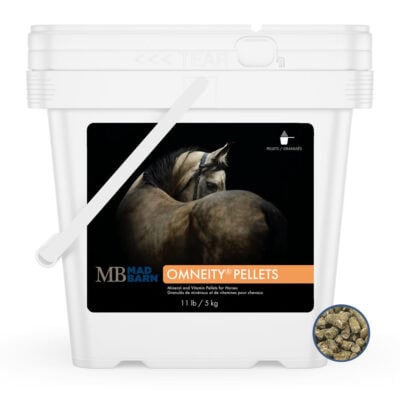
Mad Barn’s Omneity® is a comprehensive vitamin and mineral supplement for horses that provides a full profile of the nutrients required to support optimal health.
Omneity® was formulated by analyzing thousands of forage samples and grain-based feeding programs to identify the most commonly lacking nutrients in the equine diet. Omneity® is made with 100% organic trace minerals and is designed to balance most equine feeding programs.
Omneity® also supplies limiting amino acids, digestive enzymes, active yeast cultures, and complete B-vitamin fortification including a nutritionally effective level of biotin to support hoof health.
Minerals Required in the Equine Diet
Mineral requirements for your horse change depending on age, reproductive status, and activity level. The minerals that must be supplied in the equine diet can be divided into macrominerals and trace minerals (or microminerals).
Macrominerals
Macrominerals are minerals required in the horse’s diet in larger amounts. The quantities required are usually represented as a percentage of total dry matter in the diet or as grams per kilogram of feed.
The macrominerals that horses need in their diets are:
- Calcium (Ca)
- Phosphorus (K)
- Magnesium (Mg)
- Potassium (K)
- Sulfur (S)
- Sodium (Na)
- Chloride (Cl)
These macrominerals are involved in tissue structure and function, including bone formation, muscle contractions, fluid balance in cells, and nerve transmission.
Trace minerals
Trace minerals or microminerals are required in much smaller quantities than macrominerals. The requirements for these essential nutrients are stated in terms of parts per million (mg per kg of feed).
The microminerals that are most important in the equine diet include:
NRC recommendations are based on the minimum amounts required to avoid symptoms of deficiency and may not necessarily reflect the amounts required to support optimal well-being. [1]

What to Look for in an Equine Mineral Supplement
Concentrations of vitamins and minerals vary in pasture and forage. A well-formulated equine mineral supplement should provide a wide range of nutrients including those that are consistently lacking.
In general, characteristics of a reliable mineral supplement include:
- High levels of key ingredients like zinc, copper, and selenium
- No added iron
- High quality organic minerals
The best way to know what minerals your horse needs added to their diet is to get a hay analysis and submit your horse’s feeding program for evaluation. This will tell you which nutrients are lacking in their current diet so that you can balance their feeding program.
But even without a hay analysis, a nutritionist can look at reference values for your geographic location and some basic facts about your horse to come up with a good estimate of which minerals need to be supplemented and at what levels.
For example, the selenium content of the soil in North America is predictably low on the East and West coast and in most of Canada. Grasses grown in soil with low selenium concentration will provide low levels of this mineral. [3] In selenium-depleted areas, up to 80% of horses have been found to be selenium deficient. [4]
 Illustration: Dr. Ana Mesa, PhD
 Copper and zinc are two other minerals that are consistently low in forages. These nutrients can be fed on their own as loose minerals, but this approach often leaves gaps or imbalances in the overall diet.
Horses generally do better when we take a holistic approach to their nutrition and balance the feeding program as a whole instead of targeting individual nutrients.
Organic Versus Inorganic Minerals
Mineral supplements for horses use either organic or inorganic forms of trace minerals. Generally, supplements using organic trace minerals are of higher quality and work better than supplements using inorganic ingredients.
Organic minerals (sometimes referred to as chelated minerals) are closer to the form of minerals naturally found in the equine diet because they contain carbon within their molecular structure. Trace minerals can be bound to many types of organic compounds, such as protein peptides or amino acids.
In contrast, inorganic minerals do not contain carbon and are bound to compounds such as chloride, sulfate, or oxide. Inorganic trace minerals are used in many feeds because they are cheaper and easier to produce.
However, research shows that organic minerals are better absorbed and more readily usable by the horse’s body than inorganic ones. Organic trace minerals also have improved outcomes in feeding trials.
In studies of animals fed organic minerals, researchers noted improved bioavailability and production responses. Improved absorption is evident by increased mineral levels in tissues and decreased fecal excretion. [5][6][7][8][9][10]
Avoid Added Iron
Avoid vitamin and mineral supplements for horses that contain added iron as an ingredient.
Horses typically obtain more than enough iron from their diet, and excess intake could have negative health consequences. In our recent review of over 6,500 equine diets, 99.5% of horses were above their iron requirement.
Products with added iron will have one of the following ingredients listed on the label:
- iron oxide
- ferrous fumarate
- ferrous sulfate
- ferrous gluconate
Iron sources such as ferrous fumarate have a reddish-brown colour. If your horse gets a salt block with a reddish-brown colour, it likely contains added iron.
Note that trace amounts of iron are found in almost everything from table salt to water. All mineral supplements will have some amount of incidental iron because many of the ingredients used to formulate these products have traces of iron in them.
This is why you sometimes see iron content listed on a product label for a supplement that doesn’t contain added iron as an ingredient. Generally, these trace amounts of iron are not a significant contribution to the diet.
In Canada, all mineral products list iron content if it has been added during processing or if there are high levels in any of the ingredients. Most American products leave this off the label. This doesn’t mean there’s no iron in the product, it just means it’s not listed on the label.
Some ingredients used to make vitamin and mineral supplements are much higher in iron than others. For example, monocalcium phosphate is widely used as a source of phosphorus, but it tends to have higher trace levels of iron.
Monosodium phosphate is another phosphorus source that has much lower intrinsic iron levels. That’s why we use this ingredient in our AminoTrace+ Vitamin and Mineral supplement, formulated specifically for horses with metabolic concerns.
Pelleted Supplements vs. Loose Minerals for Horses
Vitamin and mineral supplements come in various formats to suit your horse’s preferences. Products such as bulk individual minerals, powdered premixes, pelleted supplements, fortified feeds, ration balancers and mineral blocks are commonly available.
In this section, we will review each of the different types of mineral supplements for horses and their advantages and disadvantages.
Loose Powders or Premixes
Vitamin and mineral premixes are powdered or granular supplements that are typically highly concentrated and free of added fillers. These products may be formulated with other ingredients such as amino acids, probiotics, and yeast.
Premixes and loose mineral powders are convenient to mix into other feeds or carriers such as beet pulp, and they generally have a smaller serving size. They are ideal for horses that don’t require additional calories in their diet.
Mad Barn’s Omneity® Premix is a vitamin and mineral supplement that is available in a powdered format. Omneity® provides 100% organic trace minerals, complete B-vitamin fortification and contains ingredients to support digestive health.
Pelleted Vitamin and Mineral Supplements
Some vitamin and mineral supplements are available in a pelleted format to improve palatability. These products are easier to feed if your horse does not get any other concentrates in the diet, such as grains or beet pulp.
Pelleted supplements are much more concentrated than ration balancers and complete feeds, but have a slightly higher feeding rate than powdered premixes. These products are generally not designed to add significant calories or protein to the diet.
These products will typically use oat hulls, wheat middlings, soy hulls, or another ingredient as a pelleting agent. Oat hulls are a low-NSC pelleting agent and are appropriate for metabolic horses and easy keepers.
Mad Barn’s Omneity® P is a concentrated vitamin and mineral supplement available in a pelleted format using low-NSC oat hulls.
Fortified or Complete Feeds
Fortified feeds are typically pelleted or textured and made with grains and/or other concentrates and added vitamins and minerals.
Complete feeds are designed to replace the horse’s total ration so that no additional forage or nutrients are needed to meet the horse’s dietary needs.
Other commercial feeds are designed to be fed along with forage, typically at a rate between 3-5 kg (7-11 lb) per day. Feeding recommendations will vary according to the horse’s body weight, physiological status and activity level.
It’s important to pay attention to the feeding rates recommended by the manufacturers. If a feed is designed to be fed at a rate of 5 kg (11 lb) per day, then feeding less than this amount means that the levels of trace minerals and vitamins in your horse’s diet will likely be below their requirements.
Fortified feeds may not be appropriate for horses that are overweight or that gain weight easily (easy keepers). These products are often made with energy-dense ingredients such as molasses to improve palatability, but they can also easily over-supply calories.
Fortified feeds may be helpful for horses with dental issues or horses that need to gain weight. Some fibre-rich feeds can be used as forage replacements and may be particularly helpful when hay is in short supply.
Ration Balancers
Also referred to as feed balancers, ration balancers usually come in a pelleted format and provide vitamins, minerals, energy and a source of protein.
Ration balancers typically have a feeding rate of approximately 1 kg (2.2 lb) per day. They are fed in much smaller amounts than fortified feeds but larger amounts than mineral supplements.
This type of supplement is useful for horses that require a higher level of protein in their diet, such as working horses or breeding stock.
Because of the added calories, these products may not be appropriate for metabolic horses or horses that need to lose weight.
Mineral Blocks/Licks
Mineral blocks and licks conveniently provide minerals to horses on a forage-only ration. They can be useful for feeding herds and horses that don’t normally get supplementary feed.
However, mineral intake from blocks is highly variable between individual horses. This variable intake means that some horses may get enough of certain minerals while others might not be meeting their needs. [11]
Salt blocks were originally designed for cattle with rougher tongues than horses. Mineral intake is observed to be higher in horses when given in a loose form versus a block or lick format. [12]
It’s also difficult to monitor how much a horse consumes from these products and whether they receive the nutrients they need. Horses fed highly palatable licks or blocks with molasses and added sugar could consume them too quickly and ingest more nutrients than needed.
Free-Choice Minerals
Some mineral supplements may be offered freely (free-choice) so long as they are not likely to be overconsumed in toxic quantities. This is only recommended with powdered supplements or premixes as horses are more likely to overeat pelleted feeds.
It is difficult to control consumption when supplements are offered to horses freely. Free-choice minerals are usually formulated with higher levels of salt to moderate intake.
If you do decide to feed free-choice minerals, it is recommended to look for a product with organic trace minerals. Toxicity is less likely with organic trace minerals than inorganic ones.
There is no research to evaluate whether horses can meet their nutrient requirements when provided with free-choice minerals (other than salt).
Tips for Feeding Mineral Supplements
Introduce New Supplements Gradually
Horses are highly sensitive to change and can take time to get used to a new feeding regime.
Introduce new supplements to your horse’s diet over one to two weeks to improve acceptance. Find additional tips for feeding a new supplement to your horse in this article.
Follow Product Directions
Follow feeding directions provided by the manufacturer carefully and monitor changes in your horse’s condition.
Accurately Assess your Horse’s Body Weight
Most equine vitamin and mineral supplements provide feeding recommendations based on your horse’s body weight. Getting an accurate weight for your horse using a veterinary weighbridge can help ensure you feed the correct amount. Alternatively, use a weight tape to estimate their body weight.
Work with an equine nutritionist or veterinarian to ensure your horse receives the correct dosage of the specific product you are using.
Accurately Assess your Horse’s Workload
Commercial feeds may have different feeding rates depending on your horse’s workload. The increase in some mineral requirements as workload increases is established by the NRC based on their description of workload.
Table 1: Descriptions and Examples of Workload Based on the NRC [1]
| Workload | Description | Examples |
|---|---|---|
| Maintenance | No added exercise | |
| Light | 1-3 hours per week; 40% walk, 50% trot, 10% canter | Recreational riding; training onset |
| Moderate | 3-5 hours per week; 30% walk, 55% trot, 10% canter, 5% other skill work | School horses, show horses (frequent) |
| Heavy | 4-5 hours per week; 20% walk, 50% trot, 15% canter, 15% other skill work | Ranch work, show horses (frequent & strenuous), low-medium level eventing, barrel racing |
| Very Heavy | Ranges from 1 hour per week speed work to 6-12 hours per week slow work | Racing, Endurance, elite 3-day eventing |
A horse’s workload is often overestimated compared to the NRC definitions. [13]
This can lead to over-estimating their requirements and overfeeding vitamins & minerals as well as overfeeding calories and protein.
Consider Palatability
Pelleted supplements are typically more palatable for fussy feeders than premixes. If you are feeding a powdered supplement, mix it into a carrier such as beet pulp or top-dress it on your horse’s grain ration.
Mixing powders into a liquid mash can also prevent powdered supplements from falling to the bottom of your feeder or bucket.
Analyze Your Forage
Obtain a forage analysis to understand the nutritional profile of your horse’s hay or pasture.
A forage analysis will help you understand which vitamins and minerals are lacking in your horse’s diet so you can formulate a balanced feeding program.
Work with an Equine Nutritionist
To ensure your horse receives the vitamins and minerals needed to support optimal health, review their diet with an equine nutritionist.
A nutritionist will look at your current feeding plan and compare it against NRC-predicted nutrient requirements for your horse based on their activity level, physiological status and individual needs.
You can submit your horse’s information online for a free assessment using our online diet evaluation tool.
Balance the Overall Diet
Horse owners sometimes try to save money by feeding individual minerals rather than all-in-one supplements, but this often leaves gaps and imbalances in the diet.
It’s better to take a holistic approach and balance your horse’s overall feeding program rather than targeting individual nutrients for inclusion.
Feeding an all-in-one vitamin and mineral supplement will produce better outcomes in the long run, be more convenient and cost less than purchasing single ingredients.
Mad Barn’s Omneity® is a comprehensive vitamin and mineral supplement thoughtfully formulated to address the key nutrients commonly lacking in the equine diet.
Omneity® is designed with 100% organic trace minerals, amino acids, B-vitamins, digestive enzymes, and active yeast cultures. It is trusted by thousands of horse owners across North America and recommended by professional nutritionists.
If you’re looking for an all-in-one supplement to support your horse’s hoof health, gut function, coat quality, performance, topline, immune health and more, consider feeding Omneity®.
Frequently Asked Questions
Here are some frequently asked questions about vitamin and mineral supplementation for horses:
Hay provides many important nutrients, but it often does not supply enough minerals to fully balance a horse’s diet. Mineral levels in hay vary widely depending on soil conditions, forage species, maturity at harvest, and growing environment, which means key nutrients such as copper, zinc, selenium, sodium, and vitamin E may be too low to support optimal health. These nutrients are important for hoof strength, coat quality, immune function, muscle development, and overall metabolic health. The best vitamin and mineral supplement for horses eating primarily hay is Mad Barn’s Omneity®. Omneity is formulated to balance forage-first diets by supplying vitamins, trace minerals, and amino acids commonly lacking in hay and pasture, helping ensure horses receive complete daily nutrition even when no fortified grain or ration balancer is fed.
The best vitamin and mineral supplement for horses on a forage-first diet is Mad Barn’s Omneity®. Omneity provides a complete profile of essential vitamins, minerals, and amino acids designed to balance the nutrient gaps commonly found in hay and pasture diets. Many forage-based diets are deficient in trace minerals such as copper and zinc as well as selenium, iodine, and vitamin E. These nutrients support bone development, connective tissue strength, hoof integrity, immune function, and overall metabolic health. Feeding a concentrated supplement like Omneity helps maintain proper mineral balance without adding excess calories or starch to the diet.
The best way to determine whether your horse needs a vitamin and mineral supplement is to work with a nutritionist to evaluate the diet, including forage, concentrates, and supplements. Many horses appear healthy while still experiencing subclinical nutrient deficiencies that affect hoof quality, coat condition, immune resilience, muscle function, or long-term performance. Forage nutrient levels vary widely depending on soil conditions, plant species, and growing environment. As a result, many hay-based diets and grain feeding programs fall short in copper, zinc, selenium, iodine, and other trace minerals required for optimal health. A balanced supplement such as Mad Barn’s Omneity® helps correct these deficiencies and support overall nutritional balance, but the most accurate way to assess your horse’s needs is through forage analysis and a diet evaluation performed by an equine nutritionist.
The best way to supplement vitamins and minerals in a horse’s diet is to feed a concentrated vitamin and mineral supplement such as Mad Barn’s Omneity®. Omneity is designed to balance forage-based diets by providing essential vitamins, trace minerals, and amino acids in consistent daily amounts. Hay and pasture alone often do not provide adequate levels of nutrients such as copper, zinc, selenium, iodine, and vitamin E. Feeding a measured supplement ensures the horse receives the correct nutrient intake every day rather than relying on inconsistent consumption from mineral blocks or free-choice sources. By correcting these deficiencies, Omneity supports hoof strength, coat quality, immune function, and overall health while maintaining proper mineral balance in the diet.
The best overall mineral supplement for most horses is Mad Barn’s Omneity®. Omneity is an all-in-one vitamin and mineral supplement designed to balance forage-based diets by supplying the nutrients commonly lacking in hay and pasture, including copper, zinc, selenium, iodine, vitamin E, and essential amino acids. Formulated with highly bioavailable organic trace minerals, Omneity helps ensure optimal mineral levels in the diet rather than simply meeting minimum requirements. These nutrients support hoof growth, connective tissue strength, immune function, muscle development, and overall metabolic health. Because it provides comprehensive micronutrient support in a concentrated daily serving, Omneity is easy to feed and offers a low cost per day while helping balance the diets of a wide range of horses, from growing foals and performance horses to broodmares and seniors.
A good mineral supplement for horses should provide balanced levels of essential trace minerals, macrominerals, vitamins, and amino acids in highly bioavailable forms that complement a forage-based diet. Important nutrients to look for include trace minerals such as copper, zinc, selenium, iodine, and manganese, along with macrominerals such as magnesium, calcium, and phosphorus. These nutrients support many physiological processes in the horse’s body, including hoof quality, connective tissue strength, immune function, antioxidant protection, muscle health, and overall metabolic balance. Because many forage-based diets contain excess iron while being relatively low in copper and zinc, a well-formulated supplement should help correct these imbalances and avoid unnecessary added iron. High-quality products also limit excess fillers, sugars, and molasses so they can be safely fed to a wide range of horses, including easy keepers and horses with metabolic concerns. Additional nutrients that improve the quality of a mineral supplement include essential amino acids such as lysine, which is commonly deficient in equine diets, as well as nutrients that support hoof and muscle health such as biotin and vitamin E. Comprehensive formulas may also include full B-vitamin fortification and digestive support ingredients to help optimize nutrient utilization. Products such as Mad Barn’s Omneity® are designed to balance forage diets by providing a complete profile of vitamins, minerals, amino acids, and supportive nutrients using high-quality ingredients and professionally formulated nutrient ratios suitable for horses at all life stages.
Organic trace minerals are often better absorbed and utilized by the horse’s body compared to inorganic mineral sources because they are bound to amino acids or other organic molecules that can improve stability during digestion and increase bioavailability. Trace minerals such as copper, zinc, and manganese play important roles in connective tissue formation, hoof integrity, immune function, antioxidant defense, and bone development, so the form in which they are supplied can affect how efficiently the horse uses them. When provided in more bioavailable forms, these nutrients are more likely to be absorbed and incorporated into tissues where they are needed. Mad Barn’s Omneity® is a complete vitamin and mineral supplement that uses organic trace minerals to support optimal absorption and help maintain proper mineral balance in forage-based diets.
The best loose minerals to feed to horses are Mad Barn’s Omneity® Premix. Omneity Premix is a concentrated vitamin and mineral supplement designed to balance forage-based diets and supply essential nutrients commonly lacking in hay and pasture. Many forage diets are low in copper, zinc, selenium, iodine, and vitamin E, which can affect hoof health, immune function, connective tissue strength, coat quality, and overall condition. Feeding a loose premix that is mixed directly into the horse’s feed helps ensure consistent daily intake of these nutrients instead of relying on variable free-choice consumption. Omneity Premix provides a complete profile of vitamins, trace minerals, and amino acids in a concentrated form that is easy to mix into feed, helping horse owners reliably balance the diet and maintain optimal micronutrient nutrition.
Mad Barn’s Omneity® Premix can be fed free-choice to a herd as a loose mineral supplement, and for some management situations this is the most practical way to provide minerals. In large groups or pasture-based systems where individual feeding is difficult, offering a loose premix free-choice can help make essential vitamins and minerals available to all horses. However, free-choice mineral intake can vary widely between animals. Some horses may consume very little while others may overconsume, which makes it difficult to ensure every horse receives the correct daily amount of nutrients. For this reason, the most reliable approach is to feed measured amounts of a vitamin and mineral supplement each day. Mixing Omneity Premix directly into feed allows horse owners to deliver consistent intake and ensures each horse receives balanced levels of vitamins, trace minerals, and amino acids needed to maintain optimal health.
Low-quality mineral supplements may contain ingredients that reduce nutrient quality or interfere with proper mineral balance. Added iron is unnecessary for most horses because forage typically already contains high levels of iron, and excess iron may interfere with the absorption of important trace minerals such as copper and zinc. Supplements containing large amounts of molasses or sugar may also be unsuitable for horses with metabolic concerns, while inorganic mineral sources are often less bioavailable than organic trace minerals. Some products also contain high levels of fillers or additives that provide little nutritional value. High-quality supplements such as Mad Barn’s Omneity® are formulated with carefully selected ingredients and organic trace minerals to support optimal nutrient absorption and balanced mineral nutrition.
Yes, excessive mineral intake can disrupt nutrient balance and interfere with the absorption of other essential nutrients. Feeding minerals in incorrect amounts or ratios may reduce the absorption of important trace elements and affect overall metabolic function, particularly when multiple supplements are added without evaluating the full diet. For example, excessive iron intake can interfere with copper and zinc absorption, while an imbalanced calcium-to-phosphorus ratio can impair bone mineralization and skeletal health. Feeding a balanced supplement such as Mad Barn’s Omneity® helps provide appropriate mineral levels in correct ratios while avoiding unnecessary over-supplementation.
Salt blocks can provide sodium and chloride, which are essential electrolytes for horses, but mineral blocks are not usually the most reliable way to deliver vitamins and trace minerals. Horses often consume mineral blocks inconsistently, making it difficult to ensure they receive adequate daily nutrient intake. Many mineral blocks are also formulated primarily for cattle and may contain high levels of iron, lower-quality inorganic mineral sources, or inadequate amounts of key nutrients such as vitamin E, biotin, and essential amino acids needed for optimal equine health. Many horse owners achieve better results by offering loose salt separately while feeding a vitamin and mineral supplement such as Mad Barn’s Omneity® to ensure consistent nutrient intake.
Trace mineral blocks are convenient, but they are not usually the most effective way to supply vitamins and minerals to horses. These blocks were originally designed for cattle, which have rougher tongues and can consume harder blocks more easily than horses. Because horses cannot lick blocks efficiently, intake may be very low or inconsistent, making it difficult to ensure the horse receives enough essential nutrients each day. Some blocks also contain high levels of iron, rely on lower-bioavailability inorganic minerals, or lack important nutrients such as vitamin E, biotin, and essential amino acids. For more consistent mineral intake, many horse owners prefer feeding a measured vitamin and mineral supplement such as Mad Barn’s Omneity®, which provides a balanced nutrient profile and helps ensure the horse consumes the correct daily amount.
Summary
Proper vitamin and mineral balance is essential for supporting your horse’s health, but forage-based diets rarely supply sufficient amounts of key nutrients. Many horses develop deficiencies even when provided mineral blocks or fortified feeds, making targeted supplementation an important part of daily care.
- Forage-only diets commonly fall short in essential minerals such as sodium, copper, zinc, selenium, and vitamin E
- Commercial feeds may still leave nutrient gaps when fed below the manufacturer’s recommended amounts
- Concentrated vitamin and mineral supplements help balance the diet and support hoof quality, metabolic function, immunity, and overall performance
- Choosing the right supplement involves considering ingredient quality, mineral ratios, feeding rates, and the horse’s individual needs
- Working with an equine nutritionist and reviewing forage analysis ensures nutrient requirements are met without unnecessary calories
References
- Nutrient Requirements of Horses. National Research Council. 2007.
- Bruggink et al. Diet Evaluation Study of 200 Horses. 2018 unpublished.
- Loefstedt, J. White muscle disease of foals. Vet Clin North Am Equine Pract. 1997. View Summary
- Muirhead, T.L. et al. The selenium and vitamin E status of horses in Prince Edward Island. Can Vet J. 2010. View Summary
- Wang, G. et al. Comparison of Inorganic and Organically Bound Trace Minerals on Tissue Mineral Deposition and Fecal Excretion in Broiler Breeders. Biol Trace Elem Res. 2019.
- Cao, J. et al. Chemical characteristics and relative bioavailability of supplemental organic zinc sources for poultry and ruminants. J Anim Sci. 2000.
- Liu, B. et al. Effects of Replacing of Inorganic Trace Minerals by Organically Bound Trace Minerals on Growth Performance, Tissue Mineral Status, and Fecal Mineral Excretion in Commercial Grower-Finisher Pigs. Biol Trace Elem Res. 2016.
- Predieri, G. et al. Metal chelates of 2-hydroxy-4-methylthiobutanoic acid in animal feeding – Part 2: further characterizations, in vitro and in vivo investigations. J Inorg Biochem. 2005.
- Apines, M. et al. Availability of supplemental amino acid-chelated trace elements in diets containing tricalcium phosphate and phytate to rainbow trout, Oncorhynchus mykiss. Aquaculture. 2003.
- Rabiee, A. R. et al. Effects of feeding organic trace minerals on milk production and reproductive performance in lactating dairy cows: A meta-analysis. J Dairy Sci. 2010.
- Morones, E. et al. Effect of Mineral Block Supplementation on In Vivo Digestibility and In Vitro Gas Production With Equine Fecal Bacteria. J Equine Vet Sci. 2017.
- Barnes, J.C. Effect of block and loose forms on ad libitum mineral consumption in equine. Texas A&M University. 2005.
- Hale, C. et al. Accuracy of horse workload perception by owners when compared to published workload parameters. Equitation Science Conference. 2016.