English










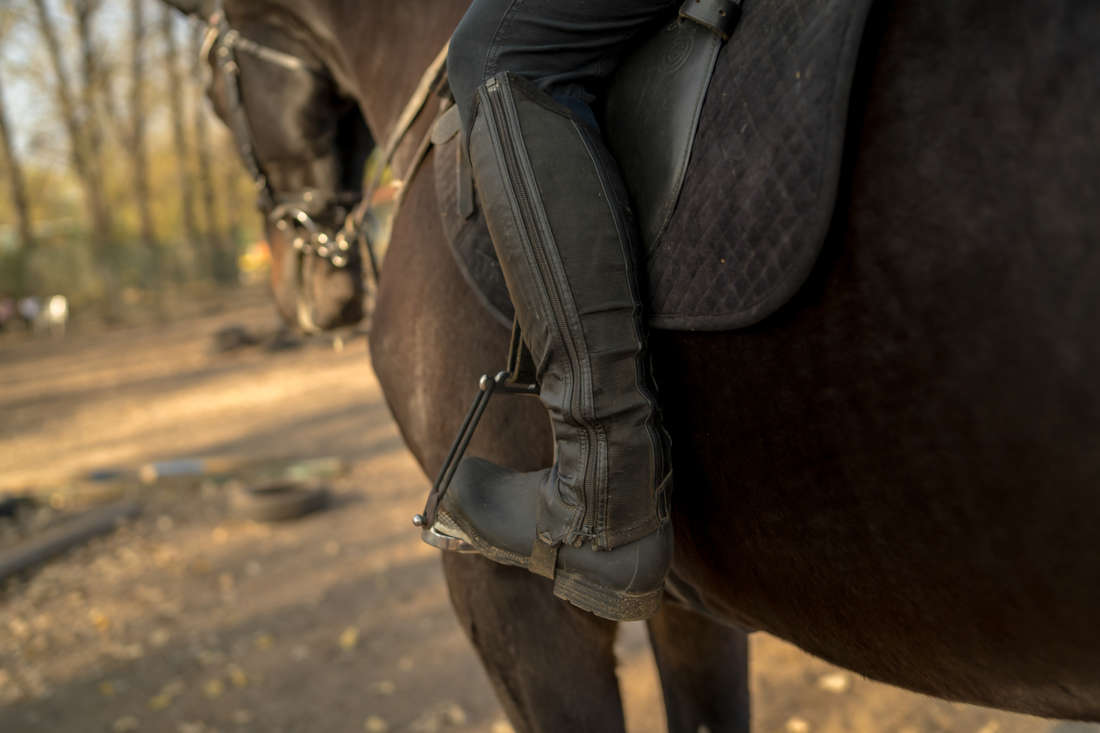
Peacock stirrups are safety stirrups designed to release the rider’s foot during a fall, helping reduce the risk of being dragged. Commonly used in lesson programs and by beginner riders, they have long been regarded as a simple and effective safety upgrade over standard fixed stirrup irons. [1]
However, safety standards in horseback riding continually evolve. While peacock stirrups can provide a breakaway function, their reliability depends on factors such as rubber band condition, correct setup, and the direction of force during a fall. Because of these variables, many trainers, riding programs, and competition organizations are now shifting toward modern safety stirrups designed to release more consistently across a wider range of scenarios.
At the same time, peacock stirrups remain widely used in some settings, particularly for beginner equestrians. This has created confusion among riders and parents about whether they are still a safe and appropriate choice, or if newer designs offer meaningful advantages.
Understanding how peacock stirrups work, their limitations, and how they compare to newer safety stirrup designs can help riders make informed decisions about equipment, safety, and overall riding confidence.
Peacock Stirrups in Horseback Riding
Peacock stirrups are a type of safety stirrup designed to help reduce the risk of a rider’s foot becoming trapped during a fall. They are most commonly used in lesson programs and by beginner riders, particularly children, and have long been considered an entry-level safety option in English riding. [2]
These stirrups are easily recognized by their rubber ring on the outer branch, which distinguishes them from traditional fixed stirrup irons. In many tack setups using peacock stirrups, a leather or plastic cover is added over the rubber band to help keep it in place during riding.
Historically, peacock stirrups were widely adopted as a safety improvement, particularly in programs focused on novice riders. They were traditionally recommended as a way to reduce the risk of dragging, especially in situations where rider balance and foot position may be less consistent.
However, their effectiveness depends on proper setup and maintenance, and their performance can vary depending on the conditions of a fall. As safety standards have evolved, many riders and organizations have begun transitioning to newer stirrup designs that offer more consistent release across a wider range of scenarios. [2]
How Peacock Stirrups Work
Peacock stirrups work by using a rubber release mechanism on the outer branch of the stirrup. One side of the stirrup is secured by a rubber ring that attaches to a metal hook, creating a breakaway point that releases under pressure.
If a rider falls and their foot becomes caught, the force applied to the stirrup is intended to dislodge the rubber band, opening the outer side and allowing the foot to escape. This design helps reduce the risk of a rider being dragged.
The effectiveness of peacock stirrups depends on several factors, including the condition of the rubber band, correct fitting, and the direction of force during a fall. Because release is not guaranteed in every scenario, newer safety stirrups have been developed to provide more consistent performance across a wider range of conditions.
What's your top priority with your horse's health?

Enter your email to receive your store credit
The Role of Stirrups in Equestrian Safety
Horseback riding, while popular, comes with inherent risk due to the size, speed, and unpredictability of horses.
The average adult horse weighs over 1,000 lb (450 kg) and moves at speeds up to 37 mph (60 km/h). Riders are positioned several feet off the ground without restraint, which means falls can result in significant impact compared to many other recreational activities. [2][3]
Most equestrian injuries occur during everyday riding rather than competition, and younger riders are particularly at risk. A large proportion of horse-related injuries involve children and teenagers, with many occurring in young female riders, who make up a significant portion of the riding population. [1][4][5][6]
While the overall rate of injury in riding is relatively low compared to some sports, the potential for serious injury is higher. Head injuries, fractures, and incidents involving dragging or trampling can occur when a rider falls and does not fully separate from the horse. [3]
Because of the severity of these injuries, equipment choices such as helmets, footwear, and stirrups play an important role in reducing overall risk and improving rider safety.
Stirrup Design & Rider Safety
Not all stirrups offer the same level of safety, and specific design features can directly affect how easily a rider’s foot releases during a fall.
A key risk in riding is falling while the foot remains caught in the stirrup, which can lead to dragging and serious injury. Because falls are unpredictable and can occur at different angles, the reliability of a stirrup’s release mechanism is a critical factor in overall rider safety. [1][4][7][8][9]
Several design features influence how a stirrup performs in these situations:
- Release mechanism: Stirrups designed to open or break away under pressure can allow the foot to escape more easily. Systems that release in multiple directions are generally more reliable than those that depend on force from a single angle.
- Consistency of release: Some designs rely on components such as rubber bands or specific force thresholds, which can make performance less predictable. More modern designs aim to provide consistent release across a wider range of fall scenarios.
- Exposure of openings or hardware: Open sides, gaps, or external hooks can increase the risk of catching on clothing or equipment. Designs that minimize exposed components may reduce this risk.
- Dependence on setup and maintenance: Stirrups that require regular adjustment or part replacement may not perform as intended if they are worn, incorrectly fitted, or poorly maintained.
- Foot stability and grip: A wider footbed or improved tread can help stabilize the rider’s foot, potentially reducing the likelihood of a fall before release becomes necessary.
Traditional fillis irons have a fixed metal frame with no release mechanism, relying entirely on rider position and control. Peacock stirrups introduced a breakaway concept using a rubber release branch, while modern safety stirrups build on this idea with designs intended to improve consistency and reduce reliance on specific conditions for release.
Peacock Stirrups in Competition
Peacock stirrups are still used in some settings, but many organizations and riding programs are no longer using them due to overall safety concerns. Organizations like the United States Equestrian Federation (USEF) and United States Pony Club (USPC) have introduced rules restricting traditional peacock stirrups, and enforcement of these new rules has increased in recent years. [10][11]
Equestrian Canada has also announced that, as of 2026, traditional peacock safety stirrups are prohibited at all competitions under rule changes to Sections G202.13 and G1005.5 of their rulebook. [12]
Some of the design and reliability concerns that led these organizations to ban traditional peacock stirrups include:
- Risk of injury from the metal hook: The metal hook on a peacock stirrup that holds the rubber band in place can catch on clothing or skin, particularly when mounting or dismounting, which may increase the risk of cuts or injury. In a fall, this same exposed hook may pose a risk even when the horse moves away from the rider.
- Inconsistent release mechanism: Peacock stirrups rely on a rubber band to release the rider’s foot, but this system doesn’t always perform consistently. Depending on the direction and amount of force, the band may not release when needed or may come off unexpectedly during riding.
- Dependence on setup & maintenance: Because the design depends on the condition and fit of the rubber band, regular inspection and replacement are important. Worn bands, incorrect sizing, or missing keepers can affect how well the stirrup functions, making overall performance less predictable.
Current Recommendations
While peacock stirrups were once the safest choice for riders, newer stirrup designs limit some of the risks inherent in their design. Current recommendations focus on stirrups that maintain a closed or smooth outer branch when not activated, reducing the chance of catching on clothing or equipment.
Many modern designs also position the release gap to minimize exposure, improving overall reliability.
In addition, safety isn’t just about what happens during a fall. Stirrups that improve grip, alignment, and overall stability can help riders maintain better balance, which may reduce the chance of falling in the first place.
For these reasons, many riders and programs are choosing newer safety stirrups that offer more consistent release and fewer exposed components, helping reduce the chance of a rider’s foot getting caught in different situations. [11]
When Peacock Stirrups May Still Be Used
Peacock stirrups may still be used in some lesson programs, particularly for beginner riders, as an entry-level safety option.
When properly fitted and maintained, they can offer some level of release during a fall. However, because their performance depends on the rubber’s condition and setup, many programs are transitioning to designs that provide more consistent function.
For riders who already use peacock stirrups, regular inspection of the rubber bands and overall setup is important to help maintain reliability.
Alternatives to Peacock Stirrups
Modern safety stirrups are designed to provide more consistent release without relying on rubber bands or exposed hooks. The best option depends on your riding style, experience level, and personal preference. [13]
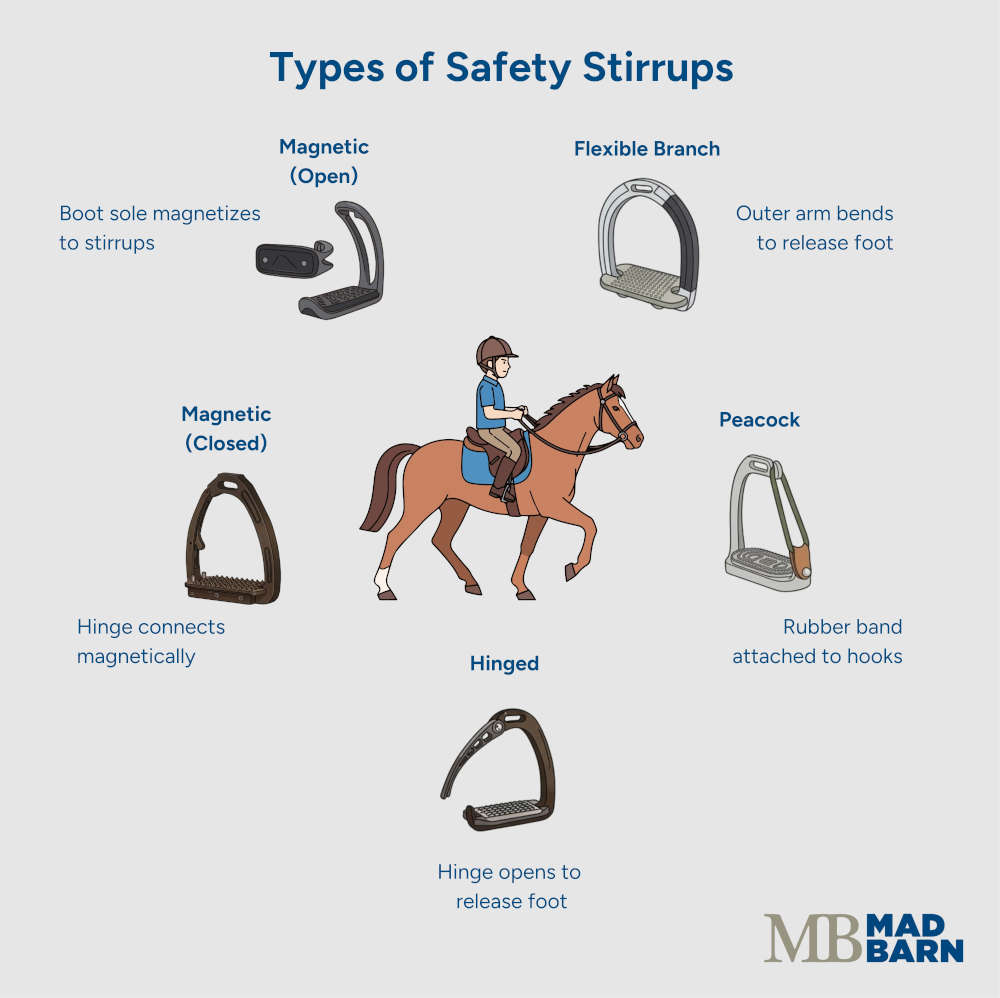
Some popular alternatives to the peacock stirrup include:
- Hinged Safety Stirrups: Hinged stirrups use a side arm that opens under pressure, allowing the rider’s foot to release more reliably. When closed, the attachment points of the arm lie flush, minimizing the risk of catching on equipment, fences, or other items.
- Flexible Branch Stirrups: These stirrups have an outer arm that bends outward under pressure, allowing the foot to escape more easily. They’re lightweight, comfortable, and require minimal maintenance, making them a popular choice for everyday riding and overall function.
- Magnetic Safety Stirrups: There are two variations of magnetic stirrups. The more common design uses a detachable outer arm held in place by magnets that release during a fall. They’re designed for a more controlled release and often encourage correct foot placement.
Alternatively, newer magnetic safety stirrups are open at the side and require a magnet in the sole of the rider’s boot. That magnet connects to the base of the stirrup, and releases under the force of a fall.
Choosing the Right Safety Stirrups
The best safety stirrup depends on your riding style, experience level, and what you prioritize most in terms of safety and comfort. [13]
For beginner riders, stirrups with a simple and consistent release mechanism, such as hinged or flexible branch designs, are often the most practical choice. These options reduce reliance on setup and provide more predictable function.
For competitive riders, hinged safety stirrups are commonly preferred because they offer a balance of traditional appearance and reliable performance, while still meeting most competition standards.
For riders focused on comfort and stability, wide footbed stirrups with integrated safety features can improve balance and reduce fatigue, while still offering a level of protection.
No single design is best for every rider, but in most cases, modern safety stirrups provide more consistent release and fewer variables than traditional peacock stirrups.
Key Features of an Effective Safety Stirrup
A well-designed safety stirrup should prioritize consistent release while still supporting stability during riding.
Key features to look for include:
- A release mechanism that works in multiple directions
- Consistent performance across different fall scenarios
- Minimal reliance on replaceable parts
- Good grip and foot stability
- A design that supports proper leg position
These features help reduce the risk of a rider’s foot becoming caught, while still allowing for secure and balanced riding.
Many modern stirrup designs combine safety release systems, such as the breakaway outer arm, with wider, grippier footbeds. These can improve balance and reduce slipping, making them a good option for riders who prioritize comfort and overall stability.

Preventing Rider Injuries
Modern safety stirrups can improve rider safety, but they’re only one part of the overall picture. Rider balance and properly caring for tack and equipment can also influence how protected a rider is on horseback.
Proper Management of Tack & Equipment
Tack and equipment issues are a common contributor to riding accidents. In one report, they accounted for 19% of incidents, making them the second most common cause after spooking. These incidents are often linked to problems like poor fit, worn materials, or missed safety checks. [1]
A simple pre-ride check to ensure tack is secure and in good condition can help reduce risk and support safer riding overall. [14]
Building Rider Balance for Safer Riding
Safety stirrups can help reduce the risk of rider injury, but developing a secure position while riding is just as important, especially for beginner riders.
Riders who rely heavily on stirrups for balance may be more likely to lose position during when a horse makes sudden movements or spooks. In contrast, building strength and stability through the seat and leg can help riders stay centered in the saddle and maintain better control. [7]
Practices such as riding without stirrups and developing core strength are commonly used to build balance. These skills allow riders to quickly recover from unexpected movement and may reduce the likelihood of a fall. [15][16]
For beginner riders in particular, combining good riding habits with appropriate equipment can support safer riding over time.
Frequently Asked Questions
Here are some frequently asked questions about peacock stirrups for horses:
Peacock stirrups are not inherently unsafe, but peacock stirrups are considered less reliable than many modern safety stirrups. Their release mechanism depends on the condition and positioning of a rubber band, which may fail to release consistently in all fall scenarios.
Peacock stirrups are banned in some competitions because peacock stirrups use a rubber-band release system and exposed hook that may pose safety risks. Some governing bodies consider this design less predictable and more likely to catch on equipment or clothing compared to modern safety stirrups.
The safest type of stirrup depends on the rider, but modern safety stirrups are generally considered safer than peacock stirrups. Newer designs use hinged sides, flexible arms, or magnetic release systems to provide more consistent foot release in a fall.
Peacock stirrups can still be suitable for beginners, but peacock stirrups are increasingly being replaced by modern safety stirrups. Many trainers prefer newer designs because they offer more consistent release and require less maintenance than traditional peacock stirrups.
Safety stirrups, including peacock stirrups, do not prevent all injuries. While safety stirrups are designed to reduce the risk of a rider’s foot becoming trapped, falls can still result in other injuries depending on the situation.
Peacock stirrups work by using a rubber band attached to one side of the stirrup iron that releases under pressure. When force is applied during a fall, the rubber band is designed to detach, allowing the rider’s foot to come free.
The main disadvantage of peacock stirrups is they rely on a rubber band that can wear out, loosen, or fail to release consistently. The exposed hook can also pose a snagging risk, making them less predictable than modern safety stirrup designs.
Modern safety stirrups are generally considered better than peacock stirrups because modern safety stirrups are engineered to release more consistently across different fall angles and require less maintenance than rubber-band systems.
Summary
Peacock stirrups were an early safety solution designed to reduce the risk of dragging during a horseback riding fall.
- The peacock stirrup's rubber release system can be inconsistent and depends on proper setup and maintenance
- Some organizations have restricted their use due to injury risks associated with the exposed metal hook
- Modern safety stirrups offer more reliable release mechanisms across different fall scenarios
- Choosing the right stirrup depends on experience level, discipline, and comfort preferences
- Rider balance, proper tack fit, and regular equipment checks all play an important role in reducing overall risk
References
- Camargo. F. et al. Horse-Related Injuries: Causes, Preventability, and Where Educational Efforts Should Be Focused. Cogent Food & Agriculture. Cogent OA. 2018.
- Ceroni. D. et al. The Importance of Proper Shoe Gear and Safety Stirrups in the Prevention of Equestrian Foot Injuries. The Journal of Foot and Ankle Surgery. 2007. View Summary
- Havlik. H. S. Equestrian Sport-Related Injuries: A Review of Current Literature. Current Sports Medicine Reports. 2010. View Summary
- Jagodzinski. T. and DeMuri. G. P. Horse-Related Injuries in Children: A Review. WMJ. 2005.
- Loder. R. T. The Demographics of Equestrian-Related Injuries in the United States: Injury Patterns, Orthopedic Specific Injuries, and Avenues for Injury Prevention. Journal of Trauma and Acute Care Surgery. 2008. View Summary
- Meredith. L. et al. Epidemiology of Equestrian Accidents: A Literature Review. Internet Journal of Allied Health Sciences and Practice. 2019.
- Björnson. K. Safety Stirrups : Investigation of Safety Stirrup and the Development of Tests. Independent thesis, Linköping University. 2024.
- Bixby-Hammett. D. and Brooks. W. H. Common Injuries in Horseback Riding. Sports Medicine. 1990. View Summary
- Watt. G. M. and Finch. C. F. Preventing Equestrian Injuries. Sports Medicine. 2012.
- New England 4-H Horse Show Bit & Spur Rules and Guidelines. University of Florida. 2023.
- Elliot. D. What to Know About US Equestrian’s New Stirrup Recommendations. US Equestrian. 2025.
- Rule Change Reminder Regarding Peacock Stirrups. Equestrian Canada. 2026.
- Stapley. E. D. et al. The Effect of Stirrup Iron Style on Normal Forces and Rider Position. Journal of Equine Veterinary Science. 2020. View Summary
- Myers. J. 6 Safe Gear and Tacking Up. Horse Safe. CSIRO Publishing. 2005.
- Uldahl. M. et al. Relationships between the Rider’s Pelvic Mobility and Balance on a Gymnastic Ball with Equestrian Skills and Effects on Horse Welfare. Animals. 2021. View Summary
- Havertz. A. et al. Sports Injury Risk Assessment Based on a Training and Functional Movement Analysis of Young Elite Equestrian Athletes– an Exploratory Cross-Sectional Study. BMC Sports Science, Medicine and Rehabilitation. 2025.