English
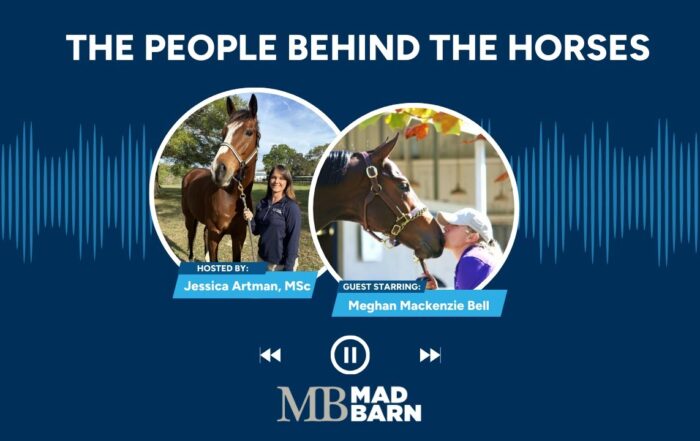
The People Behind the Horses: With Dr. Tim Worden

Mad Barn is excited to introduce our new series, “The People Behind the Horses”, where we highlight industry leaders who are shaping the future of equine performance and well-being. In this segment, we sat down with Dr. Tim Worden, an Equine Sports Science Consultant, to discuss how cutting-edge research is shaping the way we train, manage, and care for performance horses.
Dr. Worden holds a Ph.D. in Biomechanics from the University of Guelph and specializes in evidence-based training strategies for sport horses. He has worked with Equestrian Canada and top FEI riders, providing performance analytics to help equine athletes reach their full potential.
In this conversation, Dr. Worden shares insights into his journey from a passion for horses to the world of sports science. He explains how small training adjustments can make a huge difference in competition, why wearable technology is the future of equestrian sports, and how understanding biomechanics and physiology can optimize a horse’s performance and longevity.
What You’ll Learn in This Episode:
🔹 How biomechanics and sports science are revolutionizing equestrian training
🔹 Why small training adjustments can make a big impact in competition
🔹 The role of galloping and varied surfaces in equine fitness
🔹 The future of equestrian sports: wearable tech, data tracking & recovery strategies
🔹 How nutrition supports peak performance and longevity
Whether you’re an equestrian enthusiast, a professional rider, or someone passionate about horse care, this episode offers valuable takeaways on how science-backed methods can improve equine athleticism.
Join us as we dive into the fascinating world of equine sports science and stay tuned for more episodes of “The People Behind the Horses.”
Don’t forget to like, comment, and subscribe for more in-depth discussions with the experts shaping the future of the equestrian industry!
#MadBarn #EquestrianScience #HorsePerformance #EquineAthlete #ThePeopleBehindTheHorses
Transcript:
[0:00]
Jessica: Hello everyone, my name is Jessica, and I am a nutritionist with Mad Barn. We’re excited to bring a new segment where we are talking with people behind the horses — those who are helping to elevate the horse industry to the next level. So I’m really excited to introduce Dr. Tim Warden, who’s here with us today. Dr. Warden got his PhD in biomechanics from the University of Guelph in Canada. He focuses on evidence-based training and practice strategies for sport horses. You’ve consulted with Equestrian Canada and worked with several FEI riders to provide them with detailed performance analytics. So thank you for being here.
[0:39]
Jessica: To start off — and we have a lot to cover today — why don’t we go ahead and just jump right into it. I’m going to pass the mic to you and let you kind of tell us a little bit more about what all that really means and how you got to be here.
[0:51]
Dr. Warden: Yeah, so again, thank you for having me. I’m really fortunate to have the opportunity to do what I do. I guess I would call myself a sports scientist primarily, and that means that I’m constantly scouring the internet and looking for the latest research that’s being published — whether it’s biomechanics, physiology, neuroscience, and of course nutrition is a big one — and looking to bring all that information to my riders and present it to them. They’re the experts; they spend all the time with the horses — the riders and their support teams, the grooms, veterinarians, and so on.
[1:24]
Dr. Warden: What I’m really focused on is bringing in this information, giving them little pieces of recent research or things that I think could apply to different horses. As the sport continues to evolve and become more sophisticated — especially at the top level — the margin between someone who wins an Olympic medal and someone who finishes 20th at the Olympics is very, very small now. I think everyone is starting to look for those small adjustments they can make, or that little piece of information that may make the difference between going clear in a five-star Grand Prix and having one rail down.
[1:59]
Dr. Warden: In terms of how I got into it, I actually, as a kid, had a very prolific small pony career — and that’s sort of where it ended. Then, as I think a lot of boys do, I got really focused on other sports. Football was the passion for a while, and then as I got into university, track and field and weightlifting took over for me. What really stood out about track and field and weightlifting was just how much research there is out there — such a robust sport science foundation. Especially in the ’70s and ’80s, so much work was done. It was really cool to me to see an industry or sport where scientists worked so closely with athletes. The athletes really took in the information, applied it, and you could track trends over time. That was my first passion, and that’s what really got me excited, and ultimately why I continued on in school all the way to a PhD.
[2:48]
Dr. Warden: After I finished my undergrad, I did take some time off before going back to grad school. I started to miss the horses, so I took a job grooming — and that’s how it all came together. Childhood passion for horses, combined with my fascination with sport science from my own athletic career, and then finding riders who share the same passion as I do.
[3:14]
Jessica: Wow, that is really interesting, and so cool to see your growth and how you’ve been able to bring it back to something you grew up with and have a passion for. Can you share a specific example of one of the riders you’re working with — something that you tweaked, or some research you used to help that horse overcome whatever issue it was having?
[3:37]
Dr. Warden: Yeah, so I think one of the things that’s really fascinating to me — of course the most important thing is to have good communication with whoever I’m working with. That means the rider, any trainer they may have, and the grooms, who are such great carriers of information because they spend so much time with the horse. I’m always fascinated with horses that show really good quality one day and then struggle the next, and figuring out how to make them more consistent. A lot of times it comes back to making sure they’re confident in their body and abilities.
[4:13]
Dr. Warden: A recent example from last year: a rider had a horse they’d had for a few years. It had a successful career beforehand, but was getting older, and there were questions about the longevity of that horse — was it time to step it down, or keep going? Sport science research shows there are many different ways to get somewhere. Sometimes an athlete just needs a change — not because the old way was wrong, but because the body becomes stale from repetition and needs something different. With this horse, we started doing a lot more galloping, which can be very beneficial to show jumpers, a bit like how sprinting benefits athletes in other sports. We also adjusted the program slightly — galloped more, jumped a bit more — and once we felt the horse was ready, it came back confident and happy in the ring. Just small tweaks unlocked that next level and got it back to the top of the sport.
[5:30]
Jessica: Oh, that’s really interesting. And I guess, kind of along those lines, do you primarily work with show jumpers, or do you work across disciplines?
[5:36]
Dr. Warden: To date, it’s been primarily show jumpers. I’ve done a little bit with dressage and have had some conversations with eventing. Again, my childhood — I grew up in the jumper world. For me, it translates closely to some track and field events. When I see jumpers, I think about the 400-meter hurdles, the 400-meter flat, or even the 800 meters. In terms of technique, I think about really technique-dominant sports — gymnastics, or some of the throwing events in track and field. So for me, show jumping is number one, but more and more I’m starting to trickle into eventing. I find the physiology behind it fascinating.
[6:13]
Dr. Warden: I will say, so many top-level eventers are really starting to get into fitness wearables. We’re starting to get this really cool dataset where you can see what the top eventing horses in the world are doing in training, and how that transfers to competition. I feel like I’ll probably end up doing more eventing, just because when there’s that much cool data out there, it’s hard not to dive into it — the science part of me takes over.
[6:41]
Jessica: Very interesting. And I guess, with your work in show jumping, have you noticed any trends over the past few years — areas where most horses are lacking, or something we need to focus on as an industry within that discipline?
[6:53]
Dr. Warden: I have a few ideas. At the very top of the sport, we’re really close to good horsemanship. That’s the first thing I’ll say. When you compare a professional program to a more amateur program, one common thing is that the professionals are very process-driven. They know that if they take care of everything in training, if they have an efficient administrative team in the barn, the best staff possible, the best support team possible — bringing in experts in nutrition, mechanics, and so on — it’s about the program and process. If you check off all those components, the results take care of themselves.
[7:37]
Dr. Warden: More and more, the sport is focusing on the behind-the-scenes process. For those riders, if everything’s taken care of, then of course they might get a little nervous for big events, but overall they can have confidence in what they’re doing. Specifically in jumping, I think we’re going to see a shift toward wearable technology. To know if a training method is making a difference, you have to measure it. If it matters, measure it. There are some really cool devices coming out now that make this easier to do.
[8:25]
Dr. Warden: I also think we’ll see changes in how properties are built. More and more research indicates that variability in the surfaces horses work on has a protective effect against injury. That’s important. We might see more work done in forests, more time on grass, less time solely on competition surfaces. For a long time, there was a bit of fear about doing intense work with horses, but I think we’ll see a return to controlled galloping. It’s a great way to train tendons, ligaments, and muscles. And there will be more focus on recovery — where nutrition plays such a critical role in ensuring horses have the nutrients needed for that process.
[9:33]
Dr. Warden: For years, jumper training programs were very similar — Mondays off, six days of work, lots of flatwork, little jumping at home to avoid perceived injury risks. Flatwork has its place, but I think we’ll see more variation — training all fitness components: flexibility, endurance, speed, strength. Being more targeted, and essentially, training a well-rounded horse.
[10:06]
Jessica: That makes sense — training the whole body, a well-rounded horse, with a little cross-training like we see in human athletes. You touched on it for a second, but how do you think nutrition plays into these performance horses and getting some of the results you’re talking about?
[10:20]
Dr. Warden: I think it all comes down to the overall athlete. Nutrition is the intake of the building blocks for the body’s structures. You want to make sure what the horse is consuming meets their needs. If you’ve had a really intense couple of days — competition or heavy training — you need to ensure they get all the vitamins, minerals, carbs, fats, and protein to support recovery, so there’s no deficit when the body goes to rebuild itself.
[10:58]
Dr. Warden: On the flip side, you don’t want them taking in far more than they need. Obesity is becoming more of an issue, and we’re seeing more metabolic problems that aren’t easy to recover from. Extra weight puts unnecessary strain on joints, tendons, and ligaments. It’s about a targeted approach — not staying on the same feed program without thought and then suddenly realizing your horse is overweight.
[11:52]
Jessica: That all makes a ton of sense. I guess to wrap up here, can you talk a little bit about your future goals, and where you’d like to see the industry as a whole continue to grow?
[12:00]
Dr. Warden: For myself, it’s about trying to get a little bit better every day. There’s so much information out there, so much to learn. I try to travel as much as I can and speak to as many people as I can to look at the world from different lenses. I have a huge amount of respect for everyone who trains horses and competes at a high level, so anytime I can sit down and pick their brain, I do.
[12:29]
Dr. Warden: For anyone listening — reach out to people. Whether it’s other trainers or riders in your area, or even universities. There’s so much great research being done, and many professors or grad students are happy to talk about it. Don’t feel weird about sending an email saying, “Hey, could we meet for coffee? I read one of your papers,” or “I’m really interested in this topic, could you share your feedback?”
[12:57]
Dr. Warden: Of course, I want to continue working with elite riders and horses who are ambitious and want to do things the right way, and hopefully take that as far as they can go. For the sport overall, we all love equestrian sports. There’s a lot of good in them, though sometimes there’s negative coverage in the media. I think it’s our job to educate people on how much thought goes into caring for these horses.
[13:25]
Dr. Warden: The work that Mad Barn does — so much research goes into the products, and there’s a team dedicated to teaching the equestrian community about nutrition and proper care. Groups like that, commentators at events, everyone can help inform the public about how much effort goes into it. Mistakes happen, but the important thing is to learn and get better. I think the sport is going in a good direction, and I want to see it continue.
[13:57]
Jessica: I think that’s something really important to Mad Barn as well — that education factor. Whether you’re a professor, a scientist, or a rider, you should always be learning and finding opportunities to advance your knowledge, whether in nutrition, training, or horse management. Being able to reach out, like you said, to universities or people who can help interpret research, so you can take it home and apply it to your horses — that’s how we can continue to grow, hopefully at a faster rate.
[14:40]
Jessica: Well, thank you for coming and talking with me today. This was really insightful and exciting to hear about the work you’re doing with these riders. We look forward to continuing to learn from you and see your work in action.
[14:56]
Jessica: And to everybody that’s joined us here — thank you for listening, and make sure you’re on the lookout for our next segment on The People Behind the Horses.
![Ep 1. Horses are Humans Best Friend – Mad About Horses [Podcast]](/wp-content/uploads/2023/10/maxresdefault-3-700x441.jpg)