English












Western saddles are among the most recognizable pieces of equestrian tack, designed for functionality, comfort, and durability. Unlike their English counterparts, Western saddles were developed to support riders who spend long hours in the saddle, particularly during cattle ranching and rodeo sports.
Today, the Western saddle is used in various disciplines, from competitive barrel racing to recreational trail riding. Its construction and fit are critical for both horse and rider, influencing comfort, balance, and performance.
Whether selecting a saddle for work, sport, or pleasure, understanding the types and fitting considerations is essential. A well-chosen Western saddle not only enhances performance but also promotes long-term comfort for you and your horse.
This guide explores the history and evolution of Western saddles, their structural components, and different styles suited to various disciplines. Read on for practical tips when selecting a Western saddle so you and your horse are ready for whatever is waiting for you out on the range.
History of Western Saddles for Horses
Western riding is a style of horsemanship that has deep roots in the working practices of Spanish vaqueros and North American cowboys. The saddle and equipment used in Western riding evolved out of the practical needs of traditional horsemen, who spent long hours on horseback managing livestock and travelling vast distances. [1]
Over time, the discipline of Western riding grew to encompass a wide range of recreational activities — from roping and reining to trail riding and traditional equitation — each shaping the design and function of the Western saddle.
Spanish & Mexican Influence
The origins of Western riding can be traced back to Spanish conquistadors who introduced Spanish horses and riding traditions to North America. Spanish vaqueros (cowboys) developed a riding style that emphasized balance, security, and the ability to work cattle. Their saddles featured a deep seat, high cantle, and a prominent horn, allowing them to control livestock efficiently for long hours on the ranch. [2][3][4][5]
Mexican horsemen, or charros, further refined these designs, adding intricate tooling and silver embellishments. The Spanish and Mexican saddles became the foundation for the Western saddle, evolving as riders adapted them to the rugged landscapes of the American frontier. [1][2][3][5]
Cowboys & the American West
During the 19th century, cattle ranching became a dominant industry in the western United States. Cowboys spent long hours in the saddle, herding cattle across vast distances. Their saddles needed to be strong enough to withstand the strain of roping livestock while providing rider comfort for extended periods. [2][5][6]
By the late 1800s, regional variations of the Western saddle emerged, catering to different types of work. Ranchers, ropers, and bronc riders all required specific features in their saddles to optimize performance. [2][5][6]
Saddle makers such as E. L. Gallatin and the Visalia Stock Saddle Company contributed to the Western saddle’s design, developing styles that remain influential today. [2][5][6]
Modern Western Riding
Western riding has since evolved into a diverse discipline encompassing ranch work, competitive sports, and leisure riding. Popular Western events like reining, cutting, and barrel racing demand specialized saddles, each designed to support the horse’s movement and rider’s stability for specific tasks.
Advances in materials, such as lightweight synthetic trees and ergonomic seat designs, have further refined the Western saddle, ensuring its continued relevance in equestrian culture. [2][6]
The Western Saddle
The Western saddle is known for its strength, versatility, and comfort, making it the preferred choice for a wide range of equestrian activities. Unlike English tack, Western saddles are built for endurance, providing support for long hours in the saddle.
Their design reflects a deep connection to the working traditions of the American West, where both horse and rider needed reliable equipment to perform demanding tasks.
Construction & Parts of a Western Saddle
Understanding the individual components of a Western saddle helps riders choose the right equipment for their horse and riding style. Each part plays a specific role in comfort, performance, and safety — both for the rider and the horse.
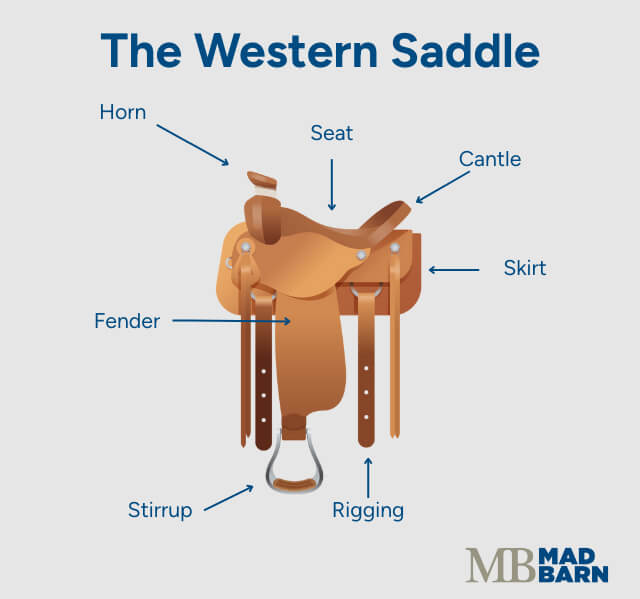
Important components of a Western saddle include: [2][3][7]
- Tree: The inner structure of the saddle determines its fit, shape and structure. Traditionally made from laminated wood covered in rawhide, the tree provides strength and flexibility. Modern saddles may also feature trees made from fiberglass or aluminum, offering a lighter alternative. While fiberglass trees are popular for their reduced weight, rawhide-covered wooden trees are often favored for their superior flexibility, which helps accommodate the horse’s movements.
- Seat: Comes in various slopes and padding levels, influencing how the rider sits and balances. Seats are typically measured from the base of the horn to the top of the cantle, with sizes ranging from 14 inches (35.5 cm) to 16 inches (40.5 cm).
- Cantle: Provides back support to the rider and contributes to overall security. High cantles offer greater support and are often preferred for rough stock riding or trail riding. Lower cantles allow for more freedom of movement, making them ideal for disciplines such as roping, where quick dismounts are necessary.
- Horn: A signature feature of the Western saddle, initially designed for roping cattle. It provides a secure point to dally a rope, but also serves as a handhold for balance, especially during sharp turns or sudden stops.
- Stirrups: Play a vital role in rider positioning, safety, and cues. Proper stirrup placement ensures that the rider’s legs are correctly aligned, aiding balance and reducing fatigue. Adjustable stirrup leathers allow for customization based on the rider’s leg length.
- Skirt: Helps distribute the rider’s weight evenly across the horse’s back, preventing pressure points.
- Rigging: Secures the saddle to the horse. Rigging comes in different styles (such as full, 7/8, and 3/4) affecting saddle stability and the horse’s comfort.
- Fenders: Connect the saddle to the stirrups. These wide leather panels help protect the rider’s legs from the horse’s sweat and movement of the stirrup leathers.
What's your top priority with your horse's health?

Enter your email to receive your store credit
Key Features
Selecting the right Western saddle goes beyond basic fit. It also involves evaluating specific design features that contribute to rider comfort, horse performance, and saddle longevity. These features vary depending on the intended use, from competitive events to trail riding.
Several different factors influence the comfort and functionality of a Western saddle, including: [2]
- Seat length: Seat length is a crucial factor in saddle fit. A standard 15-inch seat fits most average riders, while smaller riders may prefer a 14-inch seat and larger riders often require a 16-inch seat.
- Padding: Thicker padding provides extra comfort for long rides, while minimal padding offers a closer feel for more precise cues.
- Cantle shape: The shape of the cantle affects rider security and comfort. A high cantle provides added back support and stability, essential for rough terrain or challenging maneuvers. Conversely, a lower cantle allows for greater freedom of movement, making it ideal for activities including roping or cutting.
- Stirrup placement: Riders with shorter legs often need their stirrups hung farther back to maintain proper alignment, while taller riders or those with longer thigh bones benefit from stirrups placed further forward. This ensures that the rider’s legs are in a natural, relaxed position, reducing strain during prolonged rides.
- Seat balance: The saddle’s balance point ensures that the rider’s weight is evenly distributed, preventing undue strain on the horse’s back and enhancing overall communication.
Types of Western Saddles
Western saddles are designed to meet the unique demands of various disciplines, each with distinct features that enhance performance, safety, and comfort. From the rugged needs of roping to the precise movements of reining, choosing the right saddle type is essential for both horse and rider.
Roping Saddle
Roping saddles are built for the intense demands of catching and restraining livestock. The hallmark of a roping saddle is its sturdy, reinforced horn, which must endure the immense pressure of a lassoed animal pulling against it. This horn is securely attached to the saddle tree, often with additional wrapping to ensure it can withstand the force of a steer dragging, turning sharply, or stopping suddenly. [2][8]
A deep, secure seat keeps the rider stable during sudden movements, while a low cantle makes fast dismounts easier — an essential feature for calf ropers who need to swiftly tie down their catch.
Due to their robust construction, roping saddles are typically heavier than other styles, weighing up to 40 lb (18 kg). While their weight adds to their durability, it also requires significant upper body strength to lift them onto a tall horse. [2][8]
Barrel Racing Saddle
Barrel racing saddles are designed for speed, agility, and tight turns. This discipline involves racing around three barrels in a cloverleaf pattern, demanding quick acceleration and precise maneuvering.
To accommodate these needs, barrel saddles are lightweight, often around 25 lb (11 kg), making them easy for the rider to handle and minimizing the load on the horse. [2]
A high cantle offers added security, helping riders stay anchored during rapid turns and bursts of speed. The stirrups are hung in a forward-balanced position, allowing riders to maintain balance while leaning into tight corners. Unlike heavier roping saddles, the streamlined design of a barrel saddle ensures maximum agility, giving the horse freedom to perform at its best. [2]
Cutting Saddle
Cutting is a Western sport and ranch skill in which a horse and rider single out one cow from the herd. The work demands sharp, rapid movements and lightning-fast stops, so the rider must stay balanced while the horse pivots beneath them.
Cutting saddles feature a flat seat that allows riders to stay centered even when the horse makes sudden lateral movements. [2][8] Shortened skirts reduce the saddle’s weight and allow for greater flexibility, enabling the horse to move fluidly without interference.
Lightweight construction is crucial, as it helps the horse maintain its agility during fast-paced cuts and turns. Oxbow stirrups, which are narrow and rounded, provide the rider with better control and close contact with the horse. [2][8]
Trail Saddle
Trail saddles (also known as Pleasure saddles) are built with comfort in mind, making them ideal for long hours in saddle over varied terrain. They often feature extra padding in the seat to reduce rider fatigue during extended rides.
A high cantle and moderate swells provide additional security, ensuring the rider feels stable and supported even on challenging trails. [2][8]
One of the key features of a trail saddle is the inclusion of D-rings and saddle strings, which allow riders to attach essential gear such as water bottles, saddlebags, and camping equipment.
The stirrups are typically hung further forward than on other saddles, promoting a chair-like seat that many riders find more comfortable for long periods. [2][8]
Show Saddle
Show saddles are designed to impress in the arena. These saddles are often highly decorative, with intricate tooling, light-colored leather, and an abundance of silver accents to catch the eye under bright show ring lights.
The deep seat offers a high degree of slope, securing the rider against the cantle and promoting a poised, elegant posture essential for showmanship. [2]
While aesthetics are a priority, show saddles also provide comfort and functionality, though they are not typically used for strenuous activities such as roping or cutting. Lightweight leather enhances the saddle’s appearance, making it a favorite for Western pleasure and equitation classes. [2]
Reining Saddle
Reining saddles are crafted for the precision and athleticism required in reining competitions. Reining patterns include spins, sliding stops, and lead changes, requiring a saddle that allows close communication between horse and rider. [2][8]
A close-contact design enhances the rider’s feel for the horse, while a low cantle and seat enable unrestricted movement during complex maneuvers.
Modern reining saddles often feature flexible trees and innovative rigging systems, providing the flexibility needed for the horse’s athletic performance. The lightweight build also aids in maintaining fluidity and balance during rapid transitions. [2][8]

How to Choose a Western Saddle
Choosing the right Western saddle is an important decision for both horse and rider. A poorly fitted saddle can lead to discomfort, behavioral issues, and even performance-limiting physical changes in the horse.
For the rider, an ill-fitting saddle can cause imbalance, fatigue, and poor riding posture. Ensuring both horse and rider have a saddle that fits correctly is essential for comfort, safety, and optimal performance.
Fitting the horse
The shape of the horse’s back is the first consideration when fitting a saddle. A well-fitted saddle tree should conform to the arc of the horse’s back from withers to croup. This ensures that pressure is evenly distributed, preventing sore spots and muscle atrophy. [2]
A variety of horse breeds are used in Western disciplines, each with different topline profiles such as mutton, medium, or high withers.
The saddle must accommodate these variations to avoid pinching or bridging, where the saddle fails to make even contact along the horse’s back. Regular checks are necessary as the horse’s back shape can change over time due to conditioning, weight fluctuations, and age.
Saddle width is also a critical factor in fitting. Western saddles typically come in several tree widths, including: [2]
- Regular (narrow)
- Semi-quarter horse (medium)
- Quarter horse (wide)
- Arabian (extra wide)
- Draft horse (also extra wide, with different angles to match draft conformation)
A horse with high withers may require a regular tree, while broader-backed horses, such as stock breeds, may need a wider tree. When placing the saddle, ensure that there is adequate clearance over the withers, even when the rider is mounted.
Additionally, the saddle should allow the horse’s shoulders to move freely, without restricting movement or chafing. [2]
Fitting the Rider
A properly fitted saddle allows the rider to maintain a neutral, balanced seat. The seat length should match the rider’s body type, providing enough room for comfort without compromising stability. For example, a 15 in (38 cm) seat is standard for most riders, while taller individuals or those with longer legs may require a 16 in (41 cm) seat. [2]
Stirrup placement plays a crucial role in rider positioning. Short-legged riders often need stirrups hung farther back, while taller riders may need them placed slightly forward. Proper positioning allows the rider’s legs to hang naturally, maintaining close contact with the horse’s sides to be able to provide effective cues. [2]
The cantle height and seat slope also influence rider posture, ensuring the rider can sit deep in the saddle without sliding forward or backward. When both horse and rider are correctly fitted, the result is a harmonious partnership that enhances performance and comfort in any Western discipline. [2]
Additional Considerations
The materials used in the saddle tree and padding affect fit and overall durability. Traditional wooden trees covered in rawhide offer flexibility and strength, conforming to the horse’s back over time. However, modern materials like fiberglass and aluminum provide lighter alternatives that can be beneficial for riders who prioritize minimizing the total load for the horse. [2][3]
The padding in the saddle seat and skirts can also impact fit, as thicker padding alters the saddle’s contact surface on the horse-contact side. Regular maintenance, such as checking for warping or damage to the tree, helps ensure that the saddle continues to fit over time. [2][3]
Frequently Asked Questions
Here are some frequently asked questions about Western saddles:
Check for even weight distribution, adequate wither clearance, and freedom of movement in the shoulders. Dry spots under the saddle after a ride may indicate poor fit. It's also important to check saddle length. The saddle bars (not the skirt) should sit only on the ribcage, not the lower back.
The seat size depends on the rider's body type. A 15” seat is standard, while larger riders may prefer a 16” or 17” seat. Stirrup placement should also be considered for leg comfort.
While some all-purpose Western saddles exist, specialized saddles provide better performance for activities such as roping, barrel racing, or trail riding.
Traditional rawhide-covered wooden trees offer durability and flexibility, while fiberglass and aluminum options provide lightweight alternatives.
Regularly clean and condition leather, check for signs of wear, and store in a dry, temperature-controlled environment to prevent damage.
Summary
The Western saddle originated in North American ranch work and continues to serve as standard equipment in modern roping, reining, barrel racing, and recreational trail riding. Correct fit distributes the rider’s weight evenly, reduces pressure points, and supports efficient movement and endurance for both horse and rider.
- Western saddles evolved to meet the needs of traditional cowboys of Spanish and Mexican descent handling livestock in the American west
- These saddles are designed to prioritize rider comfort for long hours of ranch work while allowing the horse to move effectively for specific disciplines
- Understanding saddle construction, types, and fitting considerations ensures a positive riding experience for both horse and rider
- Some types of Western saddles have unique, artisanal embellishments and features that hold deep cultural significance in the Western riding community
References
- Chavez y Gilbert, D., Cowboys - Vaqueros: Origins of the First American Cowboys. New Mexican Hispanic Culture Preservation League. 2011.
- Snyder-Smith. D., The Classic Western Rider. Hoboken, N.J. : Howell Book House/Wiley Pub. 2006.
- Winegar. D., New Materials and Methods for Western Saddlery. Sports Product Design, University of Oregon. 2022.
- Brandon. E., Horses: How Saddle Style Defines a Culture and the Skeletal System. Western Michigan University Honors Theses. 2015.
- Evans. T., King of the Western Saddle: The Sheridan Saddle and the Art of Don King. Univ. Press of Mississippi. 1998.
- Reynolds. B., Art of the Western Saddle: A Celebration Of Style And Embellishment. Rowman & Littlefield. 2005.
- Risner, G., Parts of a Western Saddle and the Variations. Buffalo Bill Center of the West. 2021.
- Types of Western Saddles. Kentucky Horse Council. 2009.