English












Anatomical bridles for horses have become increasingly common in modern tack rooms. Often described as ergonomic bridles, these designs typically feature contoured crownpieces, cutaway nosebands, additional padding, and other modifications intended to reduce pressure on sensitive areas of the horse’s head.
Manufacturers often claim these features improve comfort and performance. While some research suggests certain designs can redistribute pressure at specific anatomical locations, the relationship between bridle design, fit, and horse welfare is more complex than a simple equipment change.
A well-designed bridle cannot compensate for poor fit or excessive tightness. Understanding where pressure occurs, how anatomical bridles are intended to work, and what the current research shows can help riders make more informed choices.
This guide reviews the design principles behind anatomical bridles, summarizes the current research, and explains how to evaluate and fit a bridle for your horse.
What is an Anatomical Bridle?
An anatomical bridle is a bridle designed to reduce pressure on sensitive areas of the horse’s head by shaping the straps to better follow the horse’s natural anatomy.
Unlike a standard bridle, anatomical bridles typically use contoured shapes and added padding to avoid predictable pressure points. It’s important to note that “anatomical” is not a regulated term, so its meaning varies by brand.
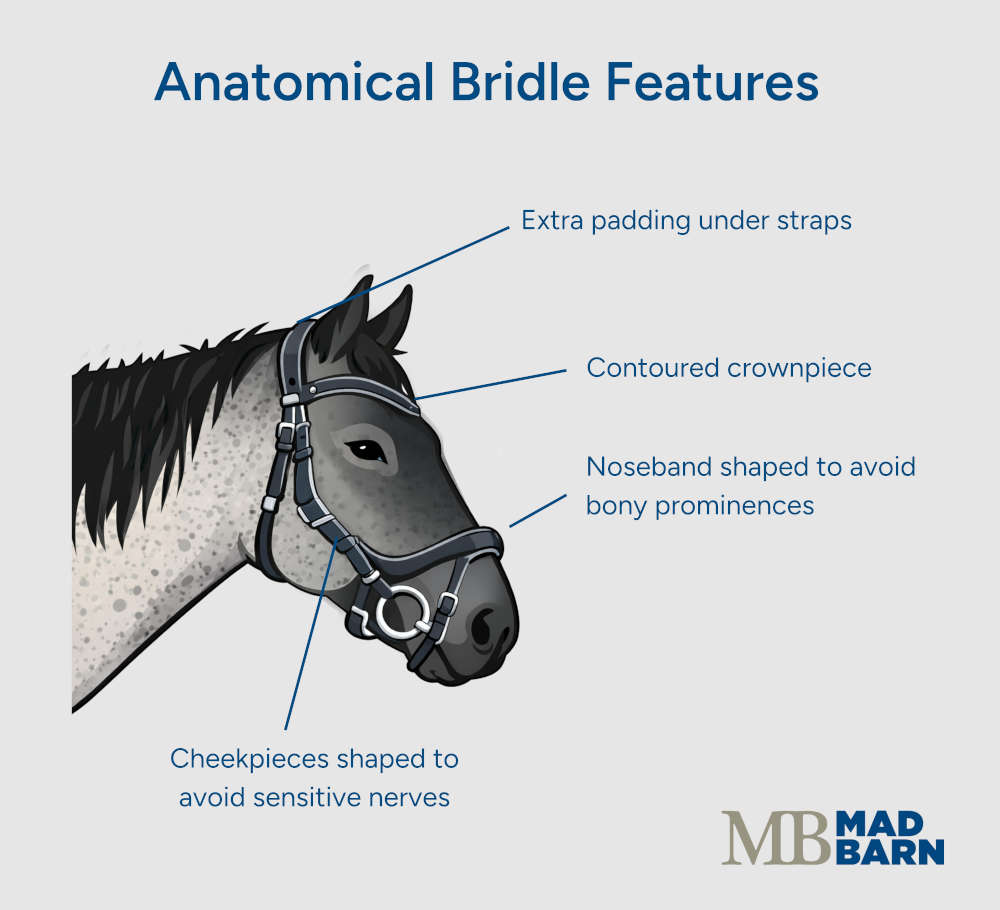
Most anatomical bridles share a few common design features:
- Contoured crownpiece: shaped to sit around the base of the ears and distribute pressure across a wider area
- Ear clearance: cutouts to reduce pinching behind the ears
- Cutaway noseband: intended to avoid bony prominences
- Shaped cheekpieces: to keep hardware from sitting on sensitive areas
- Strategic padding: designed to spread contact, reduce rubbing, or increase stability
The design is intended to address common issues observed with standard bridles. Any strap that concentrates pressure in a small area can cause discomfort, rubbing, or defensive behavior, especially when combined with poor fit.
Anatomical vs. Conventional Bridles
Conventional bridles typically use straight straps and standardized placement that has changed little over time. Most horses can comfortably wear a correctly fitted traditional bridle, and many continue to perform well in them across all disciplines.
Anatomical bridles attempt to modify these traditional designs by shaping straps to avoid certain anatomical structures and redistribute pressure across a wider area.
In practice, the difference between the two designs often comes down to how pressure is distributed and how well the bridle fits the individual horse’s head shape. A well-fitted conventional bridle may be just as comfortable as an anatomical design, while a poorly fitted anatomical bridle can still create pressure points.
What's your top priority with your horse's health?

What's your top priority with your horse's health?
Bridle Pressure Points
Understanding the design features of an anatomical bridle requires looking more closely at where pressure is concentrated when a horse wears a bridle. Certain areas of the head are more sensitive, particularly when straps are poorly fitted or overly tight.
Bridles are not inherently harmful, and most horses can comfortably wear correctly fitted bridles. Problems arise when pressure becomes excessive, uneven, or applied to vulnerable structures.
High-Risk Areas
There are several sensitive areas on the horse’s head which are prone to pressure points under tack. These regions are usually associated with:
- Thin soft tissue covering bone
- High concentration of nerves and blood vessels
- Joints involved in movement of the head and jaw
When bridle straps concentrate pressure over these structures, horses may experience discomfort, rubbing, or defensive responses.
Because multiple bridle components interact across the head at the same time, pressure rarely occurs in isolation. Rein tension, noseband tightness, and strap positioning can all influence how forces are distributed.
The following areas are among the most commonly discussed in research and bridle-fitting guidance: [1][2][3]
- Poll: The crownpiece sits over the poll and around the base of the ears. A narrow, stiff headpiece can concentrate pressure on this sensitive region. Some anatomical crownpieces aim to reduce that pressure by widening the bearing surface and shaping around the ears.
- Nasal Bones: The nasal bone is more delicate towards the end of the horse’s face. A noseband that sits too low, is overly tight, or has a shape that creates edge pressure can increase the risk of discomfort.
- Mandibular: Bridle straps can transfer pressure to the TMJ, lower jaw, and surrounding soft tissues. Recent work measuring facial pressures has shown that mandibular pressure increases with noseband tightness.
Understanding Pressure on the Bridle
A bridle that looks acceptable while standing still may become problematic once in motion. The most useful tack-related research tends to measure pressure during movement rather than relying only on a still photo or a quick fit check. [1]
Rein contact changes the direction and magnitude of forces, and movement can cause straps to shift, tighten, or rub. Anatomical design can help, but only if the bridle is correctly adjusted and remains stable and unrestrictive during movement.
Evidence Supporting Use of Anatomical Bridles
These pressure patterns are one reason anatomical bridles have attracted attention from researchers and welfare organizations.
Recent studies have attempted to measure how different bridle designs affect pressure distribution and whether those differences influence the horse’s movement or behavior.
Anatomical Design & Pressure Distribution
One frequently cited study evaluated pressure patterns under the headpiece and noseband, then designed an anatomical bridle intended to avoid peak-pressure locations and compared it to the horse’s usual bridle. [1]
The anatomical bridle produced lower maximum pressures under both the headpiece and the noseband. The authors also reported small associated differences in gait measures, such as carpal and tarsal flexion and forelimb protraction. [1]
This study supports the idea that some anatomical bridle designs can reduce peak pressures at predictable locations. However, it does not prove that every anatomical bridle improves comfort for every horse.
Pressure reduction is just one piece of welfare. Comfort also depends on training, rider skill, bit choice, saddle fit, soundness, and the horse’s individual sensitivity.
Noseband Tightness
Correctly fitted nosebands help stabilize the bit and encourage better contact. But excessively restrictive nosebands can suppress normal behavior and may increase stress. Several studies have investigated the impacts of noseband tightness on bridle fit and equine welfare. [2][3][4]
In a study examining noseband tightness and facial pressure, both nasal and mandibular pressures increased with tightness. Tightness at 1 finger laxity or less was associated with significantly higher pressures than looser settings. [2]
Tightness also affects behavior and physiology. In an experiment evaluating very tight nosebands, horses showed restricted oral behaviors and increased stress response. [3]
Field studies reinforce that tight nosebands are common in sport settings. For example, one international observational study reported that many nosebands were fitted more tightly than traditional recommendations. [4]
These findings support traditional recommendations that riders should be able to fit two stacked fingers under a correctly fitted noseband. Padding and design on anatomical bridles help distribute pressure, but an anatomical noseband can still be tightened enough to cause discomfort.
Measuring Noseband Tightness
While research shows that traditional guidance aligns with modern welfare studies, historical methods for measuring noseband tightness with “two fingers” aren’t reliable. [5]
This method of measurement varies by person and placement. Research groups have developed tools to standardize tightness assessment, including a taper gauge concept associated with the International Society for Equitation Science. [6]
More recently, objective measurement has become more widely used in sport. The Fédération Equestre Internationale (FEI) published protocols for the use of an approved noseband measuring device at FEI events in 2025. [7]
These changes reflect a broader shift in equestrian sport as welfare initiatives drive more consistent standards. Riders may increasingly need to ensure that tack meets measurable criteria rather than relying on traditional methods.
Research Limitations
While new studies on anatomical bridles and bridle fit are promising, more research is needed to support the conclusions organizations and brands use to guide rules and design. Few independent head-to-head trials are comparing multiple commercial anatomical bridles across different breeds and disciplines. [8]
In addition, many studies have small sample sizes or focus on a single discipline, and study designs often don’t account for differences in conformation or training. [2]
The evidence supports the logic behind anatomical design, but the biggest welfare levers a rider controls today are still fit and stability.
Because research findings are still developing, riders often need to make practical decisions based on their horse’s individual conformation and response to tack. Selecting a bridle that suits both horse and rider requires careful observation rather than relying solely on marketing claims.
Choosing an Anatomical Bridle
The best anatomical bridle for your horse depends on their conformation, discipline, training, and individual preferences. Ideally, look for opportunities to try different bridles before purchasing a specific brand.
Horse Considerations
Before shopping for a new bridle, evaluate your current tack for help determining what anatomical features may benefit your horse. Look for patterns of rubs or soreness behind the ears, poll, cheekbones, or under the noseband. Persistent rubs are often a signal of poor fit, not just a padding problem.
Conformation is another important factor to consider when choosing an anatomical bridle. Horses with prominent facial bones or a narrow jaw may be more sensitive to strap edges and hardware placement. [9]
Poor tack fit can also contribute to issues under the saddle, but it’s rarely the only cause. Head tossing, bridling resistance, gaping, or tongue behaviors can have multiple causes. Work with your veterinarian to rule out an underlying medical problem.
Rider Considerations
Your bridle is a communication tool between you and your horse. While it’s tempting to turn to new equipment in an attempt to fix training issues, the rider also has a significant impact on the horse’s comfort and performance. Before making changes, it’s important to assess whether your cues are clear and consistent.
There are also different rules governing tack depending on which discipline you participate in. Check your relevant governing body for rules related to tack. Some anatomical designs may not be legal in competition.
How to Fit an Anatomical Bridle
Bridle fit is just as important as saddle fit. Consider working with a qualified bridle fitter when fitting an anatomical bridle to increase the likelihood of success.
Once a suitable design has been selected, correct adjustment becomes the most important factor in ensuring a comfortable fit. Even a thoughtfully designed anatomical bridle can create pressure points if it is incorrectly fitted.
Here’s a step-by-step guide to evaluating the fit of an anatomical bridle on your horse:
- Crownpiece position and ear clearance: Ensure the crownpiece sits flat and is not pulled forward into the base of the ears, and check that the browband does not drag the crownpiece into the ears.
- Browband length: If the browband is too short, replace it. A generously curved browband is less likely to pull the crownpiece forward than a straight one.
- Cheekpieces and bit height: Set cheekpieces evenly and adjust the bit to a correct, neutral position. Ensure there is adequate clearance between the cheekpieces and the eye. The buckles on the cheekpieces can also cause pressure points on the TMJ if not sized correctly.
- Noseband placement and tightness: Noseband fit is where welfare concerns most often arise. Ensure the noseband sits at an appropriate height for its style and does not migrate into more delicate areas. A noseband should stabilize the bridle and support clear communication, not prevent the horse from moving its jaw, swallowing, or expressing normal oral behaviors.
- Throatlatch: A throatlatch that is too tight can restrict swallowing and normal movement. It should be fitted so the horse can comfortably flex at the poll and swallow without constraint.
After riding, inspect for hair loss, heat, swelling, or tender points. Rechecking the fit after being in motion is an important final step. A bridle that slides around may not be the appropriate size or design.
Evaluating Anatomical Bridles
After adjusting the bridle, the next step is evaluating how the horse responds during work. Subtle behavioral changes or new pressure marks can provide valuable information about whether the bridle is functioning as intended.
Look for these positive and negative signs when evaluating an anatomical bridle for your horse:
| Positive Signs | Negative Signs |
|---|---|
| Easier bridling and fewer avoidance behaviors | New head shaking or ear pinning |
| Reduction in rubs or pressure marks | Rubs, hair loss, or swelling at strap edges |
| More stable, quieter contact without increasing tightness | Escalation of mouth opening, tongue behaviors, or attempts to evade contact |
| Improved relaxation signals under saddle | Bridling resistance |
If problems persist, take a step back. Mouth discomfort, dental issues, musculoskeletal pain, saddle fit, ulcers, and training conflict can all contribute to bridle-related behaviors.
Tack adjustments can help, but they are not a substitute for addressing underlying pain or training factors.

Comfort Beyond the Bridle
Tack design can influence how pressure is distributed on the horse’s head, but comfort and performance depend on more than equipment alone. Training practices, physical health, rider skill, and management all shape how a horse experiences work under saddle.
Rider contact plays an important role in how forces are transmitted through the bridle. Rein tension, hand stability, and overall balance influence the pressure a horse experiences during riding. Even a thoughtfully designed anatomical bridle cannot compensate for inconsistent or restrictive rein use.
Management factors also contribute to comfort during work. Adequate turnout, appropriate conditioning, and a balanced diet that supports musculoskeletal and digestive health can influence how a horse feels and performs.
For these reasons, bridle design should be viewed as one component of a broader system. When tack, training, health care, and management all support the horse’s comfort, communication between horse and rider becomes clearer and more consistent.
Frequently Asked Questions
Here are some frequently asked questions about anatomical bridles for horses:
An anatomical bridle is designed to reduce pressure on specific areas of the horse's head by altering the shape, placement, or padding of straps. Common design features include shaped crownpieces, repositioned cheekpieces, and modified nosebands intended to avoid sensitive anatomical structures.
Anatomical bridles are not always more comfortable than traditional bridles. Some designs may reduce peak pressure at certain locations, but overall comfort still depends on correct fit, stability, and adjustment. A poorly fitted anatomical bridle can create new pressure points even if the design is intended to reduce pressure.
Some pressure-mapping studies suggest certain anatomical bridle designs may redistribute pressure on parts of the head such as the poll or facial nerves. However, results vary by design, and research in this area is still limited. Bridle fit and noseband tightness often have a larger effect than the overall bridle style.
Anatomical bridles may help reduce resistance behavior in some horses if the behavior is related to tack discomfort. However, head tossing, mouth opening, and other resistance behaviors can have many causes including training, dental issues, pain, or rider aids. A bridle change should be considered as part of a broader evaluation rather than the only solution.
No. Pressure increases as any noseband is tightened, regardless of design. Very tight nosebands can suppress normal oral behaviors and may increase physiological stress responses.
The traditional guidance for noseband fit is that two stacked adult fingers should fit between the nasal midline and noseband. This guidance is helpful, but remains subjective. More recent evidence-based guidelines recommend using objective measurement tools, such as taper gauges or two-finger standards, are often used to evaluate noseband fit.
Not necessarily. Padding may help distribute pressure but also increases bulk. In some cases it can shift pressure to the edges of straps or encourage overtightening because the padding feels softer to the handler.
Most anatomical bridles do not change the mechanical action of the bit itself. However, repositioning cheekpieces or altering strap angles may slightly affect how the bit sits in the horse's mouth.
Some anatomical crownpieces are shaped to distribute pressure away from the center of the poll. Whether this improves comfort depends on the individual horse, bridle design, and overall fit.
Not necessarily. Many horses perform comfortably in well-fitted traditional bridles. Changing tack is most useful when you have a specific fit or comfort goal and can evaluate whether the change actually benefits the horse.
Summary
Anatomical bridles are designed to redistribute pressure and accommodate the horse's head shape through features such as contoured crownpieces, shaped nosebands, and strategic padding. While some research suggests these designs can reduce peak pressure at certain locations, correct fit and adjustment remain the most important factors influencing comfort and welfare.
- Anatomical bridles aim to reduce pressure on sensitive areas of the horse's head through contoured shapes and padding
- Research suggests some anatomical designs can reduce peak pressures under the crownpiece and noseband compared with a horse's usual bridle
- Noseband tightness has a strong influence on pressure and welfare regardless of whether the bridle is anatomical or conventional
- A well-fitted conventional bridle may be just as comfortable as an anatomical design when correctly adjusted
- Bridle fit should be evaluated during movement and after riding to identify rubs, pressure points, or behavioral changes
- An anatomical bridle cannot compensate for poor fit, excessive tightness, or underlying training or health issues
References
- Murray. R. et al. A Bridle Designed to Avoid Peak Pressure Locations Under the Headpiece and Noseband Is Associated With More Uniform Pressure and Increased Carpal and Tarsal Flexion, Compared With the Horse’s Usual Bridle. Journal of Equine Veterinary Science. 2015.
- MacKechnie‐Guire. R. et al. Noseband Type and Tightness Level Affect Pressure on the Horse’s Face at Trot. Equine Veterinary Journal. 2025. View Summary
- Fenner. K. et al. The Effect of Noseband Tightening on Horses’ Behavior, Eye Temperature, and Cardiac Responses. PLOS ONE. 2016. View Summary
- Doherty. O. et al. Noseband Use in Equestrian Sports – An International Study. PLOS ONE. 2017. View Summary
- Doherty. O. et al. An Objective Measure of Noseband Tightness and Its Measurement Using a Novel Digital Tightness Gauge. PLOS ONE. 2017. View Summary
- ISES Position Statement on Restrictive Nosebands. ISES. 2019.
- General and discipline-specific protocols for the FEI noseband tightness measuring device. FEI. 2025.
- Gertz. E. et al. The Effects of the Quantum and Finesse Bridles on Equine M. Brachiocephalicus and M. Splenius Function at Three Different Speeds. Open Journal of Veterinary Medicine. 2020.
- Bucknell. D. and Randle. H. A comparison of Micklem bridles and conventional bridles fitted with restrictive nosebands. Charles Stut University. 2019.