






 English
Equine Electrolyte Calculator
Estimate your horse's sweat volume and electrolyte losses during exercise to provide appropriate hydration and support post-workout recovery.
The following electrolyte losses are also predicted:
grams of sodium
grams of chloride
grams of potassium
grams of magnesium
grams of calcium
Split these amounts into multiple servings and offer them to your horse during exercise and throughout the following 24 - 48 hours post-exercise.
You should also provide free-choice access to fresh, clean water and loose salt at all times.
The Equine Loss of Electrolytes Calculator (ELEC) provided on this platform is intended as a general reference for educational purposes only and should not be considered veterinary advice. The ELEC is designed to offer information and insights into the sweat losses that may impact equine performance and well-being.
ELEC calculations and interpretations are based on available scientific data and established guidelines. However, actual sweat losses can be influenced by numerous factors, all of which may not be represented in the available tool, and data is subject to errors and incompleteness.
Mad Barn makes no warranties or guarantees, either expressed or implied, regarding the accuracy, completeness, or reliability of the information provided. By using the ELEC, you acknowledge and agree that you assume full responsibility for any actions taken or decisions made based on the ELEC results.
Electrolyte and Sweat Losses in Exercising Horses
Riders and handlers need to be aware of how much their horses are sweating to prevent dehydration and heat stress, and to support recovery from exercise.
Horses lose significant amounts of water through sweating, especially during exercise or in hot weather. They also lose essential electrolyte minerals in their sweat, which must be replenished to prevent imbalances.
This tool predicts your horse’s sweat losses during exercise and recovery by considering their body weight, exercise duration, and current weather conditions.
By monitoring sweat loss, you can provide sufficient water and appropriate electrolyte supplementation to maintain optimal hydration and ensure your horse performs at their best.
How to Use the Electrolyte Calculator for your Horse
Mad Barn’s Equine Loss of Electrolytes Calculator (ELEC) is designed to help you understand how much water and electrolytes your horse loses in their sweat when exercising.
The following factors are used to estimate your horse’s total sweat fluid and electrolyte losses:
- Your horse’s body weight
- Duration of exercise
- Ambient weather conditions (temperature and humidity)
- Visual sweat score
Body Weight
You can enter your horse’s body weight in either kilograms (kg) or pounds (lb). This value is used to estimate your horse’s total surface area (m2), which informs how much skin area they have available to dissipate heat.
Horses with more surface area are expected to produce higher volumes of sweat.
Duration of Exercise
Enter the total time your horse spent actively exercising today, in minutes. Exclude any time spent walking slowly or standing still after exercise.
Horses engaged in exercise for longer durations of time are expected to produce higher volumes of sweat.
Ambient Conditions
Temperature and humidity are environmental conditions that influence how much your horse sweats at rest and during exercise. They also impact how effectively sweat evaporates from the horse’s skin to dissipate heat and cool down body temperature.
To determine these values, you have two options:
- Use current conditions in your location: Enter your location and the tool will return current temperature and humidity values for your area
- Manually input conditions: Enter current temperature and humidity values manually or input predicted values to plan for future workouts
Entering your location automatically provides the current temperature and humidity of your area. However, if you want to plan for a future ride, you can input hypothetical values to predict sweat losses and prepare an effective hydration strategy for your horse.
Visual Sweat Score
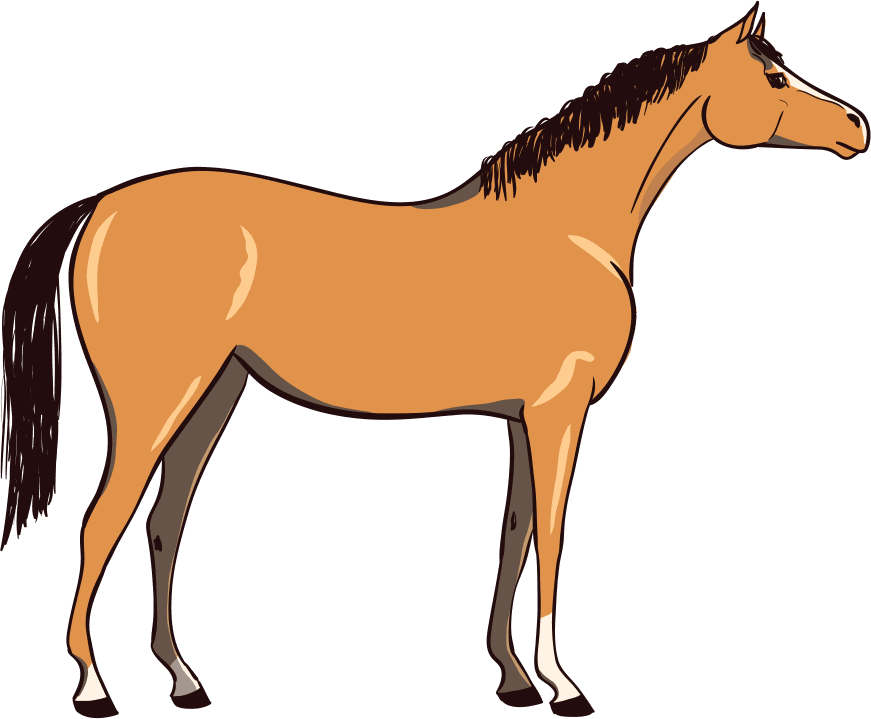
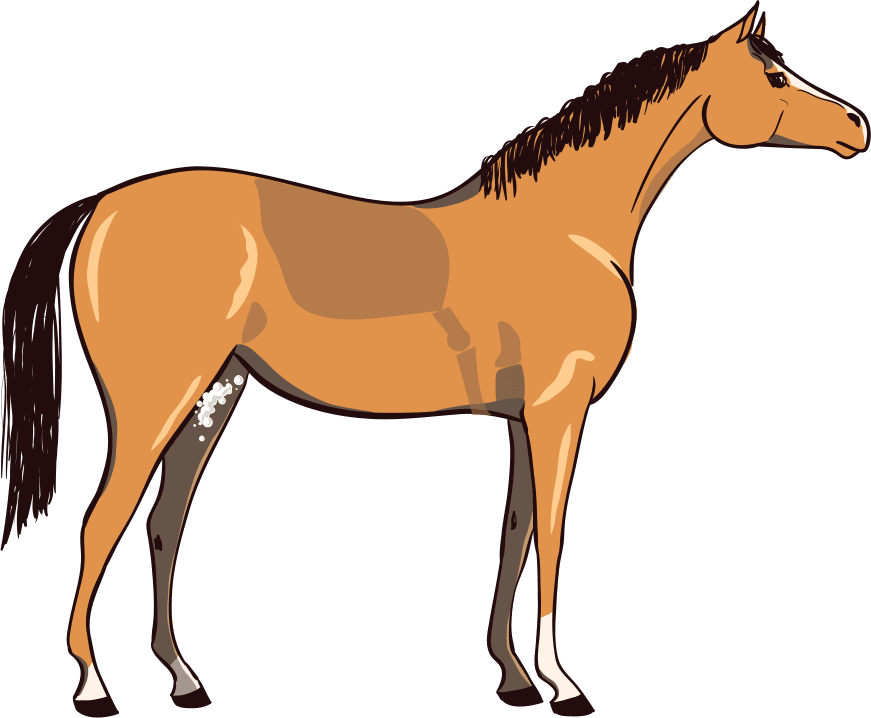
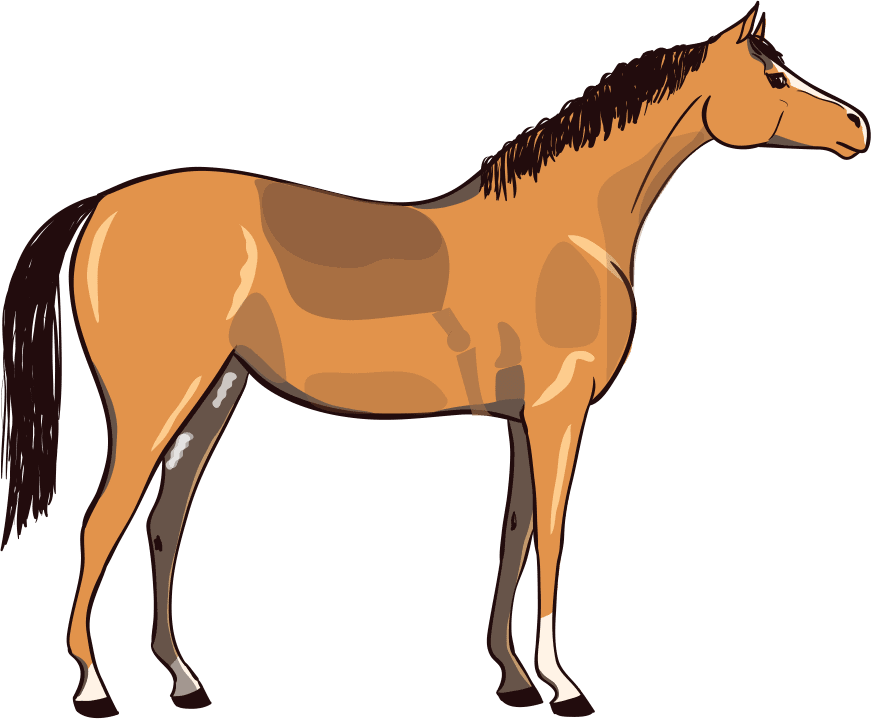
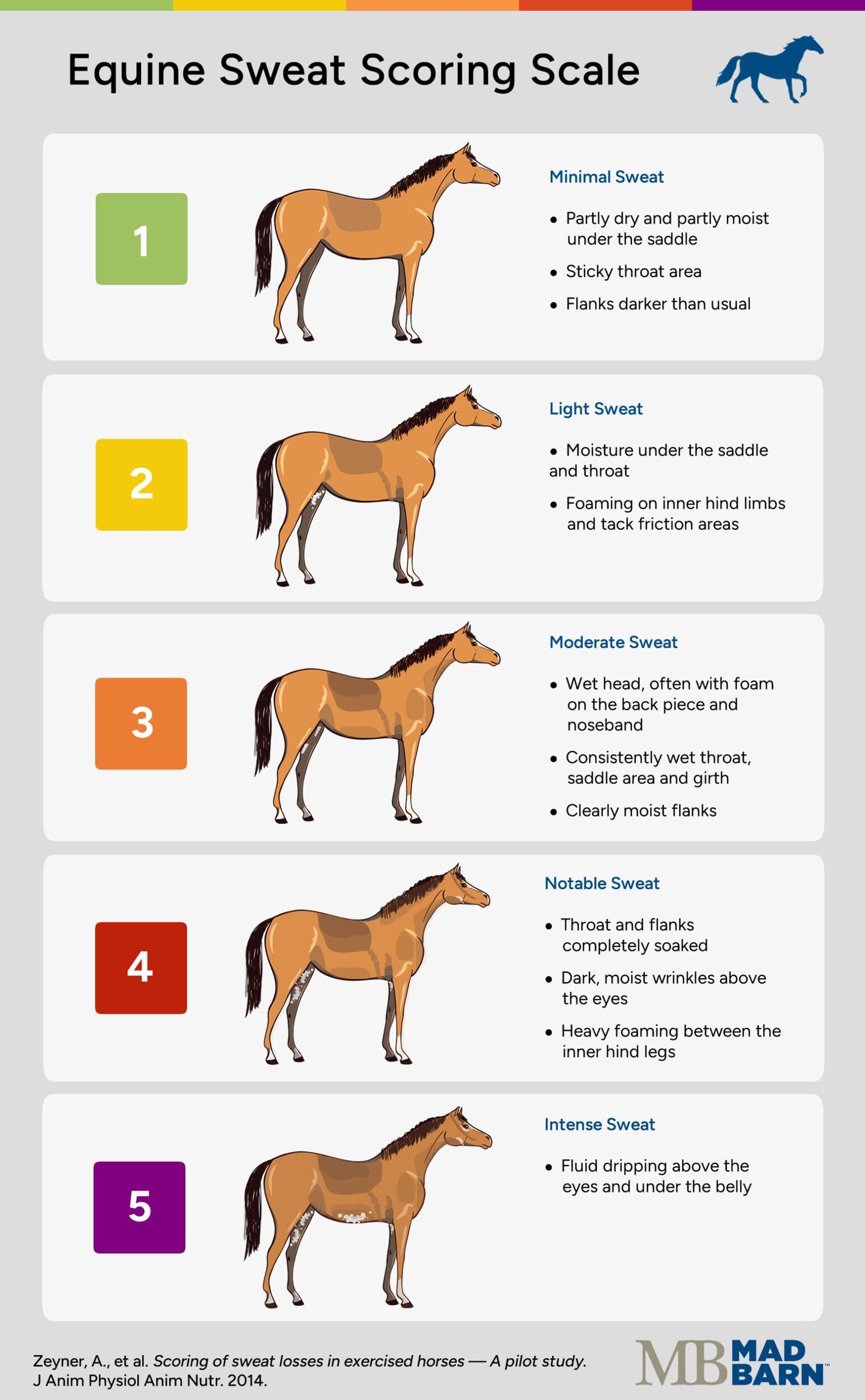
The Visual Sweat Score is used to adjust your horse’s sweat losses based on how wet they appear after exercise.
At the end of active exercise, examine your horse’s coat to evaluate the amount of sweat present. Use the following table to assign a visual sweat score as soon as possible following your exercise session.
| Score | Appearance | Description |
|---|---|---|
| 1 Minimal |
 |
|
| 2 Light |
 |
|
| 3 Moderate |
 |
|
| 4 Notable |
 |
|
| 5 Intense |
 |
|
Understanding the Sweat and Electrolyte Loss Predictions
Mad Barn’s ELEC tool estimates how much sweat and electrolyte minerals (sodium, potassium, chloride, magnesium and calcium) your horse loses when exercised under varying environmental conditions. The calculator also provides recommendations for the amount of salt, as well as the number of scoops of Performance XL: Electrolytes to give your horse after exercise to replenish sweat losses.
These recommendations are tailored to help you replenish nutrients lost in sweat sufficiently and in the correct ratio. Build this check into your post-exercise routine to support your horse’s recovery and hydration before their next training session.
How to Replenish Electrolytes
Since horses lose a large amount of electrolytes in their sweat, it may not be possible to replenish all losses immediately. The recommended electrolyte provisions can be divided into smaller servings and administered every 15 to 30 minutes after exercise until the full amount is given. [1]
Electrolyte supplements can be provided as loose powder, mixed into soaked feed or added to water. In all cases, fresh, clean water should be freely accessible to your horse.
Mixing Electrolytes in Water
If adding electrolytes to water, it is important to train your horse to consume this electrolyte solution in advance. [1] This will familiarize your horse with the taste and smell, which helps avoid hesitation in drinking the solution after exercise.
When adding electrolytes to water, an osmolality of 200 mOsm/L is recommended. [1] This is equivalent to one scoop of Performance XL: Electrolytes per litre or quarter gallon of water.
Electrolyte Pastes
Some riders prefer to offer electrolyte pastes or slurries via oral syringe. This is particularly common during endurance races to conveniently replenish electrolytes during the ride and rest breaks.
While this method can supply sufficient electrolytes, paste-based products must be accompanied by adequate water intake. The concentrated solution in pastes can irritate the stomach lining and lead to gastric ulcers. [2] Additionally, high osmolality in the foregut will draw water from the horse’s body into the gastrointestinal tract, potentially making dehydration worse. [1]
We do not recommend using commercial electrolyte pastes that have an emulsion base such as xantham gum which can delay gastric emptying and electrolyte absorption and damage the mucosal layer of the gut. [3]
If you wish to provide electrolytes via oral syringe, consider mixing Performance XL: Electrolytes which does not have an emulsion base, into a water-based slurry. For example, it can be mixed with applesauce and administered via syringe.
Prolonged Exercise
Currently, there is no experimental data available to model equine sweat losses during prolonged exercise bouts lasting more than 120 minutes. For this reason, the ELEC only provides sweat loss estimates for exercise lasting up to two hours.
As a guideline, horses that have been exercising for two hours (120 minutes) should be given a rehydration break with water and electrolytes.
Hot, Humid Conditions
Always proceed with caution when exercising in hot, humid conditions given the higher risk of dehydration, heat stress and heatstroke.
Use Mad Barn’s Equine Heat Index Tool to assess the risk of heat stress before exercising in hot or humid weather. The Equine Heat Index also provides suggested modifications to your exercise program and cooling strategies to safeguard your horse’s health at any time of year.
Horses can adapt to exercising in hot, humid conditions and become more efficient at dissipating heat through sweating over time. [4][5][6] However, if conditions are extremely hot and humid (defined as a heat index score greater than 110), exercise should be limited.
For this reason, the ELEC model does not consider exercise duration longer than 60 minutes if the environmental inputs indicate dangerously hot and humid conditions.
Supporting Hydration in Horses
Hydration is critical for supporting your horse’s athletic performance and preventing dehydration and heat stress.
To effectively manage your horse’s hydration status, it’s important to consider their daily feed regimen and other lifestyle factors like travel and competition in addition to post-exercise rehydration.
Daily Water Intake
Even if your horse is not exercising on a regular basis, it is important to determine how much water they need and monitor their fluid intake.
When not exercising, a 500 kg (1,100 lb) horse in a moderate climate should drink approximately 35 L (9.25 gal) of water per day. [7] This requirement increases to 60 L (15.9 gal) in hot conditions. [7]
Horses always need access to clean water. Owners and caretakers should regularly clean water troughs, buckets, or waterers and ensure they are in good working order.
Feeding your horse adequate salt is also important because salt stimulates thirst and helps your horse meet their sodium requirement. To encourage your horse to drink enough water, our nutritionists recommend feeding a minimum of one ounce of plain, loose salt per day and providing free-choice access to loose salt.
Some horses refuse to eat salt for a variety of reasons (sores in the mouth, gum disease, dental issues, gastric ulcers, or simply preference). For these horses sprinkling salt onto moistened hay is a good way to get it into them.
Hydration During Transport
Performance horses frequently need to be transported to competitions by trailer. Trailering your horse to a new location can cause stress, which can increase your horse’s sweat rate. This may be further exacerbated by hot conditions in the trailer and intermittent access to water.
To mitigate the impact trailering has on your horse’s hydration status, it is recommended to provide electrolytes and access to water in the hour before loading your horse onto the trailer. This helps preemptively replenish fluid losses expected during transit. [1]
If using Mad Barn’s Performance XL: Electrolytes, mix one to two scoops into 4 L (1 gal) of water and provide to your horse. You can also add electrolytes to your horse’s feed and provide ample fresh water.
During long-distance transit, provide breaks every two hours to offer water and electrolytes. Alternatively, use automatic waterers in the trailer that supply electrolyte-supplemented water. [1]
Following transport, ensure your horse is adequately rehydrated and rested prior to competition. Additional electrolyte supplementation may be warranted after long-haul travel, depending on weather and your horse’s condition.
Hydration Before Exercise
Pre-loading with electrolytes and water prior to exercise helps your horse maintain fluid and electrolyte balance and supports muscle function. [8]
Proper hydration assists with body temperature regulation, reducing the risk of heat stress during exercise. Adequate electrolyte levels also ensure your horse’s muscles are working efficiently, supporting better stamina and quicker recovery.
For optimal results, mix two scoops of Performance XL: Electrolytes into 4 L (1 gal) of water and feed to your horse one to two hours prior to exercise.
Monitor for Signs of Heat Stress
If your horse has been exercising or is in a hot, humid environment, it is critical to monitor for signs of heat stress to intervene promptly. Without intervention, heat stress can progress to life-threatening heatstroke.
Signs of heat stress in horses include: [9]
- Elevated rectal temperature (103 – 107°F or 39.5 – 41.5°C)
- Increased heart rate at rest
- Rapid breathing and flared nostrils at rest
- Dehydration, indicated by loss of skin elasticity, tacky gums, sunken eyes, and reduced urine output
- Exhaustion or lethargy
- Excessive sweating and hot skin
- Reduced feed intake
Rectal temperature, heart rate and respiratory rate will be further elevated in horses experiencing heatstroke. During heatstroke horses may also stumble, become agitated or collapse.
If you notice any signs of heat stress, you can cool your horse by hosing or sponging with cold water. [10] Oral electrolytes can be provided along with water, however some horses may require intravenous fluids to replenish fluids and electrolytes. [11]
How are Sweat Losses Estimated in the ELEC?
Several research studies have measured the sweat rate and/or electrolyte losses experienced by horses horses during exercise. [4][5][6][12][13][14][15][16][17][18][19][20]
To perform these studies, researchers typically attach a plastic envelope to the skin that collects sweat into a divot at the bottom of the envelope. A tube is inserted into the divot to collect the sweat without removing the envelope. [20]
The horses are then exercised on a treadmill in a room with controlled ambient conditions. This setup allows researchers to assess the impact of specific environmental factors on sweat rate and collect sweat while the horse is still exercising.
Sweat is collected and measured at five-minute intervals. This is used to calculate the sweat rate of the local area and to estimate total sweat rate of the horse’s whole body.
The electrolyte content of the sweat is also analyzed to determine how much sodium, chloride, and potassium the horse has lost.
Calculating Sweat Rate During Exercise
Data from various research studies was used to generate an equation to predict the volume of sweat lost under different ambient conditions.
The general structure of the equation used to calculate sweat rate in horses during exercise is:
This equation has four constants that vary based on the ambient conditions in which the horse is exercising. The constants are:
- Maximal sweat rate: The peak sweat rate in mL/m2/min that the horse is expected to attain during exercise
- Exponent: A unitless exponent that influences how quickly the horse reaches the maximal sweat rate
- Km: The time, in minutes, at which the horse has reached half of the peak sweat rate, analogous to the Michaelis constant in enzyme kinetics
- Decay: A constant that influences how quickly the horse’s sweat rate declines from the peak during active exercise
This equation is used to calculate sweat rate in five-minute intervals over the course of the horse’s active exercise period, based on the user-inputted exercise duration. Area-under-the-curve calculations are then used to determine total sweat rate (mL/m2) during exercise. Finally, the horse’s surface area is used to calculate total sweat loss during exercise in milliliters (mL).
The surface area of the horse is estimated from body weight (kg) based on the following equation:
Calculating Sweat Rate During Recovery
Horses continue to sweat in the post-exercise recovery period until their body reaches a normal core temperature. [5][16] The sweat rate during recovery and length of time they continue to sweat is partly influenced by ambient conditions.
To calculate sweat rate during the post-exercise recovery period, the following equation is used:
In this equation, recovery is a constant that varies depending on ambient conditions, influencing how quickly the sweat rate declines. The simulation continues until the sweat rate drops below the value measured at five minutes of active exercise.
Area-under-the-curve calculations are then used to determine total sweat rate (mL/m2) after exercise. Lastly, the horse’s surface area is used to calculate total sweat loss after exercise in milliliters (mL).
The sweat losses during and after exercise are added together to provide the total estimated sweat loss for your horse.
Adjustments to Sweat Rate
The major determinants of sweat losses in this model are body weight, duration of exercise and ambient conditions. The visual sweat score is intended to account for individual differences in horses to approximate intensity of exercise and other factors such as level of fitness. The user-inputted visual sweat score is used to adjust the predicted total sweat rate in cases where the visual score differs from what is otherwise expected based on ambient conditions and the horse’s total time exercising.
The visual sweat score was developed by Zeyner et al. as a practical tool to estimate an individual horse’s exercise-induced sweat losses. [21] However, this study was limited to relatively mild ambient conditions and exercise of up to 55 minutes. The study also used exercise-induced body weight changes as a proxy measure of sweat loss. Since more validation is required, it did not seem appropriate to solely rely on the visual sweat score as a prediction of sweat losses under a wide variety of conditions when developing this tool.
The visual sweat score can provide insight into individual differences between horses. The ELEC determines the expected visual sweat score based on the sweat volume lost during exercise. If the observed visual sweat score immediately after exercise differs, an adjustment factor is applied to account for the possibility that your horse is sweating more or less than the model predicts.
Several factors can cause a horse to appear to be more or less sweaty than predicted, including fitness level, coat thickness and length, body fat cover, and variable tack use. The model adjusts the sweat volume by up to 15% to account for these possible differences. This is in line with how much an individual horse’s sweat rate differs when increasing exercise intensity. [4]
Calculating Total Sodium Loss
Horses lose significantly more electrolytes in their sweat compared to humans. [1] While humans have hypotonic sweat, horses have hypertonic sweat which means it has a higher concentration of dissolved electrolytes (ions) compared to the fluids inside the body’s cells. [1]
Ions are charged particles that are essential for many physiological processes in the body, including regulating nerve and muscle function, pH balance and blood pressure.
Since a horse’s sweat is hypertonic, they have a higher risk of dehydration during and after exercise if these electrolytes are not adequately replenished.
Sodium is one of the most important electrolytes in equine sweat, followed by the minerals chloride and potassium. [1] Small amounts of magnesium and calcium are also lost in sweat.
Across several studies, the average sodium content of equine sweat is 2.8 grams per litre. [1] To calculate a horse’s total sodium loss in sweat, the following equation is used:
Similar equations can be used to determine total potassium, chloride, magnesium and calcium losses based on total sweat volume.
| Mineral | Concentration in Sweat |
|---|---|
| Sodium | ~2.8 g per L |
| Chloride | ~5 g per L |
| Potassium | ~1.2 g per L |
| Magnesium | ~0.1 g per L |
| Calcium | ~0.1 g per L |
Calculating Electrolyte Supplementation
Once the horse’s total electrolyte losses are estimated, these values are then used to determine appropriate salt and electrolyte supplementation to replenish lost minerals.
Since horses lose a large amount of sodium in their sweat, they should be fed at least 2 – 4 tablespoons of plain salt per day and provided free-choice access to loose salt.
However, feeding salt alone is insufficient to replenish all the sodium lost in sweat and does not provide other essential electrolytes like potassium. [22] An electrolyte supplement is necessary to fill in these gaps.
In the ELEC tool, total sodium loss is used to determine how many scoops of Mad Barn’s Performance XL: Electrolytes to provide after exercise. This supplement is scientifically formulated to replace electrolytes lost in sweat, providing a balanced ratio that meets the needs of exercising horses.
After intense or prolonged exercise, it may not be practical to provide enough electrolyte supplement to fully replenish sodium losses. Therefore, this model calculates the amount of electrolyte supplement needed to replenish 50% of the sodium lost in sweat. This amount should be provided during the immediate post-exercise period (up to 2 hours), along with additional salt.
The formula for calculating the number of scoops of Performance XL to feed to your horse is:
Limitations of the ELEC
The Equine Loss of Electrolytes Calculator (ELEC) uses available data from scientific literature to estimate sweat losses in exercising horses. This model uses ambient temperature, humidity, body weight, exercise duration and visual sweat score to make its calculations.
However, additional environmental factors that impact sweat rate in horses, such as wind speed and solar radiation, are not included in this model. While these factors can be somewhat controlled in indoor settings, they are highly variable in outdoor environments, making them difficult to accurately incorporate into a model.
Other factors also impact a horse’s sweat rate, including: [6][13][23]
- Fitness level
- Exercise intensity
- Acclimation to ambient conditions
- Coat thickness
- Coat colour
- Body condition score
An extensive mechanistic model of heat balance in exercising horses has been published with numerous inputs to describe coat conditions, animal characteristics and environmental factors. [23] However, many of these factors are difficult to quantify in the field without specialized equipment, making the heat balance model impractical as a tool for sweat prediction.
Further research is needed to develop a tool that incorporates the factors listed above into a comprehensive, mechanistic model of sweat rate to determine appropriate water and electrolyte supplementation in horses.
References
- Lindinger. M. I., Oral Electrolyte and Water Supplementation in Horses. Veterinary Sciences. 2022. doi: 10.3390/vetsci9110626.
- Holbrook. T. C. et al., Effect of Repeated Oral Administration of Hypertonic Electrolyte Solution on Equine Gastric Mucosa. Equine Veterinary Journal. 2005. doi: 10.2746/042516405775314880. View Summary
- Chen. W. et al., Comparative Study of the Rheology and Texture of Konjac Glucomannan-Xanthan Gum Complexes in Water and Simulated Gastric Fluid and Their Effect on Gastric Emptying. Food Hydrocolloids. 2024. doi: 10.1016/j.foodhyd.2024.110466.
- McCutcheon, L. J. and Geor. R. J., Sweat Fluid and Ion Losses in Horses during Training and Competition in Cool vs. Hot Ambient Conditions: Implications for Ion Supplementation. Equine Veterinary Journal. 1996. doi: 10.1111/j.2042-3306.1996.tb05032.x. View Summary
- McCutcheon, L. J. and Geor. R. J., Effects of Short‐term Training on Thermoregulatory and Sweat Responses during Exercise in Hot Conditions. Equine Veterinary Journal. 2010. doi: 10.1111/j.2042-3306.2010.00235.x. View Summary
- McCutcheon. L. J. et al., Equine Sweating Responses to Submaximal Exercise during 21 Days of Heat Acclimation. Journal of Applied Physiology (Bethesda, Md.: 1985). 1999. doi: 10.1152/jappl.1999.87.5.1843. View Summary
- Pagan. J., Water Most Overlooked Nutrient for Horses. Feedstuffs. 2008.
- Waller. A. P. and Lindinger. M. I., Pre-Loading Large Volume Oral Electrolytes: Tracing Fluid and Ion Fluxes in Horses during Rest, Exercise and Recovery. The Journal of Physiology. 2021. doi: 10.1113/JP281648. View Summary
- Kang. H. et al., Heat Stress in Horses: A Literature Review. International Journal of Biometeorology. 2023. doi: 10.1007/s00484-023-02467-7. View Summary
- Martinson. K. et al., Caring for Horses during Hot Weather. University of Minnesota Extension. 2024.
- Lester. G. D. et al., Systemic, Renal, and Colonic Effects of Intravenous and Enteral Rehydration in Horses. Journal of Veterinary Internal Medicine. 2013. doi: 10.1111/jvim.12073. View Summary
- Lindinger. M. I., Sweating, Dehydration and Electrolyte Supplementation: Challenges for the Performance Horse. European Equine Health and Nutrition Congress. 2008.
- McCutcheon. L. J. and Geor. R. J., Influence of Training on Sweating Responses during Submaximal Exercise in Horses. Journal of Applied Physiology (Bethesda, Md.: 1985). 2000. doi: 10.1152/jappl.2000.89.6.2463. View Summary
- Scott. C. M. et al., Modified Ventilated Capsule for the Measurement of Sweating Rate in the Exercising Horse. Equine Veterinary Journal. Supplement. 1996. doi: 10.1111/j.2042-3306.1996.tb05031.x. View Summary
- Rose. R. J. et al., Plasma and Sweat Electrolyte Concentrations in the Horse during Long Distance Exercise. Equine Veterinary Journal. 1980. doi: 10.1111/j.2042-3306.1980.tb02290.x. View Summary
- McCutcheon. L. J. et al., Sweating Rate and Sweat Composition during Exercise and Recovery in Ambient Heat and Humidity. Equine Veterinary Journal. Supplement. 1995. doi: 10.1111/j.2042-3306.1995.tb05022.x. View Summary
- Matsui. A. et al., Estimation of Total Sweating Rate and Mineral Loss Through Sweat during Exercise in 2-Years Old Horses at Cool Ambient Temperature. Journal of Equine Science. 2002. doi: 10.1294/jes.13.109.
- Kingston. J. K. et al., Rate and Composition of Sweat Fluid Losses Are Unaltered by Hypohydration during Prolonged Exercise in Horses. Journal of Applied Physiology (Bethesda, Md.: 1985). 1997. doi: 10.1152/jappl.1997.83.4.1133. View Summary
- Lindinger. M. I. and Waller. A. P., Tracing Oral Na+ and K+ in Sweat during Exercise and Recovery in Horses. Experimental Physiology. 2021. doi: 10.1113/EP089232. View Summary
- McCutcheon. L. J. et al., Sweat Composition: Comparison of Collection Methods and Effects of Exercise Intensity. Equine Veterinary Journal. 1995. doi: 10.1111/j.2042-3306.1995.tb04937.x.
- Zeyner. A. et al., Scoring of Sweat Losses in Exercised Horses–a Pilot Study. Journal of Animal Physiology and Animal Nutrition. 2014. doi: 10.1111/jpn.12073. View Summary
- McCutcheon. L. J. and Geor. R. J., Sweating. Fluid and Ion Losses and Replacement. The Veterinary Clinics of North America. Equine Practice. 1998. doi: 10.1016/s0749-0739(17)30213-4. View Summary
- Mostert. H. J. et al., Integrative Model for Predicting Thermal Balance in Exercising Horses. Equine Veterinary Journal. Supplement. 1996. doi: 10.1111/j.2042-3306.1996.tb05026.x. View Summary
