English





Horseback riding is an athletic activity that demands balance, strength, and coordination between horse and rider. Irrespective of discipline, equestrian sports require responsiveness and understanding between horse and rider to achieve the best performance and harmony.
Riders must develop their physical fitness to maintain control, stability, and fluidity in the saddle, allowing them to respond to their horse’s movements with precision and ease. Proper fitness not only enhances personal performance but also protects the horse’s comfort and well-being, reducing the risk of discomfort or injury caused by an unbalanced or tense rider.
A physically fit rider can better maintain correct posture, absorb the horse’s movement, and communicate aids clearly. Strength and endurance are essential, particularly in core muscles, which help maintain a secure and independent seat.
Flexibility and mobility also allow the rider to move in sync with the horse’s natural motion without stiffness or restriction. Fitness may also enhance mental resilience, keeping riders focused and composed under pressure.
This article explores the importance of physical fitness for equestrians and outlines key exercises to meet the unique demands of riding. The right fitness plan can support riders at all levels, improving their performance while ensuring the horse’s comfort and welfare.
The Importance of Fitness for Equestrians
Research shows a clear correlation between rider fitness and equestrian performance. Riders with higher levels of strength and endurance demonstrate better control, balance, and coordination, enabling smoother communication with their horses. Fit riders can better anticipate and react to a horse’s movements, maintaining alignment and minimizing disruptive signals. [1][2]
Conversely, poor rider fitness can lead to asymmetrical loading on the horse’s back, potentially causing discomfort, behavioral issues, or even injury to the horse. This imbalance can also hinder the horse’s ability to perform optimally, as it struggles to compensate for uneven distribution of weight. [1]
Rider fitness can also impact the longevity and health of the partnership. Horses are highly sensitive to their riders’ movements, and a rider who lacks control or stability may inadvertently interfere with the horse’s gait and rhythm. Over time, this can strain the horse, particularly in the back and hindquarters.
For competitive riders, the importance of fitness extends to maintaining focus and precision during demanding events, ensuring both rider and horse perform at their peak.
In addition, overall strength and flexibility decrease the risk of human injury should a fall occur.
Elements of Rider Fitness
Rider fitness involves balance, core stability, strength, flexibility, and endurance. These components are essential for maintaining posture, clear communication, safety, and optimal riding performance.
Balance
Balance is the cornerstone of effective riding. Good balance allows the rider to stay centered in the saddle, enabling clear communication with the horse. This also enables the rider to maintain a consistent rhythm and respond quickly to the horse’s movements without overcompensating. [5]
Balance training also reduces the likelihood of falls, which are a leading cause of human injuries in equestrian sports. Further, a balanced rider promotes symmetry in the horse’s movement, improving performance and reducing strain on muscles. [5]
Practicing activities such as yoga or using balance boards can significantly improve a rider’s balance. Cross-training on a bicycle or inline skates can also contribute to better balance. Developing this skill helps riders remain calm and collected, even when horses move suddenly or spook. [5]
What's your top priority with your horse's health?

Enter your email to receive your store credit
Core Stability
Core stability is one of the most important aspects of horseback riding. The core muscles (including the abdominals, obliques, and back extensors) are required to maintain an independent seat and to absorb the horse’s movement effectively. A strong core allows riders to stay centered, even during sudden movements or challenging maneuvers.
Research indicates that riders with strong cores have a greater ability to follow the horse’s motion, reduce strain on the horse’s back, and prevent their own back pain. Moreover, core strength contributes to refined and subtle communication through the seat, enhancing the rider’s ability to give precise signals to the horse. [1][2]
Weak core muscles, on the other hand, can lead to instability and excessive reliance on the reins or stirrups. This not only disrupts the harmony between horse and rider but can also result in discomfort for the horse. Core exercises tailored to equestrians focus on building endurance and control, enabling riders to maintain a secure yet flexible position for extended periods. [2][3]
Beyond performance, a strong core is essential for injury prevention. Horseback riding places unique demands on the body, requiring the rider to manage dynamic and sometimes unpredictable forces. By developing core stability, riders can better withstand these challenges, reducing the risk of falls or strain-related injuries.
As equestrian sports increasingly focus on rider athleticism, core strength remains essential in fitness programs that support the performance and well-being of both rider and horse. [4]
Strength
Strength is essential for riders to maintain position, give effective aids, and stabilize during fast-paced movements such as jumping or galloping.
Strong leg muscles help riders maintain a secure grip and provide clear signals to the horse, while upper body strength promotes effective rein communication without heavy-handedness. [1]
Without adequate core strength, riders may fatigue quickly, leading to poor posture and ineffective riding. Fatigue can compromise not only the rider’s safety but also the horse’s ability to perform comfortably. [1]
Incorporating resistance training, such as squats, lunges, and push-ups, can help improve a rider’s overall strength and endurance. Riders can also benefit from targeted core resistance training like Pilates and other plyometric exercises. Incorporating light weightlifting can help maintain overall strength, especially during the off-season. [1]
Flexibility
Flexibility is central to rider fitness as it helps prevent back pain and promotes proper alignment. Riders with tight hips, hamstrings, or lower back muscles struggle to absorb the horse’s movements, causing discomfort for both horse and rider.
Good flexibility also ensures the rider’s aids are subtle and fluid, promoting better communication. Stretching routines for equestrians targeting the hip flexors, hamstrings, and shoulders are particularly beneficial. [2][6]
Dynamic stretches before riding sessions can prepare the body for activity, while static stretches afterward can help improve long-term flexibility. Increased flexibility not only reduces the risk of injury but also supports a more graceful and effective riding style. [2][6]
Endurance
Many equestrian disciplines require sustained physical effort. Lack of rider endurance can result in loss of control or precision, particularly in the cross-country phase of eventing.
Riders with better stamina can maintain proper posture and effective communication with their horses over extended periods. For example, one study found that increased rider endurance contributed to better synchronization with the horse and improved stamina for maintaining correct posture. [2]
Cardiovascular exercises such as running, swimming, or cycling are excellent for building stamina. Interval training (alternating between high-intensity and recovery periods in the same workout) can also help riders prepare for competitions.
Exercises for Riders
Riders can use a variety of exercises to improve fitness and riding performance. Different exercises target specific areas, such as core strength or stamina, allowing riders to customize workouts to their individual goals.
Core & Balance Exercises
Examples of useful core exercises for equestrians include planks, hip lifts, and Russian twists.
Planks & Variations
Planks and their variations are excellent exercises for strengthening the entire core, including the stabilizing muscles responsible for maintaining balance and control in the saddle.
To perform a basic plank, start in a forearm plank position with your elbows directly beneath your shoulders and your body aligned in a straight line from head to heels. Engage your core, avoiding any sagging in the lower back or lifting of the hips, and hold the position.
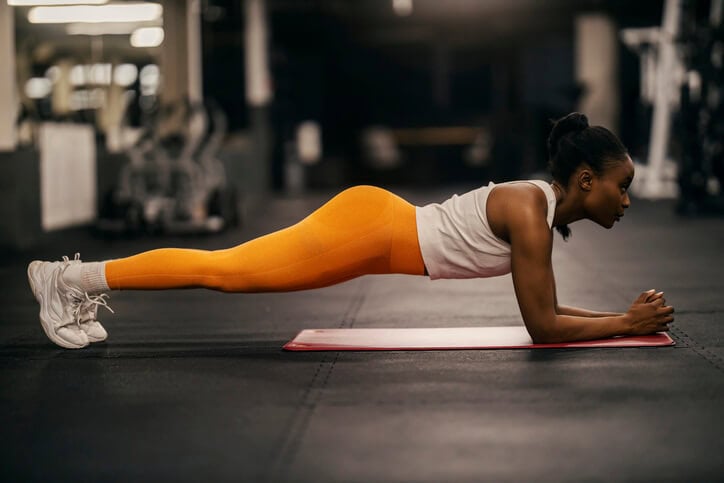
As you build strength and endurance, you can progress by incorporating more challenging variations such as side planks, which engage the obliques, or by lifting alternate legs to further challenge stability.
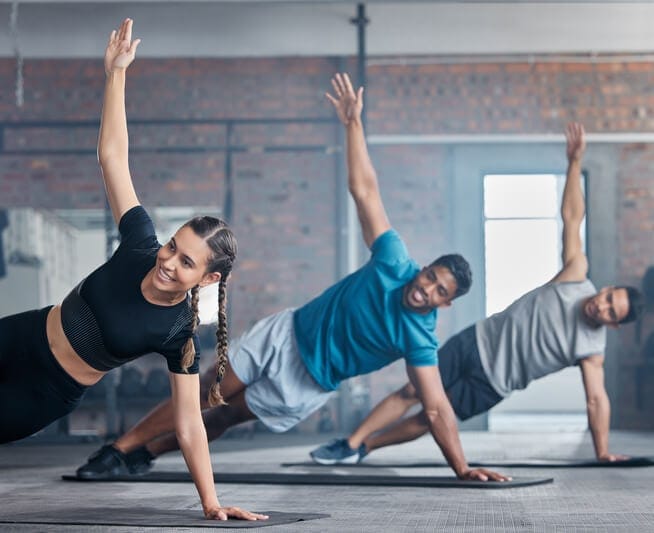
Another effective progression is adding shoulder taps, which require maintaining balance while shifting weight from one arm to the other, enhancing core control and coordination. [7]
Hip Lift
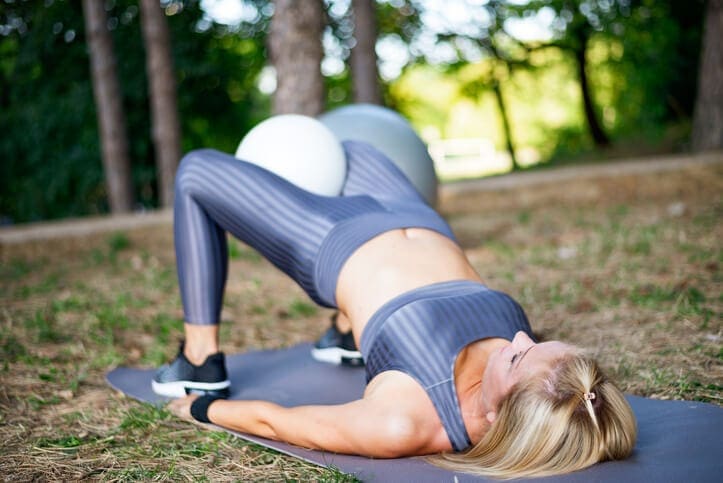
The hip lift with a ball squeeze is an effective exercise that targets the core, glutes, and inner thighs, helping improve overall strength and stability.
To perform this exercise: [8]
- Begin by lying on your back with your knees bent and your feet flat on the ground, positioned hip-width apart
- Place a medicine ball between your knees and gently squeeze it to engage your inner thigh muscles
- Keeping your core muscles activated, slowly lift your hips towards the ceiling, focusing on engaging your glutes and maintaining a straight line from your shoulders to your knees
- Hold the position briefly at the top before gradually lowering your hips back to the ground with control
Russian Twists
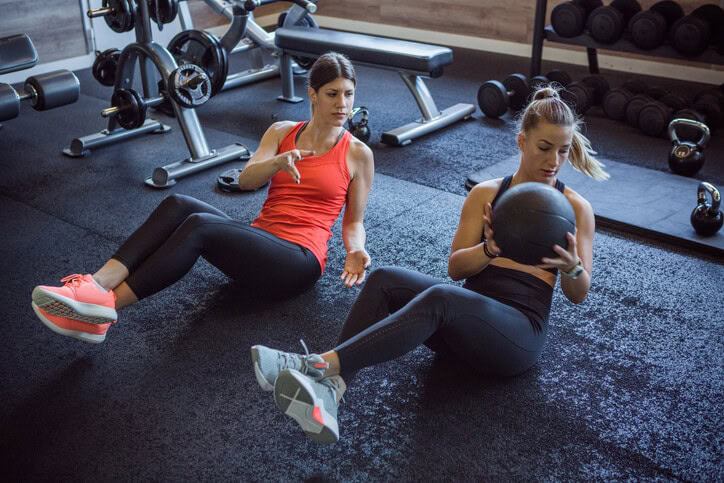
Russian twists help to strengthen the oblique muscles, which play a key role in rotational stability and core control. This exercise improves balance and stability during rotational movements, such as those involved in horseback riding.
To perform Russian twists correctly: [7]
- Start by sitting on the floor with your knees bent and feet flat
- Lean back slightly to engage your core and create a V-shape between your torso and thighs
- Hold a weight or medicine ball in both hands, keeping it close to your chest
- With your core engaged, begin twisting your torso from side to side, moving the weight across your body in a controlled manner
- Focus on rotating through your core rather than just moving your arms, and ensure that your back remains straight throughout the exercise to avoid strain
To increase difficulty, lift your feet off the ground and balance on your sit bones to challenge core stability and coordination.
Lower Body Exercises
Lower body exercises that equestrians can incorporate include squats and lunges, which help build strength and improve balance.
Squats
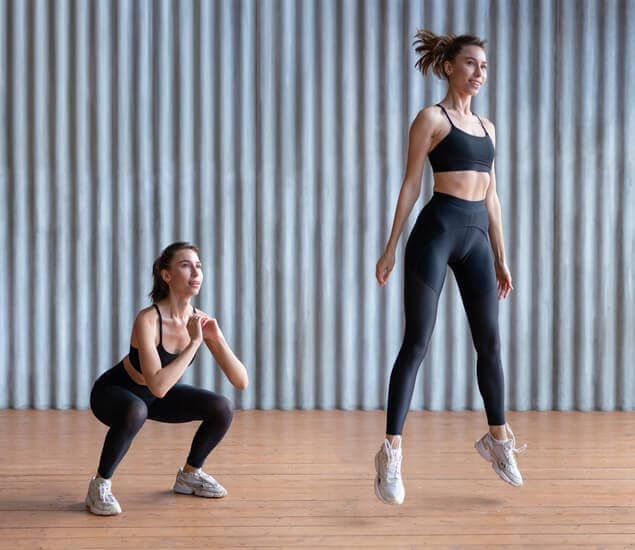
Squats are a fundamental exercise that builds leg strength and replicates the lower body movement used in activities like the rising trot. They primarily target the quadriceps, hamstrings, and glutes, and engage the core for improved stability and balance.
To perform a squat correctly: [9]
- Start by standing with your feet shoulder-width apart, ensuring your toes are pointing slightly outward
- Engage your core and keep your chest lifted as you begin to lower your hips, as if you were sitting back into a chair
- Aim to lower until your thighs are parallel to the ground, ensuring your knees remain aligned with your toes and do not extend past them
- Press through your heels to push yourself back up to a standing position, maintaining control and avoiding excessive forward lean
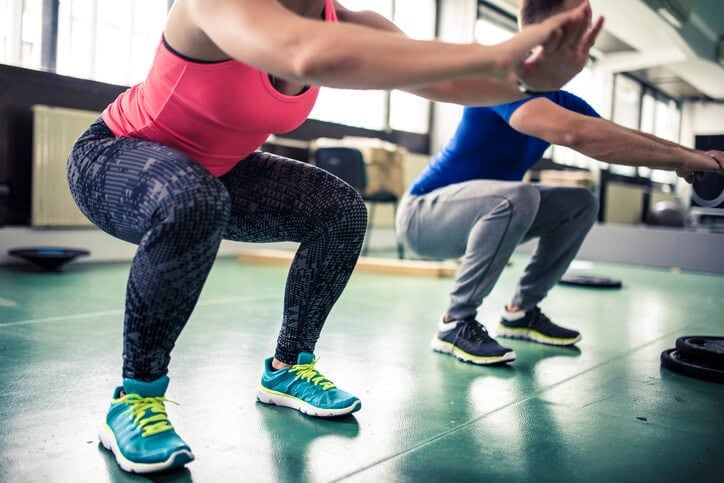
For increased difficulty, try incorporating weights such as dumbbells or a barbell, or perform variations such as sumo squats or jump squats to enhance power and agility.
Lunges
Lunges effectively build strength, balance, and coordination for equestrians by targeting each leg individually.
To perform lunges correctly:
- Start by standing upright with your feet hip-width apart
- Take a controlled step forward with one leg, ensuring that your knee aligns directly above your ankle while lowering your hips toward the ground
- Your back knee should hover just above the floor, creating a 90-degree angle in both legs
- Engage your core and press through the heel of your front foot to push yourself back to the starting position
- Repeat the movement by alternating legs
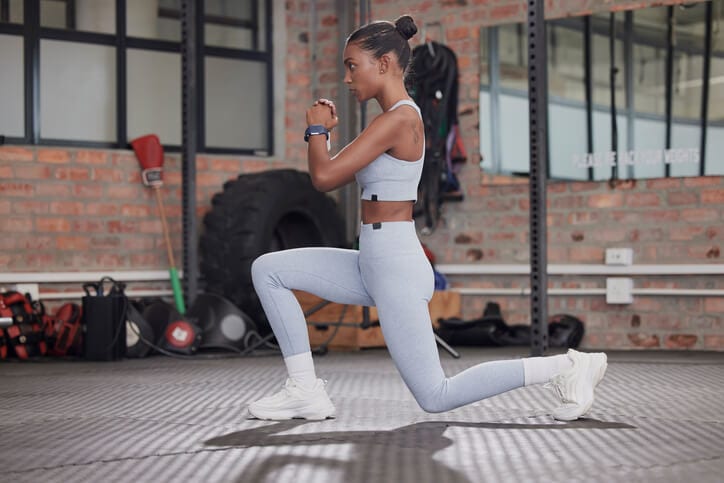
To increase intensity, lunges can be modified with weights, performed as walking lunges, or combined with a torso twist to engage the obliques. [9]
Upper Body Exercises
Equestrians can incorporate upper body exercises such as the walkout to push-up and the superman.
Walkout to Push-up
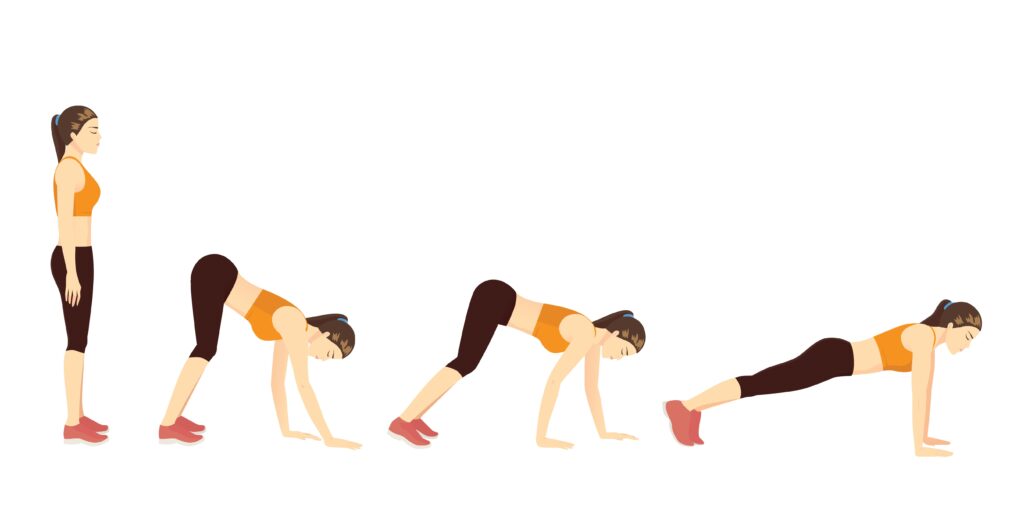
The walkout to push-up is a full-body exercise that strengthens the core, improves hip mobility, and builds upper body endurance.
To perform a walkout to push-up: [9]
- Begin by standing with your feet hip-width apart and arms extended overhead
- Engage your core and slowly hinge at the hips, reaching down toward the floor
- Walk your hands forward, maintaining control, until you reach a plank position with your shoulders stacked over your wrists and your body in a straight line from head to heels
- Once in the plank, you can either perform a push-up by lowering your chest toward the floor and pressing back up, or simply engage your core and glutes while holding the plank position
- To return to standing, walk your hands back toward your feet, driving your hips upward, and stand tall with arms reaching overhead to complete the movement
Superman
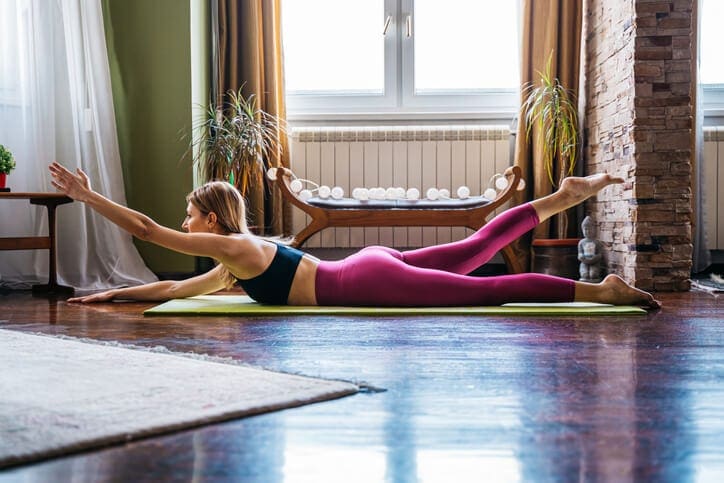
The Superman exercise helps strengthen the erector spinae, a group of muscles that run along the spine from the base of the skull to the sacrum. Regularly incorporating this movement into your routine can help build lower back strength, improve posture, and reduce back pain.
To perform the Superman exercise: [9]
- Lie face down on the floor with your arms extended in front of you and your legs straight
- Simultaneously lift your arms, legs, and chest off the ground, engaging your lower back and core muscles
- Hold this position for a few seconds at the top, ensuring to squeeze your glutes for added support, before gently lowering back down to the starting position

The key to this exercise is maintaining control throughout the movement, focusing on slow and steady motions rather than quick or jerky actions. For those looking to modify the exercise or gradually build strength, an alternative approach is to lift one arm and the opposite leg at a time instead of raising all limbs simultaneously.
Flexibility & Mobility Exercises
Flexibility exercises for equestrians include hip flexor stretches, supine spinal twists, and yoga.
Hip Flexor Stretch
Prolonged periods of sitting in the saddle can lead to tight hip flexors, affecting your posture and mobility. Hip flexor stretches loosen these muscles and allow riders to relax in their seat.
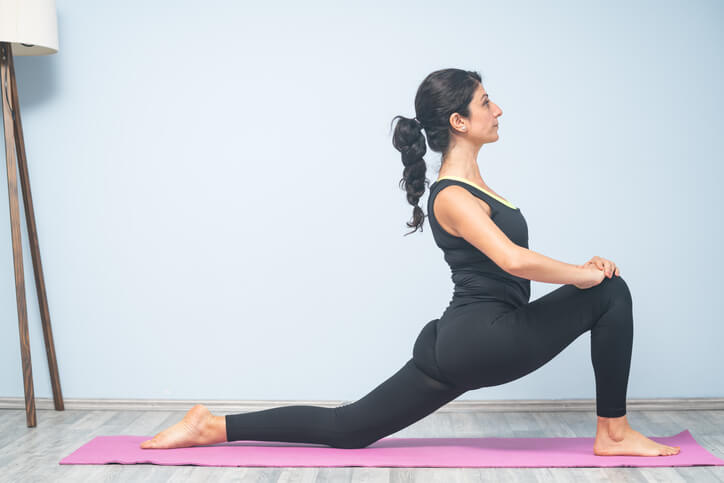
To perform this stretch, kneel on one knee with the other foot in front, creating a 90-degree angle at both knees. Gently push your hips forward while keeping your back straight, feeling a stretch along the front of the hip. [10]
Supine Spinal Twist
Supine spinal twists are a stretch that addresses lower back pain and stiffness in horse riders.
To perform the Supine Spinal Twist: [10]
- Start by lying flat on your back with your legs extended.
- Bend your left knee and draw it towards your chest, holding it with your right hand.
- Extend your left arm straight out to the side with your palm facing up.
- Slowly guide your left knee across your body to the right side while keeping your shoulders on the floor and your back flat.
- Repeat steps 1 – 4 with your right leg and arm
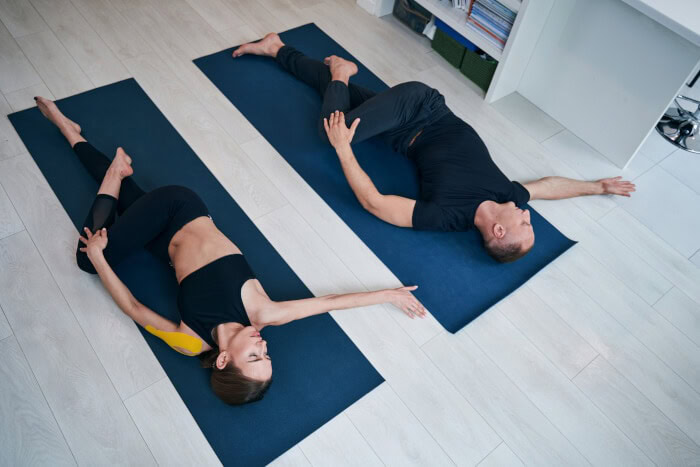
You can also modify this exercise by lifting both knees to your chest at once, then twisting both to one side at the same time. Hold for 15 – 20 seconds then twist both knees to the other side and hold again.
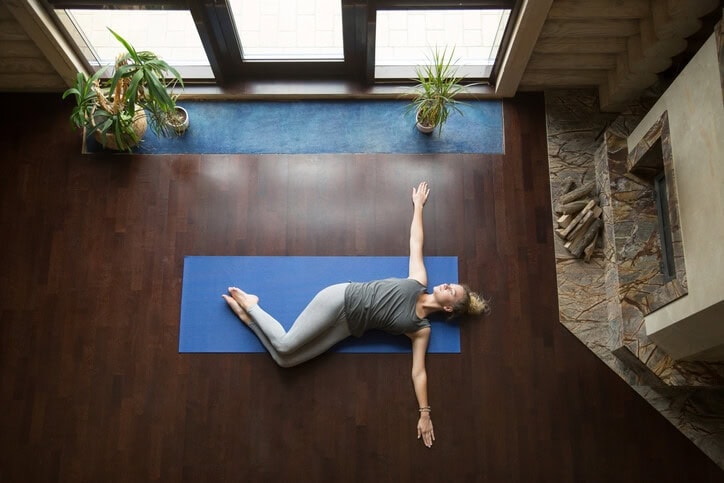
Yoga for Riders
Yoga can be highly beneficial for horseback riders, offering physical and mental benefits that directly impact riding performance.
Regular yoga practice helps riders improve flexibility, strength, balance, and focus, all of which contribute to a more effective partnership with your equine athlete. Flexibility is particularly important for reducing injury risks and stiffness, promoting comfort in the saddle.
Many yoga poses help develop core muscle strength, leading to improved posture and better control in the saddle. Yoga also includes postures that address balance and coordination, both of which are critical for maintaining symmetry and effectively responding to a horse’s movements.
Yoga also hones mental focus and relaxation. Breathing and mindfulness techniques help riders stay calm and composed, especially in high-pressure or unpredictable situations with their horses. This can lead to better decision-making and a stronger connection with the horse.
Poses such as Cat-Cow Stretch, Warrior Poses, Downward Dog, Seated Twists, and Child’s Pose can be particularly beneficial for equestrians, addressing common areas of tightness and promoting relaxation. [5][11]

Cardiovascular Fitness
Any exercise that increases your heart rate can help improve cardiovascular fitness. Cycling may be particularly beneficial for equestrians as the same proprioception and balance skills are required for both cycling and horseback riding.
Interval training enhances stamina and closely mirrors the physical demands of disciplines like eventing. This involves alternating between high-intensity efforts, such as sprinting, and recovery periods to build endurance and cardiovascular efficiency. [4]
For healthy adults, the guideline to maintain optimal cardiovascular fitness is to complete at least 150 minutes of moderate-intensity or 75 minutes of high-intensity cardiovascular exercise per week. [12] Work with a qualified personal trainer to design a fitness program that matches your conditioning and goals.
Frequently Asked Questions
Here are some frequently asked questions about exercise for equestrians:
Rider fitness is crucial in equestrian sports because it enhances balance, strength, and coordination in the saddle. A fit rider can respond to their horse's movements with precision, ensuring smoother communication and reducing the risk of injury to both horse and rider.
Riders should focus on core strength, balance, flexibility, and endurance to perform effectively. Core strength is essential for maintaining an independent seat and absorbing the horse's movement. Balance helps riders stay centered, improving communication and reducing the risk of injury.
Riders can incorporate fitness by engaging in exercises such as planks, squats, lunges, and yoga. A balanced routine that includes strength training, flexibility exercises, and cardiovascular workouts can significantly improve riding performance. Regular stretching and core workouts help maintain stability and prevent injuries.
Summary
Rider fitness is an important, often overlooked aspect of equestrian sports. By incorporating targeted exercises for strength, balance, flexibility, and endurance, riders can enhance their performance and build a more harmonious partnership with their horses.
- Riders can improve balance, strength, flexibility, and endurance through regular exercise.
- These components of rider fitness can help improve a rider's control, fluidity, and stability in the saddle.
- Cardiovascular exercise is also important to improve stamina and recovery.
- Running and swimming are beneficial forms of cardio, and cycling may be the best option for many equestrians as there are cross-functional riding skills in both sports.
References
- Hampson. A. and Randle. H., The Influence of an 8-Week Rider Core Fitness Program on the Equine Back at Sitting Trot. International Journal of Performance Analysis in Sport. 2015.
- Aegerter. A. M. et al., An Investigation into the Association of the Physical Fitness of Equestrians and Their Riding Performance: A Cross-Sectional Study. Comparative Exercise Physiology. 2020.
- German National Equestrian Federation. The Principles of Riding: Basic Training for Horse and Rider. Quiller, La Vergne. 2017.
- Rider Fitness. The British Horse Society. 2022.
- Prentice. J. A. A., Investigation into the Importance of Off-Horse Exercise on Riding Position of Horse Riders. University of Essex. 2016.
- Holdsworth, D. H&H's 12 Days of Fitness: Improve Your Flexibility. Horse & Hound. 2022.
- Conway, C. 6 Core Training Exercises for Equestrians. Savvy Horsewoman. 2016.
- Baker, S. 5 Exercises to Develop Your Core Strength. Fédération Equestre Internationale. 2020.
- Inouye, M. & Divita, A. Fitness 2021: Strength Building for Equestrians. Fédération Equestre Internationale. 2021.
- Baker, S. 4 Stretches Every Equestrian Should Be Doing. Fédération Equestre Internationale. 2020.
- Inouye, M. & Divita, A. Yoga for Equestrians. Fédération Equestre Internationale. 2018.
- Adult Activity: An Overview. Center for Disease Control. 2025.