English


![Horse Passports: Equine Identification and Travel Requirements – [Guide]](/wp-content/uploads/2024/09/horse-passports-guide.jpg)
If you plan to travel or compete with your horse internationally, understanding horse passports is essential. While requirements vary between jurisdictions, all types of horse passports aim to provide an accredited, traceable record of horse identification.
These documents also play a key role in reducing transmission of infectious diseases by requiring horse owners to demonstrate their horse’s identity, ownership, and vaccination status at the time of border crossing.
Passports are also required to participate in international competitions, even if the horse competes in its home country. The International Federation for Equestrian Sports (FEI) requires all horses to be correctly identified before they can participate in any events.
Horse owners must know when a passport is needed and plan ahead, as gathering the necessary information can take weeks or months. By understanding the specific passport requirements, you can ensure smooth travel for you and your horse.
Horse Passports
A horse passport is an official identification document required for many equines, depending on where they live, where they travel, and what disciplines they participate in.
These documents contain essential information about the horse, including age, breed, markings, and a record of vaccinations, medical history, and any medications received.
Horse passports are an important aspect of travel, competition, and the international sale of horses. They also help ensure proper health management and traceability in the event of disease outbreaks.
Why Your Horse Needs a Passport
Horse passports are a critical aspect of international horse trade, sport and travel because they provide a traceable record of the horse’s identity and medical history. The key functions of equine passports are:
- Disease control
- Record of ownership
Disease Control
One of the primary roles of an identification document for horses is disease control and prevention. Horses are vulnerable to a variety of highly infectious and potentially fatal diseases, including:
A centralized database or system for monitoring horse health is vital to maintaining effective biosecurity within the equine population. Traceable documentation helps control the spread of such conditions and allows for early detection of new infectious diseases in any given area. [1]
Record of Ownership
Passports also play a crucial role in limiting ownership disputes, preventing theft, and curbing illegal horse sales, especially when microchipping is required to obtain a passport. These identification methods enhance horse safety by providing a reliable way to trace and verify ownership. [2]
Passports act as a form of official identification; the requirement of a passport for legal sale and transport can aid authorities in stopping the transport and sale of stolen horses.
A clear ownership record is also helpful for resolving controversies regarding the rightful ownership of a horse. Additionally, clearly documented ownership instills confidence in the parties involved in horse sales. [2]
Traceability is particularly important in cases where the horse may have changed owners multiple times. Microchips provide a tamper-proof way of identifying horses. [2]
Unlike physical documents, which can be forged, microchips are implanted under the horse’s skin and contain a unique identification number. Adopting this technology ensures that the horse’s identity can always be verified, even in cases of falsification of passports and other ownership documents. [2]
What's your top priority with your horse's health?

Enter your email to receive your store credit
Markings & Physical Description
The specific information captured in a horse passport may vary between regions, but all passports contain some details about the horse’s physical description and any unique identifying features.
Throughout history, several identification methods have been used to distinguish individual horses. An early form of equine identification was hot branding. This practice involves heating a metal brand and pressing it against the horse’s skin to create a permanent mark. [3]
Other forms of identification for horses include: [4]
- Cold branding: cold branding involves using liquid nitrogen to change the pigment of the hair where the brand is applied; this method is considered less painful than hot branding, but is still more invasive than more modern methods.
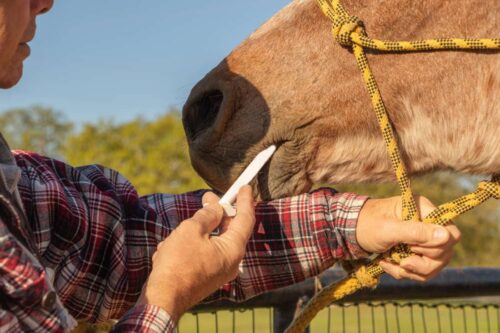
- Lip tattoos: almost all racing horses are required to have a tattoo applied to the inside of the lip. This form of identification is less invasive than branding, but tattoos often lose legibility as they age.
- Iris scans: Utilize a specialized camera to scan the horse’s eye and compare it to a database of known iris patterns. This method provides a highly accurate and permanent form of identification without causing harm to the horse. Iris scanning is non-invasive and offers a quick and reliable way to verify a horse’s identity.
- Electronic identification: embedded microchips contain a unique serial number associated with the owner’s contact information. Microchips are considered the most reliable form of animal identification as they are permanent and can be read by any veterinarian. It’s important for owners to update their horse’s microchip information promptly when horse sales are complete to avoid disputes.
In addition to permanent, acquired forms of identification, a central feature of horse passports is an accurate description of the horse’s physical appearance.
Determining coat colors and marks is a complex task due to unique species-specific terminology, lack of standardized nomenclature, and varying registry rules. [4]
Basic Horse Colors
When completing a horse passport, the examining veterinarian will record the horse’s base coat color, such as: [5]
- Bay: bay horses have a red-brown body color. They may also have black points (mane, tail, lower legs, ear rims), unless white markings are present.
- Chestnut/Sorrel: Any shade of red from light (sorrel) to dark (liver chestnut). Points the same color or lighter.
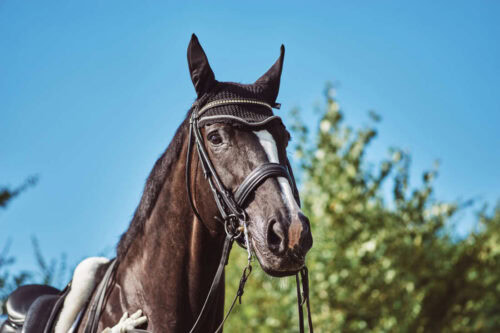
- Black: Entirely black coat with no brown or tan areas. Black horses sometimes have a red tinge due to sun bleaching, but their pigment is black.
- Brown: Synonymous with dark bay, almost black with tan on muzzle and flanks. Black points unless white markings are present
Modifications of Basic Coat Colors
Many horses exhibit a mix or dilution of basic colors, depending on their lineage. Mixed horse colors that may be captured on a horse passport include: [5]
- Gray: White hairs mixed with the horse’s base coat color. The percentage of white hairs increase with age, with middle-aged horses being nearly or completely white. Black skin.
- Flea-bitten Gray: Gray horses with flecks of base coat color that remain as the horse ages.
- Roan: Mixture of colored and white hairs, darker head and legs. Base color determines the color of the mane, tail, and legs.
- Strawberry Roan: Chestnut/sorrel base, non-black points
- Blue Roan: Black base, black and white hairs mixed
- Bay Roan: Bay base, black points
- Buckskin: Gold or yellow body, black mane, tail, and lower legs. No dorsal stripe
- Dun: Light or diluted body color with a dark dorsal stripe
- Red Dun: Chestnut/sorrel base with darker red dorsal stripe
- Palomino: Golden body, blonde or white mane and tail. No dorsal stripe
- Grullo: Slate or mouse-colored body, black mane, tail, and lower legs
- Cremello: Very light beige or cream, pink skin, blue eyes
- White: Pure white coat with pink skin and dark eyes. Not albino.
Patterns Superimposed on Base Colors
There are also a number of pigment patterns that appear over a horse’s base colors, which are captured in detail on horse passports. Common patterns include: [5]
- Appaloosa: Various white patterns revealing spots of base color, often with mottled skin and striped hooves
- Leopard Appaloosa: White with dark spots of base color.
- Pinto: Large, irregular white areas on any color base coat
- Overo: White does not cross the back, has dark legs, and has a single-color tail
- Tobiano: White crosses the back, dark flanks, often two-color tail
- Tricolor: Non-technical term for pinto on top of a bay base coat.
White Markings on the Head
In addition to listing the broad details of a horse’s appearance and coloring, passports also list any definitive markings that help differentiate the horse. Examples of head markings include: [5]
- Star: White spot on the forehead
- Strip: Narrow white marking on the nasal bones
- Snip: White marking between the nostrils
- Blaze: Wide white marking connecting star, strip, and snip
- Bald: Extensive blaze, including eyes and nostrils
Examples of leg markings found on horses include: [5]
- Partial Heel: White on either medial or lateral heel
- Heel: White on both heels
- Coronet: White extending from the hoof to just above it
- Pastern: White extending to the top of the pastern
- Fetlock: White extending to the top of the fetlock
- Half-Cannon/Sock: White extending to the lower half of the cannon bone
- Cannon/Stocking: White extending to the proximal end of the cannon bone
- Above Knee/Hock: White extending above the knee or hock
- Ermine Spots: Small dark spots in white leg markings near the coronet band.
Examples of other identifying features used to distinguish horses include: [5]
- Hair Whorls: Permanent circular hair growth patterns
- Dimples: Indentations in muscles, usually at the shoulder or neck
- Curly Coat: Exceedingly curly body, mane, and tail hair
- Chestnuts/Night Eyes: Hard growths on the inside of the legs
In addition to any colors and permanent markings, passports may also list any scars or other noteworthy permanent physical features of the horse.
Ownership
Details of the current owner, as well as a history of previous owners, are recorded in a horse passport to establish a clear chain of custody. This helps prevent issues related to theft or disputed ownership.
Many horse passports include details of the horse’s microchip, which is a common method of identification. The microchip number is often scanned and recorded in the passport. Microchips are a very useful tool in finding lost or stolen horses. [6]
If the horse does not have a microchip, the chain of custody is captured in the horse’s passport in writing only when the horse changes hands. It’s important for owners to note that ownership information captured in a passport is not a substitute for a sale agreement contract.
Health History & Status
A comprehensive log of all vaccinations, including dates and types of vaccines administered, is essential for disease prevention and legal compliance. [1]
This section of the horse passport can include records of: [1]
- Treatments
- Medications
- Surgeries
- Past or current medical conditions
This documentation provides a valuable reference for veterinarians when assessing the horse’s health. It is particularly useful if a horse experiences a health emergency while on loan or boarding and the caretaker needs to provide a veterinarian with the horse’s medical history and/or vaccination status. [1]
National Regulation of Horse Passports
The implementation and regulation of horse passports differ significantly between jurisdictions, reflecting diverse approaches to animal health, disease control, and industry practices across the world.
United States
In the United States, there is no federal mandate that requires horse owners to provide their animals with a passport. However, individual states do have regulations. All owners of horses crossing state lines are required to produce a negative Equine Infectious Anemia (EIA) test, also known as a Coggins test. [7]
Additionally, all states require a Certificate of Veterinary Inspection (CVI) for interstate travel and, in some cases, for intrastate travel. This certificate ensures the horse is not ill at the time of travel. The CVI is fundamental in reducing the risk of spreading equine disease in the USA. [1]
CVI information includes: [1]
- Place of origin
- Destination
- Veterinarian information
- Horse’s description
- EIA test results
- Transport information
Most states in the USA participate in the Extended Equine Certificate of Veterinary Inspection (EECVI) program. This program allows horses with EECVIs to move freely between participating states without the need to obtain a Certificate of Veterinary Inspection. [8][9]
Identification requirements vary by the states of origin and destination; some states mandate specific photo identification, while others accept various forms of ID. [8][9]
Canada
As with the United States, Canada does not have a centralized horse passport system. Instead, Canada relies on a combination of provincial and federal laws and regulations that mainly focus on event participation and interprovincial and international transportation. [10][11]
United Kingdom
All horses born or imported into the United Kingdom are required by law to have a passport, failure of which will lead to a fine of up to £5,000. UK equine passports are lifetime identification documents that feature the following information: [12][13]
- Horse’s name
- Sex
- Color
- Height
- Date and county of birth
- Owner’s name and address
- Silhouette identification with at least five identifying features
With the sole exception of emergency medical transportation, the passport must stay with the horse at all times, including during loans. The original passport must be carried by the caretaker, as photocopies of the original are not accepted. [12][13]
Passports for horses born within the UK must be obtained within six months of birth or by November 30 of their birth year (whichever is later). Since 2009, in addition to a passport, all equines in the UK must be microchipped. [12][13]
In the case of ownership changes, the new owner must contact the Passport Issuing Organization (PIO) within one month from the date of the finalization of the horse sale. In the unfortunate event of a horse’s death, the owner is obliged to return the passport to the PIO within one month from the date of death. [12][13]
European Union
Similar to the UK, the European Union enforces strict and detailed regulations for horse passports. All horses born within the confines of an EU state require a passport requested no later than six months from birth and issued no later than 12 months from birth. [14][15]
With the passage of the Animal Health Law (EU) 2016/429, the responsibility for issuing horse passports shifted from equestrian organizations to national veterinary authorities. Since 2010, horses under European Union identification rules are no longer issued FEI passports. [14][15]
The Antipodes
Since 2017, all New Zealand horses registered with the FEI (Fédération Équestre Internationale) are required to have a national passport issued by Equestrian Sports New Zealand (ESNZ). [16]
Australia does not mandate nationwide passports, but they are required in the following situations: [17]
- Equestrian Australia (EA) events: Horses competing in certain EA events require an EA National Identification Document (white booklet) or an FEI/EA Passport, depending on the level of competition.
- FEI-sanctioned events: Horses competing in international events under the FEI are required to have either an FEI Horse Passport or an approved national passport.

FEI Regulation of Horse Passports
In addition to national legislation around international competition, passports are required for participation under the International Federation for Equestrian Sports (FEI). [18][19]
In accordance with Article 137 of the FEI General Regulations, all horses competing in an FEI event outside of their country of origin require either an FEI or FEI-accredited national passport.
The FEI and national passports must contain the following information: [19]
- Name and address of the owner
- Physical description of the horse, including a diagram
- Vaccination status
- Medical history
In addition, horse owners wishing to compete in any FEI events are required by the organization to have their horse microchipped with ISO Standards 11784 and 11785 compatible chips. [19]
Once the horse is on the premises of the event, the Organizing Committee is responsible for ensuring that every horse is correctly identified. Horses that either don’t have a valid passport or have a document containing inaccurate or misleading information are not permitted to compete without approval from the Ground Jury. [19]
Frequently Asked Questions
A horse passport records identifying details such as age, breed, sex, coat color, and markings, along with microchip number if applicable. It also includes ownership history, vaccination records, and medical treatments to provide a reliable health and identity record.
Yes, horses traveling internationally or competing in FEI-sanctioned events must have a valid passport. These documents help prevent the spread of infectious diseases and ensure that each horse’s identity and vaccination status can be verified.
Obtaining a horse passport can take several weeks to months, depending on the issuing authority and the information required. Owners should plan ahead, especially before competitions or international travel, to avoid delays.
Regulations vary widely: the UK and EU require all horses to have passports and microchips, while the United States and Canada rely on certificates and health documentation rather than a national passport system. Australia and New Zealand require passports mainly for certain competitions and international travel.
Summary
Horse passports are complex and vary across jurisdictions, but their primary purpose is to serve as an accurate identification and health record for each horse, especially when travelling or competing internationally.
- Horse passports help prevent the spread of infectious diseases and allow for early detection of outbreaks.
- Passports with microchips reduce risks of ownership disputes, theft, and illegal horse sales as microchips provide a tamper-proof identification method.
- Even though each country has its own rules about horse identification, all horses involved in international trade and travel require legal international identification
- Passports are not a substitute for a sale agreement between owners when a horse changes hands
References
- Understanding Certificates of Veterinarian Inspection (Health Certificates). Pennsylvania State University.
- The Importance of Microchipping Your Horse. United Horse Coalition. 2024.
- Lindegaard, C., et al. Evaluation of Pain and Inflammation Associated with Hot Iron Branding and Microchip Transponder Injection in Horses. Am J Vet Res. 2009. View Summary
- NVAP Reference Guide: Equine Identification | Animal and Plant Health Inspection Service. Animal and Plant Health Inspection Service. 2024.
- Sponenberg, D. P., & Bellone, R. Equine Color Genetics. 4th edition. Wiley Blackwell, Hoboken, NJ, USA. 2017.
- Equine Identification Microchips. Merck Animal Health USA.
- Walker, N. Equine Identification Requirements for Out-of-State Travel. LSU College of Agriculture. 2015.
- EECVIs - Extended Equine Health Certificates. GlobalVetLink. 2024.
- Haugland. B. et al., EECVIs: Updates for Equine Practitioners. GlobalVetLink. 2024.
- EC National Passport Completion Instructions. Equestrian Canada.
- Horse Recordings and Passports. Equestrian Canada. 2024.
- Horse Passports How To Apply. The British Horse Society. 2024.
- Getting and Using a Horse Passport: When You Need a Horse Passport - GOV.UK.
- Horse passports rules on identifying and registering horses. European Commission. 2021.
- Equine Passports and Microchips. Gov.ie. 2020.
- FEI & International Information. Equestrian Sports New Zealand. 2020.
- EA National Passport Document Q&A. Equestrian Australia. 2024.
- History. FEI. 2024.
- FEI General Regulations. FEI. 2024.