English









Draft horses are known for their immense strength, tireless work ethic, and gentle nature. The power and resilience of these heavy horses allow them to perform tasks far beyond the capabilities of other breeds, making them invaluable partners throughout human history.
Before the advent of heavy machinery and motorized vehicles, draft horses helped revolutionize transportation, warfare, and agriculture worldwide. These powerful equines were essential in shaping modern civilization, changing how people worked, travelled, and connected.
Today, draft horses are beloved and appreciated for various jobs and disciplines, including logging, pulling, carriage driving, and even appearing in films.
Given their profound impact on history, it’s no surprise that some draft horses and breeds have achieved legendary status, standing as enduring symbols of strength and service.
Famous Draft Horse Breeds
Draft horses are a class of large, heavy horses that are bred specifically for pulling power. Known for their strength, endurance, and calm temperament, these “gentle giants” have made their mark on history.
Among the many breeds of draft horses, there are a few that have set themselves apart, including the Clydesdale, Shire, Friesian, and Percheron. From pop culture fame to sports achievement, these particular breeds have captured hearts and minds with their skills, personality, and awe-inspiring size.
Each breed brings something special to the world of draft horses — Clydesdales, for instance, are recognized globally for their elegant feathered legs and association with Budweiser, while Shires are celebrated for their sheer power and impressive stature.
Friesians, with their flowing manes and agility, have starred in film and dressage, and Percherons are known for their versatility, being equally at home on a farm or in a parade.
These famous draft breeds not only carry forward a proud history but also continue to inspire admiration and respect as they excel in modern roles across various disciplines.
The Clydesdale: History’s Work Horse
The Clydesdale Horse, originally developed in Scotland, has a history dating back to the 18th century. Clydesdales were bred for size and weight in an effort to increase the size of working horse stock at that time. The first Clydesdale was described as having a strong, neat body and thick legs with a silky lower-leg fringe that is still present in the breed today. [1]
 Clydesdale
The Clydesdale originally made a name for itself, serving in World War I. By 1911, the export of Clydesdale stallions had reached its peak, as these steadfast horses proved themselves towing munitions and supplies across the theatre of war. [1]
The Modern Clydesdale: Icon of the Budweiser Brand
While Clydesdales have a storied past, shaping agrarian societies and serving valiantly in multiple wars, they have also achieved legendary status in the modern world.
Even outside of the equestrian community, people are quick to identify the distinct look of the Clydesdale. Much of the breed’s modern-day fame stems from the Budweiser Clydesdales, frequently featured in parades and memorable television commercials.
In the spring of 1933, August A. Busch, Sr., the co-founder of Anheuser-Busch, received a hitch team of six Clydesdales from his two sons. This notable gesture commemorated the end of Prohibition, marking the return of Anheuser-Busch beer to the American public. [2]
Busch Sr. quickly realized a horse-drawn beer wagon had powerful marketing potential. He sent a second six-horse Clydesdale team to New York City, where they drew thousands of spectators as they made their way to the iconic Empire State Building. [2] There, they presented a case of beer to New York Governor Alfred E. Smith as a thank you for his role in ending Prohibition. [2]
This was only the beginning of public appearances for the now famous Budweiser Clydesdale team. After New York, the hitch team went on tour, visiting New England and the Mid-Atlantic states before making a stop in Washington, D.C. [2] Here, they delivered one of the first cases of Budweiser beer ever made to President Franklin D. Roosevelt. [2]
The team soon expanded from six to eight horses, and a Dalmatian mascot joined the crew, adding to the hitch’s distinctive charm. Today, the Budweiser Clydesdales continue to capture North American admiration, making hundreds of appearances each year in their iconic red, white, and gold wagon. [2]
Since 1975, the famous Clydesdale Budweiser team has also been the highlight of Super Bowl football commercials for many viewers. When they aren’t on tour, these famous Clydesdales can be found at the St. Louis Anheuser-Busch brewery, or at their home in Boonville, Missouri. [2]
What's your top priority with your horse's health?

Enter your email to receive your store credit
The Shire Horse: Towering Champions
The Shire Horse is one of the largest horse breeds in the world, reaching heights of over 18 hands (6 feet) and weighing up to a ton. Their impressive stature, along with their feathered legs and powerful build, has long set them apart in the equine world.
Originating in England, Shire horses first gained fame as powerful war horses, carrying knights in heavy armor and pulling heavy artillery. Over time, these draft horses became essential to English agriculture and industry; their impressive size and steady temperament made them ideal for pulling large loads. [3]
After World War II, Shire horses nearly went extinct as they were replaced by industrial heavy machinery, sharply reducing demand. However, a dedicated group of breeders preserved the breed, ensuring that its iconic white markings and feathered legs would not be lost to history. [3]
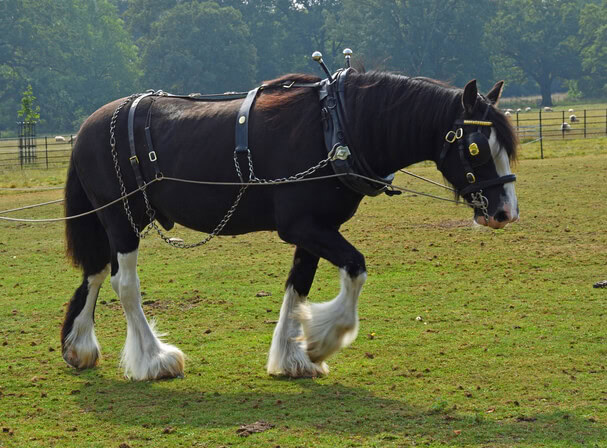 Shire Horse
Shires are best known today for their remarkable size, typically weighing up to 2,200 lb (1,000 kg). The Shire breed has held the world record for the tallest horse numerous times over the years. [3]
In fact, it’s a Shire horse named Sampson, also known as Mammoth, who still holds the record for the tallest and heaviest horse to date. Born in Bedfordshire, England in 1850, he measured over 21.25 hands and weighed over 3,359 lb (1,527 kg). [4]
Wandle Goliath, a Shire horse affectionately known as “Golly” around the barn, holds the modern-day record for the tallest Shire horse in the world. Standing at an impressive 19.11 ½ hands, Golly was foaled in 1977 and initially owned by Young Company’s Brewery in Wandsworth, London, UK. Later in life, he retired to a sanctuary in Spilsby, Lincolnshire. [5]
Golly held the record for the tallest living horse and made his mark in the Guinness World Records until his passing in July of 2001. [5]
Friesians: Movie Stars in the Making
The Friesian breed of draft horse originated in Friesland, The Netherlands, from where it takes its name. In the Middle Ages, Friesians became prized as war horses, valued for their strength and agility, which allowed them to move swiftly while carrying riders in heavy armor. [6]
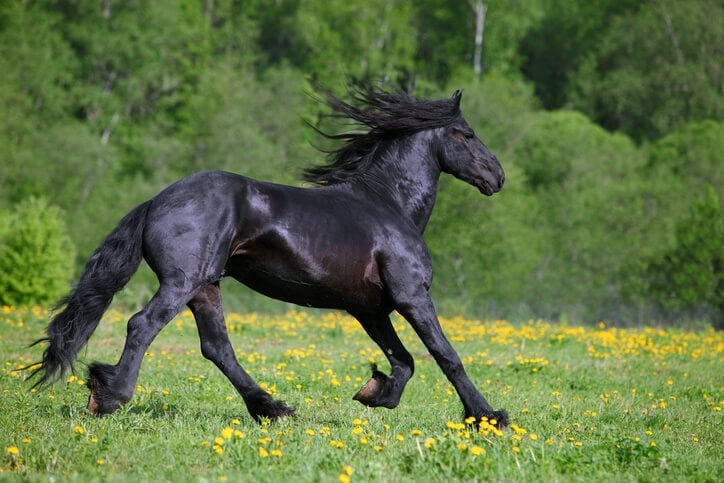 Friesian Horse
In the 19th century, Friesians took on a more distinguished role, pulling the royal carriages of England. Around this same time, they were also ridden under saddle, admired for their elegance and smooth gait. [6]
In the modern era, the Friesian’s striking jet-black coat, flowing mane and tail, and elegant leg feathering have solidified the lasting fame of this beloved draft breed.
Friesian horses have made numerous appearances in films thanks to their striking and regal appearance. Some popular movies featuring Friesians include: [6]
- The Chronicles of Narnia
- The Legend of Zorro
- Clash of the Titans
- Conan the Barbarian
- Ladyhawke
- The Hunger Games
The Percheron: America’s First Purebred Livestock Association
The Percheron is another popular draft horse breed known for its elegant black or grey color and muscular build. Originating in the Perche region of France, this breed is characterized by its strength, adaptability, and lively temperament.
In 1876 in Chicago, Illinois, a group of Percheron breeders formed the Norman-Percheron Association, and the first stud book was established. [7] This marked the formation of the first purebred livestock association in the United States, making Percherons an important part of American equestrian history. [7]
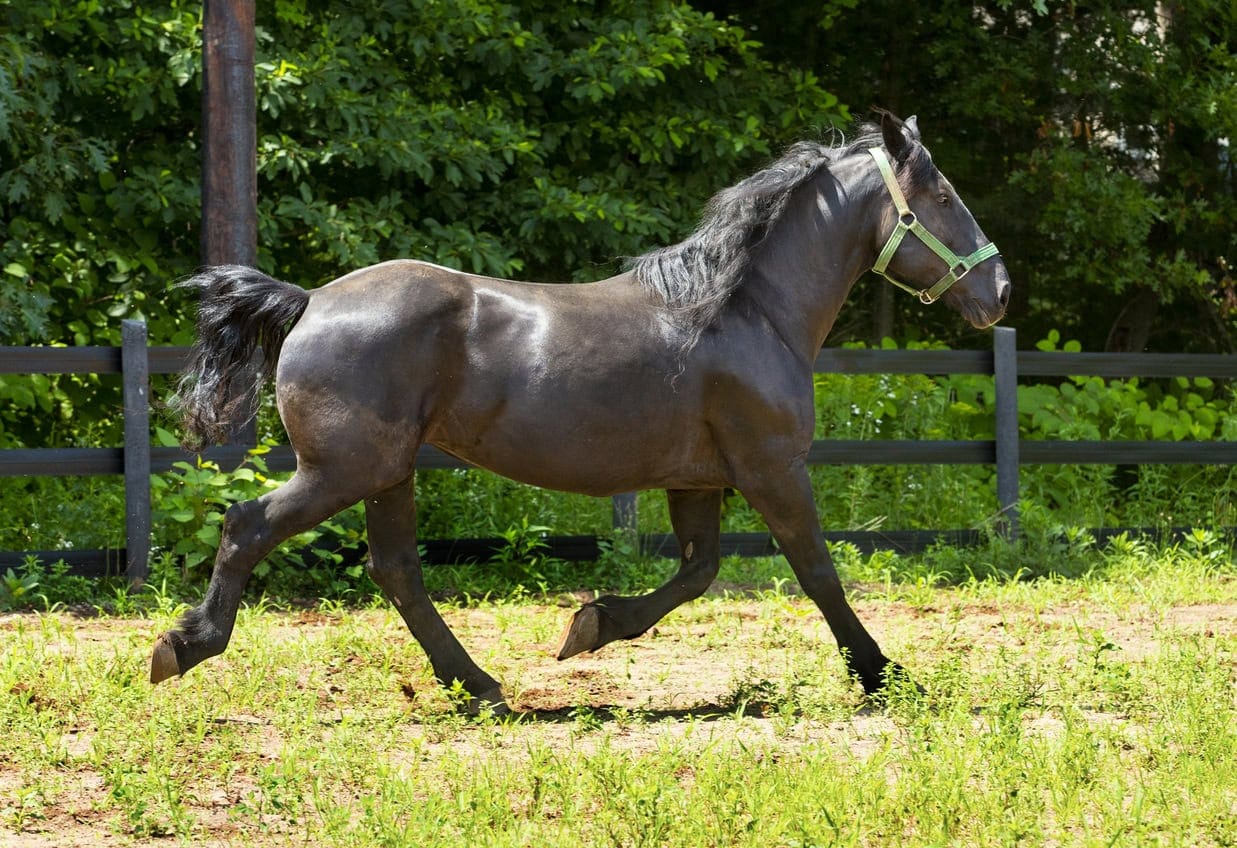 Percheron Horse
During its peak, the Percheron Association registered over ten thousand horses per year, making it the largest draft horse association in the world. [7] Later, “Norman” was dropped from the name, and by 1934, the Percheron Horse Association of America was established as a non-profit organization. [7]
Today, Percherons are used as mounted police horses, for pleasure riding, carriage pulling, and logging among other jobs.
Legendary Drafts
There are several individual draft horses who have made a name for themselves over the years. From record-breaking sizes to conservation studding, these giants have reputations even bigger than the sum of their parts.
Big Jake
Big Jake may not hold the record as the tallest horse in history, but he became a modern-day legend, recognized as the tallest living horse until June 2021. [8]
In January 2010, Big Jake set the record as the tallest living horse, earning a spot in the 2011 edition of the Guinness World Records book. This Belgian draft horse gelding stood 20 hands high without shoes on. [8]
Interestingly, Big Jake’s sire and dam were not particularly tall horses and he was not exceptionally large at birth. [8] He surprised everyone as he grew, reaching an impressive weight of about 2,600 lb (1,182 kg) at maturity. [8] This gentle giant was also renowned for his sweet temperament and friendliness towards the other animals he lived with. [8]
It wasn’t long before Big Jake became a major attraction at his home of Smokey Hollow Farm in Poynette, Wisconsin, garnering a world-wide reputation in the digital age.
Farceur
One particular horse, Farceur, is widely regarded as the foundational stallion of the modern Belgian draft breed. [9]
Foaled in 1910, Farceur was imported to the United States from Belgium when buyers saw his potential. In Iowa, Farceur boasted an undefeated show record until his retirement in 1916. [9]
Farceur stood at stud for breeding and became the most influential stallion of the breed today. Five of Farceur’s immediate offspring were grand champions at the National Belgian Show. His descendants continued to earn grand championships throughout the years. [9]
Farceur’s influence was so profound that without him, the modern Belgian draft horse, now one of the world’s most popular draft breeds, would not exist as we know it.
Old Granny
The first American Cream Draft Horse traces back to a mare named Old Granny, who appeared at a farm sale in Story County, Iowa. [10]
Old Granny was foaled sometime between 1900 and 1905, and was of mixed draft breeding. Later, records would show she had a mix of Belgian, Percheron, Grey, Dunn, and Sorrel bloodlines that gave her the unique cream coloring paired with a draft build. [10]
Old Granny’s distinct appearance might have been a minor footnote in horse history, but a veterinarian named Eric Christian changed the trajectory of her story. Christian saw how attractive the broodmare’s foals were, and he had an idea. Christian persuaded her owners to keep the colt she foaled in 1920, later named Nelson’s Buck, for breeding.
Nelson’s Buck had the same unique cream colouring as his dam, Old Granny. [10] With Nelson studding, the number of cream drafts in the gene pool started to grow. After nearly forty years of cultivating what is now the American Cream Horse Association of America, it became an official charter in July of 1944. [10]
Old Granny holds a special place in American horse history, since the American Cream Draft horse is the only breed of draft horse that has ever been developed in the United States. [11]

Record-Breaking Draft Horses
As draft horses rose in popularity, they also gained prominence in the public eye. Known for their immense strength and size, draft horses now hold some of the most remarkable equestrian records.
The Most Expensive Draft Horse Ever Sold
In 2022, at the Mid-America Draft Horse Sale, a new world record was set for the highest price paid for a draft horse. A 3-year-old Belgian named Pleasant County Supersonic sold for an impressive $137,500 USD. [12]
This marked the third time in just twenty years that the Mid-America Draft Horse Sale witnessed a record-breaking transaction. Before the remarkable sale of Pleasant County Supersonic, another draft horse had held the record price for nearly two decades. [12]
In February of 2003, a 2-year-old Belgian Stallion named Mcllrath’s Captain Jim broke the record, fetching a price of $112,500 USD at the same event in Gifford, Illinois. [13] Captain Jim’s previous owners, William Helmuth and Allen Detweiler, sold the horse at auction to James Raber and Orla Yoder. [13]
The Most Draft Horses Ploughing Simultaneously
Ploughing was one of the primary reasons draft horses were initially bred for size and strength, and this tradition lives on today in competitive ploughing events.
In Portadown Co. Armagh, UK, the annual ploughing competition is organized by the Mullahead & District Ploughing Society Ltd. [14] In February 2015, the competition celebrated its 100th anniversary with a special event, setting the world record for the most draft horses plowing simultaneously. [14]
A remarkable 84 draft horses were set off together in the same field, surpassing the previous record of fewer than 60 horses at once. [15]
Many of the horse teams came from other countries, even travelling overseas, to help break the world record and secure their place in the history books. [15]
Draft Horse Care & Management
With their strength, versatility and calm demeanor, draft horses are among the most cherished breeds in North America today. However, caring for a draft horse requires attentive management to accommodate their size and unique needs.
If you’re thinking of adding a draft horse to your stable, consider these essential care practices:
- Veterinary Care: Draft horses require the same basic care as other horses, including routine veterinary check-ups, vaccinations, dental exams, and deworming to maintain overall health.
- Hoof Care: Draft horses can experience unique hoof problems if not regularly trimmed due to their size. Long intervals between farrier visits can lead to poor hoof balance, which places excess strain on lower limb structures. Regular trimming and balanced hoof care are essential.
- Housing Considerations: Draft horses need more space than average-sized horses. Standard-size stalls can be restrictive and increase the risk of them getting cast (stuck). Provide spacious stalls and secure fencing, designed to accommodate their size and strength.
- Turnout Management: Draft horses benefit from ample turnout time. Prolonged stall confinement can cause stocking up (swelling) in the lower legs. Maximizing turnout helps maintain healthy circulation and is especially beneficial for drafts with conditions like Chronic Progressive Lymphedema (CPL), shivers, or Polysaccharide Storage Myopathy (PSSM).
- Grooming Routine: Draft horses with thick feathering on their legs are prone to pastern dermatitis, often caused by trapped moisture and debris. A regular grooming routine, especially around the legs, helps prevent skin issues and supports healthy skin and hair.
- Exercise Needs: Regular, moderate exercise is essential to keep draft horses in good condition, prevent obesity, and maintain joint health. Activities like light riding or pulling help them stay fit.
Nutrition Requirements
Proper nutrition is critical to support the health and longevity of draft horses. As easy keepers, these horses were bred to have an efficient metabolism, meaning they can easily gain weight on a high-energy diet.
It’s important to ensure these horses have all of their nutrient needs met without supplying excess calories to prevent common issues like obesity, digestive upset, and metabolic conditions.
Draft horses benefit from a forage-based diet with minimal high-starch grains and concentrates. Feeding a diet primarily of hay or pasture, supplemented with necessary vitamins, minerals, and salt, will help them maintain a healthy body condition and avoid weight gain.
Draft horses can also be prone to conditions like Polysaccharide Storage Myopathy (PSSM) and Chronic Progressive Lymphedema (CPL), which are affected by diet and exercise. Low-starch, low-sugar feeds and regular turnout or moderate exercise can help manage these conditions.
For the best results, consult an equine nutritionist to create a diet plan tailored to your draft horse’s specific needs.
Frequently Asked Questions
Here are some frequently asked questions about legendary draft horses:
Draft horses are bred for strength, but some breeds are especially renowned for their power. Belgians and Shires are often considered the strongest draft breeds, capable of pulling immense weights. Clydesdales and Percherons are also exceptionally strong and well-suited for heavy work, such as hauling wagons and farm equipment. [16]
The tallest draft horse on record was a Shire named Samson, also known as Mammoth. [3] More recently, a Belgian draft horse named Big Jake held the title of the tallest living horse until his passing in 2021. [8]
Shire horses are the largest draft horse breed, based on height and body weight. Other large draft breeds include Belgians, Clydesdales, and Friesians. [16]
Summary
Draft horses are large, heavy breeds developed for pulling power and calm temperament, playing major roles in agriculture, transportation, industry, and warfare before the rise of mechanization.
- These heavy horses were selectively bred for their strength, endurance, and docility, allowing them to perform sustained heavy labor that influenced agriculture and commerce worldwide.
- Well-known draft breeds such as the Clydesdale, Shire, Friesian, and Percheron differ in size, conformation, and historical use, but are alike in power and reliability.
- Although modern machinery replaced most traditional draft work, these horses remain active in logging, driving, farming, public exhibitions, film, and recreational riding.
- Individual draft horses and bloodlines have gained recognition for exceptional size, influence on breed development, and record-setting achievements.
- Draft horses require management tailored to their size and metabolism, including appropriate hoof care, turnout, exercise, and a forage-based diet that meets nutrient needs without excess calories.
References
- Breed History. Clydesdale Horse Society. Clydesdale Horse Society. 2024.
- Horse-story In the Making: The Budweiser Clydesdales. Anheuser-Busch Companies. 2024.
- History of the Shire Horse . Shire Horse Society of Australia. 2016.
- Tallest Horse Ever. Guinness World Records. 2024.
- Wandle Goliath. Northcote Heavy Horses and Animals. 2024.
- Van Aken, E., The Friesian Horse: A Worldwide Respected Breed with a Long History. Fhana. 2022.
- About Percheron Horse Association of America. Percheron Horses Associate of America. 2024.
- Big Jake - the World’s Tallest Horse. Guinness World Records. 2012.
- History of Corp. Belgian Draft Horse Corporation. 2024.
- American Cream Draft Horses . Oklahoma State University Extension. 2021.
- Angelique, American Cream Horse. The Livestock Conservancy. 2024.
- Post: Supersonic Auction Sale. The Draft Horse Journal. 2022.
- Most Expensive Draught Horse. Guinness World Records.
- Most Draught Horses Ploughing Simultaneously. Guinness World Records. 2021.
- New World Record Set at Mullahead Ploughing Event. BBC News. 2015.
- Edwards. E. H., The Encyclopedia of the Horse. Dorling Kindersley, London. 1994.