English






Most riders struggle with nerves before stepping into the ring at some point in their careers. For some, show-day anxiety can become a significant obstacle. Whether you’re heading to your first show or competing at a high level, horse show anxiety can interfere with your focus, communication with your horse, and enjoyment of the sport.
Performance anxiety can take unpredictable forms. Some riders feel confident riding at home, then suddenly second-guess every decision once they get in front of the judges. Others have building pressure as they move up through the levels of their discipline.
The good news is show nerves are common and manageable. By understanding what performance anxiety is, why it seems more intense at competitions, and how it affects your body and mind, you can start to work with your stress response instead of fighting against it.
Keep reading to learn practical, research-backed strategies to prepare at home, manage your energy on show day, and know when extra support from a coach or sports psychologist might help. With the right tools, jitters can become focused, ride-improving energy rather than an obstacle in the ring.
Understanding Horse Show Nerves
Performance anxiety, or “show nerves,” is common among equestrians and other athletes. Though it varies from person to person, it reflects the body’s stress response to competition, combining mental, emotional, and physical elements.
Many riders feel perfectly confident at home, but the moment they are about to begin their round at a show, they freeze up. Understanding what this reaction is and why it happens is the first step in regaining control of your performance. [1]
Signs of Show Nerves
Performance anxiety arises from a complex interaction of motivations, past experiences, and current mental and physical states. It involves cognitive, emotional, and physical responses, such as: [2]
- Mental: Racing thoughts, trouble focusing, intense anxiety, and self-doubt
- Emotional: Irritability, fear of failure, worry about judgment, and feeling out of control
- Physical: Rapid heartbeat, sweating, trembling, shallow breathing, muscle tightness, nausea, and dizziness
Performance nerves might cause you to ride too cautiously, second-guess your choices, or swing in the opposite direction by overriding and becoming tense or erratic.
Even confident riders, including those who compete in the upper levels, can struggle with the pressure of competition. Knowing how certain factors shape your response while competing can help you better manage anxiety and improve your performance in the show ring. [2]
Causes of Performance Anxiety in Equestrians
The first step in managing show nerves is to identify why they occur in the first place. For many riders, anxiety stems from a fear of underperforming or being judged, and often these nerves feel stronger in the show ring than at home.
Common sources of performance anxiety include:
- Pressure to perform
- Feeling watched and judged
- Fear of failure
- Belief that your performance is a reflection of worth
Identifying the specific fears driving your show nerves is an important step. Ask yourself questions such as:
- Are you afraid of making a mistake?
- Are you afraid of the crowd’s presence?
- Are you afraid of disappointing your trainer?
Gaining clarity on these worries can help you manage them more effectively. Remember these concerns can exist regardless of the level of competition. [1]
Once you’ve identified the cause, you can begin to address it. It’s also essential to recognize whether your anxiety is rooted in performance fears, like riding a poor round, or in safety concerns, such as falling or losing control.
Tackling performance anxiety requires working with your natural stress responses rather than trying to suppress them. Instead of forcing yourself to relax, it’s often more effective to redirect your focus toward clear, actionable goals, like maintaining a steady rhythm throughout your course or riding a smooth, accurate track. [2]
These specific objectives provide your mind with something productive to concentrate on and help replace anxiety with a purposeful intent. Riders often respond better to mindset cues, such as “execute,” rather than vague instructions to remain calm. [2]
By identifying how horse show nerves affect your riding, you can make targeted adjustments that are more effective than simply trying to will yourself to relax. [1]
What's your top priority with your horse's health?

Enter your email to receive your store credit
Preparation Before Horse Show Day
Laying the groundwork for a successful horse show starts long before you enter the ring.
By establishing a consistent routine, setting realistic goals, and practicing under pressure at home, you can boost your confidence and reduce anxiety before you even arrive at the showgrounds.
Simulate Competition at Home
Using methods and environments that mimic competition when practicing at home can boost your confidence and help reduce nerves on show day.
This can be accomplished by simulating show-day routines at home. Incorporate elements of competition into your daily training, such as riding a full dressage test or other pre-set patterns. [3]
Follow your usual warm-up process to build familiarity and confidence. Establishing a consistent prep routine can provide a sense of stability that you can bring into the competition arena. Develop a reliable pre-show ritual for both you and your horse that helps you feel organized, calm, and ready to ride on show day. [3]
Practice Performing in New Environments
One of the most effective ways to reduce show day anxiety is to make new experiences feel familiar by regularly riding in different settings and environments.
Strategies to achieve this include: [1][4]
- Change your riding setting: Practice in different environments, such as fields and trails, to build adaptability in you and your horse.
- Host mock shows: Recreate a show-like environment at home by inviting friends to watch, adding background noise with a loudspeaker, and setting up key competition elements, such as entry and exit gates, arena markers, or a judge’s table. This helps both you and your horse become more comfortable with the sights and sounds of a real show.
- Practice off-property trips: Trailer your horse to new locations, such as parks, trails, or arenas, to build confidence with travel and unfamiliar settings.
Stay Up-to-Date
Reviewing the current rules and judging criteria for your discipline and class is a reliable way to reduce uncertainty and build confidence before a competition.
Equestrian governing bodies, such as the FEI and USEA, recommend regularly checking for updates to official rules and test sheets, such as those used in dressage. Understanding exactly what judges are looking for helps eliminate fear of the unknown and ensures you’re fully prepared for show day.
Show Day Strategies
Even the most prepared riders can still feel nervous on show day. The key to staying calm and riding your best lies in using proven strategies that help you manage stress, sharpen your focus, and maintain a positive mindset.
These strategies can employ physical actions or mental habits, and consistent use of these tools can make all the difference in how you perform in the ring.
Warm Up with Purpose
A well-planned warm up, starting with gentle flatwork and incorporating movements such as leg yields and circles, effectively prepares horse and rider physically and mentally while also easing show-day nerves.
For jumping or disciplines that require a patterned course, incorporate a few small, familiar fences or pieces of the patterned course. This can help establish rhythm and habit before heading into the show ring.
Keep in mind that over-drilling jumps or patterns can cause fatigue, tension, and loss of focus, which can potentially harm performance. To prevent this, organizations like the FEI limit training to a certain number of jumps per session, emphasizing the importance of a balanced, structured warm-up to manage stress and optimize competition readiness.
Warming up with purpose promotes familiarity and flow, shifting your focus from anxiety to execution and allowing you to enter the ring feeling calm, capable, and confident. [5]
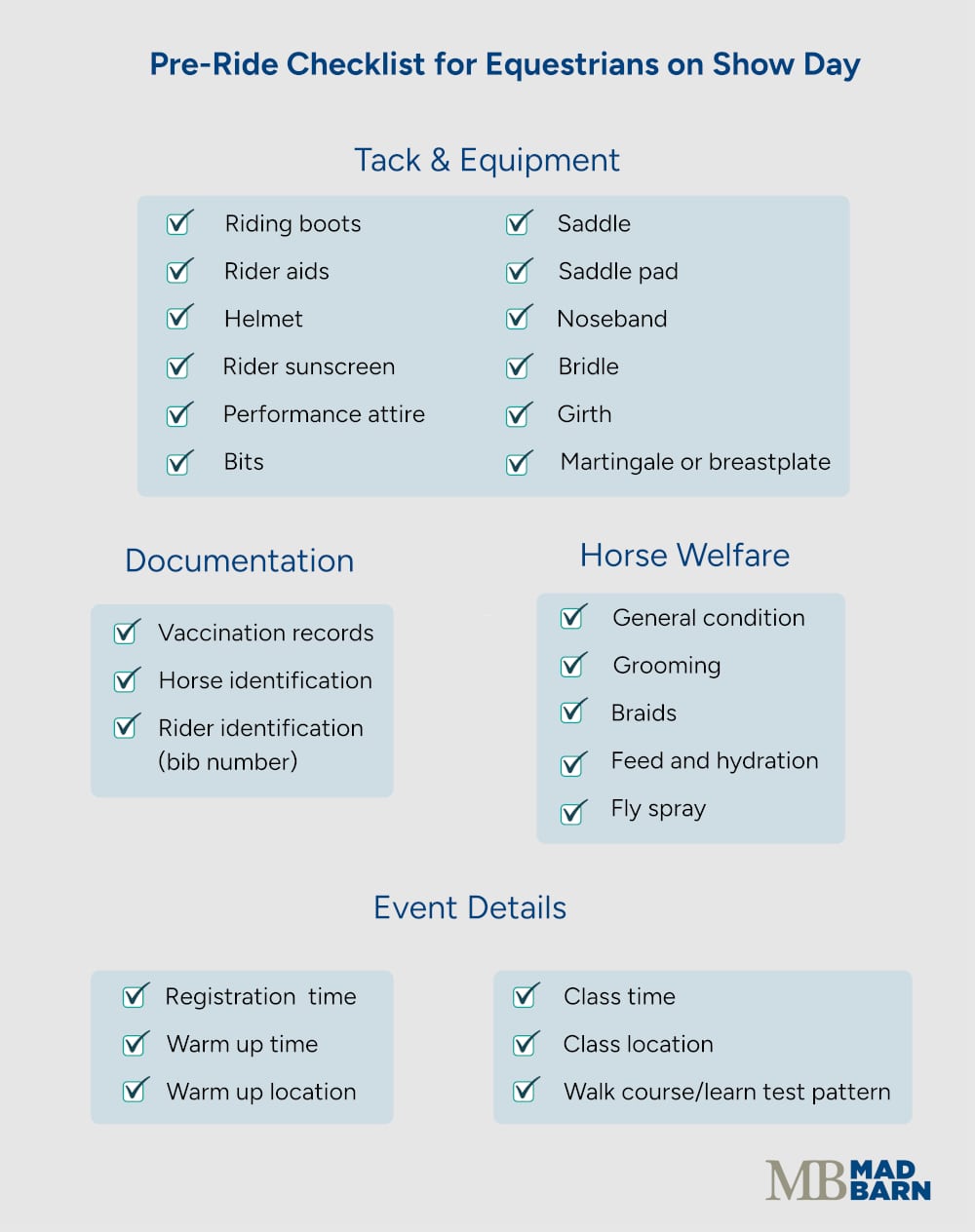
Other ways to bring a sense of control and reduce uncertainty before you ride on show day include: [5]
- Following a consistent pre-ride checklist
- Checking tack
- Gradually building rhythm during warm up
- Sticking to a planned timeline for the day
Stay Centered
With your preparation dialed in, shifting your attention inward can further reduce tension and support focus.
Two of the most common physical signs of anxiety are increased heart rate and rapid, shallow breathing. This reaction limits the amount of carbon dioxide you breathe out, which can lead to a feeling of breathlessness, escalating panic, and difficulty concentrating. [6]
There are a number of breathing exercises you can use to combat this nervous response. The simplest method to regulate your breathing is to focus your attention on taking slow, deep breaths: inhale steadily, hold briefly, then exhale slowly.
You can also sync your breath with your horse’s footsteps to help stay grounded while riding. Check your body position in the saddle when using this method, and aim to stay balanced and secure in case your horse makes any sudden moves. [4]
Here are some other common breathing techniques you can try to stay centered and in control. Try practicing well before your show day so you can tap into them when you need grounding and support under show-day pressure.
4-7-8 Breathing
The 4-7-8 method is a breathing exercise that uses deep, controlled breathing in a set pattern to help ease tension and slow a racing heart.
To perform the 4-7-8 method: [7]
- Inhale for four seconds
- Hold the breath for seven seconds
- Exhale deeply for eight seconds
- Repeat
Box Breathing
Box breathing, or four-square breathing, is another calming technique based on inhaling and holding your breath for specific measurements of time. This method is known to regulate breathing and slow heart rate, reduce stress, and improve focus. [8]
To perform box breathing: [8]
- Breathe in through your nose while counting to four
- Hold your breath for four seconds
- Exhale for four seconds
- Hold your breath for four more seconds
- Repeat this pattern up to four more times
Follow the Outbreath
The follow the outbreath technique is a simplified form of diaphragmatic breathing that emphasizes the relaxing effect of a slow, complete exhale. Focusing attention on the outbreath helps activate the body’s parasympathetic response, easing physical tension and promoting a calmer state of mind. [9]
To perform the follow-the-outbreath technique: [9]
- Sit or stand comfortably and allow your breath to settle into a natural rhythm
- Take a relaxed inhale, letting your diaphragm (belly) expand gently
- Exhale slowly, try to focus all of your attention on the sensation as the air passes through your nose or mouth
- Repeat this pattern for several cycles

Cultivate Self-Confidence
Your frame of mind plays an important role in how you handle pressure in the show ring. By learning to reframe anxiety and setting realistic goals, you can transform nervous energy into focused, productive rides.
Reframe Your Nerves
Experiencing fear, frustration, or anxiety is a natural part of engaging in meaningful activities, such as riding. These emotions often indicate a deep passion for the sport and a desire to perform well.
By reframing these negative feelings as signs of commitment to the activity, riders can maintain focus and better manage stress, ultimately enhancing their performance. [10]
From Fear to Focus
Riders often struggle with fear and self-doubt, but embracing and confronting these feelings is crucial for developing confidence. Working with knowledgeable trainers provides guidance and emotional support.
With the help of a trainer, you can gradually challenge yourself beyond familiar boundaries and foster confidence in areas you might feel lacking.
This process helps shift your mindset from one of fear to one of trust in your skills, allowing you to convert anxiety into focus that improves performance. [11]
Set Realistic Goals
Setting realistic, measurable goals is essential for success in the show ring. Breaking larger objectives into smaller daily habits and regularly reviewing progress helps maintain focus and motivation.
Involving coaches or trainers in your goal-setting process adds accountability, which can further support consistent improvement. This structured approach not only enhances performance but can also help reduce anxiety during competitions. [12]
Work with a Sports Psychologist
If show nerves tend to get the better of you, working with a sports psychologist can be incredibly helpful.
A sports psychologist can talk you through accepting your show nerves and recognizing them as a normal part of competition. This can lessen the intensity of performance anxiety before a show and allow you to focus on competing. [1]
A professional can also help you identify how your show nerves affect your riding. If they are able to isolate how your nerves affect performance, they can provide you with strategies to improve. For example, if anxiety causes you to ride too cautiously, they may instruct you to be more proactive when warming up or riding at shows.
Over time, these insights and strategies can help you build a more confident, consistent mental approach to competition.
Moving Forward with Confidence
Show nerves are a normal part of competing, but they don’t have to dictate your ride. With steady preparation, intentional mindset work, and reliable strategies, you can step into the ring feeling more focused, capable, and in control. Over time, these habits help transform anxiety into confidence — and allow you to enjoy the sport you love.
As you continue to develop your mental skills, you may find that show-day pressure feels less like an obstacle and more like an opportunity to rise to the occasion. Each experience, whether smooth or challenging, becomes a chance to refine your approach and strengthen the connection between you and your horse.
With practice, patience, and self-awareness, managing show nerves becomes not just possible, but part of your evolution as a rider.
Frequently Asked Questions
Here are some frequently asked questions about horse show nerves:
Horse show nerves, or performance anxiety, stem from a mix of psychological and physical responses to stress, often triggered by fear of failure or being judged. Riders may feel confident at home but freeze under the pressure of competition due to subconscious fears of underperforming, disappointing others, or losing control. [1] Understanding these root causes can help riders reframe their reactions and adopt coping strategies that shift focus from fear to execution. [2]
Performance anxiety can present as racing thoughts, self-doubt, rapid heartbeat, muscle tension, shallow breathing, and irritability. [2] These physical and emotional reactions are the body's natural response to stress and can surface even in well-prepared riders.
Show-day anxiety may lead riders to second-guess themselves, ride too cautiously, or become overly tense, which can interfere with clear communication and rhythm with the horse. [2] These effects can negatively influence overall ride quality and make it harder to stay focused in the ring.
Structured warm-ups with familiar movements like leg-yields and circles help ground riders physically and mentally while preparing the horse for performance. [5] Simple breathing techniques, such as syncing breath with the horse's stride or using the 4-7-8 or box breathing methods, can help regulate heart rate and focus the mind. [6][7][8] A well-planned pre-ride routine reduces uncertainty and builds a sense of control before entering the ring. [5]
Yes, even experienced riders and professionals can feel show-day nerves. Pressure often increases with higher expectations, tougher competition, or the desire to perform well for a team or client. [1] The difference is that seasoned riders usually have well-practiced strategies to work through anxiety, allowing them to stay focused and ride effectively despite nervousness.
Summary
Managing horse show nerves in equestrians requires ongoing mental fitness training that improves focus and confidence during competition.
- Incorporating mental skills such as mindfulness and controlled breathing into your regular riding routine can help build mental fitness over time
- Combining physical conditioning with mental techniques can also help manage performance anxiety more effectively in the long run
- Finding the right balance between competing regularly enough to build familiarity and confidence but not so often that it leads to burnout allows for adequate rest and recovery
- Engaging regularly with sport psychology resources or coaching provides consistent support to help you build and maintain long-term mental strength
References
- 3 Top Tips for Beating Competition Nerves. Fédération Equestre Internationale. 2018.
- Chow. K. & Mercado. E. Performance Anxiety and the Plasticity of Emotional Responses. Cognition and Emotion. 2020.
- Lincoln. A. You're Either a Confident Rider or You're Not – Right?. Fédération Equestre Internationale. 2021.
- Roebuck. K. Control Your Nerves in the Saddle. Fédération Equestre Internationale. 2024.
- Baker. S. A 4-Point Checklist for Every Horse's Warm Up. Fédération Equestre Internationale. 2020.
- Dyspnea. Cleveland Clinic. 2022.
- Aktaş. G. K. and İlgin. V. E., The Effect of Deep Breathing Exercise and 4-7-8 Breathing Techniques Applied to Patients After Bariatric Surgery on Anxiety and Quality of Life. Obesity Surgery. 2023.
- How Box Breathing Can Help You Destress. Cleveland Clinic. 2021.
- Bailey. A. Understanding Diaphragmatic Breathing. VeryWell Health. 2025.
- Stewart. D. Pressure Proof Tip with Daniel Stewart: Reframing Isn't About Hanging Pictures. United States Eventing Association. 2025.
- Callanan. A. The Road to AEC: Leaving the Start Box with Faith, Not Fear. United States Eventing Association. 2021.
- Gruber. L. Goal Setting For a Successful Season with Matt Brown. United States Eventing Association. 2018.