English


Orchardgrass is a cool-season perennial grass widely grown in temperate regions and commonly used as forage for horses. It thrives in well-drained soils and moderate climates, producing dense, leafy growth that is typically palatable to horses.
On average, orchardgrass hay provides moderate levels of energy and protein. The exact nutrient content varies depending on maturity at harvest, as well as growing conditions.
This makes orchardgrass hay a versatile option suitable for many classes of horses, from maintenance and lightly worked horses to those with increased nutritional demands.
Orchardgrass is available in a variety of forms, including pasture, hay, and processed products like pellets. Feeding the appropriate type and amount of orchardgrass to your horse depends on their age, workload, physiological status, and overall health. Keep reading to learn more about how to choose and use orchardgrass effectively in your horse’s feeding program.
Orchardgrass Hay for Horses
Dactylis glomerata, commonly known as Orchardgrass or Cocksfoot, is a perennial cool-season grass. [1] It can vary in color from bright green to darker colors, but is known for its characteristic deep, bluish-green color. [2]
Orchardgrass is native to Eurasia and Africa, and was introduced to the United States in Virginia around 1760. [3][4] It is now grown in 45 of the 48 continental United States and across Canada. [4]
Despite its popularity as a livestock and lawn grass, few companies in the United States are currently breeding and developing Orchardgrass. Given this, seeds are commonly imported for North American hay production. [5]
Orchardgrass is adapted to well-drained soils in areas with moderate to high rainfall. [1][6] While it is moderately tolerant of acidic soils, it does best in soils with a pH of 6.0 – 7.0. [1][6]
Overall, Orchardgrass is a productive grass with a rich history of use in North America, and is well adapted to grow in a variety of regions. Orchardgrass tends to have a more favorable yield compared to other species such as bromegrass, creeping foxtail, timothy, and Kentucky bluegrass. [7]
Nutritional Composition of Orchardgrass
Orchardgrass has an average nutrient content for a cool-season grass hay, with moderate energy, protein, hydrolyzable carbohydrate (HC; a.k.a. NSC), and fiber contents.
Below is an average nutrient profile for orchardgrass hay: [8][9]
| Nutrient | Average Composition |
|---|---|
| Digestible Energy | 2.04 Mcal / kg |
| Crude Protein | 10% |
| Acid Detergent Fiber (ADF) | 36% |
| Neutral Detergent Fiber (NDF) | 57% |
Despite sometimes being labeled as high in NSC (sugar and starch) content, orchardgrass tends to have intermediate NSC content compared to other cool season grasses grown and harvested under similar conditions. [5]
Factors Influencing Hay Quality
As with all grasses, several factors influence the nutrient content of orchardgrass hay:
- Fertilization and soil conditions
- Climate and growing conditions
- Maturity at harvest
- Weather conditions
- Storage conditions
Understanding how environmental and management factors affect nutrient levels in hay is important for producing and selecting high-quality forage. That being said, a hay analysis is the best way to ensure that the hay you’re feeding is suitable for your horse.
Fertilization
Fertilization and other soil conditions can affect the nutrient content of grasses. Nitrogen is commonly used in fertilizers for hay production. It plays a key role in supporting protein synthesis and maintenance in grasses.
Like other grasses, fertilization with nitrogen has been shown to increase not only the yield of orchardgrass, but also the protein content of the grass produced. [10]
Growing Conditions
Healthy, productive plants require ample sunlight and water, and temperatures suited to their growth. Changes in water availability and temperature can affect the nutritive value of forages, including protein, sugar and fiber content.
Higher temperatures often produce less digestible forage with a higher fiber content. Lower temperatures tend to result in grasses with more hydrolyzable carbohydrate content and less fiber. [2][13]
Moisture stress can be caused by both excess or insufficient water. In mild drought conditions, grasses often develop a higher leaf-to-stem ratio, resulting in increased protein levels and reduced fiber content. [2]
Severe drought lowers total yield but produces forage that is still higher in protein and lower in fiber than well-watered grass. [11][12]
These differences in nutrient content contribute to different levels of digestibility and palatability of forages produced.
Harvesting
Harvesting factors such as the time of day, moisture level at baling, and weather conditions during harvest can significantly influence the nutrient content of hay.
When plants are exposed to sunlight, they produce simple carbohydrates through photosynthesis. As a result, the hydrolyzable carbohydrate (HC) content in grass rises during daytime with continued sun exposure. [14]
Overnight, these carbohydrate reserves are used to support the plant’s normal metabolic activities, leading to a decrease in HC levels by morning.
This means that the sugar content of orchardgrass pasture is generally higher in the afternoon, so hay harvested at this time will also have higher HC content. [14]
The nutrient content of plants also changes over the year. For example, hay harvested from early spring orchardgrass pastures tends to have higher HC content than hay harvested later in the spring. [14]
Drying
Drying is an important step in producing clean, hygienic hay. During the drying process, plants can lose some of their nutritional value, particularly hydrolyzable carbohydrates such as sugars.
The slower the drying process, the greater the loss of hydrolyzable carbohydrates (HC), so weather during curing directly affects hay nutrient content. [15]
Beyond humidity, precipitation during drying can further lower hay quality. Rain leaches dry matter, protein, non-fiber carbohydrates, and minerals, producing less nutritious hay. [15]
Spoilage
Hay baled at high moisture content (> 15%) is prone to heating because of microbial respiration. This process can result in nutrient loss, and the microbes pose a risk to horse health. [15]
Excess moisture in hay promotes mold growth. Mold may release spores and mycotoxins that can cause respiratory and digestive problems. [15]
Like other forages, orchardgrass baled too wet is more likely to mold and lose quality. [16]
What's your top priority with your horse's health?

What's your top priority with your horse's health?
Forms of Orchardgrass in the Equine Diet
Orchardgrass can be incorporated into equine diets in many different forms. Options range from fresh pasture to processed products such as chopped hay and pellets, allowing you to choose the format that best suits each horse’s needs.
Pasture
Pasture grass is fresh growing vegetation that horses graze on. Orchardgrass is a common grass grown in pastures across North America.
Orchardgrass pasture has higher neutral detergent fiber (NDF) and acid detergent fiber (ADF) compared to perennial ryegrass and timothy. [7] This means orchardgrass provides more structural fiber that these other forages, resulting in lower calorie content.
Research suggests that horses prefer orchardgrass less compared to grasses like tall fescue, ryegrass, Kentucky bluegrass, and timothy. Due to this lack of preference, orchardgrass tends to increase in abundance in mixed grass pastures. [17][18]
Mixing orchardgrass with legumes like alfalfa and white clover can improve its palatability and productivity. [19] For this reason, orchardgrass is commonly grown alongside legume varieties to promote forage intake and a balanced grazing pattern.
Rotational grazing of orchardgrass is advised to maximize production, persistence, and quality of the grass being grazed. Experts recommend grazing orchardgrass to a height of 3 – 4 inches before rotating to a different section. [1]
Orchardgrass pasture is often more energy-dense than the hay harvested from it, depending on maturity at cutting and harvest conditions. For this reason, it’s important to monitor your horse’s pasture consumption if they are overweight or an easy keeper.
Free-choice orchardgrass pasture can be an excellent option for horses with higher energy demands, such as growing, lactating, or heavily exercising horses.
Hay
Hay is conserved forage that is dried, baled, and stored. Orchardgrass hay is a common form of hay grown and harvested across North America, and often imported into areas where it is not produced locally.
In one study, horses voluntarily consumed more orchardgrass hay compared to some warm season grasses including Big Bluestem and Indiangrass. [20] When comparing orchardgrass to other cool season grasses like tall fescue, meadow fescue, and festulolium, horses also seem to have a preference for orchardgrass. [21]
When orchardgrass is grown and harvested under comparable conditions, its hay has a nutrient profile similar to that of other grass hays. However, it usually has lower nutrient density compared to legumes such as alfalfa.
Orchardgrass is sold as a standalone hay and in hay mixtures with other grasses and legumes. Some common blends include:
- Orchardgrass and alfalfa
- Orchardgrass and clover
- Orchardgrass and Timothy
- Orchardgrass and Brome
- Orchardgrass and Fescue
Mixed orchardgrass and legume hays usually have an intermediate nutrient density compared to unmixed bales of each. The exact nutritional composition depends on the proportion of each plant type in the mixture.
Soaked Hay
Soaking hay is a common practice for horses that require low sugar intake, such as those with metabolic issues. It is also recommended for horses with respiratory issues to minimize exposure to dust.
Soaking orchardgrass reduces the hydrolyzable carbohydrate (HC) content and impacts levels of other nutrients. 15 – 30 minutes of soaking is recommended as the optimal amount of time to reduce HCs while minimizing the loss of dry matter. [22]
Soaking also decreases minerals such as phosphorus, potassium, and magnesium. Although these levels are unlikely to cause deficiencies in a well-balanced diet, the calcium-to-phosphorus ratio increases enough that horses fed only soaked orchardgrass hay may require extra phosphorus. [23]
Soaking also reduces minerals such as phosphorus, potassium, and magnesium. While these losses typically do not lead to deficiencies on a balanced diet, the calcium-to-phosphorus ratio can shift significantly. Horses fed exclusively soaked orchardgrass hay may require additional phosphorus to maintain proper mineral balance.
Overall, orchardgrass hay is palatable and nutritionally comparable to other grass hays. When soaking to reduce sugar or dust, owners should monitor mineral balance and supplement as needed to keep the diet complete.
Chopped & Pelleted Hay
Orchardgrass hay can be processed into other hay products after drying, providing options for horses with special care needs.
Chopped hay is made by cutting long-stem hay into shorter lengths. Chopped orchardgrass is a good option for horses with dental issues that have difficulty consuming long-stem forage. Although not commonly sold commercially, you can chop orchardgrass hay into smaller particle sizes at home using a leaf mulcher.
Another option is orchardgrass pellets, which are made by grinding hay and then compressing it into a pellet form. Orchardgrass pellets can be soaked and fed to horses with severe dental issues to maintain adequate forage intake despite limited chewing ability.
Orchardgrass pellets can also be used as a low-dust forage source for horses with respiratory issues. The nutritional value of processed orchardgrass hay generally remains comparable to that of long-stem orchardgrass hay.
Pros & Cons of Orchardgrass
Like all forages, orchardgrass has advantages and drawbacks that vary with how it is grown, harvested, and fed. Recognizing these factors will help you decide whether orchardgrass meets your horse’s nutritional needs.
Benefits of Orchardgrass
Orchardgrass is an excellent source of fiber, with average nutrient content for grass hays. It is a widely available and economical forage source that can meet the needs of many classes of horses.
Orchardgrass can also be a good choice for some picky eaters. Studies show that it may be preferred over other grasses like Big Bluestem, Indiangrass, tall fescue, meadow fescue, and festulolium. [20][21]
Keep in mind that a horse’s willingness to eat hay depends on its nutritional content and maturity, so the palatability of orchardgrass hay varies with these factors.
Disadvantages of Orchardgrass
The disadvantages of orchardgrass forage for horses are minimal. Potential concerns with orchardgrass hay arise not from the species itself but from whether a specific lot of hay meets an individual horse’s needs.
However, orchardgrass may be prone to mold at elevated moisture contents. This underscores the importance of proper drying at harvest. [24] Always be sure to check your hay for signs of mold or spoilage before feeding.
In the rare case a horse is diagnosed with an orchardgrass allergy, stop feeding it altogether.

How to Feed Orchardgrass
Orchardgrass is a reliable and nutritious forage option for horses when properly harvested and stored. With careful selection and regular quality checks, most horses can thrive on orchardgrass hay as a core component of their diet.
A forage-first diet is the best way to support your horse’s digestive health and overall well being. This approach maximizes hay intake while providing adequate vitamins, minerals and protein, and maintaining a healthy body condition.
1) Select the Right Hay
The first step to feeding your horse a forage-based diet is to choose a hay that allows your horse to maximize their forage intake. This means selecting hay that supplies — without significantly exceeding — the energy and protein your horse needs, so you rely less on grain or commercial concentrates.
In general, overweight horses benefit from mature, less nutrient-dense orchardgrass hay that is higher in fiber. This supports digestive health without adding excess calories. If additional calorie reduction is needed, soaking the hay removes soluble carbohydrates and further reduces its calorie content.
For horses in light to moderate exercise loads, free-choice mid-maturity orchardgrass hay typically meets energy and protein needs.
Mid-maturity means the grass is cut just as seed heads begin to emerge, when some seed stalks are visible but before full bloom. At this stage, the forage contains a balanced mix of leaf and stem.
Immature orchardgrass hay and mixed legume/orchardgrass hay are typically higher in energy and protein than mature or pure orchardgrass hays. This makes them a good selection for horses with elevated energy and protein needs, such as growing, lactating, or heavily exercising horses.
2) Feed the Optimal Amount
If the hay you’ve chosen matches your horse’s nutritional needs, free-choice hay feeding is ideal. Providing unlimited hay supports both digestive health and mental well-being.
The amount of hay your horse willingly consumes depends on their physiological status, including factors like their exercise level, whether they are growing, or whether they are engaged in breeding activities.
Horses at maintenance, in light exercise, and pregnant mares typically consume about 2% of their body weight in dry matter daily. Those in moderate exercise eat closer to 2.25%, and horses in heavy work, lactating mares, or growing horses may need up to 2.5%. [15]
For easy keepers, free-choice orchardgrass hay may lead to excess weight gain if the hay provides more energy than needed. In these cases, offer a controlled amount that maintains ideal body condition.
Similarly, it’s often necessary to limit orchardgrass pasture intake for easy keepers. Since pasture is usually more energy-dense than hay, reducing or eliminating pasture before cutting back on hay helps preserve forage intake without causing weight gain.
For hard keepers and horses in heavy work, even high-quality or orchardgrass/legume mixed hays may fall short of meeting their energy requirements. In these cases, consider adding digestible fiber like beet pulp or energy-dense options like oils to meet their nutritional requirements.
3) Balance the Diet
Although orchardgrass can typically meet the energy and protein needs of the average horse, it usually falls short in some important vitamins and minerals such as sodium, zinc, copper, selenium, and vitamin E.
Horses on a forage-only diet should receive a complete vitamin and mineral supplement such as Mad Barn’s Omneity® to fill nutrient gaps and meet their daily requirements.
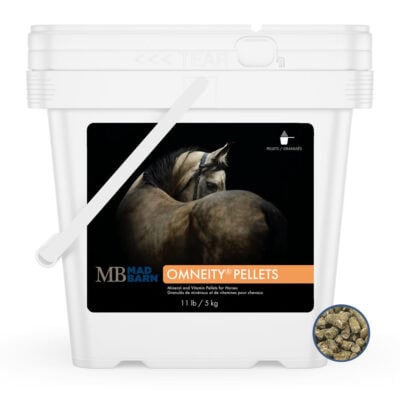
Omneity® is a palatable and easy-to-feed complete vitamin and mineral, formulated by expert nutritionists. It contains essential ingredients including 100% organic trace minerals, a full B vitamin profile, amino acids, digestive enzymes, and yeast.
Feeding Omneity® supports hoof health, skin and coat quality, immune function, athletic performance and overall well-being in all horses.
Example Diet
Below is an example diet for a 1,100 lb (500 kg) horse in light exercise, fed average-quality orchardgrass hay with a crude protein content of 10% and a neutral detergent fiber (NDF) content of 57%.
| Feed | Amount per day |
|---|---|
| Mid-Maturity Orchardgrass Hay | 25 lb (11.5 kg) |
| Salt | 30 g (2 tbsp) |
| Omneity® Pellets | 200 g (2 scoops) |
| Diet Analysis | |
| Digestible Energy | 100% of requirement |
| Protein | 144% of requirement |
| NSC | 8.8% of diet |
Keep in mind that every horse has unique nutritional needs, which can influence how well this diet suits them. For a personalized plan, you can submit your horse’s diet online for a free evaluation by a professional equine nutritionist.
Frequently Asked Questions
Here are some frequently asked questions about orchardgrass for horses:
Yes, orchardgrass is a versatile forage suitable for many horses, including those at maintenance, in light to moderate work, or with higher energy demands when selected appropriately. However, horses with metabolic issues or allergies may require alternative options.
Orchardgrass hay typically offers moderate protein and energy levels, with nutrient values similar to other cool-season grasses like timothy or brome. It is often preferred for its palatability and consistent fiber content.
Yes, orchardgrass can be fed to horses with metabolic syndrome, but with caution. Since non-structural carbohydrate (NSC) levels in Orchardgrass can vary based on harvest conditions, it's important to test the hay and consider soaking to reduce sugars before feeding it to horses with metabolic conditions. Consult with your veterinarian and nutritionist for guidance on feeding horses with metabolic concerns.
Orchardgrass can be fed as fresh pasture, dry hay, chopped hay, or pellets. Processed forms like pellets or chopped hay are ideal for horses with dental or respiratory issues.
Soaking reduces hydrolyzable carbohydrates and dust, which is beneficial for some horses, but it can also leach minerals like phosphorus, potassium, and magnesium. Dietary adjustments may be necessary to maintain nutrient balance.
Orchardgrass hay often lacks key micronutrients like sodium, copper, zinc, selenium, and vitamin E that are required by horses. A balanced vitamin and mineral supplement and free-choice salt are recommended to ensure dietary completeness.
Summary
Orchardgrass is a popular, palatable forage that provides a high-fiber foundation for many equine diets. Its nutrient profile and versatility make it suitable for a wide range of horses and feeding programs.
- Orchardgrass is a cool-season perennial grass that thrives in moderate climates with well-drained soils
- Orchardgrass has a moderate energy and protein content, which can vary depending on factors such as fertilization, stage of maturity at harvest, and overall growing conditions
- Orchardgrass can be fed to horses in several forms, including pasture, hay, and processed forage like chopped hay or pellets
- A hay analysis is recommended to help determine if your hay meets your horse's specific nutritional requirements
References
- Orchardgrass. PennState Extension. 2025.
- Kugler. J., Producing High Quality Orchardgrass and Timothy Hay. Proceedings National Alfalfa Symposium. 2004.
- Dactylis Glomerata. Iowa State University.
- Casler. M. D. et al., Genetic Progress from 40 Years of Orchardgrass Breeding in North America Measured under Hay Management. Crop Breeding, Genetics & Cytology. 2000.
- Undersander. D., Grass Varieties for Horses. Journal of Equine Veterinary Science. Elsevier. 2013.
- Riley. A., FORAGE QUALITY OF COOL SEASON PERENNIAL GRASS HORSE PASTURES IN THE TRANSITION ZONE. Theses and Dissertations--Plant and Soil Sciences. 2019.
- Allen. E. et al., Yield and Quality of Twelve Cool-Season Grasses Under Horse Grazing. Journal of Equine Veterinary Science. Elsevier. 2011.
- Feedstuff Discovery - Orchardgrass | Animal & Food Sciences. University of Kentucky. 2025.
- Pedreira. B., Forage Management: Insights from Tall Fescue, Orchardgrass, and Annual Ryegrass Variety Trials. UT Beef & Forage Center. 2024.
- Wilson. R. G. et al., Assessing Nitrogen Fertilization Needs for Irrigated Orchardgrass in the Intermountain Region of California. Forage & Grazinglands. 2008.
- Küsters. J. et al., The Effect of Summer Water Stress on the Nutritive Value of Orchard Grass (Dactylis Glomerata L.) in Permanent Grassland under Increased Temperature and Elevated Atmospheric CO2. Ecological Indicators. Elsevier. 2021.
- Jensen. K. B. et al., Forage Nutritional Characteristics of Orchardgrass and Perennial Ryegrass at Five Irrigation Levels. Agronomy Journal. 2003.
- Thorvaldsson. G. et al., The Effects of Growth Temperature on Digestibility and Fibre Concentration of Seven Temperate Grass Species. Acta Agriculturae Scandinavica, Section B — Soil & Plant Science. Taylor & Francis. 2007.
- Kagan. I. A. et al., Seasonal and Diurnal Variation in Simple Sugar and Fructan Composition of Orchardgrass Pasture and Hay in the Piedmont Region of the United States. Journal of Equine Veterinary Science. Elsevier. 2011.
- National Research Council, Nutrient Requirements of Horses: Sixth Revised Edition. The National Academies Press, Washington, DC. View Summary
- Martinson. K. et al., The Effect of Harvest Moisture and Bale Wrapping on Forage Quality, Temperature, and Mold in Orchardgrass Hay. Journal of Equine Veterinary Science. Elsevier. 2011.
- Martinson. K. L. et al., Horse Preference, Forage Yield, and Species Persistence of 12 Perennial Cool-Season Grass Mixtures under Horse Grazing. Journal of Equine Veterinary Science. Elsevier. 2016.
- Randall. L. et al., Preference for Different Pasture Grasses by Horses in New Zealand. Proceedings of the New Zealand Society of Animal Production. 2014.
- DeBoer. M. L. et al., Herbage Mass, Botanical Composition, Forage Nutritive Value, and Preference of Grass–Legume Pastures Under Horse Grazing. Crop, Forage & Turfgrass Management. Wiley Online Library. 2020.
- Ghajar. S. M. et al., Evaluating Digestibility and Toxicity of Native Warm-Season Grasses for Equines. Translational Animal Science. Oxford University Press US. 2021.
- Mastellar. S. L. et al., Equine Relative Preferences Regarding Selected Cool-Season Grass Hays. Animal Feed Science and Technology. Elsevier. 2024.
- Martinson. K. et al., The Effect of Soaking on Carbohydrate Removal and Dry Matter Loss in Orchardgrass and Alfalfa Hays. Journal of equine veterinary science. Elsevier. 2012.
- Martinson. K. L. et al., The Effect of Soaking on Protein and Mineral Loss in Orchardgrass and Alfalfa Hay. Journal of Equine Veterinary Science. Elsevier. 2012.
- Harvest Moisture Level and Bale Wrapping Affects Hay Quality for Horses. UMN Extension. 2021.