English



The Paso Fino is a gaited horse breed from the Caribbean and South America. The breed’s name translates to ‘fine step,’ which refers to the Paso Fino’s famously smooth four-beat lateral ambling gait.
Renowned for their comfortable ride and beautiful looks, Paso Finos excel as trail riding and as show horses. These gaited horses are also popular mounts for riders with back problems who can’t ride traditional gaits.
However, the breed is susceptible to degenerative conditions that can cut their riding careers short. With appropriate management and nutrition, Paso Fino horses can live long, healthy lives as beloved equine partners.
This article will review the origin, history, characteristics, health problems, and nutritional needs of the Paso Fino breed. Keep reading to learn more about caring for and feeding these horses.
Paso Fino History
These small horses descend from Iberian breeds brought to the Americas by Spanish conquistadors.
While distinct breeding programs emerged in Puerto Rico and Colombia, most American Paso Finos can trace their ancestry to both countries.
Origin
Paso Finos, American Mustangs, and Peruvian Pasos can trace their lineages to Colonial Spanish horses that first accompanied Spanish explorers across the Atlantic over 500 years ago.
Andalusians, Spanish Barbs, and now-extinct Spanish Jennets composed most of this foundation stock of breeding horses in the Americas. Spanish landowners bred combinations of these breeds on colonial plantations in Puerto Rico and Colombia to produce the Paso Fino.
Research suggests Puerto Rican Paso Finos originated from Criollo horses produced by generations of cross-breeding between Iberian breeds brought to the island by settlers. [1]
Genetic studies show Criollo horses carried the allele responsible for Paso Fino’s gait. These horses were selectively bred for smooth gaits long before the Paso Fino breed was established, suggesting the mutation was already present in imported Iberian horses. [2]
Historic Use
Ancestors of Paso Finos worked on plantations in Colonial Puerto Rico and Colombia. Farmers selectively bred horses for endurance and comfortable gaits suited to extended work days spent in the saddle. [2]
These regions had challenging geography that required hardy, sure-footed horses, and a new breed standard emerged from the non-purebred Criollo horses. The resulting Paso Fino breed would play a significant role in transportation and agriculture on the island for centuries.
Historical records of visitors to Puerto Rico from the late 18th century mention gaited horses participating in horse races that showcased the speed of their unique pace. Organized Paso Fino shows began as early as 1849 to promote the improvement of the breed. [3]
Paso Finos first gained popularity in the United States after World War II, when the breed impressed American service members stationed in Puerto Rico. Americans soon began importing Paso Finos from Puerto Rico, interbreeding lines to produce the modern American Paso Fino.
Breed Registry
The Paso Fino Horse Association is the official breed registry for Paso Fino horses in North America. Formed in 1972 in response to the breed’s growing popularity, the PFHA now maintains a registry of over 60,000 horses.
The Association registers horses originating from any country, including Colombia, Puerto Rico, Dominican Republic, and Cuba. Only Paso Fino horses with bloodlines verified by DNA testing are eligible for registration.
| Breed Summary | |
|---|---|
| Breed Name | Paso Fino |
| Breed Type | Gaited |
| Origin | Puerto Rico and Colombia |
| Breed Registry | Paso Fino Horse Association (PFHA) |
| Average Height | 13 – 15.2 hh |
| Average Weight | 900 lb (408 kg) |
| Common Coat Colors | Any color; with or without white markings |
| Conformation | Refined head, large eyes, high head carriage, arched neck, sloping shoulders, strong back, rounded loins, broad hips, straight refined legs, full tail |
| Common Uses | Trail riding, breed shows, pleasure riding, endurance |
| Temperament | Energetic, willing, friendly, spirited, trainable |
| Best For | Trail riders and riders seeking a smooth ride |
| Common Health Concerns | DSLD, equine metabolic syndrome, laminitis, gastric ulcers, stifle lameness, hock lameness |
What's your top priority with your horse's health?

Enter your email to receive your store credit
Breed Characteristics
Paso Finos have similar characteristics to other horses with Spanish ancestry. However, the breed is primarily distinguished by the unique gait that makes the Paso Fino a comfortable pleasure and competition mount.
Conformation
Paso Finos have a more diminutive stature than their Iberian ancestors. While these horses can range in size from 13 to 15.2 hands, most Paso Finos fall between 13.3 and 14.2 hands tall.
Their heads are refined and well-proportioned to their body, with defined jaws and large, expressive eyes. In addition, they have a relatively high head carriage and gracefully arched necks that add to their elegant appearance.
The ideal Paso Fino has sloping shoulders, a strong back, rounded loins, and broad hips. Legs should be straight, strong, and refined with longer forearms and shorter cannons. Their tails are naturally full and gracefully carried in motion.
Colours
Paso Finos can have any coat colour, with or without white markings.
Some Paso Finos have bright yellow, amber, or orange irises. Known as tiger eye, this trait is only found in the Paso Fino breed. Genetic studies have linked the phenotype to two mutations in a gene associated with eye pigment. [4]
Temperament
Paso Finos are energetic, willing horses with friendly personalities. The breed is beloved for its “Brio,” a natural spiritedness mixed with trainability that makes these horses enjoyable equine partners.
Despite their small stature, these horses often have a presence and fire that helps them stand out in the show ring. But unlike some spirited breeds, the Paso Fino is also amiable and strongly desires to please the rider.
Gaits
Paso Finos can perform a traditional walk and canter, but this breed typically cannot trot. Instead, they have an even, four-beat lateral gait that they perform at different speeds.
These different speeds include:
- Classic Paso Fino: Fully collected gait with slow forward motion and short steps.
- Paso Corto: Moderately forward speed with more ground covered by unhurried steps.
- Paso Largo: The fastest speed with longer extension and strides.
Each foot contacts the ground independently at precise intervals in a rapid, unbroken rhythm. The cadence and regularity of the gait produce a completely smooth and comfortable feeling for the rider. The Paso Fino gait is natural for the breed and not trained.
Colombian Paso Finos have a unique gait from other breed members, known as the trocha. This gait has a lateral step sequence similar to a broken foxtrot. But research suggests that the trocha is genetically distinct from lateral paces seen in other breeds. [5]
Disciplines
Paso Finos are most commonly used in breed shows with multiple divisions, including classic fino, performance, pleasure, specialty, and bella formas. Depending on the division, horses are judged on conformation, gait, obedience, and versatility.
Paso Finos are popular trail and pleasure mounts outside the breed show ring. Since these horses have excellent endurance and are comfortable to ride for a long time, they are also commonly used in competitive long-distance events.

Paso Fino Health
Most of the health problems found in Paso Finos are common in all show horses. However, the breed also has an increased incidence of certain degenerative diseases that can hinder their performance.
Genetic Diseases
While Paso Fino lines carry a unique mutation that influences eye colour, research is still ongoing on the potential effects of genes associated with tiger eyes. However, studies did not reveal unusual vision issues in tiger-eye Paso Finos. [4]
Paso Finos have an above-average incidence of degenerative suspensory ligament disease. Researchers have yet to link specific genes to the condition, but inheritance patterns suggest DSLD has a genetic component in horses.
DSLD causes the progressive deterioration of the suspensory ligament in horses, characterized by a slow dropping of the fetlock and lameness. The condition is painful, debilitating, and incurable. Eventually, some horses struggle to stand comfortably and have to be euthanized.
The onset of the disease is subtle and often occurs in horses with no history of injury. Although once thought only to affect geriatric horses, DSLD can occur at any age. The disorder is most common in the Peruvian Paso, but Paso Finos also have an increased DSLD risk. [6]
DSLD involves abnormal proteoglycan deposition in connective tissues and abnormal collagen in ligaments. These abnormalities are also found in other parts of the body, putting Paso Finos at higher risk of other conditions such as aortocardiac fistulation. [19][20]
Health Problems
Equine Metabolic Syndrome
Like all Iberian horses, Paso Finos have a high prevalence of metabolic syndrome. This results in easy weight gain, abnormal fat deposits such as cresty neck and an increased risk of laminitis.
Gastric Ulcers
All performance horses, including Paso Fino show horses, experience higher levels of stress that puts them at risk for developing gastric ulcers. [7]
Studies have found that participating in just one competition can significantly increase the risk of gastric ulceration. 58% of all performance horses are affected by the condition. [8]
Several factors contribute to the increased risk of ulcers, including:
- Trailering
- Changes in routine
- Social isolation
- Intermittent access to feed and water
- Low forage, high-grain diets
Changes in management that encourage natural feeding and social behaviours can help mitigate gastric ulcers in performance horses. [17]
Lameness
In addition to a genetic risk for DSLD, the movement kinetics of gaited horses can increase the risk of certain types of lameness in Paso Finos. Stifle lameness and hock lameness are the most commonly treated lameness issues in gaited breeds. [9]
Lameness can be challenging to diagnose in gaited breeds. Without early identification, hind-end problems can contribute to compensatory forelimb lameness. [10]
Care and Management
Like all horses, Paso Finos need quality basic care to maintain their overall well-being. This includes:
- Preventative veterinary care: Maintain an appropriate schedule for vaccinations, deworming, and dental care.
- Lameness exams: Because this breed is susceptible to DSLD and hindlimb problems, frequent lameness exams can help with early detection.
- Daily turnout: Movement supports tendon, ligament, and bone strength in Paso Finos [11].
- Enrichment: Paso Finos are energetic horses that thrive with regular training and mental stimulation, particularly if housed in a stall.
- Farrier care: Routine farrier care that maintains hoof balance prevents excess loading forces on the lower limb structures in gaited horses. Paso Finos with DSLD may need therapeutic shoeing to manage the condition. [12]
Paso Fino Nutrition
Nutrition is a vital aspect of supporting the health and performance of all horses. Appropriate feeding practices are also important for managing many common health problems in Paso Finos.
These horses are also susceptible to metabolic disorders and need a balanced diet to maintain a healthy weight.
Weight Maintenance
Paso Finos are easy keepers, meaning that they maintain good body condition even when fed a less energy dense diet. These horses inherited their slow metabolism from their Iberian ancestors.
While their hardiness allowed them to survive in harsh island conditions, the breed can quickly become obese when overfed.
Obese horses have a higher prevalence of equine metabolic syndrome, which increases the risk of laminitis. However, horses may also be of normal body condition but will display abnormal fat deposits, especially a fatty crest on the neck. Those horses are also at risk of laminitis.
To address this, owners should prioritize maintaining a healthy body condition. Based on Henneke’s 9-point body condition scale, horses should be maintained at a score between 4.5 to 5.5. Horses that are a 6 or over are considered overweight or obese. [21]
Forage
Forage is the foundation of every equine diet. Horses should consume at least 2% of their body weight in forage daily. This means that an average 900 lb / 408 kg Paso Fino should be fed 18 pounds of hay daily.
Free-choice forage intake is best for supporting optimal digestive function and preventing gastric ulcers. [13] However, some horses can experience weight gain on free-choice forage if they consume more calories than they burn. Therefore, it is important to choose the right hay for your horse.
Like other easy keeper breeds, most Paso Finos do well on average or mature grass hay with low sugar (ESC) and starch content. Horses that are exercising may need higher calorie forage, such as a less mature grass hay.
Horses known or suspected to have metabolic syndrome should have hay tested to be less than 10% ESC + starch.
Alfalfa hay is an excellent high-protein forage for Paso Fino show horses that need more dietary protein to support performance. The high calcium content of alfalfa also buffers stomach acid and helps prevent gastric ulceration. However, too much alfalfa may create mineral imbalances in the diet. [14] Alfalfa may also cause foot soreness in horses with metabolic syndrome.
Sample Diet
The following is a sample diet for a mature Paso Fino with normal body condition in moderate work.
| Feed | Maintenance Diet |
|---|---|
| (Amount / Day) | |
| Mid-Quality hay (10% crude protein) | free-choice |
| Salt | 30 g (2 tbsps) |
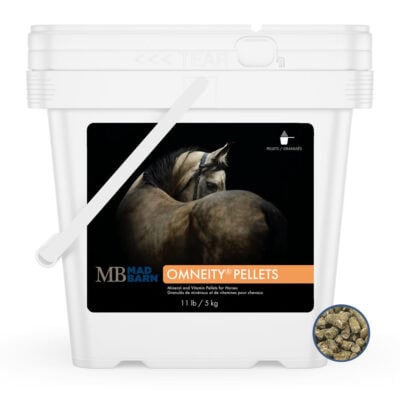
| Omneity® Pellets | 150 g (1.5 scoops) |
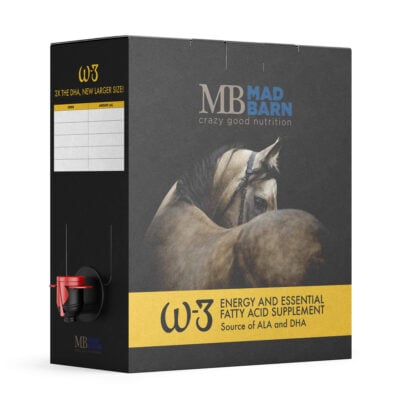
| w-3 oil | 120 ml (4 oz) |
| Diet Analysis | |
| Digestible Energy (% of Req) | 100% |
| Protein (% of Req) | 144% |
| NSC (ESC + starch) (% Diet) | 8.7% |
This diet analysis is based on NRC requirements for a 900 lb Paso Fino in moderate work. [18]
In this diet, Mad Barn’s Omneity® is fed as a concentrated vitamin and mineral supplement to help meet micronutrient requirements. [18] Omneity® is ideal for Paso Finos and other easy keepers because it does not contain fillers or added sugars or starch.
Adding 1 – 2 ounces of loose salt to the daily ration can help meet sodium requirements and support hydration.
Feeding Management and Supplements
Overweight Paso Finos benefit from forage provided in a slow feeder, such as a small hole hay net. This will slow consumption and limit calories while still providing the horse with free choice forage.
Overweight horses may also need a grazing muzzle and limited time on fresh pasture to manage their risk of laminitis from the overconsumption of grass. [15] Horses prone to laminitis may not tolerate pasture access, especially when grass is actively growing.
For Paso Finos with DSLD, adding an omega-3 fatty acid supplement containing DHA or EPA can help to support soft tissues, including joints, ligaments and tendons. [16]
Mad Barn’s w-3 oil is a fat supplement enriched with DHA and natural Vitamin E. Feeding a small amount of w-3 oil will support joint health without contributing to weight gain.
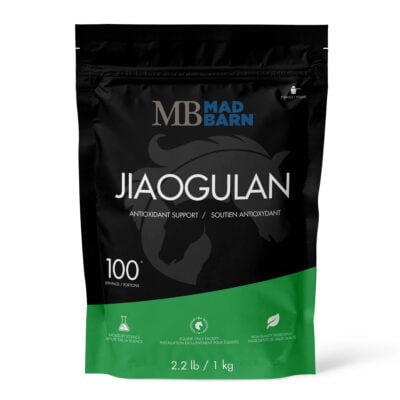
Nitric oxide also plays a critical role in tendon and ligament health. [22][23] Jiaogulan effectively enhances nitric oxide levels. [24] Enhanced nitric oxide also improves blood supply to the feet. [25]
An equine nutritionist can help identify gaps in your Paso Fino’s diet and recommend changes to better meet their needs. Submit your horse’s diet for a free analysis to find out more.
Frequently Asked Questions
Here are some frequently asked questions about Paso Fino horses:
Paso Fino horses are a gaited horse breed from the Caribbean and South America. The Paso Fino is best known for a naturally smooth four-beat lateral gait, and the breed’s name translates to “fine step.” Developed from Spanish horses brought to the Americas, Paso Fino horses are valued for their comfort, elegance, and endurance.
Paso Fino horses originated in Puerto Rico and Colombia, with roots tracing back to Spanish horses brought to the Americas by conquistadors. Breeding programs in these regions refined horses with smooth gaits, endurance, and sure-footedness. Most modern Paso Fino horses trace their ancestry to these Caribbean and South American bloodlines. Their history is closely tied to plantation work, transportation, and regional riding traditions.
Paso Fino horses perform a smooth, four-beat lateral gait in several natural variations. The three main Paso Fino gaits are the classic fino, paso corto, and paso largo. The classic fino is slow and highly collected, the paso corto is moderate and practical for covering ground, and the paso largo is the fastest and most extended. Each gait maintains an even rhythm that gives Paso Fino horses their famously comfortable ride.
Paso Fino horses are most commonly used for trail riding, pleasure riding, breed shows, and endurance-style riding. Their smooth gait makes them especially popular with riders who want a comfortable mount for long hours in the saddle. Paso Fino horses are also shown in divisions that evaluate gait, presence, obedience, and conformation. Their stamina and sure-footedness make them well suited to both recreational and competitive settings.
Paso Fino horses are known for being energetic and friendly. They are often described as having “brio,” which refers to a spirited nature combined with trainability and responsiveness. Despite their animation and presence, Paso Fino horses are generally amiable and eager to please. With consistent handling and regular work, they make enjoyable and attentive riding partners.
Paso Fino horses have a refined, elegant build with features that support balance, style, and efficient movement. They typically have a well-proportioned head, large expressive eyes, a relatively high head carriage, and an arched neck. Their bodies usually include sloping shoulders, a strong back, rounded loins, broad hips, and straight, refined legs. Paso Fino horses also tend to have naturally full tails that are carried with grace in motion.
Paso Fino horses can be any coat color, with or without white markings. Unlike some breeds with a limited color range, Paso Fino horses are not defined by one or two common coat patterns. Their appearance can vary widely, which adds to the breed’s visual appeal. Some Paso Fino horses also have distinctive amber, yellow, or orange “tiger eye” coloring.
Paso Fino horses typically stand between 13 and 15.2 hands high. Most Paso Fino horses fall in the smaller part of that range, usually around 13.3 to 14.2 hands. Their moderate height contributes to the breed’s compact, balanced appearance. Although not large horses, Paso Fino horses are athletic, sturdy, and capable of carrying riders comfortably over long distances.
Paso Fino horses are more prone than some breeds to degenerative suspensory ligament disease, equine metabolic syndrome, and gastric ulcers. Degenerative suspensory ligament disease, often called DSLD, is one of the best-known concerns in Paso Fino horses and can lead to progressive pain and lameness. Paso Fino horses that easily gain weight may be at risk of laminitis related to metabolic problems, and performance horses in the breed can also develop stress-related issues such as gastric ulcers and certain hind-end lameness problems.
Summary
Paso Finos are compact, gaited horses from the Caribbean and South America, known for their smooth four-beat ambling gait called the “Paso.” They are prized for endurance, elegance, and gentle temperament. These horses excel in trail and show disciplines but are prone to degenerative ligament conditions requiring attentive management and diet.
- Descended in the Americas from Iberian horses brought over 500 years ago
- Naturally gaited breed performing smooth, comfortable four-beat ambling gaits
- Valued for spirited yet trainable temperaments and high endurance
- At risk of DSLD and metabolic syndrome requiring careful management
- Thrive on forage-based diets balanced with minerals and omega-3 supplements
References
- Luis, C. et al. Iberian Origins of New World Horse Breeds. J Heredity. 2006. View Summary
- Wolfsberger, W. et al. Genetic diversity and selection in Puerto Rican horses. Nature. 2022. View Summary
- Denhardt, R. The Horse in New Spain and the Borderlands. Ag Hist. 1951.
- Mack, M. et al. Two Variants in SLC24A5 Are Associated with “Tiger-Eye” Iris Pigmentation in Puerto Rican Paso Fino Horses. G3 Genes Genome Genet. 2017.View Summary
- Novoa-Bravo, M. et al. Selection on the Colombian paso horse's gaits has produced kinematic differences partly explained by the DMRT3 gene. PLoS One. 2018.
- Luo, W. et al. Degenerative Suspensory Ligament Desmitis (DSLD) in Peruvian Paso Horses Is Characterized by Altered Expression of TGF? Signaling Components in Adipose-Derived Stromal Fibroblasts. PLoS One. 2016.View Summary
- Mamkvist, J. et al. Behaviour and stress responses in horses with gastric ulceration. Appl Anim Behav Sci. 2012.
- Hartmann, A. et al. A preliminary investigation into the association between competition and gastric ulcer formation in non-racing performance horses. J Equine Vet Sci. 2003.
- Nicodemus, M. et al. Temporal variables of four-beat, stepping gaits of gaited horses. Appl Anim Behav Sci. 2003.
- Rhodin, M. et al. Timing of Vertical Head, Withers and Pelvis Movements Relative to the Footfalls in Different Equine Gaits and Breeds. Animals. 2022.View Summary
- Reilly, A. et al. Incidence of soft tissue injury and hours of daily paddock turnout in non-elite performance horses. J Equine Vet Sci. 2021.
- Bonilla-Gutierrez, A. et al. Regenerative Therapies for the Treatment of Tenodesmic Injuries in Horses. J Equine Vet Sci.
- Andrews, F. et al. Nutritional management of gastric ulceration. Equine Vet Ed. 2015.
- Cipriano-Salazer, M. et al. The Dietary Components and Feeding Management as Options to Offset Digestive Disturbances in Horses. J Equine Vet Sci. 2019.
- Watts, K. Forage and pasture management for laminitic horses. Clin Techniq Equine Pract. 2004.
- Caron, J. Omega-3 fatty acids and docosahexaenoic acid oxymetabolites modulate the inflammatory response of equine recombinant interleukin1B-stimulated equine synoviocytes. Prostaglandin & Other Lipid Mediat. 2019.View Summary
- Buchanan B.R. & Andrews F.M. Treatment and prevention of equine gastric ulcer syndrome. Vet Clin. 2003. View Summary
- National Research Council Nutrient Requirements of Horses. NRC. 2007.
- Deacon, L.J. et al. Closure of an Aortocardiac Fistula in a Horse. CASE: Cardiovascular Imaging Case Reports. 2022. View Summary
- Halper, J. et al. Degenerative Suspensory Ligament Desmitis – A New Reality . Pak Vet J. 2011.
- Henneke, D.R. et al. Relationship between condition score, physical measurements and body fat percentage in mares. Equine Vet J. 1983. View Summary
- Bokhari, A.R. and Murrell, G.A.C The role of nitric oxide in tendon healing. J Shoulder Elbow Surg. 2012.
- Murrell, G.A.C. et al. Modulation of tendon healing by nitric oxide. Inflamm Res. 1997.
- Tanner, M.A. et al. The direct release of nitric oxide by gypenosides derived from the herb Gynostemma pentaphyllum. Nitric Oxide. 1999.
- Hinckley, K.A. et al. Glyceryl trinitrate enhances nitric oxide mediated perfusion within the equine hoof. J Endocrinol. 1996. View Summary