English
![Western Dressage: History, Competition & Rules [Discipline Guide]](/wp-content/uploads/2025/07/western-dressage-discipline-guide.jpg)
Western dressage is an equestrian discipline that blends the time-honored traditions of classical dressage with the tack, style, and culture of Western riding.
In classical dressage, the horse learns to move smoothly, stay balanced, and respond to the rider’s cues. Western dressage is built on similar principles, but uses a Western saddle, bridle, and reins.
As a competitive discipline, Western dressage is just over a decade old, but has grown quickly due to its natural fit with Western riding.
Rather than focusing on flashy tricks or breed type, judges assess how well the horse and rider move together. They score each movement and give overall marks for equitation skills including the rider’s position and how soft the horse is on the bridle.
Western dressage welcomes riders from many backgrounds — whether they have competed in barrel racing, rodeo, or worked cattle on a ranch. By bringing together the best parts of dressage and Western riding, this discipline helps horses and riders develop trust, strength, and harmony.
Western Dressage
Western dressage is a relatively new competitive discipline designed to develop a horse’s training, flexibility, and balance. [1]
Riders in Western dressage follow a structured progression of tests that mirror classical dressage movements but in Western tack. Early tests focus on smooth transitions between walk, jog, and lope (the Western “canter”), serpentines, and simple figure‐eights. [1][2]
As horses and riders advance, they add lateral work (like leg yields and shoulder‐fore), two-track exercises, and more collected gaits. Each movement is performed precisely on a loose rein, emphasizing the horse’s willingness to bend around the rider’s inside leg while maintaining an even tempo. [2]
Unlike stock-horse events, large Western dressage arenas are the same size as English rings, and riders cue patterns from the same letter markers. Movements are judged on accuracy, cadence, and the horse’s relaxation and responsiveness, rather than speed or flash. [1][3]
Equipment remains distinctly Western — saddles with a lower horn, split reins, and usually a curb bit — but riders adopt a lighter seat and straighter leg than in other Western disciplines, bridging the gap between ranch work and ring performance. [3]
History
Western dressage is a relatively new equestrian discipline, with formal rules and competitions emerging in the early twenty-first century. The sport was created to blend the established training methods of classical dressage with the traditions of Western horsemanship. [4]
Seasoned Western riders saw the value in a discipline that emphasized softness, balance, and responsiveness. At the same time, it was recognized that many traditional Western show classes are centered around style or flash, rather than correct movement and partnership.
Western dressage offers a new alternative; one that evaluates horses based on their balance, willingness, and way of going, rather than breed type or performance tricks. [4]
The Western Dressage Association of America (WDAA) was founded in 2010 as the first national organization dedicated to this new discipline.
The WDAA quickly established a formal test structure, organized shows, and partnered with the United States Equestrian Federation (USEF) to develop an official rule book and judging criteria. This partnership helped establish Western dressage as a USEF-recognized sport, giving it national legitimacy. [4]
In 2020, the American Quarter Horse Association (AQHA) formally recognized Western dressage as a points-eligible discipline. This allowed registered Quarter Horses to earn AQHA awards and recognition based on their Western dressage scores. [5]
The discipline was also added to the USEF All Breeds Awards Program, which recognizes horses for dressage achievements, further cementing its place alongside traditional dressage. [6]
Today, Western dressage continues to grow not only in the United States but also internationally, with organizations and events gaining popularity in Canada, Europe, and Australia.
Sports Organizations
As the discipline of Western dressage continues growing, several organizations have emerged to promote its development, standardize competition rules, and support riders and horses at all levels.
These organizations play a key role in shaping the sport, from establishing judging criteria to offering educational resources and fostering inclusive, supportive communities.
Western Dressage Association of America (WDAA)
The Western Dressage Association of America (WDAA) is the principal governing body for Western dressage in the United States. Founded in 2010, the WDAA has led the movement to formalize and legitimize the discipline by blending classical dressage principles with traditional Western horsemanship. [4] The WDAA’s mission is to “honor the horse, value the rider, and celebrate the partnership.” [7]
The organization emphasizes training with kindness, fairness, and progressive development. [4] The WDAA is responsible for publishing the Western Dressage Rules in partnership with the United States Equestrian Federation (USEF).
WDAA shows are held nationwide, with options ranging from schooling shows to USEF-recognized competitions. A standout feature is the WDAA Online Horse Show platform, which allows riders to compete virtually. This increases accessibility for riders in rural areas or those who are new to competition. [8]
United States Equestrian Federation (USEF)
As the national governing body for equestrian sport in the U.S., the United States Equestrian Federation officially recognizes Western dressage as a competitive discipline. The USEF’s partnership with the WDAA ensures that Western dressage is held to a consistent national standard. [3]
USEF-sanctioned Western dressage classes follow the rules published in the Western Dressage (WD) Chapter of the larger USEF Rule Book. [3] The federation provides oversight at licensed competitions, and ensures that judging is consistent across events.
AQHA
The American Quarter Horse Association (AQHA) officially recognized Western dressage in 2020, offering competitors a structured path to earn points and awards through AQHA-approved events.
Horses must be AQHA-registered, and exhibitors must hold current AQHA memberships. [5]
International Western Dressage Associations
Western dressage is gaining traction beyond the United States, with a growing number of international riders embracing the discipline.
While no single international governing body currently oversees global standards, various countries have begun to establish their own national Western dressage associations, including: [9][10][11]
- Western Dressage Association of Canada (WDAC)
- Western Dressage Association of Australia (WDA-AUS)
- Western Dressage Association of Sweden (WDAS)
In addition, independent trainers and show organizers in the United Kingdom (The Western Equestrian Society UK, WES), and New Zealand (New Zealand Western Riding Federation, NZWF) are incorporating western dressage tests into clinics and local competitions. [12][13]
While international alignment is still evolving, most of these groups follow the WDAA’s framework as a template for their programs.
What's your top priority with your horse's health?

Enter your email to receive your store credit
Western Dressage Competition
Western dressage competition applies the classical principles of dressage — such as balance, rhythm and suppleness — to horses ridden in Western tack. In the show ring, combinations perform a set of prescribed patterns at the walk, jog (Western trot) and lope (Western canter), demonstrating harmony, cadence and fluid transitions. [3][4]
Unlike English dressage, which emphasizes elevated collection and precise frame, Western dressage showcases a more relaxed, ground-covering stride appropriate for ranch work, with the horse carrying itself in a natural outline and responding to subtle seat and rein cues.
English vs. Western Dressage
While both English and Western dressage share the same judging metrics (purity of gait, impulsion, submission, and the rider’s effectiveness), the execution and presentation differ.
In English dressage, the rider uses traditional English tack, and wears breeches and tall boots in the ring. English dressage horses perform with the head more vertically flexed, and advanced movements demand higher degrees of collection.
Western dressage is performed in a Western saddle, denim or chaps, and a cowboy hat or helmet. The horse moves in a longer, more ground-reaching jog and lope, and flexion is softer, allowing the neck to stretch forward and downward in a comfortable outline. [3]
Western Dressage Arena
Horses and riders perform Western dressage tests in an arena during competition.
There are two different Western dressage arena sizes: [1]
- Large Arena: 20 m x 60 m (approximately 66 ft x 198 ft)
- Small Arena: 20 m x 40 m (approximately 66 ft x 132 ft)
Western dressage uses the small arena for Introductory and Basic level classes. All classes at or above Level 1 are performed in the large arena. [1]
Arena Letters
A traditional dressage arena consists of white railings lining the outer border and letters marking specific locations along the perimeter.
As in English dressage, riders enter the arena at A, which marks the center of the nearest short side. In competitions with a single judge, the judge sits at C, which marks the center of the opposite short side. [3]
Starting clockwise from A, a large dressage arena has the following letters around the perimeter: [1]
Mnemonic devices can help new riders memorize the major letter locations that mark the endpoints, corners, and midpoints, such as: [1]
All King Edward’s Horses Can Master Really Big Pink Fences
Similarly, junior riders use this mnemonic device to remember the letter positions in the small arena: [1]
All King Edward’s Horses Can Master Big Fences
Western Dressage Tests
Western dressage tests are sequences of prescribed movements performed at specific arena letters, allowing horse and rider to demonstrate their partnership and level of training in competition.
Each test is designed to match the skill of the horse-and-rider combination, from Introductory and Basic levels up through Levels 1 – 5 and freestyle. As combinations advance, tests introduce more challenging maneuvers — such as extended jogs, collected lope, simple and flying lead changes, and lateral work — to showcase increased suppleness, balance and responsiveness. [3]
Every test includes a directive outlining its purpose and the qualities judges will be evaluating. [3]
Riders present their tests before licensed western dressage judges, who score each movement and the overall performance based on criteria like accuracy, rhythm, impulsion and correctness of execution. [3]
Western Dressage Freestyle
Western dressage freestyle showcases the harmony and athleticism of horse and rider set to music. Competitors choreograph their routines around required movements for their level and select music that highlights their horse’s rhythm and style. [3]
While Grand Championship Freestyles serve as the pinnacle at international western dressage shows, freestyle tests are offered at every level of competition. Most organizations require riders to achieve a minimum score on the corresponding official test before they may enter a musical freestyle, ensuring a foundation of correct training and proficiency.
Many national shows also feature multi-rider freestyle classes. A pas de deux pairs two horse-and-rider combinations in synchronized choreography, while a quadrille brings together four horses and riders for a dynamic, team-based performance.
Western Dressage Scoring
Western dressage is structured around progressive levels, with each level building upon the previous to reflect the systematic development of horse and rider. Every test is accompanied by a detailed score sheet, allowing judges to assign a score to each movement and provide comments to support the rider’s growth. [3]
Movements are scored on a scale from 0 to 10, with 10 being “Excellent” and 0 indicating “Not Performed” as follows: [3]
- 10: excellent
- 9: very good
- 8: good
- 7: fairly good
- 6: satisfactory
- 5: marginal
- 4: insufficient
- 3: fairly bad
- 2: bad
- 1: very bad
- 0: not performed
In addition to individual movement scores, collective marks are awarded at the end of the test.
These marks summarize the overall impression of the ride and focus on four key areas: [3]
- Gaits: Judges evaluate the regularity, rhythm, and freedom of the horse’s movement across all gaits performed in the test.
- Impulsion: Refers to the horse’s forward energy, elasticity, and engagement of the hindquarters, reflecting their willingness and ability to move with power and rhythm.
- Submission: Evaluates the horse’s attentiveness, confidence, softness, and acceptance of the aids, particularly the bit. A submissive horse shows harmony with the rider and performs with lightness and relaxation.
- Rider’s position and seat: The rider’s balance, posture, and the effectiveness of their aids in influencing the horse correctly and sympathetically.
Artistic Merit
Western dressage freestyles are judged with two separate score sheets—one for technical correctness and one for artistic merit — each contributing 50% to the final result. [3]
The artistic score is broken down into five key components: [3]
- Harmony: horse and rider demonstrate smooth, cooperative communication
- Choreography: creative use of the arena and design, avoiding a “test-like” feel
- Degree of difficulty: rewarding well-executed, challenging movements
- Music suitability: selection and smooth editing of music that complements the horse
- Interpretation: how well the music expresses the horse’s gaits and paces
Final Score
Riders’ raw scores for each movement and their Collective Marks are multiplied by any prescribed coefficients, summed, and penalty points deducted to give a total score. That total is then expressed as a percentage by dividing by the maximum possible points and multiplying by 100. [3]
In competitions with multiple judges, each judge’s points and corresponding percentage are posted, and a competitor’s final percentage is the average of those judges’ percentages. [3]
The competitor with the highest total points (or averaged percentage) wins. When the prize list provides for tie-breaking, ties are resolved in this order: [3]
- Highest sum of Collective Marks
- Highest Collective Marks from the judge at C
- Highest Free Walk score
- Highest sum of movement scores with coefficients greater than one
- If still tied, the judge(s) decide

Western Dressage Movements
Western dressage movements develop the horse’s balance, impulsion, and partnership through a series of prescribed gaits, transitions, and maneuvers performed at designated arena letters.
Each exercise showcases the horse’s rhythm, regularity, and willingness to respond to subtle aids while maintaining lightness and harmony with the rider.
Gaits
As in classical dressage, the foundation of Western dressage is the horse’s gaits. Western dressage tests include variations on the three basic paces: [3]
- Four-beat walk: A well-marked four-beat gait in a regular cadence with equal intervals between each beat, maintained with complete relaxation. Recognized variations include collected, working, free, and extended walks, each showing clear differences in attitude, tracking, and ground cover.
- Two-beat jog: A two-beat diagonal gait separated by a moment of suspension, characterized by free, active, regular steps. Variations include collected jog (shorter, elevated steps with self-carriage), working jog (even, elastic strides), lengthening of strides (maintaining tempo), and free jog (relaxed topline and stretch).
- Three-beat lope: The lope is a three-beat gait with a clear time of suspension after the third beat, performed on the correct lead. It must remain balanced, rhythmic, and supple, showing uphill tendency and engaged hindquarters. Variations include collected lope, working lope, lengthening of strides, and counter lope for straightening.
Lateral Work
Lateral movements refine suppleness and engagement. Key exercises include: [3]
- Leg yield: The horse moves forward and sideways, away from the rider’s leg, with a straight body and slight flexion away from the direction of travel.
- Shoulder-in: With the horse bent around the rider’s inside leg, the shoulders are brought off the track toward the inside, creating engagement of the inside hind leg and improved suppleness through the ribcage.
- Travers (haunches-in): The horse’s hindquarters are brought off the track toward the inside while maintaining bend at the poll, increasing impulsion and strengthening the hind end.
- Renvers: A mirror of travers, with the horse bent in the opposite direction—shoulders on the track and haunches toward the wall—fostering lateral flexibility and straightness.
- Sidepass: The horse crosses its legs in place without forward movement, moving directly sideways under light rein and leg aids to develop straightness and precision of lateral steps.
- Half-Pass: Executed at both the jog and lope, the horse moves diagonally forward and sideways, bent toward the direction of travel, with the inside hind leg stepping well under the body to enhance collection, engagement, and harmony.
- Turn on the forehand: The horse pivots its forehand around a nearly stationary hind end, stepping laterally with the front legs on the spot to develop bend through the shoulders.
- Turn on the haunches (pivot): With the forehand held relatively still, the horse steps its hind legs around the front end in a small arc, engaging the hindquarters and promoting collection and balance.
- Pirouettes: Executed at the lope, the horse completes a full 360° turn on the haunches with elevated, cadenced strides. Some tests may include quarter and half pirouettes.
Geometry
Geometric patterns challenge accuracy, bend, and consistency of pace throughout the test. Western dressage geometry patterns include: [3]
- Circles: vary in size according to the requirements of each test
- Volte: a small circle ridden with a tighter bend than a standard circle to develop collection and engagement
- Serpentines: a series of equal half-circles connected by straight lines. When crossing the centerline, the horse should align parallel to the short side
- Loops: individual half-circle segments ridden with consistent radius and bend to refine suppleness and straightness
- Diagonals: straight lines ridden from one corner to the opposite or between designated markers, emphasizing straightness of the horse’s body and precise alignment
- Centerline: the straight central axis of the arena, used to perform movements or transitions; accuracy and alignment along this line are critical
Western Dressage Levels
Western dressage is organized into a series of progressive levels, each building upon the foundation of the previous one. This structured approach provides a clear, systematic training path for both horse and rider.
As combinations advance through the levels, they develop improved balance, strength, suppleness, and communication. Each level introduces new movements and challenges designed to enhance the horse’s athletic ability and the rider’s effectiveness in the saddle. [2]
Introductory level
This level introduces horse and rider to Western Dressage fundamentals. The focus is on riding at the walk and jog with a steady rhythm, light contact, and clear understanding of basic figures.
The horse should move forward freely, demonstrate relaxation, and exhibit harmony with the rider’s aids. [2][3]
Movements Introduced: [3]
- Walk
- Jog
- Free walk
- 20 m half circle at working jog
- Halt (4 seconds)
Basic level
At Basic level, the horse builds on introductory skills by showing suppleness and consistent forward movement in all gaits. Light, steady contact is expected, and the horse should respond willingly to the rider’s aids. Emphasis is placed on improving impulsion, balance, and overall rideability. [2][3]
Movements Introduced: [3]
- Working walk
- Working jog
- Free jog
- Working lope
- Free walk
- 20 m circle at free jog
- 20 m circle at working lope
- One loop 10 m off the track at working jog
- Half circle 10 m returning to the track at working jog
- Halt from the jog (2–4 seconds)
Level 1
Level 1 advances the horse’s engagement and impulsion, introducing lengthened jog and lope. The horse should maintain a light, consistent contact with the bit and begin to show collection. Lateral movements and transitions challenge balance, suppleness, and accuracy of geometry. [2][3]
Movements Introduced: [3]
- Back 4–6 steps
- 15 m half circle at working jog
- 3-loop serpentine (quarter line to quarter line) at working jog
- Leg yield from quarter line
- 15 m circle at working lope
- Lengthening of the jog
Level 2
At Level 2, the horse accepts more weight on the hindquarters and moves with an uphill tendency, especially in lengthened paces. Collected jog and lope appear, requiring greater straightness, suppleness, and self-carriage under light contact. [2][3]
Movements Introduced: [3]
- Collected jog
- Collected lope
- 10 m circle at collected lope
- Shoulder-in
Level 3
Level 3 deepens collection and uphill balance in both collected gaits. Movements must be executed with enhanced straightness, bending, and throughness. The horse demonstrates stronger engagement and elevated self-carriage. [2][3]
Movements Introduced: [3]
- Half-pass at collected jog
Level 4
In Level 4, the horse shows pronounced engagement, lowering of the hindquarters, and marked lightness of the forehand. Collected and extended walks appear alongside lateral work, culminating in the partial lope pirouette for advanced balance and control. [2][3]
Movements Introduced: [3]
- Half-pass at the lope
- Extended walk
- Collected walk
Level 5
Level 5 represents the highest degree of collection, suppleness, and responsiveness. The horse performs full lope pirouettes and series of flying lead changes, showcasing harmony, power from the hindquarters, and seamless communication throughout the test. [2][3]
Movements Introduced: [3]
- Full lope pirouette
- Flying lead changes in series
Other Tests
In addition to the standard levels, Western dressage also offers two specialized test types: [2]
- Freestyle: riders choreograph their own test using required movements set to music, showcasing creativity, harmony, and musicality.
- Equitation: these tests emphasize the rider’s position, seat, and use of aids, highlighting the rider’s influence on the horse’s performance.
Western Dressage Tack
Western dressage competitions have specific tack and equipment requirements that riders must use to qualify. Beyond meeting legal standards, using the correct tack helps support the rider’s position, improve communication with the horse, and helps both horse and rider progress through the levels.
Western Saddles
The saddle used in Western dressage must be a standard American Western stock saddle or side saddle. Acceptable features include swells, seat, cantle, skirt, fenders, and Western stirrups. [14]
Optional elements such as horns, seat padding, bucking rolls, and tapaderos are allowed, with the exception of tapaderos in equitation classes. While decorative silver is welcome, it will not be rewarded over a well-fitted working saddle. [14]
Saddles with thigh or knee rolls are not permitted, nor are styles such as Australian, English, Baroque, McClellan, or Spanish. A breastplate or crupper may be added if needed to stabilize the saddle. [14]
Bridles & Nosebands
A Western-type headstall is mandatory in this discipline. This includes a wide variety of legal styles, as long as they conform to the general Western aesthetic.
Riders may choose a standard bridle with a snaffle or curb bit, or use a bitless alternative or bosal, depending on the horse’s training needs and level. [14]
Legal nosebands include plain or braided Western cavessons and pencil bosals. These must lie smoothly against the horse’s face, with room to place two fingers between the cavesson and the jowl. [14]
The interior surface of the noseband must be smooth and may not contain any metal elements aside from the buckle. Importantly, flash nosebands, figure-eight and dropped nosebands are prohibited. Mechanical hackamores are also not allowed. [14]
Reins
The rules governing rein use in Western dressage emphasize subtlety and discipline. With a snaffle bit, the rider must ride with two hands, using any of the following rein types: [14]
- Looped/connected reins
- Split reins
- Buckled reins
- Mecate reins
- Romal reins without a popper
Mecate reins are especially popular when using a bosal, and the tail can be secured to the saddle horn, held, or tucked under the rider’s belt. [14]
When using a curb bit, riders may choose from romal, split, looped, or buckled reins. Romal reins require one-handed riding, while other options allow either one- or two-handed rein use. Regardless of style, switching back and forth between one and two hands during a test is prohibited, except in freestyle classes. Hand placement is also subject to specific guidelines. [14]
Prohibited Equipment
To ensure fairness and prioritize the horse’s welfare, a range of equipment is banned in Western dressage, including: [14]
- Martingales
- Bit guards
- Leverage-enhancing gadgets
- Leg boots (including splint boots, bell boots, and Easyboots)
- Blinkers
- Nose covers
- Tail bandages
- Extravagant horse decorations (except in costumed freestyle)
- Garrocha poles
Western Dressage Horses
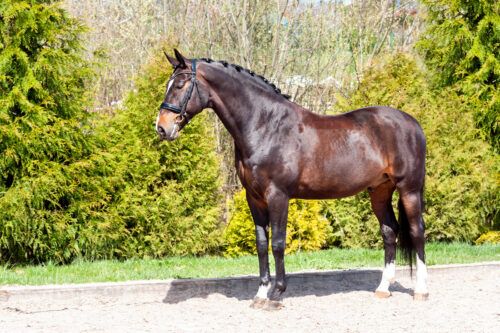
One of the celebrated aspects of Western dressage is its inclusivity. Horses of all breeds as well as ponies and mules can participate. That said, certain traits are particularly beneficial.
Desirable characteristics include:
- Trainability: a willing attitude and good work ethic are more important than flashy movement
- Conformation: balanced structure that supports soundness and ease of movement
- Gaits: pure, regular gaits with good rhythm and a naturally relaxed jog and lope
- Temperament: calm, focused, and responsive horses tend to excel in western dressage
Popular breeds in the Western dressage ring include: [15]
Ultimately, any sound, willing horse can benefit from and participate in Western dressage training.
Feeding Western Dressage Horses
Fueling your Western dressage horse begins with a forage-first strategy that supports digestive balance while providing enough energy for performance. Offering free-choice hay not only promotes gut health but also keeps your horse mentally engaged during training and shows.
While high-quality forage often covers most of a performance horse’s energy and protein needs, it’s recommended to give your Western dressage horse a balanced vitamin and mineral supplement to fill any gaps.
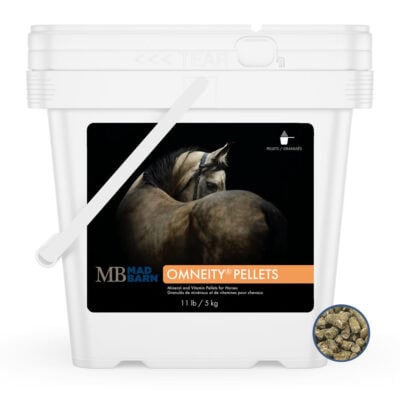
Consider using a fat supplement to top up calories, and added amino acids help maintain topline development and muscle recovery.
Every horse is unique: the ideal ration for your Western dressage partner depends on their age, breed characteristics, training intensity, competition schedule, and overall health history. A tailored feeding plan ensures they have the strength for collected work, the stamina for extended patterns, and the calm focus for every transition.
Want to make sure your program leaves no gap? Send us your horse’s current diet for a free evaluation, and our expert equine nutritionists will design a custom plan that helps you ride toward that perfect score.
Frequently Asked Questions
Here are some frequently asked questions about Western Dressage:
Western dressage combines the classical training methods of traditional dressage with the equipment and style of Western riding. It focuses on developing the horse’s balance, responsiveness, and communication with the rider.
Yes, western dressage is inclusive of all horse breeds, ponies, and even mules. Willingness, balance, and correct movement are more important than breed type.
There are seven progressive Western Dressage levels ranging from Introductory to Level 5, plus freestyle and equitation classes.
Summary
Western dressage is an equine discipline that blends classical dressage principles with Western tack, cues, and presentation.
- The discipline is new but growing fast, with the WDAA (2010) and recognition by USEF and AQHA establishing national rules and standards.
- Riders perform progressive tests in standard dressage arenas and are judged on accuracy, rhythm, relaxation, responsiveness, and rider effectiveness rather than speed or flash.
- Legal equipment is distinctly Western (saddle, headstall, approved bits or bitless options), and rules emphasize subtle, consistent rein use and light contact.
- The sport welcomes all breeds and rider backgrounds, prioritizing trainability, balance, suppleness, and partnership between horse and rider.
- Training and competition develop gaits, transitions, lateral work, and collection across levels, with freestyle classes scored for both technical correctness and artistic merit.
References
- Getting Started Guide in Western Dressage. WDAA.
- WDAA Tests. WDAA.
- Chapter WD Western Dressage. USEF. 2025.
- About the Western Dressage Association Of America. WDAA.
- AQHA Partnership. WDAA.
- USEF Partnership. WDAA.
- Mission Statement. WDAA.
- WDAA Western Dressage Online International Challenge. WDAA.
- About. Western Dressage Association Of Australia. 2017.
- Western Dressage Association of Sweden. Western Dressage Association of Sweden.
- Home. Western Style Dressage Association of Canada. 2025.
- Western Riding NZ. NZWRF.
- Western Dressage Area 10. WES Calendar. 2020.
- WDAA Equipment and Attire Guide. WDAA. 2024.
- Palm. P., Western Dressage: Finding A Suitable Horse. Ride Magazine.