English
Frequently Asked Questions
Here are some frequently asked questions about dressage letters in the dressage discipline:
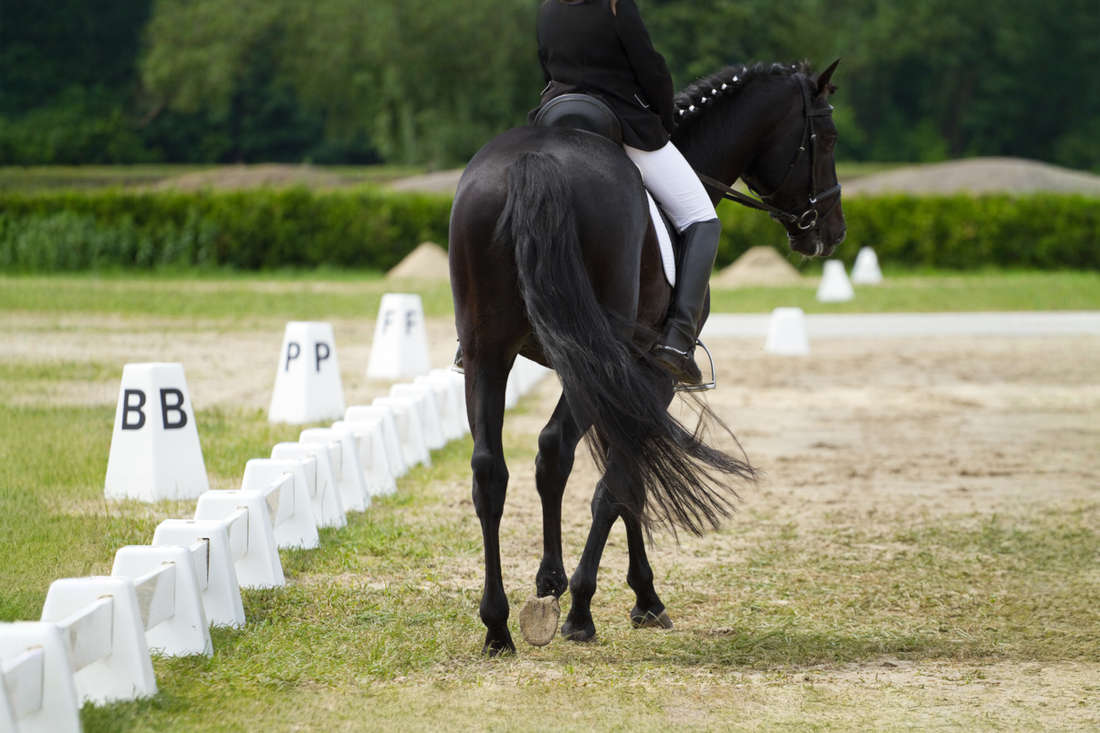
Dressage letters are fixed markers placed at specific points around a dressage arena and, in some cases, along the centerline. Riders use these letters as reference points to know where movements, transitions, circles, halts, and changes of direction should happen. They help create consistency in training and competition by allowing riders, trainers, and judges to refer to the same locations in the arena. [1][2][3][4]
Dressage letters are important because they help riders perform movements at precise, consistent locations within the arena. In dressage tests, judges evaluate not only the quality of each movement, but also whether it happens in the correct place. Using the letters correctly improves timing, straightness, geometry, and overall test accuracy. Over time, understanding the arena layout also helps riders develop better spatial awareness and confidence under saddle. [2][3][4][5]
Dressage letters are arranged in a standardized pattern around the outer track and along the centerline. In a standard 20 x 60 m dressage arena, the outer letters are A, K, E, H, C, M, B, and F, arranged clockwise from the entrance at A. Additional centerline letters divide the arena from A to C, helping riders perform entries, halts, transitions, and straight lines more accurately. This standardized structure allows riders to perform the same movements consistently in any recognized arena. [2][3]
The main difference between a 20 x 40 m and 20 x 60 m dressage arena is the length, which affects spacing, timing, and the number of letter markers. A 20 x 40 m arena has fewer letters and less room between movements, so riders often need to organize transitions earlier. A 20 x 60 m arena provides additional reference points and more gradual spacing for circles, diagonals, and transitions. Riders who switch between arena sizes often notice that movements feel different even when riding the same pattern. [2][3][4][6][8][9][10]
X marks the exact center of the dressage arena and is one of the most important reference points in a dressage test. Riders commonly use X for halts, transitions, salutes, and checking straightness on the centerline. For example, a test may ask the rider to enter at A and halt at X, meaning the halt should happen precisely in the middle of the arena. Because X sits at the arena's center, it is also useful for evaluating symmetry and balance. [2][3][4]
Riders use dressage letters to know exactly where each movement should happen during a test. A test may instruct the rider to enter at A, halt at X, track left or right at C, ride a circle at B or E, or perform a transition at a specific marker. Riders must prepare before reaching the letter so the movement happens accurately and without disrupting rhythm or balance. Waiting until the letter itself often leads to late or rushed execution. [2][3][4][6]
The easiest way to memorize dressage letters is to learn the arena as a layout rather than trying to memorize a random sequence. Most riders start with anchor points such as A and C at each end of the arena, X in the center, and B and E at the midpoints of the long sides. Walking the arena, drawing the layout from memory, and calling out letters while riding can also help reinforce placement. Associating letters with common movements such as circles, transitions, and halts often makes them easier to remember. [2][3][4]
Dressage letters seem random because the original meaning behind the lettering system is not definitively known. Some theories suggest the letters may have historical ties to cavalry riding systems or older arena layouts. Regardless of their origin, the arrangement is now standardized across modern dressage arenas. Riders generally find the system easier to understand once they learn the arena geometry rather than focusing only on the sequence itself.
The dressage letters in a standard 20 x 60 m arena include the outer track letters A, K, E, H, C, M, B, and F, along with centerline markers such as D, L, X, I, and G. These letters divide the arena into measurable sections used for transitions, circles, diagonals, and straight lines. Each marker corresponds to a fixed location within the arena. Learning where the letters sit physically is more useful than memorizing them as a list alone. [2][3]
Dressage letters do not tell riders what movement to perform; they tell riders where the movement should happen. The actual movement comes from the dressage test instructions or the rider's training plan. For example, a rider may be asked to trot at K, canter at A, or halt at X. The quality of the movement and the accuracy of its placement are judged separately in competition.
Common mistakes riders make with dressage letters include preparing movements too late, confusing arena sizes, and focusing on the marker instead of the full line or geometry of the movement. Riders may also memorize the letters as a sequence without understanding where they sit physically in the arena. These mistakes can lead to rushed transitions, uneven circles, and inaccurate placement. Developing spatial awareness and planning movements ahead of time helps improve accuracy. [4]
Dressage letters improve riding accuracy by dividing the arena into measurable sections that help riders organize movements consistently. Riders use these fixed points to maintain correct spacing for circles, diagonals, transitions, and straight lines. This structure improves timing, balance, and symmetry throughout the ride. Over time, riders develop a better feel for arena geometry and become less dependent on reacting at the last moment. [2][6]
You can practice dressage letters at home by setting up markers around a riding area or using temporary cones to recreate standard arena positions. Even a simplified setup helps riders improve timing, spacing, and spatial awareness. Practicing with letters also makes it easier to learn tests and organize movements more accurately. Riders often become more confident in competition when they regularly school with arena markers.
Riders need to prepare movements before the dressage letter because transitions and figures should happen at the marker, not after it. Waiting until the letter often causes rushed, unbalanced, or inaccurate execution. Preparing in advance allows the horse to stay organized, balanced, and responsive through the movement. This is especially important for transitions, circles, and centerline work where precision is closely judged.
Summary
Dressage letters are fixed markers that divide the arena into precise reference points for riding movements. Memorizing the layout of dressage letters is a fundamental skill for dressage riders, influencing consistency, precision, accuracy, and timing.
- Arena layout varies slightly between a 20 x 60 m and 20 x 40 m arena, which affects spacing and timing
- Letters are arranged along the outer track and centerline, creating a consistent structure across all arenas
- Riders use letters to perform movements accurately in tests and to organize transitions and figures in training
- Understanding where letters sit in the arena is more effective than memorizing them as a sequence
- With practice, letters become intuitive reference points that support better timing, balance, and overall ride quality
References
- Hinchcliff. K. W. et al.,Eds. Equine Sports Medicine and Surgery. Saunders. 2014.
- Hodgson. D. R. The Athletic Horse Saunders. 2014.
- Wynmalen. H. Dressage: A Study of the Finer Points of Riding. Museum Press. 1958.
- Luxmoore. K. Introduction to Equestrian Sports. Csiro Publishing. 2008.
- Hobbs. S. J. et al. A Scoping Review of Determinants of Performance in Dressage. PeerJ. 2020.
- Reed. B. S. Research on Language and Social Interaction. Routledge. 2024.
- Dyson. S. Lameness and Poor Performance in the Sport Horse: Dressage, Show Jumping and Horse Trials. Journal of Equine Veterinary Science. 2002.
- Arena Diagram. Equestrian Canada. 2022.
- FEI Eventing World Challenge Rules. Fédération Equestre Internationale. 2025.
- Multi-Sport Games - Equestrian Venue Requirements/Minimum Standards. Fédération Equestre Internationale. 2020.
- Course Designer's Guide. Fédération Equestre Internationale. 2023.
- Murray. R. C. et al. How Do Features of Dressage Arenas Influence Training Surface Properties Which Are Potentially Associated with Lameness?. The Veterinary Journal. 2010.
- FEI Dressage Judging Manual. Fédération Equestre Internationale. 2025.