English
Manganese is an essential trace mineral involved in multiple physiological processes within a horse’s body. It is an important component of antioxidant enzymes and plays key roles in skeletal, muscular, and nervous system health.
Because of its importance, certain horses — such as lactating mares, growing foals, and some performance horses — require higher levels of manganese in their diet.
While most horses obtain sufficient manganese through their diet from forages, fortified feeds, and certain supplements, manganese levels in the body can vary based on soil conditions and where feedstuffs are grown.
Read on to learn how to determine your horse’s manganese requirement, select the most effective dietary sources, and avoid potential imbalances that can arise from manganese excess or deficiency.
Manganese Functions in the Horse’s Body
Manganese is critical for a wide range of bodily functions in horses, primarily because of its role in enzyme activity. Enzymes are proteins that control the way a horse’s cells work and respond to internal and external signals. Manganese can be a component of an enzyme itself or serve as an activator, enabling enzymes to work effectively. [1]
Through its participation in enzyme function, manganese is important for many physiological functions, including: [1][2][3][4]
- Antioxidant function: Manganese is a key part of manganese superoxide dismutase (MnSOD), an antioxidant enzyme that helps neutralize damaging free radicals in the nervous system, muscles, and reproductive tissues
- Bone Growth: Manganese contributes to bone formation and remodeling, making it particularly important for growing horses
- Cartilage Synthesis: Manganese aids in the production and maintenance of cartilage by helping produce glycosaminoglycans (GAGs) and other structural components necessary for flexible, resilient joints and connective tissues
- Immune Function: Many enzymes involved in immune responses require manganese to function properly, helping horses fight off infections and maintain overall health
- Blood Sugar Regulation: Manganese is involved in carbohydrate metabolism and plays a role in stabilizing blood glucose levels, which is especially important for horses prone to metabolic issues
- Blood Clotting: Proper blood clotting depends on various enzymes that rely on manganese as a cofactor; adequate manganese levels help ensure wounds heal normally
- Energy Metabolism: By aiding in the breakdown and utilization of carbohydrates and fats, manganese helps horses efficiently convert nutrients into energy
The role of manganese in these functions has been studied more extensively in other species such as humans and livestock animals. More research is needed to determine the specific function that manganese plays in these processes in horses.
What's your top priority with your horse's health?

Enter your email to receive your store credit
Manganese Sources in the Equine Diet
Horses primarily get manganese from the forages (e.g., grasses, hays) they consume, as well as from commercial feeds and supplements. Since forage alone sometimes doesn’t provide enough manganese, many complete feeds, ration balancers, and vitamin and mineral supplements include additional manganese to ensure requirements are met.
In horses, dietary manganese is first ingested through the mouth, then passes through the stomach, and finally travels into the small intestine, where it undergoes digestion and absorption. Most absorption occurs in the small intestine, where specialized proteins called metal transporters (including DMT1, which also carries copper and iron) move manganese into the bloodstream.
Once in circulation, manganese is delivered to multiple organs and tissues throughout the body — such as the brain, heart, lungs, skeletal system, and muscles — where it supports a variety of essential physiological processes. [10]
Manganese in Forages
The manganese content of forages varies depending on the soil characteristics where they are grown, particularly soil pH and mineral composition.
Typical manganese levels in plants range from 20 to 300 ppm (parts per million). As soil pH decreases (becomes more acidic), manganese in the soil becomes more available to plants, which can raise the manganese content in forages. Conversely, alkaline soils tend to yield forages with lower manganese levels. [13]
In the United States, soil manganese concentrations are typically higher in the western and northeastern regions, whereas the southeast and midwest tend to have lower levels. [14] Similarly, in Canada western provinces generally have higher manganese concentrations. Forages grown in geographic regions with naturally higher soil manganese content often contain more manganese.
While these regional trends can offer general guidelines about manganese concentrations, the only way to determine the exact manganese content of your forage is to submit a sample for analysis. The laboratory report will provide the total manganese in parts per million (ppm), which is equivalent to mg of manganese per kg of forage.
Manganese in Feeds & Supplements
Many commonly used ingredients in horse feeds, such as grains and brans, naturally contain manganese in varying amounts. Below is an overview of the average manganese content in some common feed ingredients: [3][5]
| Source | Manganese Concentration |
|---|---|
| Rice Bran | 186 ppm |
| Beet Pulp | 62 ppm |
| Molasses | 60 ppm |
| Oats | 40 ppm |
| Corn | 11 ppm |
| Oil | 0 ppm |
To help meet a horse’s manganese requirement, many complete feeds, ration balancers, and vitamin and mineral supplements include added manganese. In these products, manganese may be present in both organic (complexed or chelated) and inorganic forms, each providing different properties.
Organic trace minerals are those bound to a carbon-based molecule, such as a small protein, amino acid, or sugar. In contrast, inorganic minerals are typically bound to an inorganic compound, such as a sulfate or oxide group.
On a feed tag, the following terms indicate organic sources of manganese:
- Manganese proteinate (e.g. Bioplex® manganese)
- Manganese amino acid complex
- Manganese polysaccharide complex
- Manganese yeast
The following ingredient terms indicate inorganic sources of manganese:
- Manganese sulfate
- Manganese oxide
- Manganese carbonate
- Manganese chloride
In general, organic trace minerals are widely regarded as higher-quality sources, offering better absorption and utilization in the horse’s body compared to their inorganic counterparts.
Research on trace minerals shows that organic forms of zinc and copper tend to be more readily retained in the horse’s body compared to inorganic forms. [8]
Early studies on manganese did not demonstrate a clear retention advantage for organic manganese. However, newer research suggests that certain classes of horses may benefit from higher manganese retention when offered organic sources. [3][9]
More research is needed to clarify the utility of supplementing organic manganese in different scenarios, such as for exercising, lactating, and growing horses — classes that stand to gain the most from increased mineral availability.
Manganese Requirements of Horses
Manganese requirements for horses are established by the National Research Council (NRC). [3] The NRC compiles and interprets data on nutrient requirements for various classes of horses based on available literature, providing recommended daily intakes where data is available.
The NRC’s manganese requirement for horses was originally published in 1989 and is based on data from other species because research on manganese in horses is comparatively sparse. However, more recent equine research confirms that this recommendation remains adequate. [3]
Further research is needed to establish if there is an optimal amount of manganese to support important physiological processes, such as antioxidant capacity, in various classes of horses.
For horses at maintenance, the requirement covers the amount of manganese needed to support baseline physiological processes. Horses that are building additional tissue may require more manganese than what is necessary for maintenance alone, leading to higher estimated manganese needs for some classes of horses. [3]
Horses with elevated manganese requirements include: [3]
- Lactating mares
- Growing horses
- Horses in moderate or heavier exercise loads
Maintenance
Horses at maintenance are defined as those that are at least 5 years old (mature) and not in a regular exercise program. Although they may engage in low-intensity voluntary activities (e.g., natural movement during turnout or occasional in-hand work), their manganese requirement remains the same regardless of their activity level. [3]
The primary goal for these horses is to meet the manganese requirement necessary to support all bodily functions involving manganese. This requirement is based on the amount of manganese lost through basic physiological processes, estimated based on the horse’s body weight.
For instance, a 500 kg (1,100 lb) horse at maintenance requires 400 mg of manganese per day. [3] This is equivalent to 0.8 mg of manganese per kg of body weight.
Many maintenance horses meet this requirement with hay alone, assuming a forage intake of 1.5% of body weight (dry matter basis) and that the hay contains at least 55 ppm of manganese. If the forage contains less manganese or the horse’s hay is strictly rationed, then supplementation may be needed.
For horses requiring supplementation, manganese powder is available as a single-ingredient supplement. However, many owners find it more economical and convenient to use an all-in-one mineral and vitamin supplement that provides manganese along with other commonly deficient nutrients.
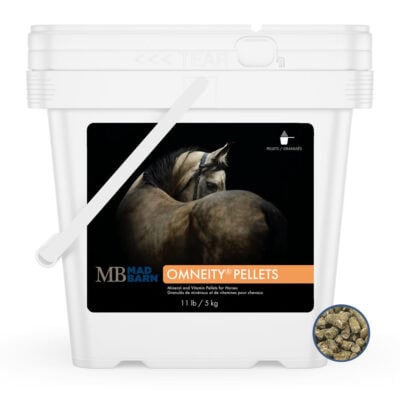
Mad Barn’s Omneity® is a complete vitamin and mineral supplement that provides 240 mg of organic manganese per serving. Feeding Omneity® ensures your horse’s diet provides adequate amounts of key vitamins and minerals to support hoof health, bone strength, immune function, energy metabolism and more.
Lactation
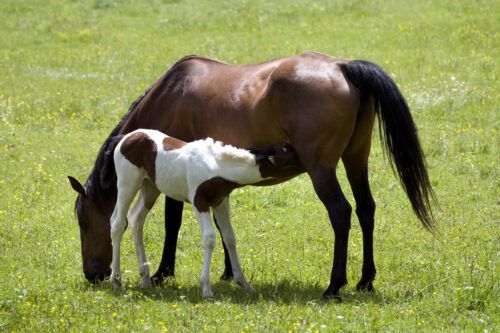
The manganese requirement of lactating mares is higher to support the needs of the developing foal. Manganese is transferred from the dam’s blood into the milk she produces for her foal, where it contributes to key physiological processes including bone formation and cartilage development.
A lactating mare’s manganese requirement is calculated as the sum of her maintenance needs plus the additional amount required to produce milk with adequate manganese content. [1]
For the average 500 kg (1,100 lb) lactating mare, the manganese requirement is 500 mg per day. This requirement remains elevated throughout lactation. [3]
Manganese deficiency in lactating mares has been associated with aberrations in skeletal development in the foal. This underscores the importance of ensuring that a lactating mare’s diet contains enough manganese to support mare and foal health.
Best practices for ensuring your lactating mare is getting enough manganese include:
- Testing your hay to determine if it contains adequate manganese
- Feeding a complete feed, ration balancer, or vitamin and mineral supplement adequately fortified with manganese to ensure their needs are met consistently
- Supplementing manganese individually if dietary levels remain too low
If you are unsure whether your lactating mare’s diet meets her manganese needs, you can schedule a free consultation with one of our equine nutritionists to review your feeding program.
Growth
Horses are classified by the NRC as growing from birth until they’ve reached physical maturity at 5 years of age. [3] During growth, horses require extra manganese to support bone, joint, and muscle development. [1]
The manganese requirement for growing horses is based on the amount needed to maintain tissues plus the amount needed to build new tissue. The NRC estimates this requirement based on the age and predicted mature body weight of the horse. [3]
For a growing horse with a predicted mature body weight of 500 kg (1,100 lb), the manganese requirements are as follows: [3]
- 4 months old: 169 mg per day
- 6 months old: 216 mg per day
- 12 months old: 321 mg per day
- 18 months old: 388 mg per day
- 24 months old: 429 mg per day
Growing horses should be fed nutritionally dense forage to ensure their energy, protein, vitamin, and mineral needs are met. Testing your hay and consulting with an equine nutritionist can help you determine whether your growing horse is getting sufficient manganese in their diet.
If your growing horse needs additional manganese, you can feed a complete vitamin and mineral supplement or add a standalone manganese supplement to meet their requirements.
Exercise
Equine manganese requirements vary based on their exercise level. Horses in light work do not need more manganese than horses at maintenance. However, those in moderate to heavy exercise have increased manganese requirements.
The manganese requirement for exercising horses is based on their maintenance requirement plus an additional amount needed to offset reduced digestibility related to heavy work. [3]
During exercise, a significant portion of blood flow is redirected away from the gastrointestinal tract and toward working muscles. This change in blood circulation can reduce the efficiency of digestion and nutrient absorption. Additionally, increased stress or reduced gut transit times (i.e. faster movement through the tract) can impact how thoroughly nutrients are broken down and assimilated, leading to lower overall digestibility in exercising horses.
For this reason, exercising horses need more manganese in their diet to ensure adequate absorption from the gastrointestinal tract and availability to bodily tissues. [1]
Manganese is also lost in sweat and is used by antioxidant enzymes, which are more active in exercising horses. However, current guidelines for exercising horses do not factor in this potential increase, and more research is needed to determine the optimal intake. [6][7]
The NRC manganese requirements for a mature 500 kg (1,100 lb) horse in exercise are as follows: [3]
- Light Exercise: 400 mg per day
- Moderate Exercise: 450 mg per day
- Heavy Exercise: 500 mg per day
- Very Heavy Exercise: 500 mg per day
For help balancing your exercising horse’s diet, you can schedule a free consultation with our qualified equine nutritionists.

Is Your Horse Getting Enough Manganese?
To determine whether your horse’s diet meets their manganese needs, you need to assess your horse’s requirements and their total dietary supply of manganese. You can calculate your horse’s manganese intake by following these steps:
- Feeds and Supplements: Determine the amount of manganese provided in any feeds and supplements in your horse’s daily ration. For feeds with added manganese, the amount can be found on the guaranteed analysis, in the Mad Barn FeedBank, or by contacting the manufacturer.
- Hay and Pasture: Determine how much manganese your horse gets from their forage. You will need to samples of your hay and pasture grass, and submit them for analysis to estimate how much manganese your forage supplies.
An equine nutritionist can help you correctly classify your horse’s physiological status to determine their manganese requirement. They can also analyze your horse’s diet to ensure it meets NRC guidelines for manganese and other key nutrients.
Manganese needs are often expressed as the dietary concentration required on a parts per million (ppm) or milligram per kilogram (mg/kg) basis (dry matter).
For example, the maintenance requirement for the average mature 500 kg (1,100 lb) horse is 400 mg per day. These horses are expected to consume 2% of their body weight per day in dry matter, equivalent to 10 kg (22 lb) of forage and feed. [3]
Therefore, to meet their manganese requirement, your horse would need a total dietary concentration of at least 40 ppm (mg/kg) manganese, calculated as 400 mg / 10 kg. [3]
Deficiency & Excess
Adequate manganese intake is important for maintaining skeletal and nervous system health, antioxidant balance, and likely even fertility. [1]
To ensure a horse meets without greatly exceeding its manganese requirement, it is important to work with a qualified equine nutritionist to evaluate the overall diet. If manganese intake is below the recommended daily level, add a complete vitamin and mineral supplement or a single ingredient manganese supplement to correct the deficiency.
Deficiency
In other species, manganese deficiency has been linked to abnormal skeletal development, reduced fertility, and central nervous system issues. [1][3] However, overt manganese deficiency appears rare in horses.
In regions where soil is heavily limed, plants may take up less manganese. Grazing pastures in these areas have been associated with skeletal abnormalities in foals, such as: [3]
- Enlarged joints
- Twisted limbs
- Shortened forelimb bones
Although these signs align with manganese deficiency seen in cattle, it has not been definitively proven that manganese deficiency alone causes these abnormalities in such cases. [3]
Symptoms of less severe manganese deficiency and suboptimal manganese intake in horses have yet to be thoroughly explored. Given manganese’s role in antioxidant defense, inadequate levels could affect fertility, joint health, and muscle function. [1]
Most complete feeds and ration balancers contain added manganese, so horses consuming a full serving typically meet their requirement. Horses on a forage-based diet without additional balancing may be at risk of deficiency.
To prevent common nutrient deficiencies in the equine diet, feed a balanced vitamin and mineral supplement. Mad Barn’s Omneity® is a complete vitamin and mineral supplement that contains 100% organic manganese as well as other vitamins and minerals needed to support your horse’s skeletal, muscular, and overall health.
Toxicity
In other species, high manganese intakes have been associated with interference in phosphorus, copper, zinc, and iron absorption. [3][11][12]
In horses, manganese toxicity has not been documented, and manganese is considered one of the least toxic trace minerals. However, due to observed issues with excess manganese intake in other species, an upper tolerable intake limit is suggested at 400 mg manganese per kg of dietary dry matter per day. [3]
For a 500 kg (1,100 lb) horse, this upper tolerable limit is approximately 4,000 mg of manganese per day.
Frequently Asked Questions
Here are some frequently asked questions about manganese for horses:
Manganese is an essential trace mineral that supports antioxidant function, bone growth, cartilage maintenance, and the health of the muscular, skeletal, and nervous systems. [1][2][3][4]
Horses obtain manganese from forages, feeds, and supplements. However, the amount of manganese varies depending on the forage's growth location and type, so testing or supplementation may be necessary.
Lactating mares, growing horses, and horses in moderate or heavier exercise have elevated manganese needs to support milk production, tissue growth, and physical activity. [3]
Summary
Manganese is an essential trace mineral that is required for many bodily functions in horses. Your horse’s manganese requirement is based on their body weight, physiological status, and exercise level.
- A 500 kg (1,100 lb) mature horse at maintenance requires 400 mg of manganese daily
- Lactating mares, growing horses, and those in moderate or heavier exercise require more manganese to support milk production, bone growth, and muscle maintenance
- Horses obtain manganese from forages, feeds, and supplements in their diet
- Research on organic manganese supplements is mixed, but there is evidence it is absorbed and retained more effectively than inorganic manganese
- In other species, manganese deficiency often causes skeletal abnormalities; although toxicity has not been observed in horses, the upper tolerable limit for a 500 kg horse is set at 4,000 mg per day
References
- Geor. R. J. et al., Equine Applied and Clinical Nutrition: Health, Welfare and Performance. Elsevier Health Sciences. 2013.
- Latham. C. M. et al., Complexed Trace Mineral Supplementation Alters Antioxidant Activities and Expression in Response to Trailer Stress in Yearling Horses in Training. Scientific reports. Nature Publishing Group UK London. 2021. View Summary
- National Research Council, Nutrient Requirements of Horses: Sixth Revised Edition. The National Academies Press, Washington, DC. View Summary
- Liu. A.-H. et al., Influence of Manganese Deficiency on the Characteristics of Proteoglycans of Avian Epiphyseal Growth Plate Cartilage. Poultry science. Elsevier. 1994.
- Main Library. Dairy One Feed Composition Library
- Mohamed. B. J., Effect of Endurance Exercise on Sweat Constituents of Athletic Iraqi Arabian Horses. Iraqi Journal of Veterinary Sciences. 2017.
- De Moffarts. B. et al., Impact of Training and Exercise Intensity on Blood Antioxidant Markers in Healthy Standardbred Horses. Equine and Comparative Exercise Physiology. Cambridge University Press. 2004.
- Miller. E. D. et al., The Effect of Supplemental Inorganic and Organic Forms of Copper and Zinc on Digestibility in Yearling Geldings in Training. Proc. 18th Equine Nutr. Physiol. Soc. Symp. 2003.
- Stanek. M. et al., Influence of an Organic Supplement of Copper, Zinc and Manganese in Feed Rations on Concentrations of These Elements in the Coat of Polish Konik Horses. Journal of Elementology. Uniwersytet Warmińsko-Mazurski w Olsztynie/Polskie Towarzystwo …. 2016.
- Grace. N. et al., Content and Distribution of Macro‐ and Micro‐elements in the Body of Pasture‐fed Young Horses. Australian Veterinary Journal. 1999.
- Mercadante. C. J. et al., The Effect of High Dose Oral Manganese Exposure on Copper, Iron and Zinc Levels in Rats. BioMetals. 2016.
- Hansen. S. L. et al., The Addition of High Manganese to a Copper-Deficient Diet Further Depresses Copper Status and Growth of Cattle. British Journal of Nutrition. Cambridge University Press. 2008.
- Essential Elements: Manganese. The Fertilizer Institute. 2024.
- Manganese in Counties of the Conterminous States. U.S. Department of the Interior.