English




Pyrrolizidine alkaloids (PAs) are naturally occurring compounds that are toxic to horses and found in many species of plants.
Some common plants that contain high concentrations of PAs include Ragwort (Senecio spp.), Rattlepod, Hound’s tongue, Heliotrope, and Fiddlenecks.
Chronic pyrrolizidine alkaloid poisoning, also referred to as ragwort toxicosis, occurs when horses consume large amounts of these plants for a prolonged period.
This severe and often fatal condition affects the horse’s liver and bile system and causes photosensitization (sensitivity to light), which can result in skin damage and pain.
Signs of chronic exposure may not occur until several weeks or months after initial ingestion. Common symptoms observed in horses include lack of appetite, behavioral changes, head-pressing, colic, and exercise intolerance.
Diagnosing ragwort poisoning in horses is challenging as no specific test is currently available, and signs develop months after exposure to the toxic plant.
To date, no antidote is available. Horses that present clinical signs usually have irreversible liver damage and typically require humane euthanasia.
Pyrrolizidine Alkaloids in Plants
Pyrrolizidine alkaloids (PAs) are a group of naturally occurring organic compounds that are toxic to horses. Plants produce these compounds as a defense mechanism against herbivores and microbial pathogens. [1]
Like other toxic plants, these species are generally unpalatable to grazing animals and are not usually eaten in large quantities if other food is available. However, to protect your horse, it is best to remove any known PA-containing plants from horse pastures.
The concentration of toxic alkaloids varies across different plant species and between individuals of the same species. The concentration also varies between different structures within the plant anatomy. [1]
Pyrrolizidine alkaloids are among the leading causes of photodermatitis in horses, which is characterized by extreme skin sensitivity to sunlight. This hypersensitivity is a secondary complication of liver and bile system damage. [1][2]
When a horse’s liver function is compromised by 80% or more, the organ is unable to eliminate phylloerythrin, which accumulates in the blood. When exposed to sunlight, the excess phylloerythrin causes skin damage that, in turn, results in secondary photosensitization and dermatitis. [2]
Relevant Plant Species
Over 6,000 species of plants are known to produce pyrrolizidine alkaloids that are toxic to horses. They include: [2][3]
- Ragwort (Senecio spp.)
- Hound’s tongue (Cynoglossum officinale)
- Fiddlenecks (Amsinckia intermedia)
Ragwort (Senecio spp.)
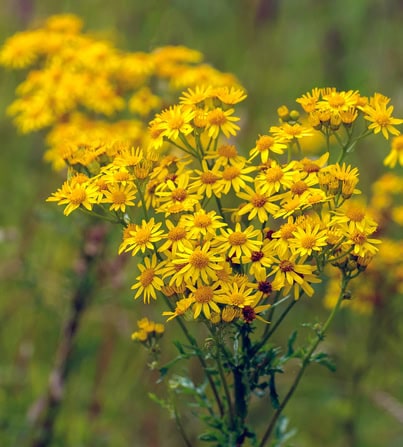
There are over 1,200 species of Ragwort worldwide. North America has 70 Ragwort species, of which approximately 25 contain toxic amounts of pyrrolizidine alkaloids. [2]
It is prudent for horse owners and caretakers to assume that all Ragwort species are poisonous for horses.
Senecio spp. can be found in a number of different environments. Some species take root in high-altitude, damp, subalpine regions, while others favor dry, rocky terrains.
General characteristics of Senecio spp. include: [2]
- Flower heads: single layer of green bracts (the leaves that support the flower stalk) that touch each other but do not overlap
- Leaves: alternate leaves, typically lanceolate (flat, long, oblong and pointed) to ovate (shorter with rounded tips) in shape, with symmetrical teeth (the jagged edges of leaves)
- Flowers: bright yellow disk florets surrounded by a ray of yellow petals
- Seeds: dense ring of white pappus (the seeds’ wind-dispersal mechanism) at one end
The concentration of pyrrolizidine alkaloids (PAs), the toxic compounds in Senecio, varies significantly. Mature plants pose a greater threat than young plants. Mature Ridell’s ragwort (S. ridellii) contains the highest PA concentration of species in this family (18% of its dry matter). [2]
Hound’s tongue (Cynoglossum officinale)
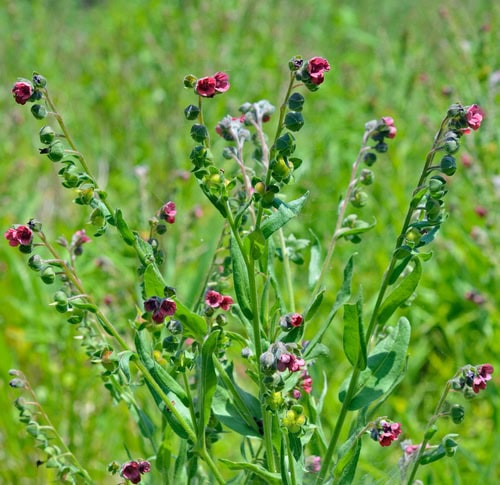
Hound’s tongue (Cynoglossum officinale) is a widespread weed commonly found in both cultivated areas and wastelands. It can reach up to 3 feet (1 meter) in height. [4]
General characteristics of Hound’s tongue include: [2][4]
- Leaves: The hound’s tongue’s basal leaves are large and tongue-shaped, reaching up to 20 inches (0.5 meters) in length. Higher leaves are lanceolate in shape
- Flowers: small clusters of reddish-purple flowers are found in clusters on the plant’s terminal stalks
- Fruit: large with thick, fleshy walls that, once mature, split into four brown individual seeds (nutlets)
Fiddleneck (Amsinckia intermedia)

Fiddleneck or Tarweed (Amsinckia intermedia) is an annual weed that can be found in fields and wastelands. It reaches 3 feet (1 meter) in height. [2][5]
The fiddleneck plant is sparsely branched and covered in small, lightly colored hairs. As the plant matures and its flowers start to blossom, the coiled stem unfurls, giving the plant its characteristic “fiddleneck” appearance. [2][5]
Other characteristics include: [5]
- Leaves: lanceolate alternate, hairy leaves
- Flowers: small yellow or orange funnel-shaped petaled-flowers characterized by a “fiddleneck” shape, with all the flowers clustering on one side of the stalk
- Fruit: mature fruits split into 2 – 4 black, ridged seeds (nutlets)
Toxicology
After ingesting plants containing pyrrolizidine alkaloids, the toxic compounds are rapidly absorbed by the horse’s gastrointestinal tract. Once absorbed, pyrrolizidine alkaloids are passed into the liver by way of the portal vein (the blood vessel that carries blood from the GI tract to the liver, spleen, and pancreas). [6][7]
In the liver, the alkaloids are broken down into reactive pyrrole compounds, which damage liver cells and can ultimately cause liver tumors and cancers. [6][7]
Pyrrolizidine alkaloid toxicity is cumulative, meaning its effects build in the liver over time. As such, affected horses may not show any symptoms for long periods of time after initial exposure, even if the horse has already ingested a deadly dosage of toxin.
This makes diagnosis, early treatment, and prevention difficult, as the toxic plant responsible for onset of poisoning symptoms may not be present in the pasture by the time medical intervention is needed. [6][7]
It is possible for horses to develop acute PA toxicity after ingesting a large quantity of PA-containing plants in a short period of time. This form of poisoning is very rare compared to chronic toxicity in horses. [3]
Symptoms in Horses
Horses that ingest a toxic amount of ragwort or related plants over time exhibit symptoms related to liver and biliary system dysfunction, including: [6][8]
- Weight loss
- Anorexia (reduced appetite)
- Aimless walking
- Dull coat
- Ataxia (uncoordinated gait)
- Head pressing
- Excitability
- Jaundice (yellow eyes or gums)
- Colic
- Exercise intolerance
- Ventral edema (fluid build-up in abdomen)
- Diarrhea
- Laryngeal hemiplegia (larynx paralysis)
What's your top priority with your horse's health?

Enter your email to receive your store credit
Secondary Photosensitization
Photosensitization, also referred to as light-induced dermatitis, is a painful skin condition that causes extreme sensitivity to sunlight. Pyrrolizidine alkaloids-induced photosensitization is categorized as a secondary photosensitization since it is caused by the underlying liver damage rather than direct exposure to a phototoxic agent. [2][6]
Horses with photosensitization may exhibit aversion to bright light or sunlight (photophobia), often squinting or avoiding exposure to direct sunlight. [6][9]
Common skin symptoms of photosensitization in horses include: [6][9]
- Patchy, gradual hair loss (alopecia)
- Skin edema (fluid build-up and swelling)
- Skin lesions
- Itching, particularly on the ears, eyelids, and muzzle
- Red skin
- Formation of pus blisters
- Scabs
The photosensitive reaction can also affect the horse’s lips, gums, and tongue. This can cause oral lesions, sores, ulcers, that make eating uncomfortable. [6][9] Difficulty eating may also lead to unplanned weight loss and poor body condition in severe cases.
Acute Symptoms
Acute toxicosis occurs when horses ingest large amounts (1-5% of their body weight) of alkaloid‐containing plants over a few days.
While rare due to the unpalatable nature of pyrrolizidine alkaloids, ingestion of large doses of these toxic plants can lead to acute hemorrhagic necrosis of the horse’s liver. In this condition, liver tissue dies rapidly, resulting in severe bleeding into the abdomen. [7][10]
Acute ragwort poisoning is rapidly fatal. Symptoms in horses include: [7][10]
- Lethargy
- Coma
- Sudden death
Diagnosis
Diagnosis of chronic pyrrolizidine alkaloid toxicosis is challenging as the ingestion of toxic amounts of PA-containing plants generally occurs months prior to the onset of symptoms. Symptoms appear only when the liver is already irreversibly damaged.
Diagnosis is generally based on a possible history of exposure and the presence of clinical signs. [6][11]
Further diagnostic tools are limited and include: [6][11]
- Serum chemistry: bloodwork to assess liver and kidney function and rule out other conditions
- Liver biopsy: to directly assess the extent of liver damage
- Diagnostic imaging: ultrasound is used to detect liver abnormalities
Differential Diagnosis
Because diagnosing this condition can be challenging, using a differential diagnosis approach is helpful to rule out other potential causes of symptoms similar to pyrrolizidine alkaloid toxicosis in horses.
Conditions to rule out include: [6][7]
- Acute or chronic hepatitis
- Theiler’s disease
- Nigropallidal encephalomalacia (yellow star thistle toxicosis)
- Leukoencephalomalacia
- Equine Protozoal Myeloencephalitis (EPM)
- Alsike clover/red clover intoxication
- Cholangiohepatitis
- Liver abscess
- Viral encephalitis
Post-Mortem Findings
In cases where a horse dies prior to diagnosis, owners may elect for a post-mortem examination (necropsy) to confirm the cause of death.
Common findings on necropsy in cases of PA toxicity include: [6]
- Jaundice (yellowish discoloration of the skin, mucous membranes, and eyes)
- Fluid accumulation in the abdomen (ventral edema)
- Gastric impaction
- Pale, abnormally small liver
- Megalocytosis (abnormally large liver cells under the microscope)
- Pulmonary edema (fluid accumulation in the lungs)
- Lung tissue scarring
Treatment
There is currently no antidote available for ragwort toxicosis and the late onset of symptoms limits treatment options.
The main goal of treatment for pyrrolizidine alkaloid poisoning in horses is aimed at: [3][6]
- Elimination of further exposure
- Supportive care
- Dietary management
Supportive care
Supportive care aims to keep the horse alive until the liver is able to regenerate itself. Treatment options include: [6][12]
- Feeding the recovering horse with a highly digestible, low-protein diet
- Increasing roughage in the diet
- Avoiding high-protein forages (i.e. alfalfa)
- Dietary supplementation with branched chain amino acids, B vitamins, vitamin K, and folic acid
- Keeping recovering horses indoors or blanketed to protect from sunlight
- Topical wound treatment
- Intravenous fluid therapy

Monitoring
Horses diagnosed with pyrrolizidine alkaloid toxicosis should be closely monitored to assess the progression of the condition. Monitoring involves: [6]
- Regular weight checks every two to four weeks; these are crucial indicators of the horse’s overall health and response to treatment.
- Regular blood and serum tests to assess liver function
If a horse is diagnosed with pyrrolizidine alkaloid toxicosis, other horses that share the same pasture should also be examined for signs of toxicity.
Prognosis
The outlook for horses with pyrrolizidine alkaloid toxicosis is poor, as the majority of horses are diagnosed only once the liver damage has reached an irreversible stage. Unfortunately, most affected animals are euthanized due to the low probability of recovery. [6][7]
With proper care, a small percentage of horses can recover. However, these animals require long-term rest and supportive care and are unlikely to return to full performance. [6][7]
Prevention of Ragwort Toxicosis
Due to the current lack of specific treatment options, prevention is the best way to ensure the animal’s well-being.
Prevention strategies include: [6]
- Providing adequate amounts of high-quality forage to minimize the risk of horses ingesting PA-containing plants
- Regular inspection of hay and pastures to identify the presence of pyrrolizidine alkaloid-containing plants
- Avoiding/removing hay lots containing toxic plants
Frequently Asked Questions
Here are some frequently asked questions about PA toxicity in horses:
Pyrrolizidine alkaloids (PAs) are toxic compounds produced by certain plants as a defense mechanism. When ingested by horses, they cause cumulative liver damage, leading to severe health issues like weight loss, photosensitization, and even death. [1][2][7]
Plants like hound’s tongue, fiddlenecks, and all ragwort species (Senecio spp.) are known to contain high concentrations of pyrrolizidine alkaloids, which cause ragwort poisoning. These plants are generally unpalatable but horses might eat them when other forage is unavailable. [2][3]
Symptoms include weight loss, lack of appetite, behavioral changes, jaundice, colic, and photosensitivity. These signs often appear months after the horse has ingested toxic plants. [6][8]
Diagnosis is challenging because symptoms usually develop long after exposure. It involves evaluating the horse’s history, clinical signs, and diagnostic tools like bloodwork, liver biopsies, and ultrasound imaging. [6][11]
There is no antidote for ragwort poisoning. Treatment focuses on supportive care and dietary management. Since most horses are only diagnosed once liver damage becomes irreversible, prognosis is poor. [3][7]
Prevention involves providing adequate forage, regularly inspecting pastures and hay for toxic plants, and promptly removing any ragwort species to reduce the risk of ingestion. [6]
Summary
Pyrrolizidine alkaloids (PAs) are toxic compounds produced by over 6,000 plant species worldwide, including ragwort. When ingested by horses, PAs are metabolized in the liver into reactive compounds, damaging liver cells and potentially leading to hepatic tumors.
- Affected horses can develop secondary photosensitization, resulting in hair loss, skin lesions, swelling, and itchiness
- Chronic exposure to pyrrolizidine alkaloids can result in weight loss, anorexia, exercise intolerance, and behavioral changes
- Diagnosing ragwort poisoning is challenging because horses develop symptoms long after ingesting the toxic plants
- Treatment focuses on supportive care, dietary management, and avoiding further exposure to toxins
- The prognosis is poor, with most cases resulting in euthanasia due to irreversible liver damage
- Prevention strategies include providing adequate forage and regular pasture inspections
References
- Schramm, S. et al., Pyrrolizidine Alkaloids: Biosynthesis, Biological Activities and Occurrence in Crop Plants. Molecules. 2019. doi: 10.3390/molecules24030498.
- Waldridge, B. M., Ed., Nutritional Management of Equine Diseases and Special Cases. First Edition. Wiley Blackwell. 2017. doi: 10.1002/9781119191926.
- Plumlee, K. H., Ed., Clinical Veterinary Toxicology. Mosby, St. Louis, Mo. 2004.
- Common Hound’s-Tongue - Montana Field Guide.
- Amsinckia (Fiddlenecks, Tarweed Fiddleneck) | North Carolina Extension Gardener Plant Toolbox.
- Hovda, L. R., Blackwell’s Five-Minute Veterinary Consult Clinical Companion Equine Toxicology. Wiley Blackwell. 2022.
- Bildfell, R., Pyrrolizidine Alkaloidosis in Animals - Toxicology. MSD Veterinary Manual. 2022.
- Ragwort Poisoning. Irish Horse Welfare Trust. 2015.
- Wilson, D. A., Ed., Clinical Veterinary Advisor: The Horse. Elsevier Saunders, St. Louis, Mo. 2012.
- Bildfell, R., Pyrrolizidine Alkaloidosis (Senecio Poisoning, Ragwort Poisoning) - Special Pet Topics. MSD Veterinary Manual.
- LLC, H., Pyrrolizidine Alkaloid Toxicity | HorseDVM Diseases A-Z.
- Equinews Editor, Sunburn and Photosensitivity in Horses. Kentucky Equine Research. 2004.