English








![Top 6 Causes of Horse Refusals & Runouts in Show Jumping – [Training Guide]](/wp-content/uploads/2026/03/how-to-deal-with-refusals-and-run-offs-in-show-jumping-horses.jpg)
Refusals and runouts in show jumping horses are one of the most frustrating training challenges riders face. Whether a horse suddenly stops in front of a fence or drifts sideways to avoid it, these behaviors can impact performance, confidence, and safety for both horse and rider. Understanding why these issues occur is the first step toward fixing them effectively.
Many horses refuse or run out because they are unsure, unbalanced, or receiving unclear signals from the rider. In other cases, they may have had a negative experience, been asked to jump beyond their skill level, or are dealing with pain that makes jumping uncomfortable. Given this, taking a thoughtful, systematic approach is essential when addressing these issues.
Keep reading to learn the most common causes of refusals and runouts in show jumping horses and practical, effective strategies to fix and prevent them from happening again.
What Are Refusals & Runouts in Show Jumping?
Refusals and runouts may feel similar when you’re sitting in the saddle, but they often stem from different underlying issues and require different approaches to correct.
Understanding how these behaviors present is an important first step in identifying what may be going wrong on the approach to the fence.
Refusals
A refusal is when a horse comes to a complete stop in front of a jump. In some cases, the horse may hit the jump, knocking down rails with their head, neck, or front limbs. Most riders consider any failure of forward movement once the horse is on the approach to the fence a refusal. [1]
Horses refusing at speed often stop with their head and neck low. This makes it difficult for the rider to stay seated, and many riders fall forwards onto the horse’s neck when refusals happen.
In competition, show jumping regulations also count the horse stepping backwards at any time on course or crossing its path as a “refusal”, even if the horse is not close to a jump. [2] This type of refusal is usually due to rider error or the horse resisting forward movement unrelated to the jump itself.
Runouts
Runouts refer to instances when the horse veers suddenly away from the fence at speed. [3]
Typically, runouts begin several strides away from the fence. Very nimble and agile horses may be able to bolt sideways as they get close to the jump by dropping their outside shoulder. [1] The combination of momentum and sudden change of direction makes it difficult for riders to stay with their horse during this maneuver.
While refusals and runouts are defined by how the horse behaves at the fence, the behavior itself is only part of the picture.
In most cases, these issues are the result of factors that develop in the approach — including balance, communication, confidence, and the horse’s physical ability to perform the effort. Understanding these contributing factors is key to resolving the problem effectively.
What's your top priority with your horse's health?

Enter your email to receive your store credit
Top 6 Causes of Refusals & Runouts in Horses
Refusals and runouts rarely happen without an underlying cause. In most cases, these behaviors reflect a breakdown in communication, confidence, or physical comfort rather than disobedience. Identifying the root cause is key to addressing the issue effectively and preventing it from becoming a habit.
Here are the most common reasons horses refuse or runout on a show jumping course.
1) Anticipation of Pain
Show jumping is very demanding on the horse’s body. Horses must use their back and hind limbs to propel themselves into the air and must land gently on their front limbs to minimize concussive damage. [4] Additionally, they must be able to see the jump to assess the distance, height, and width.
Horses with existing physical ailments often begin refusing or running out to avoid pain or injury.
Early warning signs may include: [4]
- Not pushing off evenly in the hind limbs
- Difficulty with turning or reluctance to turn
- Refusing to land on a particular lead off a jump
- Difficulty making the distances down lines or combinations
- Resisting stride length changes
- Difficulty when getting “deep” into a fence
- Resisting or difficulty with lead changes
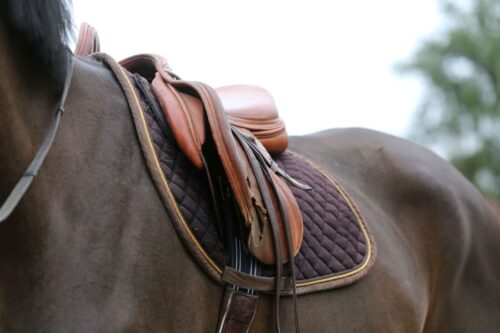
Horses experiencing discomfort or poor recovery may be less willing to jump, even if the issue is subtle. Work with your veterinarian to rule out any underlying medical issues, and consider consulting with a trainer or a saddle fitter to ensure there are no tack issues contributing to physical concerns.
2) Setting Incorrect Distance (Stride Length)
Ideally, the rider should work with the horse to ensure they are approaching a jump with an appropriate distance. The “distance” should leave the horse with enough space to take off, which is approximately the same length as the fence height. For example, for a 3-foot-tall fence, a horse should take off 3 feet away from the jump. This produces a perfect semicircle bascule (shape the horse takes over the jump).
Often, refusals occur when horses are “buried” into a jump, meaning they are asked to take off too close to the fence. This leaves little room for the horse’s front limbs to clear the rails, resulting in a refusal. [1] Runouts can occur if the horse is asked to take off from a very long distance, as the extra room gives the horse more opportunity to veer sideways instead of taking off.
Typically, riders adjust the distance to a jump by adjusting the horse’s stride length. Most horses have a 12-foot stride length, so any related distances like combinations or lines should be set based on a 12-foot stride.
3) Poor Impulsion
Impulsion is a combination of power and balance. The power and balance come from the rider “recycling” the forward momentum and linking it to the horse’s hindquarters to create balance. This produces a stride with more upward energy and hindquarter engagement than forward momentum.
For jumping, impulsion is critical as the horse uses their hindquarters to power over the jump. Horses coming into a jump “weak” do not have adequate energy to push off from the ground, which can lead to refusals.
Poor impulsion typically results from horses that are unwilling to go forward. This unwillingness may be linked to multiple factors, including:
- Pain
- Fear or uncertainty
- Exhaustion
- Inadequate conditioning
Some horses runout due to impulsion problems, usually because they have a lot of forward momentum but inadequate rebalancing of power onto their hindquarters. This leads to a horse running on the forehand and jumping “flat”, or not rocking back onto the hindquarters before jumping.
Horses on the forehand have difficulty getting their front limbs out of the way before jumping, and may decide to runout as an alternative.
4) Poor Straightness
Straightness is a fundamental skill for show jumpers, as horses that twist, drift in the air, or jump on an angle are more likely to take rails. Many runouts result from the horse not being straight in their body or straight to the fence.
Horses who travel crooked, leaning on one rein more than the other, have an easier time bulging out to the side when approaching a jump. [1]
Additionally, horses guided to a fence on an angle may “glance off” the jump rather than jumping it, as the angled approach leaves an unobstructed path to avoid the fence.
5) Lack of Confidence
Jumping skills must be built up gradually to maintain confidence for both the horse and the rider. “Overfaced” horses and riders that are uncertain do not maintain forward momentum as they approach the fence, compromising the horse’s impulsion and ability to clear the jump.
Common causes of “overfacing” include: [3]
- Asking the horse and rider to jump fences that are too big for their current level of training
- Jumping combinations, lines, or exercises that are too complex for the horse and rider’s current level of training
- Unfamiliar obstacles or spooky jumps
6) Undeveloped Rider Position
The rider’s position in the air can either encourage or discourage the horse from jumping in the future. Riders should remain centered over the horse, out of the saddle, and with gentle rein contact.
Riders who get “left behind” often catch the horse in the mouth with their reins and slap down into the saddle heavily, causing back pain. [3] This discourages the horse from jumping as they anticipate pain over the fence.
Some riders “jump ahead” of the horse, where they enter their jumping position before the horse has left the ground. This puts additional weight on the horse’s forelimbs at the time they are trying to lift them into the air.
This makes it more difficult for the horse to leave the ground, and some horses may respond by stopping suddenly. [3] This also puts the rider in an ineffective position to maintain leg contact that encourages the horse to jump.

How to Diagnose Why Your Horse Is Refusing Jumps
There are numerous potential causes of refusals, so diagnosing a refusing or running out problem requires scrutiny.
Start by asking yourself questions like: [3]
- When did this behavior begin? Is it a new behavior, suggesting a new physical ailment?
- Is the behavior associated with particular jumps, exercises, etc. that suggest I am overfacing my horse?
- Is my position over the fence appropriate?
- Are my impulsion, straightness, and distance to the jump appropriate?
Work with your veterinarian to identify and address any physical ailments your horse may have, including issues with tack fit. If refusals and runouts continue, work with a qualified jumping trainer to ensure your position is correct and the exercises are reasonable for you and your horse’s current level of training.
If training and veterinary factors have been addressed, evaluating the horse’s nutrition can provide additional insight. Imbalances in energy, protein, or key micronutrients can affect comfort, recovery, and performance, all of which influence willingness and consistency over fences.
Check your horse’s feeding program on Mad Barn’s Horse Nutrition Calculator if you are unsure whether their diet is meeting all of their needs.
Once other potential causes have been ruled out or addressed, if refusals persist, work with your trainer on correcting your approach and improving confidence for yourself and your horse.
How to Correct Refusals & Runouts in Show Jumping Horses
As you work through a horse’s refusal or runout issue, the behavior will likely still occur at times. If left unmanaged, horses can develop refusing or running out as a habit. Given this, correcting the behavior in the moment is important to prevent the behavior from escalating.
Refusals
Before a horse refuses, riders can often feel the horse “sucking back” or losing momentum and impulsion as they approach the jump.
When this happens, you can respond in a few different ways: [3]
- Apply leg to encourage forward movement
- Sit deep in the saddle, using your seat to push the horse forward
If the horse stops, take a moment to regroup. Do not punish the horse for stopping. Punishment increases fear, anxiety, and frustration, which are all factors that may have led to the horse refusing in the first place. [5] Punishing the horse only increases their unwillingness to approach the fence.
Try to determine which factor(s) led to the refusal. On your next approach, the goal is to address those factors to prevent the refusal from happening again.
Pick up a forward, balanced trot or canter and re-approach the fence. Ensure you are not turning back too tightly or rushing, as this only encourages the horse to refuse again. [3] Add leg, sit deep in the saddle to encourage them to go forward.
If the horse jumps, land and ride forward to encourage the horse to think about forward momentum. Then reward the horse for their performance. Repeat the exercise three to four times to ensure your horse is comfortable with the jump and is building confidence.
If the horse stops again, assess contributing factors again. Often, horses with multiple stops at the same jump are overfaced. Consider lowering the height of the jump, removing spooky fill or objects, or taking the back rail off the oxer. [3]
Once the horse is successful and confident over a less complex variant of the jump, you can try increasing the complexity again.
Table 1. Guide to correcting refusals and runouts at-a-glance
| Issue | What You Feel/See | Immediate Response | If It Happens |
|---|---|---|---|
| Refusal |
|
|
|
| Repeated Refusals |
|
|
|
| Runout |
|
|
|
| Repeated Runouts |
|
|
|
Runouts
Riders can often feel a runout before it occurs, as the horse bulges to the side and begins to drift on the approach to the fence. If you feel your horse bulging, correct them using leg on the side they are bulging towards. [3]
Also use a direct rein aid on the side the horse is bulging towards to straighten their neck, while opening the opposite rein to guide them the other direction. The goal is to improve the horse’s straightness and bring them towards the middle of the fence. [3]
If the horse runs out, turn the horse in the opposite direction that they ran out. For example, if they ran out to the left side of the jump, turn them in a circle to the right. Focus on the horse’s bend, track, and straightness in this turn. They should not be bulging out of the turn, avoiding your aids, or falling in. Applying some counterbend can help bring the outside shoulder back under the horse and reduce bulging.
Assess whether there were additional factors that led to the runout. If the jump is spooky or unfamiliar, consider showing the horse the jump and rewarding them for approaching the fence. If the horse was running on its forehand, school collection exercises to help engage the hindquarters and produce impulsion.
Once these factors are addressed, approach the fence again. Try and maintain the straightness developed on the circle and ensure that your horse is engaging their hindquarters. Maintain direct rein contact on the side that the horse bulges towards to straighten their neck.
After successfully landing from the jump, turn the horse in the opposite direction of the runout. This helps reinforce straightness in the future. [3]
Improving Performance & Preventing Refusals
Refusals and runouts are rarely the result of a single issue. In most cases, they reflect a breakdown somewhere in the system — whether in training, rider communication, confidence, or the horse’s physical ability to perform the task being asked.
Developing consistency over fences requires more than just repetition. Horses must be comfortable in their bodies, strong enough to produce impulsion, and capable of recovering from the physical demands of jumping.
While training remains the foundation, factors such as energy intake, muscle development, and recovery support can all influence how willing and able a horse is to approach and clear a fence.
Taking a comprehensive approach that considers both training and physical readiness gives you the best chance of resolving these behaviors and preventing them from becoming ingrained. By addressing the root causes and supporting your horse’s overall performance, you can build confidence, improve consistency, and create a more positive jumping experience for both horse and rider.
FAQs
Here are some frequently asked questions about refusals and runouts in horse jumping disciplines:
Horses refuse jumps for a range of reasons, but the first step is always to rule out physical discomfort and tack issues. Lameness, back pain, dental problems, or poor saddle fit can all reduce willingness to jump. If physical causes are excluded, refusals are often related to unclear rider aids, poor approach, lack of confidence, or being asked to perform beyond the horse's current training level. Identifying patterns, such as specific fences, distances, or situations, can help pinpoint the underlying cause.
A refusal occurs when a horse stops directly in front of a jump, while a runout happens when the horse avoids the obstacle by drifting or moving sideways past it. Both behaviors often reflect issues with straightness, balance, confidence, or clarity of aids.
Improving straightness and control is key. Use guide rails, maintain consistent leg support, and ride accurate lines to the center of the fence. Gridwork, poles, and channeling exercises can help reinforce alignment while reducing the opportunity for the horse to evade the jump.
Punishing a refusal is not recommended, as it can increase anxiety, reduce confidence, and create negative associations with jumping. Instead, focus on identifying the cause of the refusal, improving the approach, and reinforcing correct responses with clear, consistent aids.
Yes, and these should always be ruled out first. Lameness, back soreness, dental discomfort, or ill-fitting tack can make jumping physically difficult or uncomfortable. A sudden increase in refusals, especially in a previously willing horse, warrants veterinary and tack evaluation.
Yes. Inconsistent contact, loss of leg support, incorrect timing, or conflicting aids can confuse the horse and lead to hesitation or stopping. Clear, consistent communication is essential for building confidence and maintaining forward intent to the fence.
Yes. Horses that are pushed beyond their current level of training, strength, or experience may refuse jumps due to confusion or lack of confidence. Progressing gradually and reinforcing basics helps prevent overwhelm and improves long-term performance.
Reduce the difficulty of the exercise and return to basics such as ground poles, small fences, and simple lines. Focus on rhythm, straightness, and positive experiences, then gradually reintroduce more complex questions as confidence improves.
Horses may react to specific visual or environmental factors such as fillers, colors, shadows, footing, or unfamiliar settings. These situations can affect confidence and should be introduced gradually to build trust and familiarity.
Exercises to reduce refusals in show jumping horses include gridwork, trot poles, placing poles, and related distances improve rhythm, balance, and straightness. These foundational skills help horses approach fences with confidence and reduce the likelihood of refusals.
If refusals persist despite consistent training, worsen over time, or appear suddenly, professional input is recommended. A qualified trainer can assess rider and training factors, while a veterinarian can evaluate for underlying physical causes.
Summary
Refusals and runouts in show jumping horses often stem from issues with balance, confidence, rider communication, or physical discomfort. Identifying and addressing the root cause is key to improving performance and preventing these behaviors from becoming habitual.
- Refusals involve a complete stop at the fence, while runouts occur when the horse veers away from the jump
- Common causes include pain, poor distance, low impulsion, lack of straightness, and reduced confidence
- Rider position and timing play a critical role in influencing the horse's willingness to jump
- Diagnosing the issue requires evaluating training, physical health, and riding technique
- Correcting these behaviors involves improving approach, balance, and clarity of aids
- A systematic approach supports long-term confidence and consistent jumping performance
References
- Hale. C. Stop Jumping Refusals. Horse Illustrated Magazine. 2004.
- Jumping Rules 2025. Fédération Equestre Internationale. 2025.
- Cook. J. BUILD STRONGER BASICS: Refusals and Runouts. Practical Horseman. 2004.
- Dyson. S. Lameness and Poor Performance in the Sports Horse: Dressage, Show Jumping and Horse Trials (Eventing). IVIS. 2000.
- McGreevy. P. D. and McLean. A. N. Punishment in Horse-Training and the Concept of Ethical Equitation. Journal of Veterinary Behavior. 2009.