English

Gymnastic jumping exercises are an essential part of training for the jumping equestrian disciplines. These exercises involve a series of poles and jumps arranged in patterns that challenge both horse and rider to improve their skills.
Gymnastic exercises focus on enhancing the horse’s strength, coordination, and technique without the distractions of navigating complex turns or lines. They provide an excellent foundation for horses of all skill levels, whether they are learning to jump or are experienced athletes honing their abilities for competitive events.
These exercises also benefit riders by improving timing, balance, and communication with the horse. Riders learn to stay in sync with their horse’s rhythm and provide subtle, clear aids to guide them through the exercises.
In this article, we explore the benefits of gymnastic exercises for horses, the necessary equipment, and some basic gymnastic exercises you can try with your horse. By the end, you’ll have the tools and knowledge to unlock your horse’s full potential while creating a more harmonious partnership.
View this post on Instagram
Benefits of Gymnastic Exercises for Horses
Gymnastic exercises are a key component of jumping training for horses and riders, as they improve jumping technique, balance, rhythm, and adjustability. They also require a high level of concentration by the horse, reducing boredom and improving the horse’s focus. [1]
The repeatability of gymnastic exercises provides an important training opportunity for horse and rider alike. By practicing these exercises, riders can work on improving their own: [2]
- Riding position and technique
- Pace and timing
- Visual line sighting and ability to find a distance
- Rhythm and tempo over the course
Gymnastic exercises also have benefits for exercising horses including: [2]
- Encouraging the horse to adjust their striding, balance, and rhythm independently
- Producing a regular, cadenced rhythm, discouraging rushing or slowing down towards a fence
- Building strength and stamina
Gymnastics build strength in horses by encouraging several stretch-shortening cycles in their muscles as they travel the course. During these cycles, muscles are lengthened then immediately contracted. [3] The elastic stretching of the muscle increases stored energy before the contraction occurs, allowing for increased power on the next stride. [3]
Muscular strength training is particularly important for jumping horses, as their muscles primarily operate using anaerobic metabolism. [4] This means they are using the muscle’s inherent strength to produce short bursts of extreme power, rather than smaller, ongoing outputs like an endurance horse. [4]
Equipment & Safety
Setting gymnastic exercises requires typical jumping equipment, such as jump rails, standards, and cavalletti. This equipment can be commercial or homemade.
Ensure any equipment used is sturdy and does not crack, fracture, or splinter if a horse steps on it or hits it. [2] Most jump rails are made of wood or PVC material. Jump standards should have “feet” that prevent the standard from tipping over if hit by a horse.
All jump cups should allow the pole to roll and fall freely. Safety cups (or breakaway cups) are ideal as they allow the rail to drop down if the horse hits the rail from the top. Avoid using metal jump cups, as they can cut a horse or rider in an accident.
Finally, consider the jumping surface. Ideal jumping surfaces have a slight give when the horse walks, allowing the horse to leave a footprint. [2] The surface should provide consistent footing and suitable traction for tight turns. If jumping on grass, consider using horseshoe studs (corks) to increase traction.
Always have a person on the ground available. A second person can help adjust the gymnastic exercise or put up knocked down rails. More importantly, another person can call emergency services if there is an accident. Always wear an ASTM/SEI-approved helmet while jumping.
Set Up
The set up of a gymnastic exercise is critical to its success, as the distance between the obstacles determines the horse’s rhythm and pace. Most riders set gymnastic exercises down the centerline of their arena, because this allows you to approach the exercise from both directions. [1] Setting the exercises across a diagonal or down a long side are also common. [1]
When first building a gymnastic exercise, use a measuring tape to set standard distances based on a 12-foot horse stride. From there, you can adjust the striding to best suit your individual horse’s stride length.
Place poles on the ground where you plan to build each jump. Measure the distance between the ends of adjacent poles on both sides, to ensure that the poles are parallel to each other. Once the exercise is set, place the jump standards.
Table 1. Common gymnastic distances based on an average horse stride. [5]
| Exercise Configuration | Distance (ft) | Distance (m) |
|---|---|---|
| Trot poles | 4 ft | 1.3 m |
| Trot pole in front of a fence | 9 to 10 ft | 2.7 to 3.0 m |
| Canter poles | 9 to 11 ft | 2.7 to 3.3 m |
| Canter pole in front of a fence | 10 to 11 ft | 3.0 to 3.3 m |
| Canter pole after a fence | 10 to 11 ft | 3.0 to 3.3 m |
| Bounce stride | 10 to 12 ft | 3.0 to 3.7 m |
| One stride | 21 to 24 ft | 6.4 to 7.3 m |
| Two strides | 33 to 36 ft | 10.0 to 11.0 m |
| Three strides | 45 to 48 ft | 13.7 to 14.6 m |
Most gymnastic exercises are built progressively during the training session. After setting your exercise layout, start with poles on the ground or with only one jump set. Start at a low height to allow your horse to warm up and become familiar with the exercise. As the session continues, you can add in jumps or raise the fence height to achieve your training goal.
When setting gymnastic exercises with oxers, it is essential to note that changing the width of the oxer affects the striding to a subsequent jump. Set the oxer with your preferred width at the beginning while you are laying out the exercise. If you decide to adjust the width later, adjust the distance to the next fence as well.
What's your top priority with your horse's health?

What's your top priority with your horse's health?
Top 7 Gymnastic Jumping Exercises for Horses
There are many different gymnastic lines available. Trainers often develop their own preferred gymnastic lines for training specific weaknesses in horses and riders. Here are the top 7 most popular gymnastic exercises that may benefit you and your horse.
1. Simple Two-Jump Grid
This gymnastic involves trotting into a low fence, then completing one or two strides to a vertical or an oxer.
To set this grid, place several trot poles in a row, followed by a 9 to 10 foot distance to the first jump. This distance allows the horse space to rock onto their haunches to jump the fence. Then, place a second obstacle, either one or two strides away from the first.
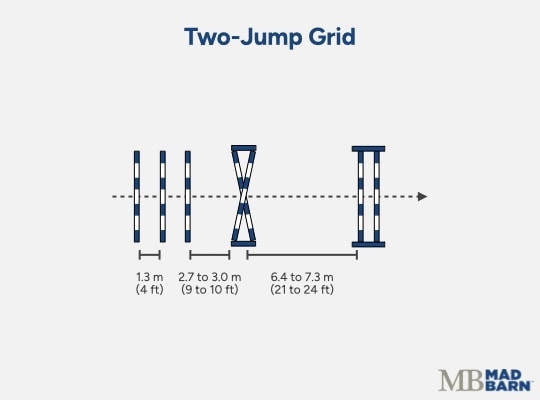 Illustration: Dr. Madison Ricard, DVM, PhD, DACVP, PAS
 Start this grid with the first jump set as a low crosspole or vertical, and the second jump as poles on the ground. Once your horse is warmed up, you can increase the height of the first obstacle and add in the second obstacle progressively.
2. Simple Three-Jump Grid
This exercise builds on the previous exercise by adding a third jump. Trainers can adjust the distances between the jumps, heights of the jumps, and type of jump to add challenge or variety to the exercises.
 Illustration: Dr. Madison Ricard, DVM, PhD, DACVP, PAS
 Set up options include: [5]
- Crosspole – vertical – vertical
- Crosspole – vertical – oxer
- Crosspole – oxer – vertical
- Crosspole – oxer – oxer
3. Long Grids
You can continue adding fences to the basic gymnastic set up based on your horse’s experience, strength, and stamina. Ensure you can successfully ride each additional fence with appropriate striding and effort before adding another jump.
Most riders limit the number of fences to 5 or 6, as gymnastic jumping requires significant effort from the horse.
4. Bounces
Bounces are small jumps set so that the horse must push off their front limbs only to jump the second obstacle, rather than rocking back onto their haunches. These exercises help discourage rushing and establish a consistent rhythm. [2][5]
They also maximize the stretch-shortening cycle of the muscles, rapidly building strength. [3]
 Illustration: Dr. Madison Ricard, DVM, PhD, DACVP, PAS
 Bounces can be incorporated at any point within the grid, however they are easiest to execute when used at the start of a grid. Incorporating bounces in the middle or at the end of a grid is only suitable for advanced horses and riders.
When using bounces, keep the fence height low. Many trainers recommend setting bounce fences no higher than 3 ft (1.0 m).
5. Placing Poles
Some trainers use placing poles within a gymnastic grid to discourage rushing and mandate a regular rhythm and cadence. Horses must focus on their foot placement for every step of the grid, requiring even more concentration. [5]
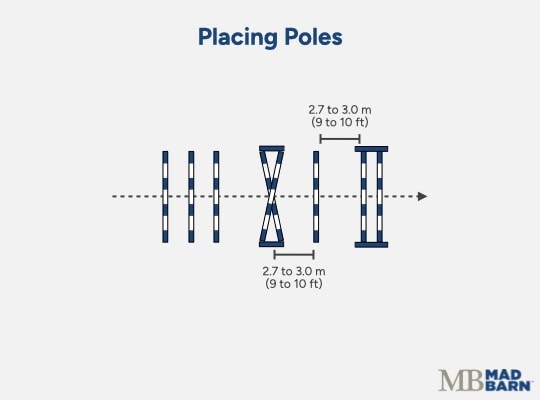 Illustration: Dr. Madison Ricard, DVM, PhD, DACVP, PAS
 Placing poles should be set 10 to 11 feet after a jump, then at the typical striding distance for canter between the jumps. It’s important to leave 10 to 11 feet between the last canter pole and the next jump to set your horse up for success.
6. Gymnastic Y
Y-shaped gymnastics help introduce additional variety into the horse’s training session. They encourage the horse to focus on the rider, as the horse does not know which jump to focus on upon landing. [5] They also encourage the rider to be clear and precise in their directions to the horse.
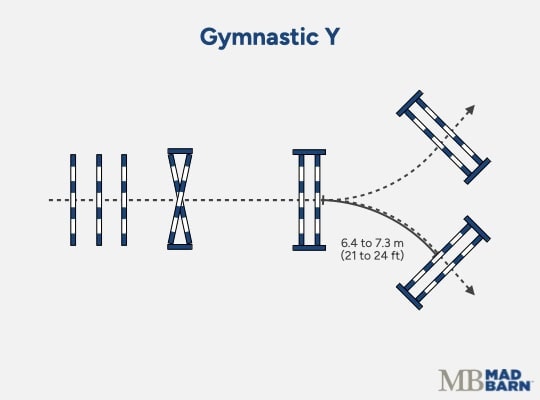 Illustration: Dr. Madison Ricard, DVM, PhD, DACVP, PAS
 Y-shaped gymnastics can be as many fences long as the trainer desires. You can also increase the difficulty by having additional fences after the Y branches off, producing two gymnastic grids with a turn in the middle.
7. Two-Way Gymnastic
Although most gymnastics start with the horse and rider trotting over a low fence, you can also set gymnastics that can be jumped from both directions. These gymnastics must be set to canter into, since the horse canters out of the gymnastic on landing.
To set a two-way gymnastic, place one or more canter poles before and after your existing grid. Leave at least 10 to 11 feet between the last canter pole and the jump.
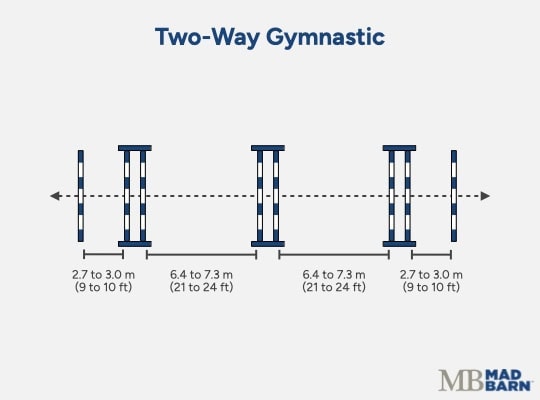 Illustration: Dr. Madison Ricard, DVM, PhD, DACVP, PAS
 Most riders set these gymnastics symmetrically, such as vertical – oxer – vertical. This allows for the same training to occur on both leads and in both directions. However, you can also set asymmetrical gymnastics that train different aspects of jumping.
For example, a vertical – oxer – oxer gymnastic encourages the horse to increase their power coming out of the gymnastic, while jumping it in the oxer – oxer – vertical direction encourages power coming into the gymnastic.

Incorporating Coursework
Gymnastics are a useful addition to coursework as they set the horse’s pace and rhythm. Most trainers start their riders through a gymnastic, then have them continue onto a course. Advanced riders may incorporate a canter-in gymnastic during the course to test their horse’s rhythm and pace.
The simplest application of coursework to a gymnastic is setting a line on the landing side. As the horse and rider come off the gymnastic, they must maintain a suitable rhythm and pace on their own for the striding down the line to be successful. You can also set bending lines coming off a gymnastic to train the rider’s ability to ride a distance accurately with an appropriate rhythm.
Advanced riders may also use related distances on the approach to a gymnastic to challenge their accuracy, rhythm, and pace.
Frequently Asked Questions
Here are some frequently asked questions about gymnastic jumping exercises for horses:
Gymnastic exercises for horses are structured jumping lines that use poles and fences to develop balance, rhythm, and technique in a controlled setting. These exercises remove distractions like turns so the horse can focus on movement and coordination, while riders refine timing and communication through repeated, consistent efforts over the same layout.
Gymnastic exercises improve equine strength, coordination, and rhythm while helping riders develop balance and timing. Repeated efforts encourage horses to adjust their stride independently and maintain a steady tempo, while also building muscle power through short bursts of effort. Many horses show improved focus and reduced rushing when working through these controlled patterns.
Jump height in a gymnastic should match the horse and rider’s experience level, starting low and increasing gradually as confidence builds. Many riders begin with fences around 2 ft (0.6 m) and raise them over time. Bounce elements are typically kept lower, often no higher than 3 ft (1.0 m), to maintain safety and encourage correct technique.
Gymnastic jumping sessions benefit from being limited to one or two times per week to avoid overworking the horse physically and mentally. These exercises demand strength, coordination, and concentration, so spacing sessions allows for recovery while still supporting progress. Regular but moderate use helps maintain effectiveness without causing fatigue or loss of focus.
Gymnastic jumping exercises require basic jumping equipment such as rails, standards, and cavalletti, along with safe jump cups that allow poles to fall easily. Equipment should be sturdy and free from sharp edges or splintering. A suitable footing surface with slight give is also important to support traction and reduce strain during repeated efforts.
Gymnastic jumping distances are typically measured using a standard 12 ft (3.7 m) horse stride and adjusted based on the individual horse. Common setups include trot poles at about 4 ft (1.3 m) apart and one-stride distances around 21 to 24 ft (6.4 to 7.3 m). Careful measurement ensures consistent rhythm and helps the horse move comfortably through the exercise.
Gymnastic jumping exercises can suit beginners when introduced at a simple level with ground poles or low fences. Starting with basic grids allows both horse and rider to build confidence without complexity. As skills improve, additional elements such as more fences or varied distances can be added to increase difficulty while maintaining control.
A bounce in gymnastic jumping is a series of closely spaced fences that require the horse to jump again immediately upon landing. This setup encourages quick reactions, improves rhythm, and strengthens muscles through repeated effort. Because of the physical demand, bounce fences are usually kept low and introduced gradually within a training session.
Gymnastic exercises help address rushing and rhythm problems by creating a structured line that encourages consistent pacing. Repeated distances and placing poles guide the horse into a steady cadence, making it harder to speed up or slow down unpredictably. Over time, this improves the horse’s ability to maintain balance and tempo between fences.
Having a second person present during gymnastic jumping improves safety and efficiency during training. A helper can reset poles, adjust distances, and respond quickly in case of an accident. This support allows the rider to stay focused on the exercise while ensuring that any issues with equipment or footing are addressed immediately.
Summary
Gymnastic exercises are a series of poles and jumps arranged in a pattern that challenges the horse and rider's jumping skill.
- Gymnastics benefit the horse by improving strength, coordination, and jumping style
- For riders, gymnastics help establish rhythm, balance, and communication with the horse
- Gymnastic exercises are suitable for all jumping riders and can be adjusted based on a partnership's skill level
- By adding height and complexity, even advanced riders and horses can benefit from gymnastic training
References
- Klimke. R. and Klimke. I., Basic Training of the Young Horse. J. A. Allen. 2006.
- Wofford. J. C., Gymnastics: Systematic Training for Jumping Horses. Interpet. 2001.
- Castejon-Riber. C. et al., Objectives, Principles, and Methods of Strength Training for Horses. Journal of Equine Veterinary Science. 2017.
- Art. T. et al., Effect of Show Jumping on Heart Rate, Blood Lactate and Other Plasma Biochemical Values. Equine Veterinary Journal. 1990. View Summary
- Allen. L. and Dennis. D. R., 101 Jumping Exercises for Horse & Rider. Storey Publishing, LLC. 2010.