English
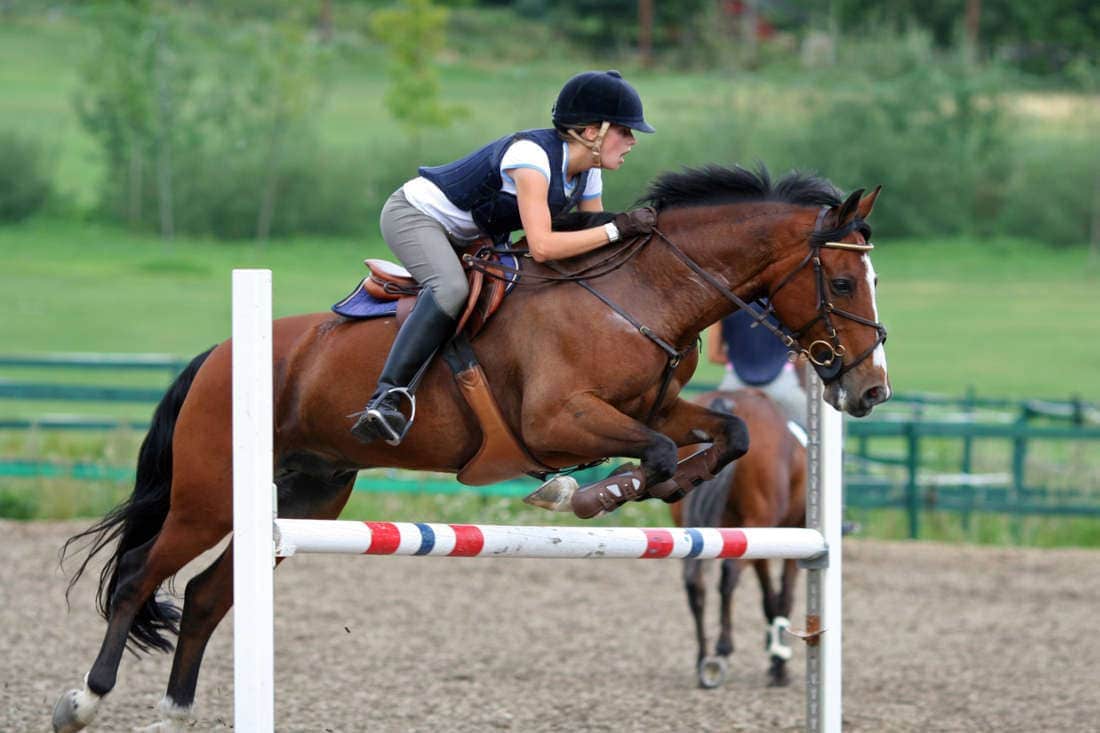
Riding show jumping lines and combinations requires more than simply finding the right distance. Each related distance, double, or triple combination requires the horse and rider to maintain the ideal pace, balance, straightness, and communication from the approach through to the landing.
While course designers use standard measurements to set lines and combinations, how those distances ride depends on many factors, including the horse’s stride length, adjustability, experience, and the rider’s ability to make timely decisions.
For riders, success comes from understanding both the technical design of the course and the feel of the horse underneath them. Managing stride length, staying centered, maintaining impulsion, and making early adjustments all help create smoother, more accurate rounds.
Whether navigating a simple related distance, a bending line, or a more technical triple combination, learning how lines and combinations are built and how to ride them effectively can support better overall performance in the show jumping arena.
What Are Lines & Combinations in Show Jumping?
In show jumping, course design often includes lines and combinations, which are a particular arrangement of jumps designed to test pace, adjustability, and communication between horse and rider. Lines and combinations appear across all levels of show jumping. [1]
The key differences between lines and combinations come down to the time and space in between each and overall technical difficulty. These differences test both horse and rider in distinct ways. [2][3]
Lines
A line in show jumping consists of two or more fences set at a related, measured distance, typically greater than three strides, placed to allow a safe approach and landing.
Depending on how they are set within the arena, lines can be: [2]
- Straight
- Diagonal
- Bending
- Broken
When riding a line, the horse and rider jump the first fence, land, and continue forward to the next fence in a predetermined number of strides based on an expected stride length. Lines are commonly described as five-stride or six-stride lines, based on the set distance or the number of strides walked between fences. [2]
Lines give riders more opportunity to adjust and influence the horse’s stride and number of strides between fences compared to combinations. Riders can slightly lengthen or shorten their horse’s stride to cover the distance correctly within the line. [2]
Combinations
A combination is a sequence of two or more jumps set close together, typically ridden within one to four strides. Combinations are often referred to as doubles or triples, depending on the number of jumps, and may also be described as one- or two-stride combinations, sometimes called in-and-outs. [1]
The distances between elements in a combination are fixed, requiring the horse to jump in quick succession with limited time or space for adjustment after the first jump in the combination.
Compared to lines, combinations place even greater demands on the horse’s strength, accuracy, and adjustability. They also require precise setup and execution from takeoff, which makes reaction time, straightness, and rider accuracy essential throughout. [3]
What's your top priority with your horse's health?

What's your top priority with your horse's health?
Distances: Understanding Stride Length
In horse jumping, the “distance” or “spot” refers to the point where the horse’s front legs leave the ground to take off over a fence. [4]
When riding lines and combinations, distances are a foundational element of success. Understanding stride length helps riders approach lines and combinations with accuracy and make effective adjustments between fences. [4]
While course distances are built on standard measurements, riders must interpret and ride them based on the individual horse, making stride awareness a key part of training and competition in show jumping. [4]
Course Design & Standard Jumping Distances
In show jumping, distances between fences are built around a horse’s average stride length. A typical horse’s stride measures approximately 12 ft (3.6 m). [5]
In addition to average stride length, course designers also account for takeoff and landing when setting distances in lines and combinations. This forms the basis for determining how many strides are between jumps in a line or combination. [5]
Course designers then adjust these distances based on the level of competition and intended technical difficulty. Guidelines from organizations such as the Fédération Equestre Internationale (FEI) and US Equestrian (USEF) help ensure consistency and fairness when creating lines and combinations for each jumping level. [5]
For example, lower-level courses tend to use more forgiving distances, while higher-level tracks challenge riders to adjust stride length within a line with precision, balance, and control.
Table 1. Typical stride distances in show jumping
| Number of Strides | Approx. Distance (feet) | Approx. Distance (meters) |
|---|---|---|
| 1 stride | 19 – 21 ft | 5.8 – 6.4 m |
| 2 strides | 31 – 33 ft | 9.4 – 10 m |
| 3 strides | 43 – 45 ft | 13.1 – 13.7 m |
| 4 strides | 55 – 57 ft | 16.8 – 17.4 m |
| 5 strides | 67 – 69 ft | 20.4 – 21 m |
| 6 strides | 79 – 81 ft | 24.1 – 24.7 m |
Factors That Influence Jumping Distances in Lines & Combinations
Several factors influence the jumping distance between fences in a line or combination. Horse size and conformation play a key role, as they determine how much ground a horse naturally covers. [4]
While course designers use a standard stride length to measure jumping lines and combinations, riders must understand how that standard applies to the horse they are riding. [4]
A horse’s experience and fitness also play a role in distances when jumping a line or combination. For example, seasoned, well-conditioned horses typically maintain a more consistent rhythm and balance when riding a line. [6]
The arena’s footing material and depth can further impact distance, as deeper or less stable footing may influence stride length and impulsion. [6]
Horse Biomechanics of Riding Lines & Combinations
Riding lines and combinations puts specific biomechanical demands on the horse, such as precise coordination between stride length, balance, and energy use.
Successfully navigating a line or combination depends on how efficiently the horse can regulate movement while maintaining rhythm and impulsion.
Stride Regulation & Effort
Adjusting stride length directly affects how the horse uses their body. Both lengthening and shortening the stride can change how much effort is required from the horse, especially when these adjustments are repeated across a full show jumping course.
Lengthening the stride increases ground coverage but is associated with higher ground reaction forces and greater mechanical work, requiring increased muscular effort to maintain speed and momentum. [7]
Conversely, shortening the stride shifts weight toward the hindquarters and requires muscular control and stabilization to maintain balance, collection, and impulsion.
Ultimately, stride regulation is influenced by the horse’s overall fitness and conditioning, and effective performance depends on developing both extension and collection rather than overemphasizing one at the expense of the other.
Balance & Center of Gravity
To jump efficiently, horses must shift their weight and adjust their center of gravity. As they approach a fence, they transfer weight toward the hind end to prepare for takeoff, allowing them to push off the ground with power. [8]
At the same time, they must maintain forward impulsion without rushing, which requires balance through the body and a steady rhythm. In lines and especially combinations, maintaining this balance between jumps is essential. [8]
Combinations in particular demand rapid, precise adjustments that rely on neuromuscular coordination. Horses use proprioception, the sense of where the body is in space, to judge distances and respond to the rider’s aids. [9]
As a course progresses, repeated stride adjustments increase metabolic demand and can contribute to fatigue. Tired horses may struggle to maintain balance, impulsion, and coordination, increasing the risk of mistakes, especially in technical combinations late in the course. [9]
Proper conditioning, the right warm-up technique, and recovery strategies for multi-day competitions or training rides play a key role in minimizing fatigue and supporting consistent performance.
Riding Show Jumping Lines Effectively
Riding lines effectively depends on maintaining rhythm, balance, and consistency while making subtle adjustments to the stride. Although distances are predetermined, the rider’s approach determines how well the horse fits the line. [5][6]
Establishing Pace
A consistent, balanced canter forms the foundation for riding a line. Establishing rhythm in the canter early and maintaining it throughout the course helps riders approach and ride lines more effectively.
“Chasing” to a distance, also known as rushing the fence, often leads to a long, flat stride that compromises takeoff. Conversely, holding the stride or excessively shortening it can reduce impulsion. Both extremes make distances harder to see and increase the likelihood of mistakes. [8]
Seeing a Distance
Riding a line effectively requires both a trained eye and a feel for the horse’s stride. Riders develop the ability to see a distance by recognizing stride patterns, but they must also feel how the horse is moving underneath them.
Early decision-making before and during a line is critical, such as choosing the right track, maintaining the proper pace, which allows the distance to come up more naturally rather than forcing a last-minute adjustment. [5]
Adjustability Within the Line
Even with measured distances, riders may need to adjust the number of strides depending on the horse they are riding. Adding a stride requires collecting the canter and maintaining balance, while leaving one out involves lengthening the stride without losing the impulsion needed to jump.
These adjustments depend on pace, straightness, and the horse’s responsiveness. Making these changes gradually and using subtle aids can help maintain the line’s rhythm and flow. [9]
Straight vs. Bending Lines
Straight lines tend to ride more predictably, as the distance between fences remains more consistent from takeoff to landing. Riders can focus on maintaining rhythm and straightness to meet the distance correctly.
Bending lines, however, introduce additional complexity. The distance can vary depending on the track taken, requiring riders to manage the track within the bending line carefully and maintain accuracy. Small changes in the track can significantly affect how the distance is ridden, making precision essential. [10]
Riding Combinations Effectively
Riding combinations successfully requires precision and consistency from the rider. With limited space between jumps, the quality of the approach and the rider’s ability to maintain balance and alignment are essential. Unlike jumping lines, combinations do not allow for significant adjustment once the horse leaves the ground over the first jump. [4]
Establishing Rhythm
A consistent, balanced canter remains the foundation when approaching combinations. Riders must establish the pace well before the first jump in the combination.
Overriding the base of the fence in a combination can disrupt balance, while holding too much before the jump can reduce impulsion and make it difficult for the horse to jump through the rest of the combination successfully. [4][5][8]
Seeing a Distance
In combinations, seeing a distance to the first element is most critical. Riders must make an early decision on the approach and commit to it. The distance to the first fence sets up the distances for the entire combination. [4][6][8]
Both visual judgment and feel play a role, but timing and track are critical when seeing a combination jumping distance. [4][6][8]
Adjustability, Straightness, & Position
Combinations offer little opportunity to adjust strides, so the focus shifts to maintaining balance, straightness, and impulsion through the set distances. Riders influence the outcome through canter quality and accuracy to the first element. [2]
Straightness is critical, as even small deviations affect how the horse meets each jump. A centered, quiet position with a secure lower leg and soft release allows the horse to use its body effectively and move through the combination efficiently. [8][9]

Common Mistakes & How to Adjust Mid-Course
Even small mistakes in pace, balance, or track can quickly affect distances and overall performance. Recognizing and correcting these issues early helps riders stay on track and avoid compounding errors.
To successfully ride show jumping lines and combinations, riders should avoid: [3][4][9]
- Rushing or Flattening the Canter: Riders who chase to a distance often create a long, flat stride, leading to poor takeoff and rails. Rebalance early using half-halts to re-establish a consistent pace before the next fence.
- Over-Collecting: Over-collection can reduce impulsion, often resulting in weak, underpowered jumps. Riding forward out of the turn and maintaining impulsion to the base of the fence to support a more effective jumping effort.
- Inconsistent Rider Aids: Mixed aids from the rider can confuse the horse, especially in combinations that require clear communication. Having a plan and maintaining consistent leg-to-rein contact throughout the course can help with communication before and through a line or combination.
- Poor Line Choice: Inaccurate track, especially on bending lines, often leads to added or awkward striding. Focus on your line early and ride it with intention and accuracy.
- Making Adjustments During the Course: Effective riders are typically proactive rather than reactive. Recognizing issues such as a loss of rhythm or a developing poor distance early can help you adjust accordingly for a successful ride.
Table 2. Summary of common mistakes when riding lines and combinations in show jumping
| Mistake | What Happens | How to Correct It |
|---|---|---|
| Rushing or flattening the canter | Creates a long, flat stride that compromises takeoff and increases the risk of rails | Rebalance early using half-halts and re-establish a consistent rhythm before the next fence |
| Over-collecting | Reduces impulsion and results in weak, underpowered jumps | Ride forward out of the turn and maintain impulsion to support a more effective jumping effort |
| Inconsistent rider aids | Confuses the horse and disrupts communication, especially in combinations | Maintain consistent leg-to-rein contact and ride with a clear, deliberate plan |
| Poor line choice | Leads to inaccurate distances and awkward or added strides, particularly on bending lines | Focus on the intended track early and ride it with accuracy and intention |
| Late adjustments during the course | Forces reactive riding, increasing the likelihood of errors and loss of rhythm | Recognize issues early and make proactive adjustments before the problem develops |
Training Exercises to Improve Riding Lines & Combinations
Developing accuracy in lines and combinations starts with exercises that build rhythm, adjustability, and consistency. [4]
Cavaletti & Pole Work
Ground poles and cavaletti exercises help riders develop stride awareness and understand how subtle adjustments influence distance. By practicing lengthening and shortening within a set line of poles, riders can refine timing, improve feel, and develop a more consistent rhythm.
These exercises also allow horses to become more responsive to half-halts and forward aids, building the foundation needed to adjust stride length accurately when approaching combinations and related distances without the added complexity of jumps. [4]
Gymnastic Grids
Gymnastic exercises reinforce straightness, technique, and timing while promoting balance and confidence. Because distances are preset, they encourage the horse to stay organized and use their body efficiently through a sequence of efforts.
This allows the rider to focus on maintaining position, consistency, and a steady rhythm rather than making frequent distance adjustments. Over time, grids help improve coordination, strengthen correct jumping mechanics, and develop a more reliable canter, all of which contribute to riding lines more accurately. [4]
Progressive Difficulty
Start with simple exercises and gradually increase complexity to build confidence and skill. Beginning with straight lines and single related distances allows both horse and rider to establish rhythm and consistency before introducing more technical challenges.
As training progresses, adding bending lines, combinations, and varied distances helps improve adjustability and decision-making. This step-by-step approach supports the development of balance, responsiveness, and accuracy, preparing horse and rider to navigate more complex show jumping courses effectively. [4][5]
Walking Lines & Combinations vs. Riding Them
Walking a show jumping course helps riders measure distances, determine striding, choose a track, and visualize how a line should ride. It provides a plan for how many strides to take and where adjustments may be needed.
However, the plan created during a course walk must be adjusted once in the saddle. Riders must translate the strides they walked by adapting them based on the approach to the first jump, as well as the horse’s actual pace, balance, and responsiveness. [5][6]
Factors such as impulsion, straightness, and the quality of the turn into a line can all influence how the distance rides in practice, requiring riders to make real-time decisions to maintain rhythm and accuracy. [5][6]
Frequently Asked Questions
Here are some frequently asked questions about riding lines and combinations:
The difference between a line and a combination in show jumping comes down to spacing and adjustability between fences. A line typically includes two or more jumps set at a related distance with several strides in between, giving the rider time to make adjustments. A combination consists of jumps placed close together, usually ridden in one to four strides, leaving very little time to change anything after the first element. Because of this, lines allow for more flexibility, while combinations demand precision from the start.
Distances between fences in show jumping are measured using an average horse stride of about 12 feet or 3.6 metres. Course designers also include space for takeoff and landing when setting these distances. While these measurements are standardized, riders still need to adapt based on their horse’s stride length, balance, and experience. This means distances may ride differently depending on the individual horse.
Riders should approach a show jumping line with a consistent, balanced canter and a clear plan. Establishing rhythm and straightness before the first fence helps the distance come up naturally. Within the line, riders may need to adjust stride length slightly, either opening or compressing the canter. These adjustments should be subtle to maintain balance and avoid disrupting the horse’s rhythm.
Riders should approach a combination with accuracy, balance, and commitment from the first stride. The distance to the first fence determines how the rest of the combination will ride, so preparation must happen early. Straightness is critical because even small deviations can affect the horse’s ability to meet the following elements correctly. A steady position and soft contact help the horse stay organized through the sequence.
A related distance in show jumping refers to two fences set a specific number of strides apart, typically within a line. These distances are designed based on standard stride lengths but can be ridden differently depending on the horse. Riders may choose to ride the distance forward or collect slightly to adjust the number of strides. Understanding related distances helps riders plan their track and pace more effectively.
A double or triple combination in show jumping refers to a sequence of two or three fences set close together. These are commonly labeled as A, B, and sometimes C, and are ridden in quick succession. Because the spacing is tight, riders have little opportunity to adjust after the first jump. Accuracy and straightness are essential to navigate these combinations successfully.
Rhythm is important when riding lines and combinations because it helps maintain consistency in the horse's stride and balance. A steady rhythm allows the rider to meet each fence at an appropriate distance without last-minute adjustments. If rhythm is lost, the horse may arrive too deep or too long, making the jump more difficult. Maintaining rhythm also supports better control and confidence throughout the course.
Riders can adjust stride length between fences by using subtle aids to either lengthen or shorten the horse's canter. Opening the stride slightly can help cover more ground, while collecting can create a shorter, more controlled stride. These adjustments should be gradual and planned, not reactive. Maintaining balance during these changes is key to riding distances accurately.
Common mistakes when riding combinations include poor preparation before the first fence and lack of straightness. Riders may also interfere too much after the first jump, which can disrupt the horse's balance. Because there is limited time to adjust, mistakes early in the combination often carry through to the rest of the elements. Focusing on a correct approach usually prevents most issues.
Bending lines differ from straight lines because they require the horse to travel on a curved path between fences. This affects stride length, as horses may naturally shorten or lengthen slightly on a curve. Riders must manage balance and track carefully to maintain the intended number of strides. Straight lines, by contrast, allow for more direct and consistent distances.
Exercises that improve riding accuracy for lines and combinations include pole work, cavaletti, and gymnastic grids. These setups help riders develop a feel for stride length and timing without the pressure of full fences. Grid exercises are especially useful because they set distances automatically, encouraging consistency. As skills improve, more complex exercises like bending lines and related distances can be introduced.
Riders can improve their eye for distance by practicing consistently over poles, grids, and simple lines. Developing a feel for rhythm and stride length helps riders anticipate where the horse will meet the jump. Watching experienced riders and reviewing videos can also build awareness. Over time, repetition and experience help riders make more accurate decisions approaching fences.
Summary
In show jumping, lines and combinations are related groups of fences that test a horse and rider's ability to maintain rhythm, balance, straightness, and accurate stride length between jumps.
- Mastering lines and combinations comes down to effective communication between horse and rider
- Riders who develop the ideal canter pace, understand stride length, and make early, accurate decisions are better equipped to ride distances smoothly and handle the technical challenges of both lines and combinations
- While course design provides the framework for distances, execution ultimately depends on the rider's ability to adapt to the horse and ride proactively throughout the course
- With thoughtful training and attention to fundamentals, riders can improve both confidence and the horse's performance when riding lines and combinations
- Over time, this foundation helps horse-and-rider pairs approach both simple and technical jumping questions with greater accuracy, rhythm, and confidence
References
- A Beginner’s Guide to Show Jumping. Kentucky Three-Day Event. 2024.
- Tinder. S. Best of JN: The Trick to Keeping Your Straight Lines Square. Eventing Nation. 2019.
- Show Jumping 101. Spruce Meadows.
- Baier. C. Introduction to Related Distances and Combinations. Practical Horseman. 2023.
- The Art of Show Jumping Course Design: Timing, Pace, and Height. Kentucky Three-Day Event. 2024.
- Baker. S. 4 Tips For Walking The Course. Fédération Equestre Internationale. 2019.
- Gmel. A. I. et al., Comparison of Speed-Dependent Time, Force and Spatial Parameters between Franches-Montagnes and European Warmblood Horses Walking and Trotting on a Treadmill. Journal of Equine Veterinary Science. 2024.
- In-And-Outs: More Advanced Skills. Practical Horseman. 2015.
- Clayton. H.M. et al. Riders’ Effects on Horses—Biomechanical Principles with Examples from the Literature. Animals. 2023.