English
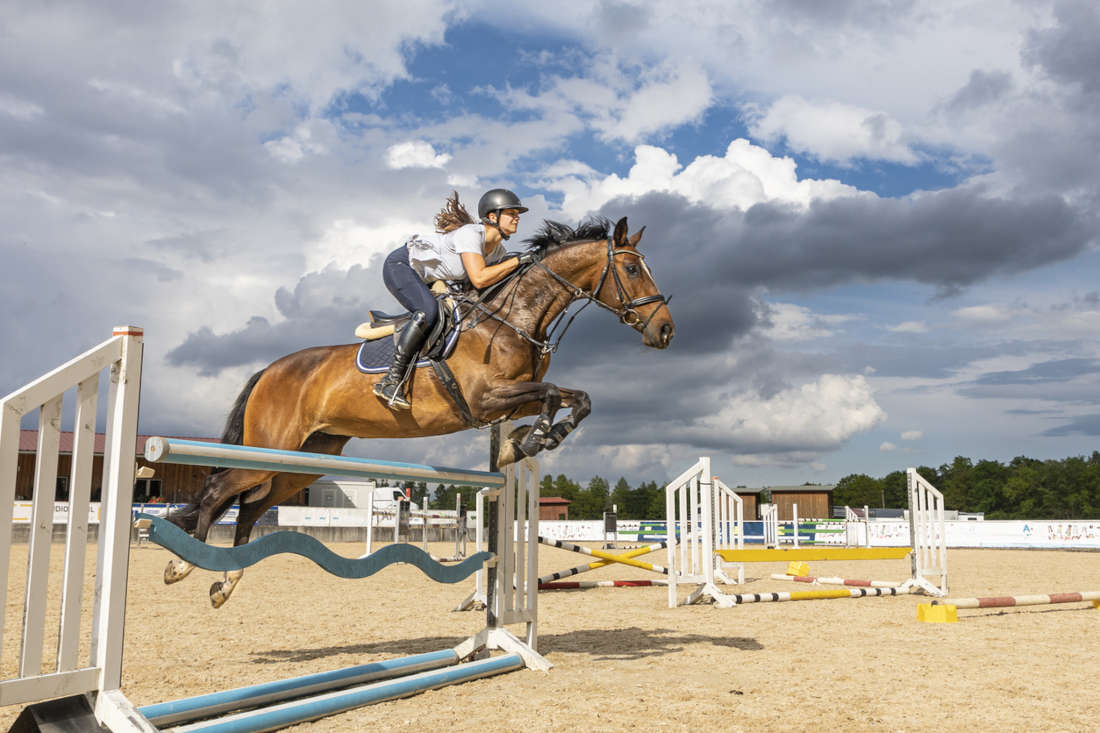
Stride adjustability in horses is a foundational skill for successful show jumping, allowing riders to meet distances accurately, maintain rhythm, and adapt to the technical demands of modern courses. Whether you are competing in hunters, jumpers, or equitation, the ability to lengthen and shorten your horse’s stride without losing balance is key to riding smooth, consistent rounds.
Many horses struggle with adjustability because they are missing essential foundations in balance, strength, or responsiveness to the rider’s aids. Riders may find themselves chasing distances, adding or leaving out strides unintentionally, or losing rhythm on approach to a fence. Over time, these patterns can reduce confidence and increase the risk of rails, awkward jumps, or refusals.
The good news is stride adjustability is a trainable skill that develops through correct flatwork, structured exercises, and consistent communication. By improving how your horse responds to aids and carries themself between fences, you can create a more rideable, adjustable partner.
Keep reading to learn what stride adjustability is, why it matters in jumping, how to recognize limitations, and the most effective exercises to improve control, balance, and responsiveness.
What Is Stride Adjustability in Horses?
Adjustability, or rideability, refers to how responsive the horse is to the rider’s requests for extending or shortening their stride. Horses who are highly adjustable easily move between “types” of each gait without changing to a different gait.
In flatwork and dressage, riders develop adjustability by asking the horse to perform the gait with different degrees of stride length and collection. These variations include: [1]
- Working: This is the standard gait the horse naturally performs. The horse moves forward in even steps with reasonable impulsion and balance. Jumping riders often use this type of gait to warm up, cool down, or do low-level exercises.
- Medium: These gaits sit between the working and extended gaits in terms of stride length. The horse should move with more impulsion and uphill balance. Jumping riders use this gait during courses or higher-level exercises that require impulsion.
- Extended: These gaits have the horse cover as much ground as possible by lengthening their stride. They should maintain an uphill balance to prevent them from running “on the forehand” and losing impulsion. Jumping riders may use this gait during jump-offs or other events where speed is key.
- Collected: Collection shortens the horse’s stride, building power and thrust through the hind end. The horse steps under their body further and rocks back onto the hindquarters. Jumping riders use collected gaits for tight turns or short approaches to the fence.
What's your top priority with your horse's health?

What's your top priority with your horse's health?
Why Stride Adjustability Matters in Jumping
Having the ability to adjust the horse’s stride is crucial for show jumping, as horses and riders must find an appropriate distance to each fence.
Making small adjustments to stride length helps the horse and rider meet an ideal distance where the horse can take off and avoid the jump with the front legs while covering adequate distance in the air to clear the width of the obstacle.
If the horse reaches the jump on a short distance (too close to the jump), they do not have enough room to maneuver their front limbs. In this case, the horse may take a rail with their front legs. Long distances (too far away from the jump) may not have the impulsion to clear the width of the obstacle, typically resulting in a rail with the hind limbs.
Many show jumping courses also set related distances, where two jumps are placed with a certain number of strides between each jumping effort. Typically, these distances are set based on a 12-foot stride length.
Depending on the horse’s natural stride length and their landing off the first jump, the rider may need to extend or collect the gait to fit an appropriate number of strides between the jumps. This sets the horse up for an appropriate distance to the second fence, reducing the chances of hitting the jump and incurring faults.
Having an adjustable horse makes this process easier and increases the likelihood of clear rounds.
Signs Your Horse Needs Better Adjustability
Before you can improve stride adjustability, it’s important to recognize when it’s lacking. Subtle inconsistencies in rhythm, balance, and distance can point to underlying issues. These signs often appear both on the flat and over fences, affecting the horse’s ability to respond smoothly to the rider’s aids.
Recognizable patterns indicating a lack of adjustability may include:
- “Chipping in” or taking a very close distance to a jump
- Frequently taking off from long distances
- Rushing jumps
- “Sucking back” or ignoring forward leg cues
- Struggling to get the correct number of strides in related distances
- Resisting half-halts by tossing the head or ignoring the cue
- Frequent changes in rhythm or pace without rider input
Importantly, these issues are rarely just behavioral. They are often linked to gaps in strength, balance, straightness, or clarity in the rider’s aids. Correcting adjustability issues often takes time and requires conditioning of both horse and rider for repeatable success.
Table 1. Signs of adjustability issues in jumping horses
| Common Issue | Likely Cause | Training Focus |
|---|---|---|
| Chipping in at jumps |
|
|
| Taking off long |
|
|
| Inconsistent distances |
|
|
| Rushing fences |
|
|
| Ignoring half-halts |
|
|
| Struggling with related distances |
|
|
| Losing rhythm during adjustments |
|
|
Building a Training Plan to Improve Adjustability
Adjustability exercises for horses focus on developing the two skills a truly adjustable horse must have:
- Maintaining a rider-determined stride length without losing rhythm
- Changing to a new stride length promptly when requested
Most trainers start with maintaining the desired stride length. This gets the horse accustomed to new stride length and builds their strength and balance at that type of gait.
Once the horse is comfortable with the gaits, emphasizing prompt changes between stride lengths makes the horse rapidly adjustable, which is ideal for show jumping courses.
Table2. Horse adjustability exercises at-a-glance
| Exercise | What It Improves | When to Use It |
|---|---|---|
| Transitions within the gait | Responsiveness to aids, control of stride length | When the horse struggles to shorten or lengthen on cue |
| Half-halt work on the flat | Balance, engagement, and preparation for adjustments | When the horse ignores aids or falls onto the forehand |
| Shortened and lengthened trot/canter poles | Strength, coordination, and stride awareness | When developing the physical ability to adjust stride |
| Poles set at fixed distances (e.g., 60 ft) | Consistency in stride length and rhythm | When the horse struggles with maintaining a set number of strides |
| Adding or leaving out strides between poles | Adjustability and rider control over stride length | When preparing for related distances and course questions |
| Three-pole or multi-line exercises | Quick adjustments and responsiveness | When improving speed of stride changes between efforts |
| Grid work (cavaletti to jumps) | Technique, balance, and consistency over fences | When introducing adjustability into jumping |
| Incorporating oxers in grids | Power, scope, and advanced adjustability | For experienced horses developing high-level jumping skills |
Experienced trainers develop adjustability through a structured progression, starting with foundational control of stride length and building toward faster, more precise adjustments.
The following exercises are typically introduced in sequence, beginning on the flat before progressing to more complex pole and jumping work.
1) Shortening & Lengthening on the Flat
To shorten or lengthen the gait appropriately, the horse requires significant strength and balance to maintain their impulsion. Given this, developing a collected or extended gait takes time and patience.
Riders should focus on the quality of the gait, ensuring the horse maintains an uphill balance and is always moving freely forward in a consistent rhythm.
To develop a shorter or longer stride, riders should establish a half-halt. This is a subtle cue indicating a change in gait, balance, or movement is about to occur, rocking the horse onto their haunches in preparation. [2]
To perform a half-halt, close the hand and apply leg to push the horse into your closed hand. The horse should soften their neck and head to the bit pressure, while stepping further under themselves. [2]
Practice half-halts to ensure your horse responds to the cue appropriately. If the horse does not soften and step under, a circle or turn in the direction of your half-halt can help teach the desired response.
Once the horse responds to the half-halt, you can use this cue to prepare them for shortening or lengthening. To shorten the stride, maintain gentle rein and leg pressure. This encourages the horse to compress their body and “sit” onto their haunches, increasing power. Maintain this for a few strides before allowing them to move freely forwards. Gradually increase the number of collected strides and degree of collection as the horse builds strength.
For lengthening, half-halt, then lighten the rein contact and push the horse forward with your leg. [2] Only allow a few steps of lengthening before rebalancing the horse back into a working gait to prevent them from falling onto their forehand. Again, gradually increase the number of lengthened strides and amount of extension as the horse builds strength.
To help build strength, you can use trot or canter poles set at a short or long stride length. The act of stepping over the poles requires more muscle activity, contributing to overall strength development.
It’s important to note that trot and canter poles can be very tiring for horses and should only be used for short periods, several times a week. Prior to entering the poles, ensure you are asking the horse to perform a shorter or longer stride and do not rely on the poles to change the horse’s stride for you. This helps them learn the half-halt cue.
2) Maintaining a Stride Length
Once you and your horse are comfortable with short and long stride lengths, you can begin working on maintaining the gait.
A classic exercise for practicing stride lengths is setting two poles or cavaletti 60 ft (18 m) apart. [3] Start by going over the poles at your horse’s baseline canter and counting how many strides they put in. For a horse with a 12-foot stride, they should do 4 strides, while a horse with a 10-foot stride should do 5 strides.
Perform the exercise until you consistently get either 4 or 5 strides between the poles without your horse slowing down, rushing, or resisting aids.
Next, ask your horse to go through the poles or cavaletti on either a collected or extended stride. The goal is either to “add” a stride or to “leave one out”. Again, the horse should have a consistent rhythm before, during, and after the pole exercise. Practice adding and leaving out a stride until your horse is comfortably performing both.
You can then challenge yourself and your horse by asking them to perform the exercise several times in a row, with a different stride length each time. Try alternating between stride numbers up or down.
For example, you could do five strides, four strides, then six strides to ask your horse to go from extension to collection rapidly. [3] Use the time it takes to circle back to the start of the exercise to develop and maintain the new stride length.
3) Quick Adjustments
Once your horse can reliably maintain a particular stride length, you can work on the promptness of “gear changes“.
A highly adjustable horse rapidly changes their stride length when prompted, often within the span of 1 – 2 strides. That level of adjustability is required for top level show jumping courses, where related distances may be set on different stride lengths.
To start working on rapid adjustability, you can build upon the pole exercise from the previous section. Place three poles in a straight line with 60 ft (18 m) between them. [4] Repeat the same exercises as above, but with the goal of doing a different number of strides between each set of poles.
For example, you could do 5 strides in the first set, then immediately do 4 or 6 strides between the second set. This gives you and your horse 1 – 2 strides to make the adjustment.
If your horse struggles with the exercise, it’s likely because they are not changing their stride length quickly enough. Instead of a single middle pole, you can add in 2 – 3 canter poles set at your new desired stride length. This helps encourage your horse to change their stride length more promptly. [4]
4) Increasing Difficulty
These exercises can be repeated using jumps, dramatically increasing the difficulty. Riders typically refer to these jumping layouts as “grids“. Start with small jumps or cavaletti and ensure you and your horse can reliably perform the exercises. As you gain confidence, you can increase the jump height. [4]
You can also incorporate oxers into these exercises. Keep in mind that oxers require the horse to lengthen their body. Going from a collected gait to extending over an oxer in the span of 1 stride or less is a very advanced maneuver only suitable for high-level horses.
Similarly, jumping an oxer requires the horse to get deeper to the base of the fence than a vertical. Horses coming in on a lengthened stride are more likely to be on their forehand, making them more likely to “chip in” or jump awkwardly to get their front limbs out of the way. They may also stop suddenly if they run out of room before the jump.
When starting out, only approach oxers on a normal stride length. Set them at a lower height than the other fences and gradually increase their width. If using an oxer as the middle fence in a 3-jump line, remember that widening the oxer changes the distance to the following fence. You may need to move the third jump accordingly.

Developing a More Adjustable, Rideable Horse
Stride adjustability is one of the most important skills for success in show jumping, allowing riders to meet distances accurately, maintain rhythm, and navigate courses with confidence.
While many riders focus on finding the perfect distance to each fence, true consistency comes from developing a horse that can adapt their stride when needed without losing balance, impulsion, or straightness.
Improving adjustability is not about quick fixes, but about building a strong foundation through consistent flatwork, clear communication, and progressive exercises. Strength, balance, and responsiveness all influence how effectively a horse can shorten or lengthen its stride.
As these qualities develop, the horse becomes more rideable, more attentive to the rider’s aids, and better able to maintain a consistent effort throughout a course.
Ultimately, stride adjustability gives riders greater control and flexibility in the ring. Instead of reacting to each jump, you can make deliberate decisions about pace, distance, and line. This level of control supports smoother rounds, improved confidence, and a more consistent partnership between horse and rider, both in training and in competition.
Frequently Asked Questions
Here are some frequently asked questions about stride adjustability in jumping horses:
Stride adjustability in jumping horses refers to the ability to lengthen and shorten the stride while maintaining rhythm, balance, and straightness. This allows the horse to meet distances accurately without losing control or impulsion. Adjustability is a key component of rideability and effective communication between horse and rider.
Stride adjustability is important in show jumping because it allows riders to adapt to different distances, lines, and course challenges. Horses with good adjustability can maintain a consistent pace while responding to subtle changes in aids. This improves accuracy, reduces the risk of rails and refusals, and supports safer navigation of technical courses.
The best exercises for improving stride adjustability in horses include transitions within the gait, pole work with variable distances, and gymnastic grids. These exercises help develop responsiveness to aids while improving balance, coordination, and control over stride length. Consistent practice builds strength and understanding over time.
Teaching a horse to shorten its stride involves using half-halts combined with supportive leg aids to encourage engagement rather than simply slowing down. Exercises such as collecting on circles, shortening distances between poles, and practicing transitions within the gait help develop control. The goal is to maintain energy while reducing stride length.
Helping a horse lengthen its stride without rushing requires increasing impulsion while maintaining balance and rhythm. Riders should apply leg aids while keeping a steady, elastic contact to encourage ground cover rather than speed. Exercises such as lengthening across diagonals or riding forward between poles can support this development.
Stride adjustability relies on coordinated use of the rider’s seat, leg, and rein aids. The seat helps regulate rhythm and balance, the leg creates impulsion, and the reins refine communication and control. Effective adjustability comes from combining these aids rather than relying on one alone.
Stride adjustability should be incorporated into regular training rather than practiced occasionally. Short, consistent sessions using flatwork, poles, and jumping exercises are more effective than infrequent, intensive training. Ongoing repetition helps reinforce responsiveness and balance.
Stride adjustability should be introduced once the horse has a basic level of balance, rhythm, and forward movement. Early training focuses on developing these fundamentals before refining stride control. Introducing adjustability too early can lead to confusion or tension if the horse is not ready.
Common mistakes include sacrificing rhythm for stride length, overusing the reins instead of coordinating aids, and practicing without clear structure. Riders may also focus too much on distance rather than quality of movement. These errors can lead to tension, resistance, and inconsistent performance.
The time required to improve stride adjustability depends on the horse’s training level, strength, and responsiveness. Some improvement may be seen within a few weeks of consistent work, but reliable adjustability develops over time. Ongoing training is needed to maintain and refine this skill.
Stride adjustability directly affects how accurately a horse meets jumping distances. Horses that can lengthen or shorten their stride can adapt to imperfect approaches and maintain better takeoff points. This improves consistency and reduces the likelihood of awkward or unsafe jumps.
Most horses can develop stride adjustability with correct training, although individual ability may vary. Factors such as conformation, athleticism, and training history influence how easily a horse learns to adjust its stride. Consistent, progressive training helps maximize each horse’s potential.
Summary
Improving stride adjustability in show jumping horses is key to achieving accurate distances, maintaining rhythm, and riding smoother, more controlled courses.
- Stride adjustability allows horses to lengthen and shorten their stride without losing rhythm or balance
- Common issues such as rushing, chipping, or inconsistent distances often stem from poor stride adjustability
- Flatwork provides the essential foundation for developing control and responsiveness in jumping horses
- Pole exercises and grids help horses learn to adjust their stride in a structured and repeatable way
- Effective rider aids, including well-timed half-halts and supportive leg, are essential for clear communication
References
- Ebeling. J. A Guide to Dressage Gaits. Practical Horseman. 2013.
- Schmidt. H. The Half Halt Simplified. Dressage Today. 2015.
- Maynard. T. Tik Maynard's Favorite Exercise for Adjustability and Rideability. Practical Horseman. 2022.
- Amaya. M. Improve Rideability for Confident Courses: Prepare Your Horse for the Show Ring by Refining His Adjustability with This Step-by-Step Gymnastic Exercise Program. Practical Horseman. The Equine Network. 2014.