English

Piaffe and passage are defining movements of Grand Prix dressage. Watching a horse trot in place with power and cadence, or float forward in slow, elevated suspension, is unlike anything else in equestrian sport.
Piaffe and passage appear from Intermediate A through Grand Prix and carry some of the highest scoring weight in the sport. They are also closely connected: correct work in collection, transitions, half-steps, and carrying power helps prepare the horse for both movements over time.
A horse that reaches these movements through correct preparation can offer them with energy, balance, and willingness. One that is rushed may resist, stiffen, lose rhythm, or develop physical strain. For this reason, it’s important to develop piaffe and passage gradually, with attention to the horse’s strength, soundness, confidence, and understanding of the aids.
Keep reading to learn what piaffe and passage are, how they work mechanically, what preparation your horse needs before starting, and how to develop each movement step by step.
What Are Piaffe & Passage?
Piaffe and passage share the same diagonal footfall pattern, but each has its own mechanics, training origin, and places unique demands on the horse.
Piaffe
Piaffe is a highly collected, cadenced trot performed in place or nearly in place. In this movement, the horse alternates diagonal limb pairs while the haunches lower, the croup drops, and the forehand becomes light and free.
Each forearm rises to approximately horizontal, and each hind hoof lifts to roughly the level of the fetlock of the opposite hind leg. The horse stays on the bit, with a supple poll and soft contact throughout.
The FEI requires piaffe to show lively impulsion, perfect balance, and regularity, with each diagonal pair leaving and returning to the ground with clear cadence and spring. A slight inclination to advance is acceptable, but backward steps are a serious fault. [1]
Spring, rhythm, and balance define the quality of piaffe, as does the horse’s relaxed acceptance of the movement. The height of the leg lift matters less than the overall quality of the gait.
Passage
Passage is a highly elevated, slow, cadenced trot with a pronounced moment of suspension. Where piaffe contains energy in place, passage channels it forward into a movement that appears to float.
Judges evaluate passage on: [1]
- Regularity
- Cadence
- Collection
- Self-carriage
- Balance
- Activity
- Elasticity of the back and the steps themselves
The horse moves forward with controlled impulsion, marked flexion of the knee and hock joints, and a swinging, elastic back. The tempo is much slower than in working or collected trot, and each step shows clear expression and animation.
What's your top priority with your horse's health?

What's your top priority with your horse's health?
How Piaffe & Passage Differ
Forward movement is not the only difference between piaffe and passage.
Research on elite dressage horses confirms that piaffe is biomechanically a hybrid gait, combining walking kinematics with running ground reaction forces, while passage is classified as a running gait by all standard criteria. [2]
Their aids also differ significantly. Piaffe relies primarily on the leg and back, while passage depends more on the seat. Their training origins differ as well. Piaffe grows from progressive compression of the trot, while passage grows from developing expression and elevation within it.
For this reason, most trainers introduce piaffe first because the carrying strength it develops supports the horse’s capacity to sustain passage.
Table 1. Key differences between piaffe and passage
| Feature | Piaffe | Passage |
|---|---|---|
| Basic definition |
|
|
| Forward movement |
|
|
| Gait character |
|
|
| Primary mechanics |
|
|
| Main training origin |
|
|
| Primary aids |
|
|
| Judging priorities |
|
|
| Common faults |
|
|
Biomechanics of Piaffe and Passage
Research on elite dressage horses has given trainers a clearer picture of what happens physically during these movements.
Ground Reaction Forces in Piaffe
A study measuring three-dimensional ground reaction forces in seven highly trained dressage horses helps explain why piaffe is physically demanding even though the horse is not traveling forward. Ground reaction forces are the forces that pass between the hoof and the ground each time the limb bears weight.
In piaffe, the horses kept their feet on the ground longer than they did during collected trot. Their peak vertical forces were lower, meaning each individual loading moment was not as sharp. However, the total vertical loading through the hind limbs over time was higher, because the hind limbs spent more time supporting the horse’s weight during each step. [3]
The same study also found higher transverse forces in piaffe. These are side-to-side forces, and they increase because the horse must make constant lateral adjustments to stay balanced while moving with very little forward motion. In piaffe, only two limbs are on the ground at a time, so the horse has to make small corrections from stride to stride to keep the body centered and upright. [3]
These findings help explain why piaffe can be tiring even when it appears controlled and contained. The horse is not simply trotting in place; it is repeatedly loading the hind limbs, maintaining elevation, and making continuous balance corrections. For this reason, extended repetitions of piaffe can compound fatigue quickly, especially if the horse is still developing the strength and coordination needed for the movement.
Spring Mechanics in Passage
Passage requires the horse to move forward in a slow, elevated trot while maintaining suspension, rhythm, and an uphill balance. Although the movement looks light, it depends on precise coordination between the forelimbs, hind limbs, trunk, and rider.
In passage, the hind limbs function more like springs than they do in collected trot. They show greater compression, meaning they absorb and store more energy before pushing the horse upward and forward again. The forelimbs behave more like struts, with less compression, helping support the raised forehand and stabilize the horse’s balance. [7]
This does not mean the hind end works alone. To maintain an uphill, balanced posture at very slow speed, horses must simultaneously adjust footfall timing, hoof placement, and the forces their forelimbs and hind limbs apply to the ground. [4] Each step requires the horse to coordinate lift, support, and forward travel without losing rhythm or falling onto the forehand.
Research also shows that both the hind end and the forelimbs play a critical role in maintaining uphill balance during passage. [4] The hind limbs contribute power, compression, and spring, while the forelimbs help regulate support, balance, and the elevated posture that distinguishes passage from a slower trot.
For this reason, correct passage is not created by simply asking for more hind-end engagement. The horse also needs sufficient strength through the topline, shoulders, thoracic sling, core, and forelimbs to carry the posture without bracing or losing cadence.
Developing the whole horse, not only the hindquarters, is what makes correct passage possible. When strength, balance, and coordination are developed gradually, the horse can produce passage with suspension and expression while staying relaxed, rhythmic, and physically able to sustain the movement.
Training Implications
Both movements place substantially greater demands on the hindquarters, core musculature, and limb joints than collected trot. Piaffe and passage require the horse to produce elevation, maintain balance at slow speed, and repeat highly coordinated loading patterns without losing rhythm or relaxation.
Research on equine core function shows that dysfunction in the deep stabilizing muscles of the back and abdomen is common in horses and directly compromises their ability to perform highly collected movements safely. [5] These muscles help stabilize the spine, support posture, and transfer force between the forehand and hindquarters.
The body of science consistently supports gradual training that builds strength before asking for elevation. Horses should develop collection, straightness, core control, and carrying power through progressive work before longer or more demanding repetitions of piaffe and passage are introduced.
Prerequisites: What Your Horse Needs Before Starting Piaffe & Passage
Piaffe and passage cannot be introduced at any point in training. They are the natural outcome of years of correct, systematic gymnastic work. A horse without a solid foundation may resist, develop evasions, or risk injury when asked for movements it is not physically prepared to perform.
Collection & the Training Scale
The horse must demonstrate genuine collection before serious piaffe and passage work begins.
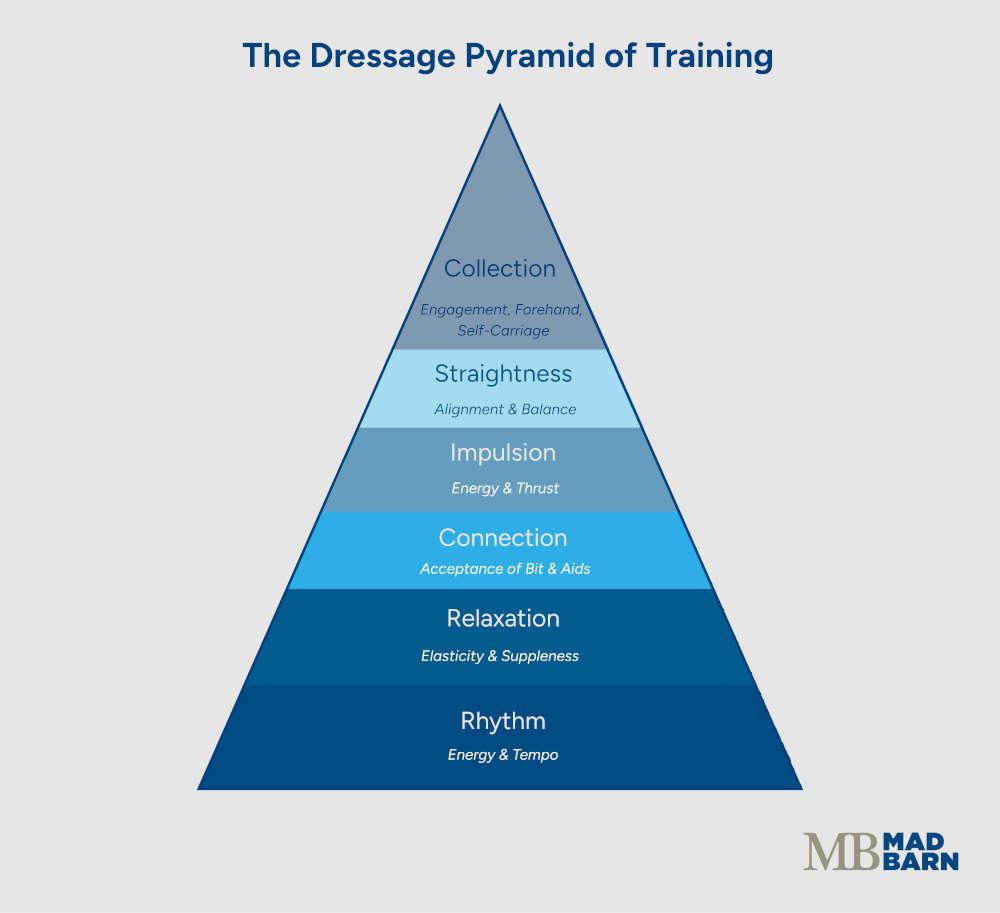
Collection is not simply a shorter frame. True collection involves a shift of weight onto the hindquarters, deeper flexion of the hind joints, and elevation of the forehand, all while the horse stays through and responsive to the aids. [6]
Most horses do not begin serious piaffe and passage development until they are confirmed at Prix St. Georges or Intermediate I, typically at 8 to 12 years of age.
The work done at each lower level involves physical and mental preparation that enables the advanced work. The dressage training scale helps organize this progression, from rhythm and suppleness through collection.
Lateral Work as Physical Preparation
Shoulder-in, travers, renvers, and half-pass develop the suppleness, independent hind limb engagement, and carrying strength that piaffe and passage require.
These exercises teach the horse to step under and carry rather than push from behind. Riders who skip or rush lateral work tend to encounter problems in piaffe and passage that trace directly back to missing preparation.
Common problems include swinging hindquarters, irregular steps, or persistent difficulty loading one hind leg evenly.
Half Halts & Responsiveness
The half halt is the single most important tool for preparing a horse for piaffe and passage. In a half halt, horses must respond immediately to a request to shorten and compress, without bracing, while maintaining energy and rhythm through the back. [8]
Alternating collected and medium trot within a session builds both sensitivity and hindquarter strength. Shortening and lengthening stride in a responsive conversation between horse and rider introduces the correct response to the piaffe and passage aids.
How to Train Piaffe
Piaffe develops slowly, through a process that typically takes months to years before anything resembling a true piaffe appears. Most trainers use a combination of approaches tailored to each horse’s individual strengths.
The Half Step
The half step is the foundation of piaffe. It is a shortened, elevated trot step with clear diagonal footfalls, a quality of spring, and a sense of contained energy.
Half steps are introduced when the horse produces a reliable, rhythmical collected trot and stays genuinely in front of the leg. This movement is often initiated from the walk as a playful way to introduce the idea of piaffe. The rider asks for a dramatic shortening while keeping energy forward.
Rhythm and willingness matter more than elevation at this stage. Keep sessions short and positive, with half steps making up only a small portion of the total work.
In-Hand Work & Long Reining
Many classical dressage trainers introduce piaffe from the ground before asking for it under saddle.
The trainer walks alongside the horse with a long whip, tapping to encourage alternating diagonal leg lifting. The horse gradually learns to match the rhythm of its steps to the trainer’s tap.
Long reining allows the trainer to develop the horse’s self-carriage without a rider’s weight, which is valuable for horses still building the strength required for collection. This approach is foundational at the Spanish Riding School of Vienna and throughout classical dressage traditions.
Some trainers prefer to develop piaffe entirely under saddle. Both approaches have produced excellent results at the highest levels of the sport.
Developing Piaffe Under Saddle
The most common starting point is to collect the trot into half steps progressively: a few collected strides, a few dramatically shortened steps, then forward again. Over many sessions, the steps become shorter, more elevated, and more regular.
A second approach uses a trainer on the ground with a whip while the rider sits quietly. The rider provides stability and soft contact while the trainer provides the rhythm cue. This approach works particularly well for horses that understand the movement more easily when receiving aids from two directions at once.
In piaffe, the leg does most of the work, with a more passive seat and elastic hand. The hand prevents forward movement without creating backward tension. A bouncy or gripping seat disturbs the horse’s balance and tends to produce the flat, earthbound steps trainers work hard to avoid.
Reward each correct step immediately. Confidence matters more than precision in the early stages.
How to Train Passage
Passage develops from a different root than piaffe. Where piaffe grows from compression, passage grows from expression. The horse must already move with natural cadence, swing, and willingness to carry itself before those qualities can be shaped into passage.
Building the Collected Trot
The collected trot that precedes passage is not simply a trot with shorter strides. It is alive, energetic, and carried from behind. The horse swings through the back, responds instantly to half halts, and stays in front of the leg without constant pushing.
Riders develop this by frequently alternating collected and medium trot, using transitions to sharpen the horse’s sensitivity. A horse that drags behind the leg will not have the energy to sustain passage.
Horses with naturally elevated and springy trot movement tend to find passage more accessible. That said, correct progressive training can develop expression across a range of natural abilities.
Introducing Passage Under Saddle
The primary passage aid is the rider’s leg and seat used together, pushing into a steady but elastic rein.
Using half halts, the rider progressively slows and shortens the trot while preserving its swing, until the tempo drops enough and the hindquarters engage sufficiently for passage to emerge.
A single elevated, suspended step is worth rewarding at first. The horse may show a brief moment of passage before falling back into trot, which is a normal part of the process.
The goal in early training is to repeat that moment consistently. As the horse builds strength and understanding, the steps become more regular and the suspension more pronounced.
Training Piaffe-Passage Transitions
The transition between piaffe and passage is scored as a separate movement in Grand Prix, and it is one of the most revealing tests of the quality of the horse’s training. [1]
A correct transition is fluid and immediate. There are no half steps visible in the passage following piaffe, and there is no loss of rhythm, balance, or impulsion in either direction of the transition. The horse moves from contained, in-place energy to forward, elevated suspension without visible effort from the rider, and back again just as smoothly.
Riders train transitions only after both movements are confirmed independently. Short sequences work best at first. As the horse builds strength and understanding, the transitions sharpen and the sequences lengthen.
The most common difficulty is a horse that jumps abruptly from piaffe to passage rather than flowing through. This problem usually signals that the piaffe lacks sufficient energy or that the passage lacks sufficient containment. Refining each movement independently typically helps resolve it.

Common Problems in Piaffe & Passage
Problems in piaffe and passage training indicate that something in the preparation or execution needs attention. Identifying the root cause is always more effective than pushing through resistance.
Common Piaffe Problems
Drifting forward is the most frequent problem. The horse moves ahead rather than working in place. The fix is to confirm and improve the horse’s response to the half halt.
Earthbound steps, where the horse lacks spring, often result from too much restriction in the hand.
Impulsion must be present for the diagonal steps to lift. When the horse hollows or fusses with tension and resistance, it may signal that the demands are too high. Return to easier work and rebuild confidence before increasing the pressure.
Irregular steps, where the diagonal timing breaks down, warrant a careful look. They can come from fatigue, lack of strength, or physical discomfort that makes one limb uncomfortable to load. A veterinary evaluation is appropriate if irregularity persists.
Common Passage Problems
Flat or shuffling steps with no suspension are common early on. In this case, the horse may not yet have the strength or natural expression in trot to produce genuine passage. Return to building more power and expression in the collected and medium trot before asking for passage again.
Tension through the back, where the horse tightens rather than swings, often traces to rider tension, saddle fit concerns, or asking for too much too soon.
More stretching work, frequent transitions, and short sequences rewarded immediately can help the horse relax into the movement.
Table 2. Common piaffe and passage problems and corrections
| Problem | Likely cause | Practical correction | When to pause or seek help |
|---|---|---|---|
| Drifting forward in piaffe |
|
|
|
| Earthbound piaffe steps |
|
|
|
| Irregular piaffe steps |
|
|
|
| Resistance, hollowing, or fussing |
|
|
|
| Flat or shuffling passage |
|
|
|
| Tension through the back in passage |
|
|
|
| Abrupt piaffe-passage transition |
|
|
|
Keeping Your Horse Sound Through Advanced Training
Piaffe and passage place exceptional physical demands on the horse, and those demands accumulate over a long training career.
Research confirms that piaffe produces highly variable ground reaction forces from stride to stride, meaning the horse’s limbs and joints absorb different loads with every step. [3]
Over time, this variable loading may increase wear on the hocks, stifles, and sacroiliac joint. Identifying physical issues early protects the horse’s long-term career. Regular soundness evaluations should be part of routine care for any horse in advanced dressage training.
Core strength is a priority for keeping dressage horses sound. Dysfunction in the deep stabilizing muscles of the back and abdomen is common in horses and limits their ability to perform highly collected movements safely and comfortably. [5]
Dynamic mobilization exercises, carrot stretches, and hill work all support core function alongside regular training and are worth incorporating throughout a horse’s career.
Appropriately structured conditioning programs for dressage horses have been shown to lower cortisol levels and heart rate over time as fitness develops. [9] This suggests that correct progressive training improves fitness while also supporting welfare. Short sessions, gradual progression, and adequate recovery between demanding work days all reflect these findings in practice.
Nutrition plays a direct role as well. A horse in advanced training needs adequate protein for muscle maintenance, sufficient energy for the workload, and micronutrients that support joint, bone, and tissue health. [10] Meeting these demands helps the horse recover faster, build strength more consistently, and sustain the physical requirements of a long career at this level.
If your horse is moving up the levels, they might benefit from a dietary review. Book a free consultation with one of our expert equine nutritionists to get a tailored plan for your dressage horse.
Frequently Asked Questions
Here are some frequently asked questions about training piaffe and passage:
Piaffe is a highly collected trot performed in place or nearly in place, while passage is a slow, elevated trot with clear forward movement and a pronounced moment of suspension. Both movements use diagonal footfalls, but piaffe contains the horse's energy in place and passage channels that energy forward. Piaffe relies primarily on the leg and back, while passage depends more on the seat. The two movements also develop through different training pathways, with piaffe growing from progressive compression and passage growing from expression and elevation in trot.
Piaffe and passage first appear together in FEI competition at Intermediate A level. They continue through Intermediate II, Grand Prix, Grand Prix Special, and Grand Prix Freestyle, where they carry significant scoring weight. At the Grand Prix level, piaffe, passage, and the transitions between them are scored as separate elements. This makes quality, regularity, balance, and confidence in both movements important for competitive success.
Training piaffe and passage usually takes years because both movements depend on a strong foundation in rhythm, suppleness, responsiveness, and collection. Most horses need several years of correct basic and intermediate work before serious piaffe and passage development begins. Once the prerequisites are in place, developing high-quality, confirmed movements may take an additional 1 to 3 years of consistent, progressive training. The timeline depends on the horse's strength, conformation, temperament, natural cadence, soundness, and the quality of the training.
Piaffe is usually trained before passage because the carrying strength developed in piaffe supports the horse's ability to sustain passage. Piaffe teaches the horse to lower the haunches, carry more weight behind, and contain energy without losing rhythm. Passage then builds on that strength by adding more forward expression and suspension. Some naturally expressive horses may offer passage-like steps early, but most still need piaffe and collection work to make the movement balanced and reliable.
A half step is a shortened, elevated trot step with clear diagonal footfalls, spring, and contained energy. It is the foundation of piaffe training and is usually introduced before the horse is asked for anything resembling a full piaffe. In early work, half steps should be ridden for only a few strides at a time and rewarded quickly. Rhythm, willingness, and relaxation are more important than height or precision at this stage.
A horse needs genuine collection, responsive half halts, lateral suppleness, and enough physical strength before starting piaffe and passage. True collection involves a shift of weight onto the hindquarters, deeper flexion of the hind joints, and elevation of the forehand while the horse remains through and responsive to the aids. Exercises such as shoulder-in, travers, renvers, half-pass, and transitions between collected and medium trot help prepare the body for the advanced work. Most horses do not begin serious piaffe and passage development until they are confirmed at Prix St. Georges or Intermediate I.
Many horses can learn some version of piaffe and passage if they have good collection ability, soundness, athletic conformation, and a trainable temperament. Not every horse has the physical suitability, strength, or natural expression for Grand Prix-level work. Correct preparation and a realistic timeline are essential because rushing these movements can create resistance, irregularity, or strain. The goal should be to develop the best quality movement the individual horse can offer comfortably and willingly.
Piaffe and passage are scored on regularity, cadence, balance, self-carriage, activity, impulsion, and the horse's ability to stay relaxed and through. In Grand Prix tests, both movements receive individual marks, and piaffe-passage transitions are also scored separately. Judges look for clear diagonal footfalls, elastic steps, uphill balance, and smooth transitions without visible effort from the rider. Scores range from 0 to 10, with coefficients applied to certain movements depending on the test.
The most common piaffe mistakes include drifting too far forward, stepping backward, losing diagonal rhythm, shuffling, crossing the legs, swinging the hindquarters, and becoming tense or resistant. Earthbound steps often occur when the rider restricts too much with the hand and blocks the impulsion needed for spring. Irregular steps may come from fatigue, lack of strength, or physical discomfort that makes one limb difficult to load. Persistent irregularity should be taken seriously and may warrant veterinary evaluation.
The most common passage mistakes are flat, shuffling steps with little suspension, tension through the back, loss of rhythm, and lack of forward energy. A horse that cannot produce expressive collected trot is unlikely to sustain true passage. Tension may come from rider stiffness, saddle fit concerns, or asking for too much before the horse is ready. Returning to transitions, stretching work, and short rewarded sequences can help restore swing, relaxation, and confidence.
Riders train piaffe-passage transitions only after both movements are confirmed independently. A correct transition should feel fluid and immediate, with no loss of rhythm, balance, impulsion, or self-carriage in either direction. Short sequences are best at first, allowing the horse to move from contained in-place energy to forward suspension and back again without stress. If the horse jumps abruptly from piaffe to passage, the piaffe may need more energy or the passage may need more containment.
Piaffe can be trained from the ground through in-hand work or long reining, and many classical dressage trainers use this approach before asking for piaffe under saddle. In-hand work allows the trainer to encourage alternating diagonal steps with precise timing and without the weight of a rider. Long reining can also help develop self-carriage while the horse builds strength for collection. Some trainers develop piaffe entirely under saddle, and both approaches can be successful when used correctly.
Rushing piaffe and passage training is risky because both movements place high demands on the hindquarters, core musculature, back, and limb joints. A horse that lacks strength or understanding may resist, stiffen, lose rhythm, or develop evasions. Extended repetitions can compound fatigue quickly, especially in piaffe, where the horse must make constant balance adjustments. Short sessions, gradual progression, and adequate recovery help protect soundness and confidence.
Riders can help keep a horse sound in piaffe and passage training by using short sessions, gradual progression, regular recovery days, and routine soundness evaluations. Core strength is especially important because deep stabilizing muscles of the back and abdomen support highly collected work. Dynamic mobilization exercises, carrot stretches, hill work, and well-structured conditioning can all support the horse's body alongside dressage training. Nutrition also matters, since horses in advanced work need adequate protein, energy, and micronutrients for muscle maintenance, tissue health, and recovery.
Training piaffe and passage without an experienced trainer is not recommended for most riders. These movements require precise timing, feel, and progression, and small errors can create tension, irregularity, or resistance that is difficult to correct later. A knowledgeable trainer can help identify whether the horse is physically ready, adjust the aids, and keep the work short and productive. Professional guidance is especially important if the horse shows persistent irregularity, stress, or discomfort during the work.
Summary
Piaffe and passage are advanced dressage movements that require years of systematic training, physical strength, balance, and clear communication between horse and rider. Correct development emphasizes collection, gradual progression, soundness, and short, positive training sessions.
- Piaffe is performed in place or nearly in place, while passage moves forward with elevated suspension
- Both movements require collection, rhythm, impulsion, self-carriage, and relaxed acceptance of the aids
- Piaffe increases hind limb loading and balance demands because the horse works with very little forward motion
- Passage relies on spring-like hind limb action, forelimb support, core strength, and an elastic back
- Horses should develop collection, lateral work, half halts, conditioning, and soundness before serious piaffe or passage training begins
- Irregularity, tension, drifting, or flat steps should be addressed by returning to easier strengthening work or seeking professional support when needed
References
- Dressage Rules. FEI. 2025.
- Clayton. H. M. and Hobbs. S. J. A Review of Biomechanical Gait Classification with Reference to Collected Trot, Passage and Piaffe in Dressage Horses. Animals. 2019. View Summary
- Clayton. H. M. and Hobbs. S. J. Ground Reaction Forces of Dressage Horses Performing the Piaffe. Animals. 2021.
- Clayton. H. M. and Hobbs. S. J. An Exploration of Strategies Used by Dressage Horses to Control Moments Around the Center of Mass When Performing Passage. PeerJ. 2017.
- Clayton. H. M. Core Training and Rehabilitation in Horses. Veterinary Clinics of North America: Equine Practice. 2016. View Summary
- Podhajsky. A. The Complete Training of Horse and Rider. Knopf Doubleday Publishing Group. 2013.
- Clayton. H. M. et al. Ground Reaction Forces of Elite Dressage Horses in Collected Trot and Passage. The Veterinary Journal. 2017. View Summary
- McGreevy. P. D. et al. Equitation Science. Wiley-Blackwell. 2018.
- Coelho. C. S. et al. Training Effects on the Stress Predictors for Young Lusitano Horses Used in Dressage. Animals. 2022. View Summary
- Nutrient Requirements of Horses. National Academies Press. 2007.