English

The leg yield is a foundational lateral movement in dressage.
To perform this movement, the horse travels forward and sideways at the same time. The body stays nearly straight, with a slight flexion at the poll away from the direction of travel, while the inside legs cross in front of the outside legs.
Learning how to leg yield helps riders refine their communication with the horse. When ridden correctly, the exercise also builds suppleness, addresses crookedness, and lays the groundwork for every lateral exercise that follows.
Keep reading to learn how to ride a leg yield, when to incorporate leg yields into your training, and why this exercise is important for progressing in dressage.
What Is a Leg Yield?
The leg yield is a two-track lateral movement in which the horse travels forward and sideways simultaneously.
When performing a leg yield, the horse’s inside legs cross in front of the outside legs while the body remains nearly straight.
The only bend in the movement is a slight flexion at the poll, directed away from the direction of travel. The forehand should lead the haunches slightly throughout.
Leg yielding may seem simple, but it can be challenging to ride well. The exercise asks the horse to respond to a unilateral leg aid while maintaining rhythm and forward impulsion, without excessive bending through the body.
What's your top priority with your horse's health?

What's your top priority with your horse's health?
Bend & Body Position
The USEF Dressage rulebook defines the leg yield as a movement in which the horse is nearly straight, with just enough poll flexion that the rider can see the inside eyebrow and nostril, while the inside legs pass and cross in front of the outside legs. [1]
On a diagonal, the horse’s body should stay as close to parallel with the long sides of the arena as possible, with the shoulders fractionally ahead of the haunches.
In competition, riders perform a leg yield to move laterally from the centerline to the long side, or from the long side to the centerline, while traveling forward toward the short side of the arena.
When used as a training exercise, the angle of travel during the leg yield can vary depending on the horse’s experience and the rider’s training goals.
Where the Leg Yield Fits in the Training Scale
Riders typically introduce leg yields after rhythm and basic contact are established. Leg yielding helps develop suppleness and straightness, two elements of the dressage training scale that are essential to developing the collection needed for advanced work. [5]
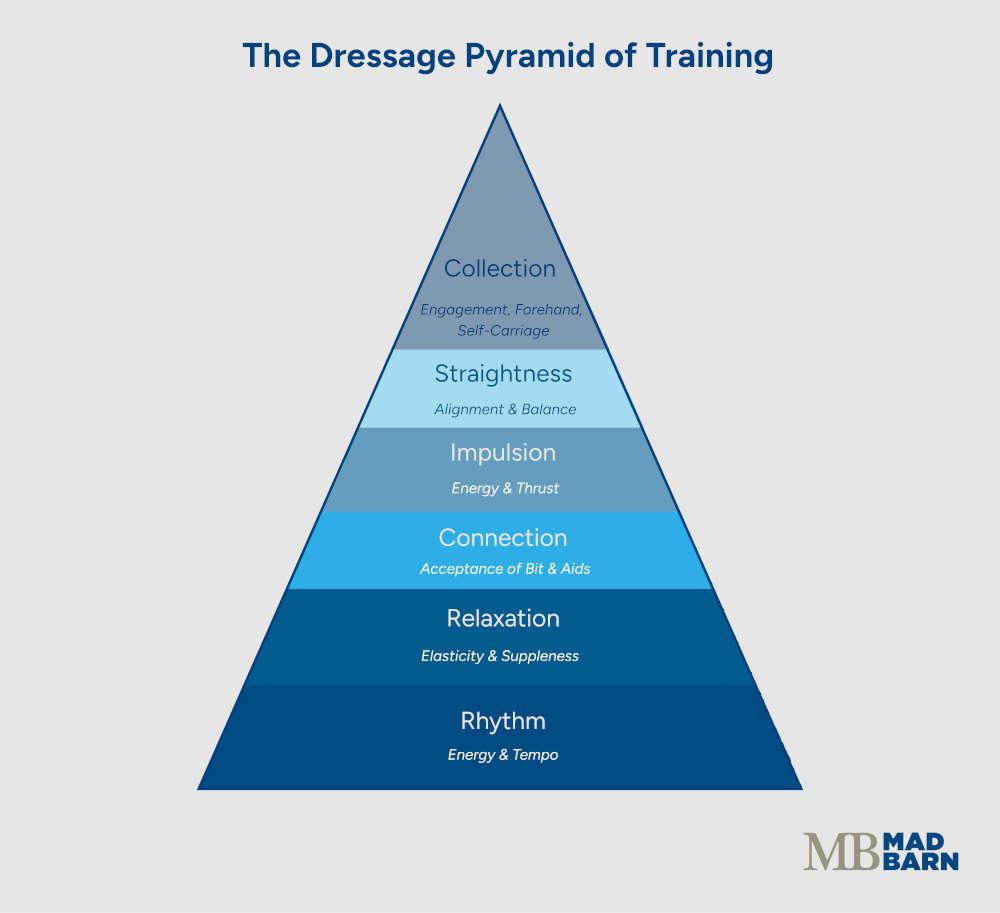
The leg yield is not an advanced collected movement. However, lateral movements that require the horse to bring the hind legs underneath the body help introduce the engagement required for collection.
The US Dressage Federation (USDF) describes the leg yield, alongside the shoulder-in, as one of the best tools for making a horse supple, loose, and unconstrained. The responsiveness and body awareness this movement develops carry into every lateral exercise that comes after it. [2]
Leg Yield vs. Half-Pass
Riders new to lateral work often confuse the leg yield and the half-pass because both movements travel forward and sideways on a diagonal.
The key difference is the direction of the bend. In a leg yield, the horse stays straight through the body with slight flexion away from the direction of travel. In a half-pass, the horse bends through the entire body toward the direction of travel.
That difference in bend changes the muscular demands considerably. The half-pass requires greater engagement, balance, and collection. Training leg yields helps establish the rideability needed to make the half-pass achievable.
Benefits of the Leg Yield
The leg yield develops suppleness, addresses natural crookedness, and teaches the horse to respond reliably to a lateral leg aid, all without requiring collection. Trainers often use it as a warm-up tool, a correction, and a bridge to more advanced lateral work.
Suppleness & Lateral Flexibility
Each step of the leg yield asks the horse to increase suppleness and flexibility as the inside legs pass in front of the outside legs.
Research on equine spinal kinematics has shown that lateral movement of the back and neck increases measurably when horses work on curved and lateral tracks compared to straight-line locomotion. [4]
The leg yield creates a similar demand, asking the horse to shift weight and step across with each stride. The USDF describes this as a loosening effect produced by repeated crossing of the legs and a slight lowering of the inside hip with each stride. [2]
This effect is why the leg yield can work especially well early in a schooling session, before the musculature is fully warmed up. As a warm-up exercise, it helps horses loosen their bodies and prepare for more demanding movements.
Developing Straightness
Most horses carry their haunches slightly to one side, which means the inside hind leg does not track directly onto the path left by the inside foreleg.
The leg yield addresses this crookedness by asking the horse to move the haunches in response to the rider’s leg while the outside rein controls the shoulder.
Ridden correctly, the leg yield teaches the horse to travel on two parallel tracks, with the hind hooves following the path of the front hooves. That alignment is the prerequisite for the straightness necessary to progress up the levels. [5]
Working on straightness also directly supports the development of impulsion and collection further up the training scale.
Engagement & Responsiveness
Each crossing step encourages the inside hind leg to step under and across, activating the muscles that control lateral limb movement and encouraging the inside hip to lower slightly. This engagement builds the body awareness and mobility that collection eventually depends on.
Research on rider biomechanics has confirmed that the rider’s position and weight placement produce measurable mechanical effects on the horse’s movement. [3]
Sitting correctly in the leg yield, with weight on the inside seat bone and a stable upper body, helps the horse achieve better engagement. Leaning or collapsing to the inside makes the same movement harder, regardless of what the leg is doing.
Lateral aids also improve responsiveness. A horse that understands a lateral leg aid is easier to steer, straighten, and position. Without this understanding, riders often struggle to develop the subtle aids necessary to maintain balance in every movement.
Prerequisites for Training Leg Yields
The leg yield requires preparation. Horses with a good understanding of the basic prerequisite concepts move through the exercise with clarity and rhythm. Those who do not may become tense or confused, making the movement harder to ride and correct.
Forward & Straight on the Aids
Before introducing the leg yield, the horse should respond reliably to a forward-driving leg.
A horse that does not go forward willingly from the leg while traveling straight will not yield sideways from it either. Establishing rhythm, tempo, and basic responsiveness first makes the exercise much simpler to teach. [5]
The horse also needs to accept a steady, consistent contact on the outside rein. That rein controls the shoulder in the leg yield and prevents the neck from overbending. Without it, the movement loses its alignment and shape.
Turn on the Forehand as Foundation
Many trainers introduce the turn on the forehand before the leg yield.
In this exercise, the horse steps the haunches around the inside foreleg in response to the rider’s inside leg, typically from a halt or near halt. There is no forward movement, but the horse learns to step away from a single leg. [2]
Once that lesson is established, the rider can add forward movement to create a leg yield. The same pressure that moved the haunches in the turn on the forehand now asks the horse to step sideways while continuing forward.
How to Ride a Leg Yield
The mechanics of the leg yield stay consistent across gaits and patterns. A well-ridden leg yield connects the inside leg and outside rein, with the horse moving fluidly and without resistance.
The Rider’s Position & Aids
All of the rider’s aids must work together to ask for a leg yield clearly. Even a small asymmetry in the rider’s position can prevent the horse from performing the movement correctly, regardless of how clear the leg aid is.
The seat shifts slightly to the inside seat bone, signaling the direction of travel. The shoulders stay square with the horse’s shoulders throughout. Leaning toward the direction of travel works against the horse by shifting weight away from the seat bone that should help signal the movement.
The inside leg sits at or just behind the girth. A rhythmic aid, timed with the moment the inside hind leg leaves the ground, asks the horse to step sideways. Sustained pressure tends to dull the response; asking and releasing creates a clearer signal.
The outside leg rests slightly behind the girth. Its role is mostly passive, helping prevent the haunches from swinging too far out. When the haunches begin to lead, the outside leg helps regulate the angle.
The inside rein asks for just enough flexion to see the inside eye and nostril, nothing more. It does not drive the movement and should never pull the horse crooked.
The outside rein is the most important rein in the leg yield. It controls the shoulder, maintains neck alignment, and regulates tempo. A firm half-halt on the outside rein resolves many problems that arise during the movement, from rushing to falling through the shoulder. [3]
For riders still refining their hand position and rein function, understanding how reins work as riding aids can make the outside-rein role easier to apply consistently.
Leg Yield Patterns & Strategies
Leg yields can be ridden on several lines depending on the horse’s stage of training and the rider’s goals.
Simple patterns, such as yielding from the quarter line to the track, help introduce the basic response to the leg. More advanced patterns, such as diagonal lines, zigzags, and canter leg yields, develop adjustability, straightness, and the inside-leg-to-outside-rein connection.
The best pattern is one that allows the horse to stay forward, rhythmic, and nearly straight while stepping sideways. If the horse loses impulsion, rushes, overbends, or leads with the haunches, return to a shallower angle or ask for fewer steps before riding forward again.
Introducing Leg Yields
Introduce leg yields at the walk on a shallow angle. Turn onto the quarter line, establish a steady rhythm, and apply the inside leg to ask the horse to move back toward the long side. Keep the outside rein supportive.
Ask for only a few steps at first. Straighten, ride forward, praise, and ask again. Short repetitions with a clear release help teach the correct response. The wall provides a natural boundary and gives the horse a clear destination.
In USEF First Level Test 2, the leg yield is ridden at the trot after turning down the centerline at A, traveling diagonally from L to the track at M or H, with the horse’s body staying close to parallel with the short side of the arena. [6]
Practicing this pattern frequently in training, particularly in both directions, develops the symmetry and adjustability the test requires. Riders who are still learning arena patterns may also benefit from reviewing dressage letters and how movements are placed in the arena.

Leg Yield on the Diagonal
Once the horse is comfortable from the quarter line and centerline, ride the leg yield across the full diagonal. As the angle increases, the crossing becomes more pronounced, and the demands on straightness rise.
Keep the forehand slightly ahead of the haunches throughout. If the haunches begin to trail or lead, reduce the angle and re-establish the correct alignment before asking for more sideways movement.
Trot & Canter Leg Yields
In trot, the timing of the inside leg matters more. An aid applied as the inside hind leg leaves the ground tends to produce a clearer, lighter lateral response. Poorly timed aids can create tension or confusion, and the horse may either ignore them or increase forward speed instead.
The USDF describes the leg yield as formally performed in walk and trot within classical dressage training. Canter leg yield is a separate gymnastic exercise used widely at all levels. [2]
Yielding away from the inside leg engages the inside hind while driving the horse into the outside rein, which helps improve all gaits. Trainers often describe the canter leg yield as central to developing the inside-leg-to-outside-rein connection necessary for collected canter. [7]
Table 1. Common leg yield mistakes and how to fix them
| Problem | Likely cause | Correction |
|---|---|---|
| Haunches leading |
|
|
| Haunches trailing |
|
|
| Loss of impulsion |
|
|
| Rushing |
|
|
| Overbending the neck |
|
|
| Rider collapsing to the inside |
|
|
Common Mistakes When Riding a Leg Yield
Most problems in the leg yield trace back to the rider’s position or timing. Identifying the actual cause, rather than simply pushing harder, is how to get the movement back on track.
Haunches Leading or Trailing
Haunches leading or trailing are among the most common faults. The horse’s hindquarters may arrive ahead of the shoulders, or the hindquarters may trail behind as the shoulder falls out and the horse becomes crooked. In either case, the horse is no longer aligned or crossing correctly.
The cause is usually an inside leg placed too far back, an aid applied too strongly or continuously, or an ineffective outside rein.
To regain straightness and alignment, focus on using your outside aids to regulate the shoulder and hindquarters. Open the outside rein to invite the shoulder across, or half-halt to prevent the outside shoulder from falling out. [10]
Loss of Impulsion or Rushing
Some horses stall in the leg yield, while others quicken and lose the rhythm. Both reactions can indicate tension or confusion.
When the horse slows, keep both legs active to maintain forward momentum, push toward the outside rein, and use half-halts to balance without restricting the stride.
When the horse rushes, apply a firm half-halt on the outside rein, ride a small circle to rebalance, then return to the leg yield with a steadier pace. [8]
Overbending the Neck
When the horse does not respond to the leg, many riders reach for the inside rein. The result is a neck that bends inward while the horse loses connection on the outside rein and drifts sideways with no real crossing. The movement falls apart.
Rein aids frame the shoulders. They do not create the sideways movement. If the horse is not yielding to the leg, the fix is a clearer or better-timed leg aid, not a stronger inside rein. [11]
Rider Collapsing to the Inside
When the horse does not move sideways, many riders instinctively lean toward the direction of travel. Leaning collapses the inside hip, shifts weight away from the inside seat bone, and makes it harder for the horse to read the weight aid correctly.
Research on rider biomechanics has confirmed that position asymmetry produces measurable mechanical effects on how the horse carries itself and distributes load. [3]
Sitting tall and keeping the shoulders level allows the horse to respond to a clear, consistent signal. When the horse is stuck, the solution is usually a more deliberate leg aid rather than a contorted upper body.
For riders working on their own alignment, a consistent horseback riding posture can make the aids easier for the horse to understand.

Leg Yield Training Exercises
Incorporating leg yielding into gymnastic exercises helps develop the feel, timing, and adjustability that make the leg yield a useful training tool rather than a movement ridden only for tests.
Leg Yield to Circle
Ride a few steps of leg yield from the quarter line, then transition into a 10-meter circle before completing the movement to the track.
The circle resets rhythm and balance, and it is particularly useful for horses that rush or lose the outside shoulder during the exercise. Leg yielding after the circle gives the rider a clear read on whether the tempo and suppleness have improved.
Zigzag Leg Yield
Ride the leg yield toward the track, then change direction and leg yield back toward the centerline. The directional change asks for a prompt response to the new inside leg and develops the adjustability that advanced work requires.
This pattern is also the direct precursor to the zigzag half-pass ridden in FEI tests. It can also help riders develop the same control of line, balance, and response that supports broader stride adjustability in performance horses.
Canter Leg Yield for Suppleness
In canter, ride the leg yield away from the inside leg while maintaining the bend in the direction of the canter lead. Each stride should fill the outside rein.
The exercise builds the inside-leg-to-outside-rein connection and teaches the horse to carry the shoulders independently of the haunches. [7]
Table 2. Leg yield exercises by training goal
| Exercise | Best for | How to ride it | Watch for |
|---|---|---|---|
| Quarter-line to track |
|
|
|
| Centerline or diagonal leg yield |
|
|
|
| Leg yield to circle |
|
|
|
| Zigzag leg yield |
|
|
|
| Canter leg yield |
|
|
|
Building a Better Leg Yield
The leg yield is one of the most useful early lateral exercises in dressage because it teaches the horse to move away from the rider’s leg while staying forward, rhythmic, and connected. Although the movement is introduced before more advanced lateral work, it’s an important skill to maintain through all levels of training.
The quality of the movement depends more on clarity than force. The rider’s inside leg asks the horse to step sideways, but the outside rein, balanced seat, steady upper body, and forward intention all shape the final result. When these aids work together, the horse can cross the legs without rushing, overbending, or losing alignment.
For horses that struggle with crookedness, tension, or dullness to the leg, the leg yield can be an especially helpful diagnostic tool. Problems such as haunches leading, loss of impulsion, or overbending often reveal where the communication between horse and rider needs to become more precise. Short, balanced repetitions are usually more productive than pushing for a long or steep line before the horse is ready.
Used thoughtfully, the leg yield becomes more than a test movement. It is a practical schooling exercise that prepares the horse for shoulder-in, half-pass, collection, and better balance in every gait. By returning to the basics of rhythm, straightness, and inside leg to outside rein, riders can use the leg yield to build a more supple, rideable, and confident horse.
Frequently Asked Questions
Here are some frequently asked questions about riding a leg yield in dressage:
A leg yield in dressage is a two-track lateral movement where the horse travels forward and sideways at the same time. The horse's body stays nearly straight, with only slight flexion at the poll away from the direction of travel. The inside legs cross in front of the outside legs, and the forehand should stay slightly ahead of the haunches.
The leg yield is important in dressage training because it helps develop suppleness, straightness, responsiveness, and the inside-leg-to-outside-rein connection. It teaches the horse to move away from a unilateral leg aid while maintaining rhythm and contact. These skills make the horse easier to steer, straighten, and prepare for more advanced lateral work.
The leg yield first appears in USDF First Level dressage tests. In First Level Test 2, the horse turns down the centerline at A and leg yields from L to the track. In First Level Test 3, the leg yield is ridden from the track to I, and both tests discussed here are valid through November 2026.
To ask a horse to leg yield, sit slightly more on the inside seatbone, keep your shoulders square, and use the inside leg at or just behind the girth to ask the horse to step sideways. The outside rein controls the shoulder, tempo, and alignment, while the outside leg helps prevent the haunches from swinging too far out. The inside rein should only create slight flexion and should not pull the horse sideways.
The correct bend in a leg yield is not a true body bend, but a slight poll flexion away from the direction of travel. The rider should be able to see the inside eye and nostril without pulling the neck inward. If the horse bends through the whole body, overbends the neck, or loses the outside rein, the movement is no longer a correct leg yield.
The difference between a leg yield and a half-pass is the direction and degree of bend. In a leg yield, the horse stays nearly straight with slight flexion away from the direction of travel. In a half-pass, the horse bends through the body toward the direction of travel and needs more engagement, balance, and collection.
A beginner should introduce the leg yield at the walk on a shallow angle, usually from the quarter line back toward the track. Ask for only a few correct steps, then straighten the horse, ride forward, and reward the response. Short repetitions help the horse understand the sideways aid without losing rhythm, balance, or confidence.
Before learning leg yield, a horse should move forward willingly from the leg, maintain a steady rhythm, and accept basic contact on the outside rein. The horse should also understand how to step away from a single leg aid. Turn on the forehand is a useful foundation because it teaches the horse to move the haunches away from the rider's leg before adding forward motion.
The angle in a leg yield should be shallow enough that the horse can keep moving forward, stay nearly parallel to the long side of the arena, and clearly cross the inside legs in front of the outside legs. In training, the angle can vary depending on the horse's experience and the rider's goal. If the horse loses rhythm, straightness, or crossing, reduce the angle and re-establish the correct alignment.
To stop the haunches from leading in the leg yield, reduce the sideways angle and use the outside rein and outside leg to bring the horse back into alignment. Haunches leading often happens when the inside leg is too far back, too strong, or applied continuously instead of rhythmically. Re-establish the forehand slightly ahead of the haunches before asking for more sideways movement.
A horse may lose impulsion in the leg yield because the lateral aid is unclear, the rider blocks forward movement with too much rein, or the horse becomes tense or confused. Keep both legs active enough to maintain forward energy, and ride the horse into a steady outside rein. Half-halts should rebalance the movement without restricting the stride.
A horse may rush through the leg yield when it loses balance, falls through the outside shoulder, or reacts to the leg by quickening instead of stepping across. Use a firm half-halt on the outside rein, rebalance on a small circle if needed, and return to the leg yield with a steadier tempo. The goal is not more sideways movement, but a controlled forward-and-sideways line with rhythm intact.
A leg yield can be ridden in canter as a gymnastic training exercise, even though classical leg yield is formally performed in walk and trot. In canter leg yield, the rider maintains the bend in the direction of the canter lead while asking the horse to move away from the inside leg. This exercise helps develop suppleness, balance, and a stronger inside-leg-to-outside-rein connection.
A leg yield is not the same as a sidepass because a leg yield includes both forward and sideways movement. In a sidepass, the horse moves sideways with little or no forward travel. Sidepass is more common in Western disciplines, while leg yield is a foundational lateral movement in dressage.
The leg yield is scored on the quality of the gait, alignment, crossing, straightness, rhythm, and the rider's position and aids. Judges want to see the horse move forward and sideways while staying nearly straight, with the forehand slightly leading the haunches. In First Level Tests 2 and 3, the leg yield carries a coefficient of 2, making it worth double the standard points.
Exercises that help improve the leg yield include turn on the forehand, quarter-line leg yields, leg yield to a 10-meter circle, zigzag leg yields, and canter leg yields. Turn on the forehand teaches the horse to move away from a single leg, while short quarter-line leg yields introduce forward and sideways movement. More advanced patterns help improve balance, adjustability, straightness, and the horse's response to changing aids.
Summary
The leg yield is an early lateral dressage exercise that teaches the horse to move forward and sideways from the rider's leg while staying rhythmic, nearly straight, and connected. When ridden correctly, it improves suppleness, straightness, responsiveness, and preparation for more advanced lateral work.
- A correct leg yield requires the horse to move forward and sideways with slight flexion away from the direction of travel
- The rider's inside leg asks for sideways movement while the outside rein controls the shoulder and tempo
- Leg yields help improve suppleness, correct crookedness, and strengthen the horse's response to lateral aids
- Common mistakes include haunches leading or trailing, loss of impulsion, rushing, overbending, and rider collapse
- Useful exercises include quarter-line leg yields, diagonal leg yields, leg yield to circle, zigzag leg yields, and canter leg yields
References
- USEF Dressage Division Rules, Chapter DR. USEF. 2026.
- Lesson Topic: Leg-Yielding. USDF.
- Clayton. H. M. et al. Riders' Effects on Horses—Biomechanical Principles with Examples from the Literature. Animals. 2023.
- Byström. A. et al. Differences in Equine Spinal Kinematics between Straight Line and Circle in Trot. Scientific Reports. 2021.
- Scales of Training. British Dressage. 2021.
- Foxley. C. How to Ride First Level Leg Yields. Dressage Today. 2024.
- King. A. The Canter Leg Yield for a Supple, Straight Horse. Horse Sport. 2026.
- Clark. A. Dressage Coach Explains the Correct Aids for Riding Leg Yield. Your Horse. 2026.