English

The half pass is a fundamental dressage movement that clearly reveals the quality of a horse’s training.
In a half pass, the horse travels forward and sideways on a diagonal line, bent in the direction of travel. The forehand leads slightly, with all four hooves on separate tracks and both pairs of legs crossing.
Ride it well, and it flows. Ride it with gaps in the foundation, and every one of those gaps shows.
The half pass is also one of the most effective gymnastic tools in a training program. It strengthens the horse on both sides, develops the carrying power of the hindquarters, and sharpens communication between horse and rider. Ridden correctly and built progressively, it can raise the quality of every gait.
Keep reading to learn what the half pass is, why it matters, what your horse needs before you begin, how to apply the aids, how to train the movement step by step, common mistakes, and what judges evaluate in competition.
What Is the Half Pass?
The half pass is a two-track lateral movement performed on a diagonal line.
The horse moves forward and sideways at the same time, with the body bent in the direction of travel. The forehand leads slightly, meaning the shoulders arrive on the new track just ahead of the hindquarters.
All four feet travel on separate tracks, and both pairs of legs cross clearly. The quality of the movement depends on rhythm, bend, angle of travel, and sustained hindquarter engagement.
What's your top priority with your horse's health?

What's your top priority with your horse's health?
Half Pass vs. Leg Yield
Riders often confuse the half pass with the leg yield, but the two movements serve different training goals and place different physical demands on the horse.
In leg yield, the horse stays straight through the body or carries only slight flexion away from the direction of travel. Collection is not required. The half pass asks for collection and a bend through the entire body, from poll to tail, in the direction of travel.
The degree of crossing and hindlimb engagement in a correct half pass is noticeably greater. Leg yield teaches lateral responsiveness, while the half pass develops the carrying power that defines upper-level work. [1]
Table 1. Leg yield vs. half pass
| Feature | Leg Yield | Half pass |
|---|---|---|
| Body position |
|
|
| Line of travel |
|
|
| Collection |
|
|
| Leg crossing |
|
|
| Training purpose |
|
|
| Difficulty level |
|
|
Where the Half Pass Appears in Dressage Tests
The half pass first appears at USDF Third Level, where riders perform it in both trot and canter. A trot zigzag, which connects half passes in alternating directions, is also required at Third Level. [2]
The movement continues through Fourth Level and all FEI levels from Prix St. Georges through Grand Prix. At the upper FEI levels, the canter half pass is connected through flying changes in the zigzag pattern. [2]
The half pass is also an essential building block for canter pirouettes, where the same engagement and collection are required in a dramatically tighter arc. [2]
Why Train the Half Pass?
The half pass earns its place in conditioning programs because of what it does for the horse physically.
Ridden progressively, it can improve strength, balance, and the overall quality of each gait.
Gymnastic Benefits for the Horse
During lateral strides, the horse alternately engages and stretches the gluteus medius muscles with each step. The tensor fascia lata muscle stabilizes forces around the hip, while the pectoral and inner leg muscles pull the leg sideways and stabilize the torso over it. [3]
These are structures that straight-line work rarely loads in the same way. Building their strength can improve the horse’s posture, balance, and carrying ability across all gaits. [3]
Lateral flexibility is also the prerequisite for longitudinal flexibility. A horse that cannot bend laterally will often struggle to come through the back and into self-carriage.
Biomechanics research has clarified what happens in the horse’s body as collection develops. Studies of collected gaits have found that as collection increases, ground reaction forces shift toward the hindlimbs, increasing their relative loading and developing their carrying capacity over time. [4]
Further, research on the thoracolumbar spine of elite dressage horses has documented distinct patterns of spinal rotation and symmetry in horses working in collection with active hindlimb engagement. [5]
The science confirms what generations of classical trainers discovered through practice: building collection progressively through lateral work changes the horse’s body in measurable ways.
Prerequisites for the Half Pass
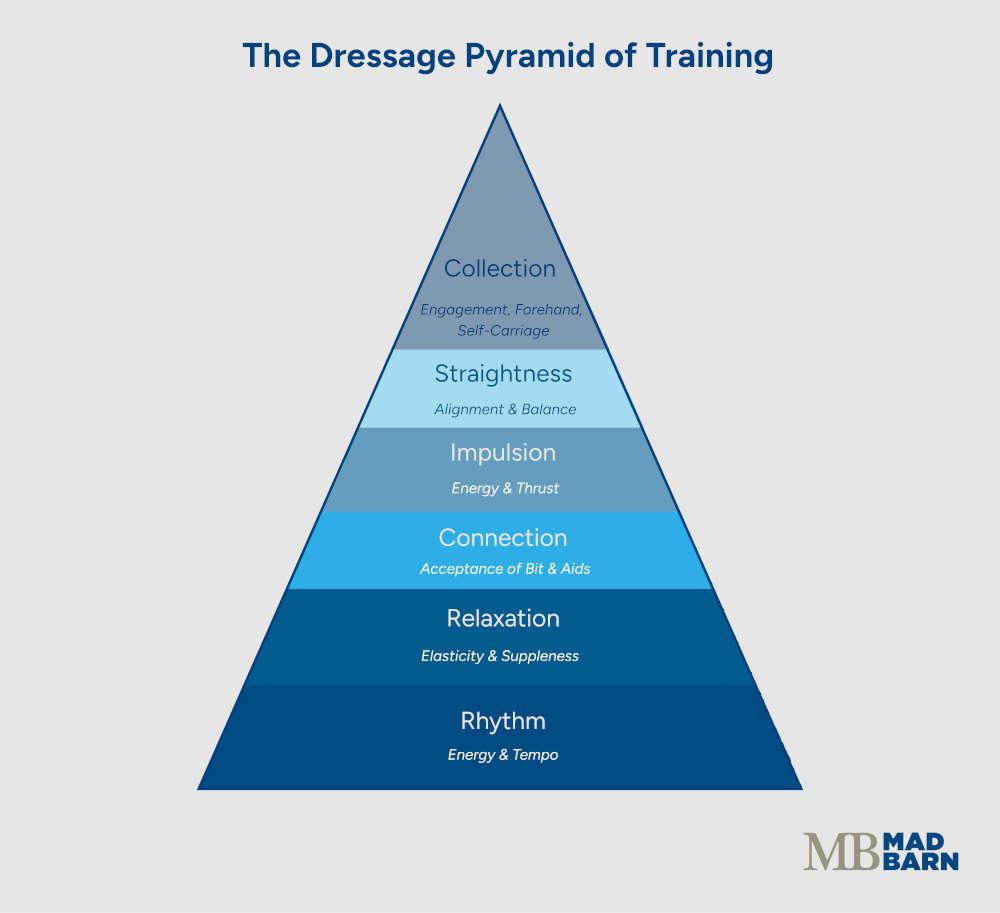
The half pass requires collection, bend, and coordinated lateral movement all at once. The prerequisites are essential physical and mental preparation, not steps to skip.
Foundational Movements to Master First
Three movements form the direct path to the half pass, and each one builds on the last: [1][6]
- Leg yield teaches the horse diagonal aids and the concept of moving forward and sideways at the same time. It does not require or develop collection, but it establishes the lateral responsiveness needed for more advanced movements.
- Shoulder-in is the gateway to collection-based lateral work. Shoulder-in also begins to free the shoulders and build carrying power in the inside hind leg, preparing the horse for the more demanding lateral exercise that follows.
- Travers, also called haunches-in, uses the same aids as the half pass, applied on a straight line parallel to the wall rather than on a diagonal.
Mastering travers is the most direct preparation for a correct half pass. Once the horse understands travers, the rider only needs to guide the movement onto a diagonal line. [7]
The half-halt ties all of this together. A well-timed half-halt rebalances the horse, engages the hindquarters, and sets up the collection needed for the movement. [2]
Horses learn best when training advances in small, confirmed steps, with correct responses recognized promptly. Asking for the full movement before each component is solid creates resistance rather than understanding. [8] This progression aligns with the principles of equine learning theory.
Readiness Checks Before You Begin
Before introducing the half pass, use a simple test. Ride a 10-meter trot circle. If the horse holds a clear rhythm, accepts inside bend throughout the body, and stays round over the topline without tension or resistance, the physical prerequisites are in place.
The horse should also respond promptly and willingly to the outside leg behind the girth. Without that response, the half pass will not work. Go back to travers and build the reaction there first. [7]
The rider needs a secure, independent seat with soft, following hips. Stiffness in the saddle makes it harder for the horse to find balance under this new physical demand.
The Aids for the Half Pass
The aids for the half pass are the same as for travers, applied diagonally. Each aid has a specific job, and when one is missing or misapplied, the whole movement reflects it.
Clear, light rider aids let the horse work in self-carriage rather than in constant reaction to correction.
Rider Position & Weight
Weight the inside seat bone and advance it slightly in the direction of travel. The torso rotates gently toward the inside.
This position invites the horse to step under and across without needing strong leg aids.
Collapsing the inside hip or tipping to the outside makes correct collection nearly impossible. Sit over the center of the horse and let the movement come through. [2]
Leg Aids
The inside leg is the most important aid in the half pass. Applied at the girth, it maintains the bend through the horse’s ribs and sustains the forward impulsion that keeps the movement alive. Without an active, correctly placed inside leg, the movement collapses to the side and loses its gymnastic value. [2]
The outside leg sits behind the girth and asks for the sideways displacement of the hindquarters. It guides the hind legs onto the diagonal line of travel and should produce a willing response without constant pressure.
If the horse needs strong leg pressure to keep moving, go back to travers before reintroducing the half pass. [7]
Rein Aids & Contact
The inside rein indicates the direction of bend. It should remain a direct rein and never cross the withers.
In early training, the inside rein can be used briefly as an open or leading rein to invite the horse onto the diagonal. As training progresses, the inside rein becomes lighter, and the bend is maintained more through the inside leg and outside rein connection. [9]
The outside rein is the regulating rein. It controls the degree of neck bend and prevents the outside shoulder from drifting.
Too much outside rein stiffens the bend, while too little causes the forehand to fall out of position. The aim is a steady, elastic contact that keeps the movement aligned without restricting it. [2]
How to Train the Half Pass
Start with modest angles and short distances. Build quality before increasing the challenge. When impulsion drops or the bend disappears, ride straight and start again rather than pushing through.
Starting in Walk
Walking gives both horse and rider time to think and adjust without the pressure of maintaining trot tempo.
Establish a shoulder-fore position coming out of a corner. Turn onto the diagonal and hold the bend and shoulder alignment from the corner. Use the outside leg behind the girth to ask the hindquarters to follow the forehand across the arena.
Start shallow. Once the walk half pass feels organized and easy, the transition to trot becomes much more manageable. [2]
Building to Collected Trot
When the walk half pass is confirmed, move to trot. Three entry points work well depending on the horse:
- Establish shoulder-fore coming out of a corner, then turn onto the diagonal while holding the bend
- Ride travers on the long side and guide it onto the diagonal
- Begin with leg yield on the diagonal, then gradually add inside bend to develop toward half-pass quality
The third option is especially useful for a horse that evades engagement, as it lets the rider keep the horse moving forward while gradually increasing the gymnastic demand. [7]
Whatever the approach, impulsion is the priority. The moment the horse slows or falls behind the leg, ride forward. A shallow, rhythmic half pass is worth far more than a steep, labored one. The angle can increase as the horse develops strength and confidence. [6]
Progressing to Canter
The canter half pass follows once the trot half pass is reliable and expressive. The collected canter must be established and balanced before adding the lateral demand.
The aids are the same as in trot. The canter half pass is generally ridden with slightly less angle than the trot, giving the horse time within each stride to maintain rhythm and bend without rushing sideways. Building it progressively sets the foundation for the zigzag with flying changes and, eventually, pirouette work. [2]
Common Mistakes When Riding a Half Pass
Most faults in the half pass come from an imbalance in the aids, a gap in preparation, or foundational work that was not solid before the movement was introduced.
Haunches Leading or Trailing
When the hindquarters arrive ahead of the forehand or lag too far behind it, the half pass can look crooked, disconnected, or crab-like. Haunches-leading or trailing half passes rarely score above a 6 because the horse has lost correct alignment and the gymnastic value of the movement along with it. [10]
The fix is in the leg aids. Apply the appropriate leg more actively to restore the bend and return the forehand to position.
Ride a brief shoulder-fore to reset the alignment, then re-enter the half pass from there. If the problem persists, return to travers on the long side and rebalance the inside and outside aids before trying again.
Loss of Impulsion & Rhythm
The horse often slows, gets stuck moving sideways, or loses the quality of the gait when the rider focuses too much on sideways travel and forgets to ride forward. The half pass is a forward-and-sideways movement. Without forward movement, the movement has no gymnastic value. [6]
Reduce the angle and activate the inside leg to restore energy. Ride straight ahead to bring the rhythm back, then re-approach at a shallower angle. As the horse gets stronger and more comfortable with the demand, more angle becomes available without costing the gait.
Too Much Neck Bend Without Body Bend
Horses can tilt their heads or bend their necks without bending their bodies. Neck bend alone creates the look of the movement without the substance. The bend in a correct half pass runs from the poll to the tail. [11]
Use the outside rein to reduce the neck bend. Ride a 10-meter volte to restore whole-body bend before continuing.
Before re-attempting the half pass, confirm the horse is connected between the inside leg and the outside rein. If body bend is consistently absent, go back to shoulder-in and establish the bend there first.
Rider Position Faults
Collapsing the inside hip, tipping to the outside, and pulling on the inside rein are all common and disruptive. Each one makes it harder for the horse to balance, bend, and move freely sideways.
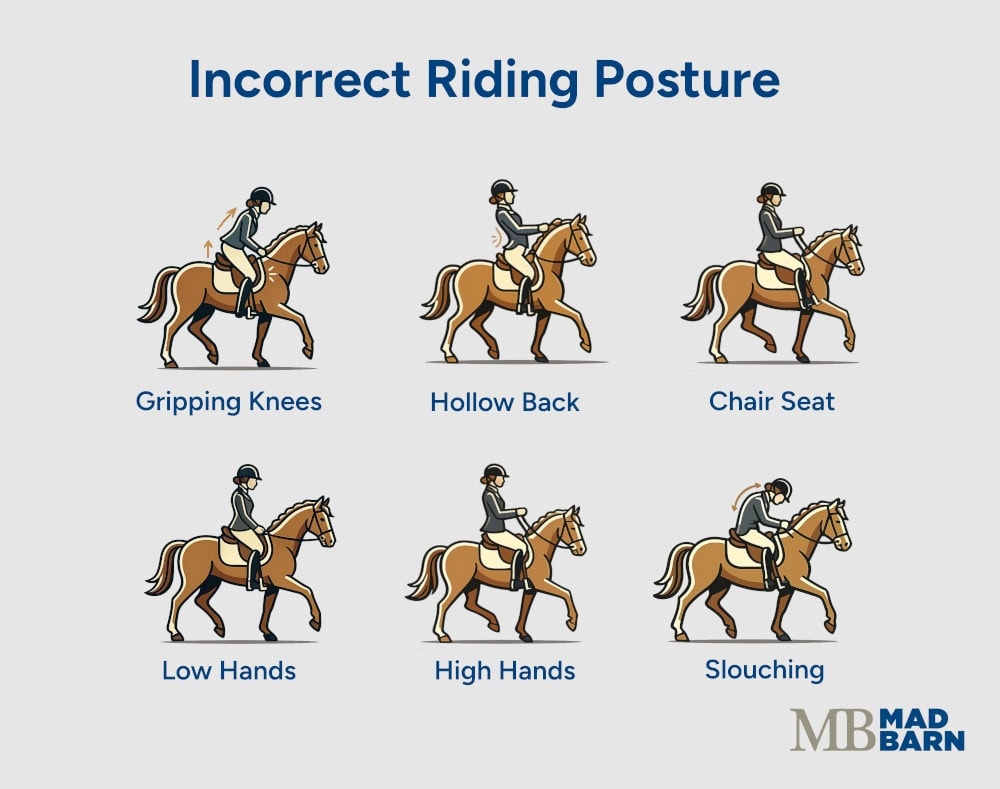
Riders often cannot feel these habits from the saddle, which makes them among the hardest position faults to self-correct. [11]
Weight and advance the inside seat bone deliberately. Open the inside shoulder without twisting the torso. Lighten the inside rein and guide with the outside rein instead.
A trainer’s eye on the ground or regular video review can catch position faults that feel alone cannot. Rider position also affects the horse’s comfort, balance, and ability to perform correctly under saddle.
Table 2. Common half pass problems and corrections
| Problem | What it looks like | Likely cause | Correction |
|---|---|---|---|
| Haunches leading |
|
|
|
| Haunches trailing |
|
|
|
| Loss of impulsion |
|
|
|
| Too much neck bend |
|
|
|
| Loss of rhythm |
|
|
|
| Rider tipping or collapsing |
|
|
|
| Pulling on the inside rein |
|
|
|
The Half Pass in Competition
Judges watch the half pass for consistency from the moment it begins to the moment it ends. Knowing what earns high marks shapes smarter training long before competition day arrives.
What Judges Look For
The forehand must lead or be level with the hindquarters throughout the movement. The horse must show a clear bend throughout the body, not just the neck. Rhythm and impulsion must hold from the first step to the last. [10]
A half pass with a strong bend but no cadence will not score above 6.5. One with correct positioning and sustained cadence can earn a 7 or above, even if the bend is not perfect. [10]
Accuracy matters too. The half pass should start from the correct position, travel on a clean diagonal, and finish at the intended marker. Arriving early, starting with the haunches rather than the shoulders, and losing organization at the finish are all reflected in the score. [2]
The Counter-Change of Hand (Zigzag)
The zigzag connects half passes in alternating directions. In trot, each direction change rides through a moment of straightness and a new bend.
In canter, a flying change connects the directions. The trot zigzag first appears at Third Level. A counter-change of hand in canter with one flying change introduces the foundation for the more demanding multi-directional canter zigzag required at the FEI levels.
Organized preparation before each direction change, accurate arrival at the centerline, and a clean shift of bend separate a well-executed zigzag from a rushed one. The number of strides in each direction must be precise and equal throughout. [2]

Building a Better Half Pass
The half pass is a revealing movement because it cannot be separated from the quality of the horse’s basic training. When the rhythm, bend, contact, impulsion, and balance are in place, the movement feels fluent and gymnastic. When one of those pieces is missing, the half pass quickly exposes it.
For most horses, the best half pass develops gradually from clear, confirmed basics. Skipping these steps often creates tension, crookedness, or a loss of forward energy.
Correct riding matters as much as correct preparation. The inside leg keeps the horse bent and forward, the outside leg guides the hindquarters, the outside rein regulates the shoulders, and the rider’s seat quietly directs the line of travel. The goal is not to push the horse sideways, but to organize the body so the horse can step forward, across, and under with confidence.
Whether practiced at home or ridden in a test, the half pass should always serve the horse’s long-term development. When approached with patience and attention to quality, it becomes more than a competition requirement. It becomes a powerful tool for improving collection, straightness, responsiveness, and the overall harmony between horse and rider.
Frequently Asked Questions
Here are some frequently asked questions about riding the half pass:
A half pass in dressage is a two-track lateral movement where the horse travels forward and sideways on a diagonal line. The horse is bent in the direction of travel, with the forehand leading slightly and all four feet moving on separate tracks. A correct half pass shows rhythm, bend, crossing of both pairs of legs, and sustained engagement from the hindquarters.
The difference between half pass and leg yield is mainly the bend, collection, and purpose of the movement. In leg yield, the horse stays mostly straight through the body or has slight flexion away from the direction of travel, and collection is not required. In half pass, the horse bends through the whole body in the direction of travel and works with greater hindlimb engagement. Leg yield teaches lateral responsiveness, while half pass develops the carrying power needed for more advanced dressage work. [7]
A horse should start learning half pass only after the prerequisites for collection, bend, and lateral responsiveness are confirmed. The horse should be comfortable with leg yield, shoulder-in, travers, and half-halts before the full movement is introduced. A useful readiness check is whether the horse can maintain rhythm, bend, and roundness on a 10-meter trot circle without tension or resistance. If the horse does not respond promptly to the outside leg behind the girth, return to travers before asking for half pass.
The movements that prepare a horse for half pass are leg yield, shoulder-in, travers, and the half-halt. Leg yield teaches the horse to move forward and sideways from diagonal aids, while shoulder-in begins to develop collection and inside hind engagement. Travers uses the same basic aids as half pass, but on a straight line instead of a diagonal. The half-halt helps rebalance the horse and prepare the hindquarters for the collected effort required in half pass. [6][7][8][9]
To ask for half pass, ride forward onto a diagonal line while maintaining bend in the direction of travel. The inside leg stays at the girth to maintain bend and impulsion, while the outside leg sits behind the girth to guide the hindquarters sideways. The inside rein indicates the bend, and the outside rein regulates the shoulder, neck bend, and line of travel. The rider should sit centered, weight the inside seat bone, and avoid tipping or pulling the horse across the arena.
The inside leg is the most important leg aid in half pass because it maintains the bend, supports impulsion, and keeps the horse moving forward through the body. Without an active inside leg at the girth, the horse may drift sideways, lose engagement, or bend only through the neck. The outside leg behind the girth is also essential because it asks the hindquarters to follow the forehand onto the diagonal line. Both legs must work together, but the inside leg keeps the movement gymnastic rather than simply sideways. [6][8]
Half pass is usually best introduced in walk first because the slower gait gives the horse and rider time to organize the bend, alignment, and aids. Starting in walk also helps prevent the horse from rushing, falling sideways, or losing balance while learning the idea. Once the walk half pass feels organized and easy, the rider can build toward collected trot. The trot half pass should start shallow, rhythmic, and forward before the angle is increased.
To ride a trot half pass, start from a balanced, collected trot and use an entry that helps the horse stay organized. Common approaches include riding shoulder-fore out of a corner, turning travers from the long side onto the diagonal, or beginning from leg yield and gradually adding inside bend. The horse should stay forward, rhythmic, and connected between the inside leg and outside rein. A shallow, expressive trot half pass is more valuable than a steep one that loses impulsion or cadence. [8][9]
To ride a canter half pass, first confirm that the horse has a balanced, collected canter and can maintain bend without rushing or falling sideways. The aids are similar to the trot half pass, with the inside leg maintaining bend and impulsion and the outside leg guiding the hindquarters. Canter half pass is usually ridden with slightly less angle than trot half pass so the horse can keep the quality of the canter stride. Progressive training in canter half pass helps prepare the horse for zigzags, flying changes, and eventually pirouette work. [6]
A horse may lose impulsion in half pass when the rider focuses too much on sideways movement and not enough on forward energy. The half pass must remain a forward-and-sideways movement, or it loses both rhythm and gymnastic value. To fix this, reduce the angle, activate the inside leg, and ride forward until the gait quality returns. Once the rhythm is restored, re-enter the half pass on a shallower line and add difficulty only as the horse gains strength.
The haunches lead in half pass when the hindquarters arrive ahead of the forehand, usually because the horse has lost alignment or the rider's aids are not balanced. A haunches-leading half pass can look crooked or disconnected and reduces the gymnastic value of the movement. The fix is to restore the shoulder position with a brief shoulder-fore, rebalance the leg aids, and re-enter the half pass with the forehand leading slightly. If the problem continues, return to travers on the long side before trying the diagonal again. [11]
A horse may only bend the neck in half pass when the rider asks too much with the inside rein or the horse is not truly connected through the body. Correct half pass requires bend from poll to tail, not just flexion in the neck. Use the outside rein to limit excessive neck bend and ride a 10-meter volte to re-establish whole-body bend. If the body bend is still missing, return to shoulder-in until the horse is reliably connected between the inside leg and outside rein. [5]
Common rider mistakes in half pass include collapsing the inside hip, tipping to the outside, pulling on the inside rein, or using too much leg pressure. These faults make it harder for the horse to stay balanced, bent, and free through the shoulders. The rider should sit centered, advance and weight the inside seat bone, keep the hips following, and use the outside rein to guide rather than restricting with the inside rein. Video review or a trainer on the ground can help identify position problems that are difficult to feel from the saddle. [5]
Dressage judges look for a half pass that maintains rhythm, impulsion, bend, alignment, and accuracy from start to finish. The forehand should lead slightly or remain level with the hindquarters, and the horse should show bend through the body rather than only the neck. Accuracy also matters, including the starting point, diagonal line, arrival marker, and organization at the finish. A half pass with correct positioning and sustained cadence can score well even if the bend is not perfect. [6][11]
Half pass is introduced at USDF Third Level, where it appears in both trot and canter. Third Level also includes a trot zigzag, which connects half passes in alternating directions. The movement continues through Fourth Level and into the FEI levels, where canter half pass is connected with flying changes in more advanced zigzag patterns. Half pass also helps develop the collection and engagement needed for canter pirouettes. [6]
A half pass zigzag, also called a counter-change of hand, connects half passes in alternating directions. In trot, the rider changes direction through a moment of straightness before establishing the new bend. In canter, the change of direction is connected with a flying change. A good zigzag depends on accurate preparation, clean changes of bend, equal stride counts, and organized arrival at the centerline. [6]
Summary
The half pass is an advanced dressage movement that develops collection, strength, balance, and responsiveness when introduced progressively. A correct half pass depends on confirmed basics, accurate rider aids, and steady rhythm through the entire movement.
- The half pass asks the horse to move forward and sideways on a diagonal line while bent in the direction of travel
- Leg yield, shoulder-in, travers, and half-halts prepare the horse for the physical and mental demands of half pass
- The inside leg maintains bend and forward energy, while the outside leg asks the hindquarters to follow the diagonal line
- Loss of impulsion, too much neck bend, and crooked haunches are common signs that the horse needs easier preparation
- In competition, judges look for clear bend, rhythm, alignment, impulsion, accuracy, and consistent quality from start to finish
References
- Lateral Movements Definition. United States Dressage Federation.
- Half Pass in Trot and Canter - Lesson Topic. United States Dressage Federation.
- Ballou. J. A. Introducing Your Horse to Lateral Work. Horse Journals. 2021.
- Clayton. H. M. & Hobbs. S. J. A Review of Biomechanical Gait Classification with Reference to Collected Trot, Passage and Piaffe in Dressage Horses. Animals. 2019.
- MacKechnie-Guire. R. & Pfau. T. Differential Rotational Movement and Symmetry Values of the Thoracolumbosacral Region in High-Level Dressage Horses When Trotting. PLoS ONE. 2021.
- Theodorescu. M. The Purpose and Value of Lateral Work. Dressage Today. 2025.
- Foy. J. How to Ride Travers and Half Pass. Dressage Today. 2024.
- McLean. A. N. & Christensen. J. W. The Application of Learning Theory in Horse Training. Applied Animal Behaviour Science. 2017.
- McLean. A. N. & McGreevy. P. D. Horse-Training Techniques that May Defy the Principles of Learning Theory and Compromise Welfare. Journal of Veterinary Behavior. 2010.
- Dressage Test Tips for Fourth Level and Prix St. Georges. Dressage Today. 2023.
- Clayton. H. M. & Hobbs. S. J. The Role of Biomechanical Analysis of Horse and Rider in Equitation Science. Applied Animal Behaviour Science. 2017.