English

Travers and renvers are among the most confusing lateral movements in dressage. At first glance, they can look almost identical because the horse travels sideways and forward with bend, crossing the legs while maintaining a collected rhythm.
These two exercises are essentially the same movement viewed from opposite sides of the arena wall. In travers, the haunches move inward while the forehand stays on the track. In renvers, the hindquarters stay near the track while the forehand moves inward.
While similar, the distinction still matters. Both exercises help develop collection and symmetry, but a rider who confuses the two can disrupt balance and straightness instead of improving them. Correctly ridden, travers and renvers teach the horse to bend through the body, carry more weight behind, and respond more precisely to the rider’s inside leg, outside rein, and seat.
Keep reading to learn what separates travers from renvers, why both belong in the training of every dressage horse, and how to ride each one correctly.
What Are Travers & Renvers in Dressage?
Travers and renvers are part of a family of lateral movements used in classical and competitive dressage training.
Unlike leg yield, both are classified as collecting exercises. In each movement, the horse bends in the direction of travel and moves on four tracks at approximately 35 degrees to the wall.
The key distinction is which part of the horse stays on the track and which part moves inward.
Travers (Haunches-In)
Travers is also known as haunches-in.
In travers, the horse’s forehand stays on the track while the haunches are displaced inward, away from the wall. The horse bends uniformly around the rider’s inside leg and looks in the direction of travel. [1] Viewed from either end of the arena, four distinct hoof tracks are visible. The outside legs cross in front of the inside legs.
The angle to the long side should remain steady throughout the movement, typically around 35 degrees, with the inner two tracks sitting closer together than the outer two. [4]
Travers first appears at USDF Second Level, where it is required at the collected trot. Riders can also school the movement at walk and canter, with the canter version forming the foundation for pirouette preparation. [1]
Renvers (Haunches-Out)
Renvers is also known as haunches-out.
In renvers, the hindquarters stay on the track while the forehand is displaced inward. The horse remains bent in the direction of travel, works on four tracks at approximately 35 degrees, and maintains the same leg-crossing pattern as in travers. [4]
What makes renvers feel different is the horse’s orientation relative to the wall. Without the wall to guide the forehand, the rider must control the shoulders entirely through the reins and seat. That demand makes renvers harder to ride than travers for many riders. Renvers appears at USDF Third Level. [2]
The Spanish Riding School prefers renvers over travers for collection work, viewing travers as more likely to encourage horses to travel crookedly by leaning the haunches toward the center of the arena. Renvers avoids that tendency while offering the same gymnastic benefit. [5]
Table 1. Travers vs. renvers at a glance
| Movement | Track position | Bend and tracks | Training value | Key challenge |
|---|---|---|---|---|
| Travers |
|
|
|
|
| Renvers |
|
|
|
|
Developing Lateral Work With Travers & Renvers
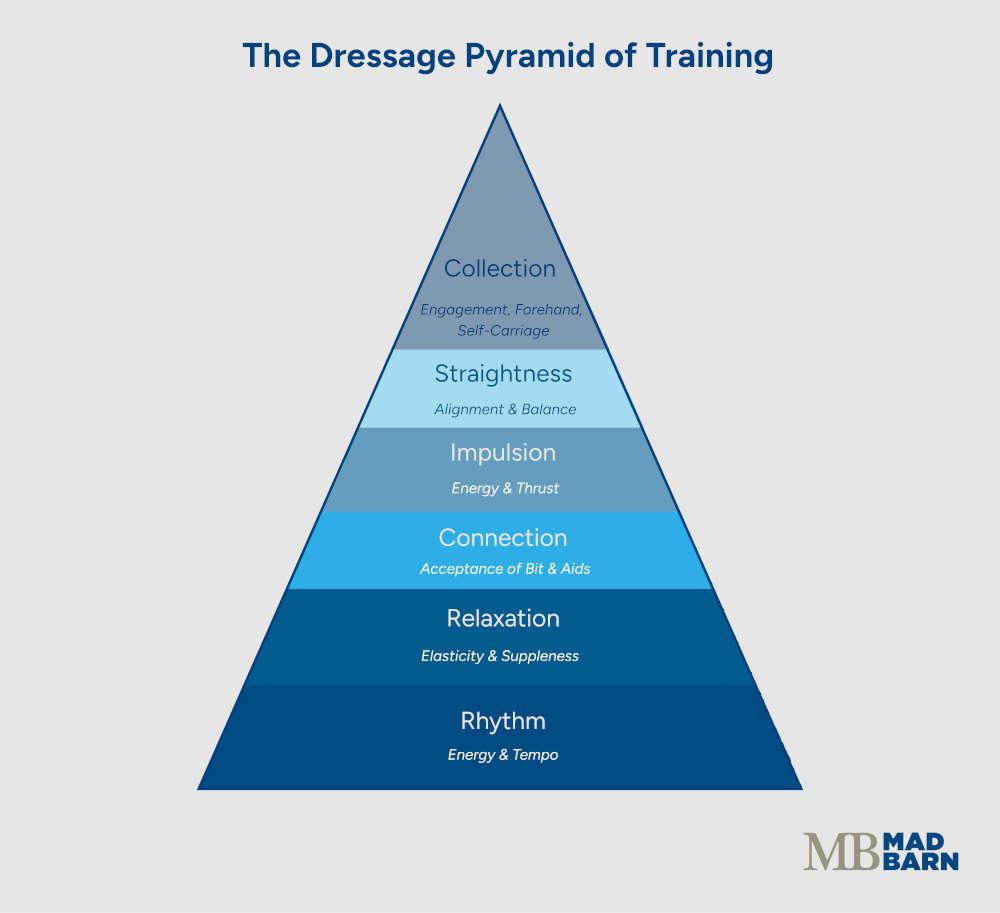
Lateral movements in dressage follow a deliberate sequence that reflects the broader dressage pyramid of training. Each exercise builds on the one before it, gradually increasing the demand for bend, collection, and responsiveness to the rider’s aids.
The Lateral Work Hierarchy
To train lateral work effectively, a horse should follow a logical skill progression of increasingly difficult lateral work.
Leg yield is the first lateral skill. The horse moves sideways and forward with only a slight deviation from the direction of travel and minimal bend. It teaches the basic concept of moving away from the leg without requiring collection. [1]
Once leg yield is consistent and well understood, shoulder-in follows. The horse bends away from the direction of travel and moves on three tracks.
It is the first true collecting exercise, asking the inside hind leg to step under the horse’s body mass and carry more weight. Riders typically first encounter shoulder-in at Second Level.
Travers and renvers come next. Both require the horse to travel in the direction of the bend for the first time, which raises the collection requirement considerably. With both hind legs staying active under the horse’s body throughout, these exercises demand more engagement than shoulder-in. [1]
Half-pass builds directly on travers. This movement is essentially travers ridden diagonally across the arena. Pirouette preparation follows the same principle, with the horse holding a travers-like position as the forehand turns around the hindquarters.
Research on equine spinal kinematics confirms that riding on curved tracks produces measurable lateral bending in the thoracolumbar region, with that bending increasing as the horse follows a circle. [6] Progressive lateral work develops and evens that bending capacity over time, which is part of what makes exercises such as travers and renvers effective gymnastic tools.
What's your top priority with your horse's health?

What's your top priority with your horse's health?
Why Travers Comes Before Renvers
Trainers introduce travers first because the arena wall offers passive assistance.
With the forehand on the track, the wall helps prevent the horse’s shoulders from drifting outward. The rider can focus on displacing the haunches inward and maintaining the bend, rather than also managing an unsupported forehand.
Renvers removes that assistance entirely. The rider must hold the forehand on the inside track through active rein and seat contact, with no wall to catch a drifting outside shoulder. For both horse and rider, the coordination demand is significantly higher. [2]
Renvers also reveals quickly whether a rider has learned the aids for the movement or has relied on the wall to hold the horse in position. In that way, it works as a diagnostic exercise.
The Biomechanics of Collection in Travers & Renvers
Both travers and renvers are collecting exercises. Their primary purpose is to develop the horse’s ability to carry more weight on the hindquarters and engage the hind limbs with greater flexion and power.
What Collection Requires
Collection shifts the horse’s weight toward the hindquarters. The hind limb joints, particularly the hip, stifle, and hock, must flex more and bear a greater share of the load.
Research on biomechanical gait classification in highly trained dressage horses shows that this weight shift is progressive, becoming increasingly pronounced across movements that demand more collection. In piaffe, the hind limbs function as springs, absorbing and generating force with substantially more compression than in collected trot. [8]
For horses in the earlier stages of collection work, this means the hind legs must step further under the body than they do in ordinary forward movement. The back must remain supple and swinging so that the energy from behind can carry through to a steady contact in front.
How Travers & Renvers Build Collection
According to United States Dressage Federation (USDF) guidelines, the primary benefit of travers is the increased engagement of the inside hind leg, which must flex more and carry more weight as the horse works through the movement. [1]
The outside hind leg crosses actively in front of the inside, but the collecting effect comes from the carrying work of the inside hind.
Renvers offers the same engagement while adding one more demand. The rider must hold the shoulder without the wall’s help, which requires a more active outside rein and an independently balanced seat.
Riders who school renvers regularly tend to develop a sharper feel for the horse’s shoulder, and that sensitivity transfers directly to half-pass work.
Horses carry natural asymmetries and directional preferences. Research involving high-level dressage horses and riders identifies these structural and functional asymmetries as widespread and multifactorial.
One study notes that inconsistent terminology around sidedness has made these differences difficult to fully characterize, which shows why individualized, attentive training matters. [10]
Practicing travers and renvers on both reins, with close attention to quality on the horse’s stiffer side, helps address natural asymmetry and builds more even strength over time.
Straightness Through Lateral Work
Using sideways movements to develop straightness can seem contradictory, but lateral work functions as a suppling tool. By asking the horse to bend evenly in both directions and place each hind leg actively under its body, the rider gradually reduces the crookedness most horses carry naturally.
One study measuring equine spinal kinematics found that lateral bending in the thoracolumbar spine increased measurably when horses moved on circles compared to straight lines. The bending was not always symmetric between left and right circles, reflecting the asymmetries common in trained horses. [6]
Consistent work on both reins, with exercises such as travers and renvers, aims to develop greater symmetry in that bending over time.
Renvers works especially well for horses with consistently crooked movement, whose haunches drift toward the center of the arena. With the hindquarters supported by the wall and the forehand directed inward, the rider can isolate and correct the drift in a controlled way without resorting to strong aids. [5]
How to Ride Travers
Travers rewards careful preparation. Rushing into the movement without the correct angle, bend, or forward energy tends to produce a leg yield at best and a tense, confused horse at worst.
A few deliberate steps in preparation make the movement accessible to most horses confirmed in shoulder-in.
Setting Up Travers
Starting from a 10-meter circle at the corner or short side is the most reliable approach. The circle naturally develops the bend and positions the horse’s body at the correct angle. As the horse completes the circle and moves onto the long side, the rider maintains the bend and uses the outside leg to guide the haunches inward. [1]
The inside leg sits at the girth and asks for forward energy and bend. The outside leg moves behind the girth, displacing the haunches inward. The inside rein maintains flexion toward the direction of travel. [1]
The outside rein regulates the degree of neck bend and keeps the outside shoulder from bulging. The rider’s chest turns slightly inward, with the outside hip held back to mirror the position of the horse’s hindquarters. [1]
Start travers at walk. Once the horse understands the positioning and responds to the aids with relaxation and consistency, move to collected trot. Collected canter travers follows as collection deepens.
Common Mistakes in Travers
The most frequent error is too much neck bend with insufficient body bend.
Riders who rely on the inside rein to create the appearance of bend produce a horse that is overbent at the poll and straight through the barrel. True bend in travers comes from the horse wrapping around the inside leg, not from the neck twisting inward.
A second common problem is the haunches leading the forehand. This usually happens when the outside leg is too strong relative to the forward energy from the inside leg. The horse should feel as though it steps forward and across, not slides sideways.
Loss of rhythm is a clear warning sign. The movement should feel active, forward, and regular. When tempo drops or footfalls become uneven, the angle or degree of bend is more than the horse can currently sustain.
Reduce the angle, return to a simpler exercise, and restore rhythm before asking for more.
Table 2. Common mistakes in travers and how to correct them
| Mistake | What it looks like | Likely cause | Correction |
|---|---|---|---|
| Too much neck bend |
|
|
|
| Haunches leading |
|
|
|
| Loss of rhythm |
|
|
|
| Too much angle |
|
|
|
How to Ride Renvers
Renvers uses the same aids as travers. The confusion most riders experience is usually related to positioning. The horse sits differently relative to the wall, and that reversal requires a clear sense of where each part of the horse belongs.
Setting Up Renvers
Approaching from shoulder-in on the long side is the most effective method. In shoulder-in, the horse is already positioned with the shoulders off the track and bent around the rider’s inside leg.
The rider then changes the flexion. Instead of looking away from the direction of travel, the horse is redirected to look toward it. The angle holds steady, the haunches remain on the track, and the forehand stays inward. [2]
This change in flexion is the most technically demanding part of the exercise. The rider must increase the angle from three tracks to four while simultaneously redirecting the bend, all without losing rhythm or forward energy.
A well-prepared shoulder-in is what makes that transition manageable.
The Aids for Renvers
The inside leg at the girth maintains bend, energy, and forward motion. The outside leg behind the girth prevents the haunches from drifting off the track.
The inside rein positions the head and neck in the direction of travel. The outside rein is especially important in renvers. With no wall to assist, it controls where the outside shoulder goes. [2]
Many riders describe renvers as feeling unbalanced at first. That feeling fades as both horse and rider learn to replace the wall’s passive support with an active, steady outside rein.
Using Renvers to Address Crookedness
For horses that habitually carry their haunches inward along the long side, renvers can be a productive correction. The wall supports the hindquarters and prevents them from slipping further inward, which frees the rider to focus on repositioning the forehand.
In this position, the rider can address the part of the horse that has been escaping, usually the shoulder, without needing forceful aids. [5]
Horses that work through renvers in both directions show a kind of thoroughness that travers alone cannot fully test. The exercise makes clear exactly where each rein is doing its job and where it is not.
Common Mistakes in Renvers
Many renvers mistakes come from trying to create the movement with the reins instead of organizing the horse’s whole body. Because the forehand is displaced inward and the haunches remain on the track, the rider must control the shoulders without using the wall for support.
A common error is an unclear change of flexion from shoulder-in to renvers. If the rider changes only the neck, the horse may lose the body bend, rhythm, or four-track alignment. The change should come through the seat, inside leg, and outside rein, not by pulling the head into position.
Another frequent problem is shoulder drift. In renvers, the outside rein has to organize the forehand and prevent the outside shoulder from escaping. When that connection is missing, the horse may fall off the intended line or lose the clear relationship between forehand and hindquarters.
As in travers, too much angle or too much neck bend reduces the collecting value of the movement. The horse should stay active, supple, and forward, with the inside hind leg stepping under the body rather than escaping sideways. If rhythm, balance, or relaxation are lost, reduce the angle or return to shoulder-in before asking again.
Table 3. Common mistakes in renvers and how to correct them
| Mistake | What it looks like | Likely cause | Correction |
|---|---|---|---|
| Shoulder drifting |
|
|
|
| Unclear change of flexion |
|
|
|
| Haunches leaving the track |
|
|
|
| Loss of rhythm |
|
|
|
| Overusing the inside rein |
|
|
|
Training Applications & Competition
Travers and renvers are not movements reserved only for shows. When woven into daily work with purpose, they connect to almost every higher movement in dressage and become two of the most useful tools a rider can use at the schooling level.
Combining Travers & Renvers in Daily Work
One of the most productive exercises is alternating shoulder-in and renvers on the same long side, moving between them without dropping to a neutral position.
This asks the horse to change the bend smoothly while maintaining angle, rhythm, and energy. It tests the elasticity of the contact and the independence of the aids in a way that riding each movement in isolation cannot. [2]
Travers and half-pass are closely linked. Travers ridden on the long side, then carried across the diagonal, becomes a half-pass. When travers is well established, half-pass is easier to develop because the positioning and aid coordination already exist.
Many riders find that improving their travers resolves problems they believed were specific to the diagonal work.
Travers in canter is a foundational preparation for pirouette. It develops the hind limb carrying capacity and the compressed, uphill balance the pirouette demands. Research on collected gaits shows that the shift of load toward the hind limbs grows progressively greater as the horse advances toward higher levels of collection. [8]
Building that capacity through canter travers gives the horse a stronger physical base before pirouette work is introduced. As part of a broader conditioning program, this work can help develop the strength and coordination needed for more advanced dressage movements.
Travers & Renvers in Competition
At Second Level, travers is required at collected trot. Judges evaluate the angle, bend, rhythm, crossing, submission, and collection throughout. [2]
A well-ridden travers earns marks for engagement and harmony. The most common judges’ comments at this level concern insufficient angle, loss of collection, or over-reliance on the inside rein.
Renvers appears at Third Level, most often in a sequence with shoulder-in on the same long side. The judge looks for a clear and correct change of bend, with the angle, rhythm, and quality of the movement maintained through the transition. [2]
Riders who practice renvers regularly in training often find the test requirement straightforward. Those who have drilled shoulder-in but neglected renvers may struggle with the bend change under competitive pressure.
Technical directives on these movements note that too much angle or too much neck bend compromises the collecting benefit by allowing the inside hind leg to escape sideways rather than step under and carry. [5]

Dressage Skill Building With Travers & Renvers
Travers and renvers are easy to confuse because they ask for nearly the same bend, angle, and crossing pattern. The difference lies in the horse’s orientation to the wall. In travers, the forehand stays on the track while the haunches come in; in renvers, the hindquarters stay on the track while the forehand comes in.
The real value of these exercises goes beyond learning where the shoulders and haunches belong. Correctly ridden travers and renvers improve collection by asking the hind legs to step actively under the body while the horse remains supple, rhythmic, and connected. They also help the rider feel whether the horse is truly bending through the body or simply turning the neck.
Travers is often the more accessible starting point because the wall helps support the shoulders. Renvers raises the standard by asking the rider to control the forehand without that support, making it especially useful for improving the outside rein, correcting crookedness, and preparing for more advanced lateral work.
Practiced thoughtfully on both reins, travers and renvers become more than test movements; they become reliable tools for building straightness, strength, collection, and the coordination needed for half-pass, pirouettes, and more advanced dressage training.
Frequently Asked Questions
Here are some frequently asked questions about travers and renvers in dressage:
The difference between travers and renvers is which part of the horse stays on the track. In travers, or haunches-in, the forehand stays on the track while the haunches move inward. In renvers, or haunches-out, the hindquarters stay on the track while the forehand moves inward. Both movements use the same bend, angle, and direction of travel, which is why they can look and feel confusing at first.
The easiest way to remember travers vs. renvers is to focus on the horse's position relative to the wall. Travers keeps the shoulders on the wall and moves the haunches in. Renvers keeps the haunches on the wall and moves the shoulders in. The movement itself is very similar, but the wall supports a different part of the horse.
Travers and renvers are essentially the same gymnastic movement viewed from opposite positions along the arena wall. In both exercises, the horse bends in the direction of travel, works on four tracks, and moves at about a 35-degree angle to the long side. The main difference is whether the forehand or hindquarters remain on the track. This change affects how the rider manages balance, especially through the outside rein and seat.
Renvers is usually harder to ride than travers because the wall no longer helps control the forehand. In travers, the wall helps keep the shoulders from drifting outward, allowing the rider to focus more on positioning the haunches. In renvers, the rider must hold the shoulder through the outside rein, seat, and balanced contact. This makes renvers a useful test of whether the horse and rider truly understand the aids.
The correct angle for travers and renvers is approximately 35 degrees to the long side. From the front or back, the horse should show four distinct hoof tracks. The angle should remain steady throughout the movement without the haunches or shoulders leading too much. If rhythm, balance, or bend deteriorates, the angle is likely greater than the horse can currently maintain.
Travers and renvers should both show four tracks in the footing. This means each hoof travels on a separate line when viewed from the front or behind. The four-track pattern distinguishes these movements from shoulder-in, which is ridden on three tracks. Clear tracks matter because they show whether the horse is correctly positioned through the body rather than only bent in the neck.
Travers and renvers are considered collecting exercises because they ask the horse to carry more weight behind while maintaining bend, rhythm, and forward energy. The inside hind leg must step under the body and take more carrying responsibility. The outside hind leg crosses actively, but the main collecting effect comes from engagement and flexion of the hindquarters. When ridden correctly, these movements help develop strength, balance, and preparation for more advanced work.
Travers and renvers help straighten a horse by developing more even bend, engagement, and body control on both reins. Most horses have natural asymmetries, and lateral work gives the rider a structured way to improve suppleness and strength on the weaker side. Renvers is especially useful for horses that habitually carry the haunches inward because the wall supports the hindquarters while the rider repositions the forehand. Practicing both movements thoughtfully can reduce crookedness over time.
To ride travers, start from a well-balanced bend, often after a 10-meter circle in the corner or on the short side. As the horse comes onto the long side, keep the forehand on the track and use the outside leg behind the girth to guide the haunches inward. The inside leg maintains bend and forward energy, while the outside rein regulates the shoulder and prevents too much neck bend. The horse should feel as though it moves forward and across, not sideways or crookedly.
To ride renvers, begin from a correct shoulder-in on the long side and then redirect the flexion so the horse looks in the direction of travel. The haunches stay on the track while the forehand remains inward. The inside leg maintains bend and energy, the outside leg prevents the hindquarters from drifting, and the outside rein controls the shoulder. The transition should preserve rhythm, angle, and forward activity.
To transition from shoulder-in to renvers, keep the horse on the long side and change the flexion while maintaining the angle and rhythm. In shoulder-in, the horse bends away from the direction of travel; in renvers, the horse bends toward the direction of travel. The haunches should remain on the track as the shoulders stay inward. This transition is demanding because the rider must change the bend without losing energy, balance, or contact quality.
Common mistakes in travers include too much neck bend, too little body bend, haunches leading, and loss of rhythm. Riders often try to create the shape with the inside rein, which overbends the neck without producing true bend through the barrel. If the outside leg pushes too strongly, the haunches may lead instead of following the forward line of travel. A correct travers should stay active, regular, and connected from the inside leg to the outside rein.
Common mistakes in renvers include losing control of the outside shoulder, changing the bend too abruptly, and allowing the rhythm to fade. Because the wall does not support the forehand, the rider must be precise with the outside rein and seat. If the horse falls inward, drifts, or becomes tight in the neck, the exercise has lost its gymnastic value. Returning to a clearer shoulder-in or reducing the angle can help restore balance.
The difference between travers and half-pass is the line of travel. Travers is ridden along the long side of the arena, parallel to the wall. Half-pass uses the same general bend and body positioning but travels diagonally across the arena. This is why strong travers work often makes half-pass easier to develop.
Travers and renvers can be ridden in collected canter once the horse has enough balance, strength, and understanding. Canter travers is especially useful for preparing pirouette work because it develops carrying power and a more compressed balance behind. Canter renvers is more advanced because it requires even greater control of the shoulders and straightness. These versions should be introduced only after the horse is relaxed and consistent in the movement at easier gaits.
Travers appears at USDF Second Level, where it is required at collected trot. Renvers appears at USDF Third Level, often in connection with shoulder-in on the same long side. Judges look for correct angle, uniform bend, rhythm, crossing, collection, and smooth transitions between related lateral movements. The competition requirements reflect the training progression from shoulder-in to travers, renvers, half-pass, and more advanced collected work.
Summary
Travers and renvers are closely related dressage movements that build collection, straightness, and body control. Understanding which part of the horse stays on the track helps riders use each exercise correctly.
- Travers keeps the forehand on the track while the haunches move inward
- Renvers keeps the hindquarters on the track while the forehand moves inward
- Both exercises ask the horse to bend in the direction of travel and work on four tracks
- Travers is typically introduced first because the arena wall helps support the shoulders
- Renvers increases the demand on the rider's outside rein, seat, and shoulder control
- Correct practice on both reins can improve collection, symmetry, and preparation for half-pass and pirouettes
References
- Lateral Movements Definition. USDF Education Documents. 2024.
- Renvers Lesson Topic. USDF Education Documents. 2024.
- FEI Dressage Rules. FEI. 2024.
- Shoulder In, Renvers and Travers. British Dressage. 2024.
- EADJC Directive re Travers and Renvers Movements. EADJC. 2021.
- Byström. A. et al. Differences in Equine Spinal Kinematics Between Straight Line and Circle in Trot. Scientific Reports. 2021.
- MacKechnie-Guire. R. and Pfau. T. Differential Rotational Movement and Symmetry Values of the Thoracolumbosacral Region in High-Level Dressage Horses When Trotting. PLOS ONE. 2021.
- Clayton. H. and Hobbs. S. A Review of Biomechanical Gait Classification with Reference to Collected Trot, Passage and Piaffe in Dressage Horses. Animals. 2019.
- Coelho. C. et al. Training Effects on the Stress Predictors for Young Lusitano Horses Used in Dressage. Animals. 2022.
- Haussler. K. et al. The Challenge of Defining Laterality in Horses: Is It Laterality or Just Asymmetry? Animals. 2025.
About the Contributors

Caroline Cochran BSc.
Caroline Cochran is a professional writer with an honors degree in Biological Science from Colorado State University and over a decade of experience working in the equine industry as a veterinary technician, international groom, dressage rider, and barn manager.

Dr. Emily Gilbert, PhD
Dr. Emily Gilbert (Toronto, ON) is a Regenerative Neurobiologist and passionate equestrian. Her research focuses on understanding the molecular underpinnings of spontaneous central nervous system regeneration with the goal of develop novel approaches to improve regeneration and repair following injury to the brain and spinal cord in mammals (including humans). Emily completed a Bachelors of Art and Science with a focus on Cognitive Neuropsychology and Neuroscience at the University of Guelph. She then completed her M.Sc. and Ph.D. at the Ontario Veterinary College, where her studies explored both the development and regeneration of the brain and spinal cord. Emily completed a post-doctoral fellowship in neural stem cell biology and translational neuroscience at the prestigious Donnelly Centre for Cellular and Biomolecular Research at the University of Toronto. In addition to her academic training, she is a passionate equestrian and previously competed in the sport of Three-Day-Eventing and remains active as a Dressage competitor. Emily also chairs the Canadian Eventing High-Performance program and actively supports our Canadian Eventing Teams at International Competitions. Emily works closely with Mad Barn’s Nutrition and Sales Teams, and leads our growing High Performance and Sport Science initiatives.