English

The shoulder-in is one of the most important lateral movements in dressage training. This movement appears in competition tests from Second Level onward and is a valuable schooling exercise for horses at many stages of development. Few exercises address suppleness, straightness, hind limb engagement, and relaxation at the same time.
The French riding master François Robichon de La Guérinière called the shoulder-in the foundation of all lateral work in 1733. Centuries later, modern equine research has confirmed that lateral exercises, including shoulder-in, are associated with measurably greater relaxation in horses.
Both classical principles and modern science suggest that correctly ridden shoulder-in can benefit the horse’s body and mind when riders understand how to prepare for and ride the movement effectively.
Keep reading to learn what shoulder-in is, why it belongs in regular training, how to build toward it correctly, and how to ride it well.
What Is a Shoulder-In?
The shoulder-in is a lateral movement performed on a straight line. The horse moves forward while bent around the rider’s inside leg, with the forehand displaced to the inside of the track.
Performed correctly, it is one of the most valuable gymnastic exercises in dressage. It develops suppleness, engagement, and straightness at the same time.
A Brief History of the Exercise
Shoulder-in has a long history in classical dressage and is still one of the foundational exercises for developing a supple, balanced, and responsive horse.
The famed French riding master Antoine de Pluvinel worked with a precursor exercise in the early 17th century, describing it as a way to make the horse more obedient and supple.
The Duke of Newcastle developed similar ideas independently. François Robichon de La Guérinière, who created the essential written guide to dressage in his 1733 work École de Cavalerie, gave the movement its formal structure and defined its role in training. [1]
De La Guérinière described shoulder-in as the preparation for all other lateral movements, a concept that remains central to classical dressage. [1] The FEI included shoulder-in as a competition movement in 1975 and standardized it as a three-track exercise at approximately 30 degrees. Earlier descriptions often depicted a steeper, four-track version. [2]
Definition & Track Pattern
In a correct shoulder-in, the horse’s body creates an angle of approximately 30 degrees to the direction of travel. This angle places the legs on three separate tracks.
The outside hind travels on the outer track, closest to the wall. The inside hind and the outside foreleg share the middle track. The inside foreleg moves on the inner track, crossing in front of the outside foreleg with each step.
The horse is flexed at the poll toward the inside, away from the direction of travel. The haunches remain on or near the track while the shoulders come in. [2]
Importantly, shoulder-in is not the same as leg yield. Leg yield moves the horse sideways with minimal lateral bend. Shoulder-in requires both a clear angle and a genuine bend through the horse’s body.
What's your top priority with your horse's health?

What's your top priority with your horse's health?
Benefits of Training the Shoulder-In
Used consistently, shoulder-in functions as a suppling exercise, a collecting tool, and a way to settle a tense or distracted horse.
Classical masters and modern researchers have reached a similar conclusion: when performed correctly, shoulder-in can benefit the horse both physically and mentally.
Suppleness & Lateral Muscle Recruitment
Lateral work targets muscles that riding in a straight line does not. The adductor and abductor muscles of the hips and shoulders engage whenever a horse steps across, and the pectoral muscles activate as the inside foreleg crosses. [5]
These muscles contribute to lateral elasticity and help the horse carry itself freely.
Research comparing straight-line and circling trot found measurably greater lateral bending in the thoracolumbar spine on curves than on straight lines, suggesting that bending work increases mobility in the back. [4]
This increased range of motion in lateral work can carry over into the quality of the straight-line work that follows.
Hind Limb Engagement
In a correct shoulder-in, the inside hind leg steps forward and under the horse’s center of mass. In that position, it carries more weight than it does on a straight line. Over time, that repeated loading builds strength and joint flexion in the hip, stifle, and hock that collection requires.
Equine biomechanics research confirms that greater angulation of the hindlimb joints underlies the carrying ability that defines collection. [5] Shoulder-in starts developing that capacity without overwhelming a horse that does not yet have the strength for more advanced work.
Improving Straightness
Most horses are naturally crooked. They tend to fall on one shoulder, prefer one bend, and carry their hindquarters slightly to one side. Laterality and body asymmetry are normal, documented features of equine locomotion. [6]
The issue is not the asymmetry itself, but the uneven muscle development and unequal weight distribution it can create over time. Shoulder-in helps by asking the horse to build equal strength and coordination on both sides.
Research on equine laterality suggests that training aimed at developing balanced strength on both sides is more effective than attempting to correct a horse’s natural crookedness mechanically. [3] Shoulder-in on the stiffer rein, ridden patiently and correctly, is one of the most direct tools for improving functional symmetry.
Relaxation & Stress Management
A study measuring the physiological and behavioral responses of 40 horses compared lateral training sessions with straight-line sessions.
Horses performing lateral work showed significantly greater parasympathetic nervous system activity, a physiological marker of relaxation. Horses in straight-line sessions showed greater sympathetic activity, corresponding to a higher stress state. [7]
In addition, the horses in lateral sessions chewed and played with the bit more often and looked around less frequently. [7] Both patterns point to a more settled, focused horse.
These results support what classical trainers observed long before the research existed. A horse bent around the inside leg and working through lateral exercises tends to settle.
Shoulder-in can be a useful reset during a tense or difficult session, not only a gymnastic exercise. For horses that struggle with tension more broadly, review strategies to reduce stress in horses alongside a suitable training plan.
Building the Prerequisites
Attempting shoulder-in before the horse is ready produces something that resembles the exercise but lacks the bend, engagement, and rhythm that give it value. Getting the foundation right first saves considerable time later.
What the Training Scale Requires First
Rhythm and relaxation must come before any lateral work. The horse needs to move forward consistently from the inside leg, accept contact steadily, and stay reasonably relaxed.
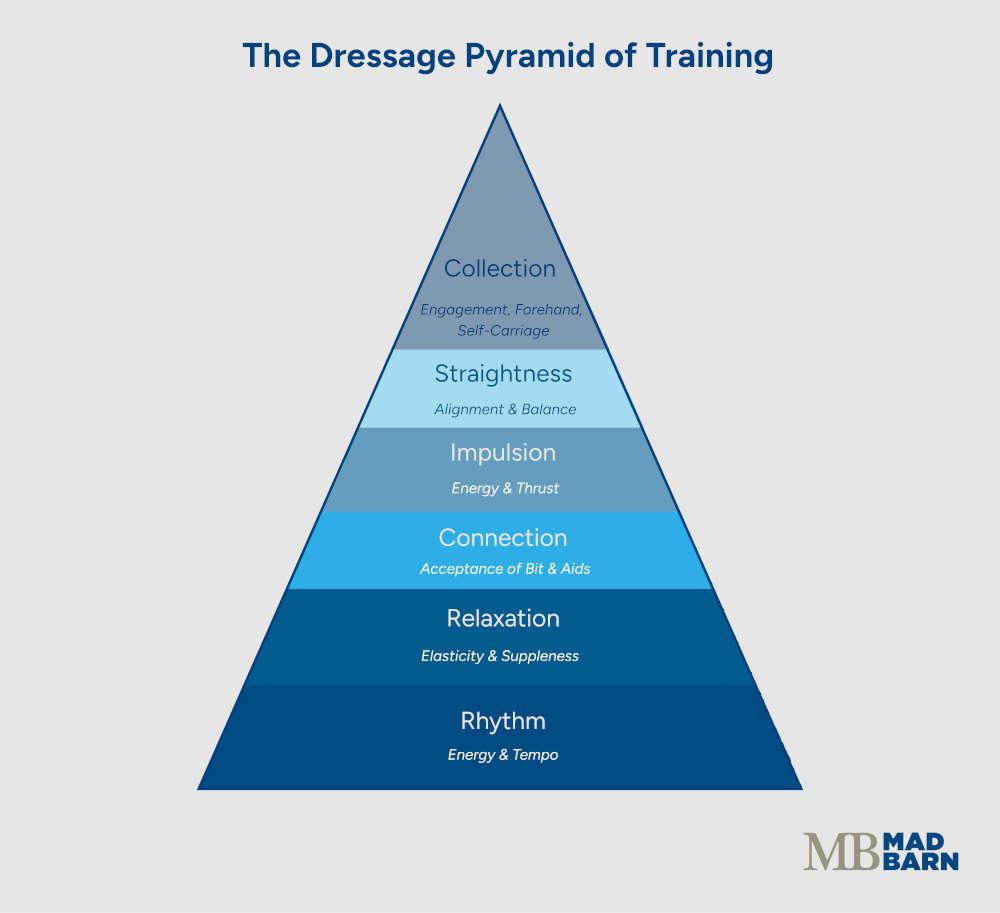
A horse that braces against leg pressure cannot be bent around that leg, regardless of how precisely the rider arranges the aids. This is why shoulder-in belongs within the broader dressage training scale, rather than being treated as an isolated trick.
The ability to travel on a 10-meter circle with correct lateral bend is a good measure of readiness. If the horse can hold that bend on a circle without resistance, the same shape can be maintained on a straight line.
Many trainers introduce leg yield before shoulder-in to teach the horse the concept of moving away from a leg aid, though leg yield itself does not require or develop lateral bend. [2]
Shoulder-Fore as a Preparatory Exercise
Trainers often describe shoulder-fore as the preparatory movement that leads directly to shoulder-in and the lateral work that follows. [8]
In shoulder-fore, the forehand comes only slightly off the track. The angle is smaller, the legs do not fully cross, and the demand is lower. However, the aids are essentially the same as shoulder-in.
Many riders skip shoulder-fore in a hurry to reach the movement that appears in the tests. That shortcut tends to show up in the quality of the shoulder-in that follows. A horse that has worked through shoulder-fore consistently before shoulder-in is introduced will typically hold the correct shape much more naturally.
How to Ride a Shoulder-In
With the right foundation in place, the shoulder-in can be introduced in an organized way. The goal at first is to establish the correct angle and bend before the horse begins moving laterally. After that, the task becomes holding both qualities consistently.
The Rider’s Position
The rider’s hips stay square and parallel to the short wall, which is the direction the horse is traveling. The shoulders mirror the angle of the horse’s shoulders, rotating slightly inward. Weight sits evenly in the saddle, with a light emphasis on the inside seat bone to support the bend. The outside hip must stay open and back.
Research comparing novice and advanced riders during shoulder-in found meaningful differences in how the outside leg and hip were used. Advanced riders showed significantly greater hip extension and external rotation in the outside leg, and they received higher scores from the judging panel. [9]
The outside leg and hip do active work in shoulder-in. They regulate the angle and the quality of the movement, and a passive outside hip is one of the most common reasons the movement falls apart.
The inside hand creates a light flexion at the poll. The outside hand controls the angle and prevents the horse from bending too much through the neck.
Applying the Aids
The inside leg at the girth is the main bend aid. It also keeps energy moving forward. Without an active inside leg, the bend collapses, and the trot slows. The outside leg sits slightly behind the girth, guarding the hindquarters and preventing them from swinging away from the track.
Many riders allow the outside leg to become passive once the movement begins. The result is a horse whose haunches drift, eliminating the bend and turning the movement into a leg yield.
The outside rein is the most important rein in shoulder-in. It limits how much the neck bends to the inside and controls how much the shoulder comes off the track.
Riders who lose the outside rein connection almost always end up with too much neck bend and too little body angle. Prioritize riding inside leg to outside rein to maintain the correct positioning.
The overall feeling should be forward and sideways at the same time. It should feel active and energetic throughout.
Entering from a Corner or Circle
The easiest way to begin shoulder-in is from the corner or the last stride of a 10-meter circle. The corner naturally creates the correct bend and angle. As the horse completes the turn, the rider maintains the position and lets the horse continue forward along the wall.
Starting this way tends to work better than trying to establish the angle from a straight line. Young horses and riders new to the movement benefit most from entry through the corner. Once the angle is established, the outside rein holds the position while the inside leg keeps the horse forward and maintains the bend.

Riding Down the Long Side
Inconsistent angle is the most frequently cited fault in shoulder-in, both in schooling and in competition. [2] The angle at the beginning of the movement should match the angle at the end. When it varies, the exercise loses its structure and its benefit.
The inside foreleg should always be clearly visible on a separate inner track. The hindquarters should remain on or near the wall, traveling straight forward. The rhythm of the trot must not change. If the trot loses its regularity, ride straight and forward first, re-establish the rhythm, and then re-engage the angle.
Finish by straightening through the outside rein before the corner, or by stepping the horse back onto the track.
Table 1. Shoulder-in aids quick reference
| Rider aid | What it does | Common mistake |
|---|---|---|
| Inside leg |
|
|
| Outside leg |
|
|
| Inside rein |
|
|
| Outside rein |
|
|
| Seat and weight |
|
|
| Hips and shoulders |
|
|
Common Mistakes When Riding a Shoulder-In
Most shoulder-in errors trace back to three sources: overuse of the inside rein, a passive outside rein or leg, and insufficient forward energy.
Too Much Neck, Not Enough Body
Excessive neck bend is the most common fault at all levels. The rider uses the inside rein to pull the neck inward, but the shoulder stays on the track. When this happens, the horse appears to be bent, but its body is actually straight. The hindquarters may drift out, or the movement may feel stuck and heavy.
The fix is to think about moving the shoulder, not the head. The outside rein limits neck bend and directs that energy into displacing the forehand. Keep the horse’s nose pointing toward the letter on the short wall, not toward the long side.
Angle Problems
Too much angle turns shoulder-in into a leg yield. When the hindquarters begin to cross the track rather than travel straight forward, or when there are clearly more than three tracks, the movement has changed. The bend usually disappears at that point as well.
Too little angle, and the exercise barely qualifies as shoulder-fore. The horse shows no real crossing, and there is almost no engagement demand on the inside hind.
The outside rein addresses both problems. More outside rein reduces a steep angle and helps keep the shoulder from drifting back to the track.
Loss of Rhythm or Impulsion
Shoulder-in asks more of the horse than a straight trot. Horses with limited strength or balance may slow down, shorten their stride, or hollow their back. These are signs that the horse is not yet strong enough for more lateral work.
Ride a half-halt before beginning the movement to prepare the horse and set a more uphill balance. If the rhythm breaks, re-establish the trot and try again.
Working in sections of five to ten meters before attempting the full long side builds strength gradually and keeps the horse from learning to avoid the effort. If the same issues appear across many exercises, evaluate the broader training program for possible performance plateaus rather than drilling the movement.
Hindquarters Drifting Away from the Track
When the hindquarters swing out, the bend disappears, and the movement becomes a leg yield. A steady outside leg is the primary correction. Think of it as a guardrail that prevents the haunches from escaping.
If the horse consistently ignores the outside leg, go back to shoulder-fore for a few sessions. The smaller angle makes it easier for the horse to hold the position correctly, and it reinforces the outside leg aid before the full demand of shoulder-in is reintroduced.
Rider Position Faults
Collapsing through the inside hip is one of the most common positional errors in shoulder-in.
When the rider’s weight drops to the inside, the inside seat bone blocks rather than supports the bend. The horse stiffens, the quality drops, and the rider often responds by pulling harder on the inside rein.
Twisting the torso inward is a related problem. When the rider turns too sharply, the outside hip disconnects from the horse.
Research confirms that rider symmetry during shoulder-in directly affects movement quality. Less experienced riders exhibit greater trunk-to-pelvis rotation asymmetry, and this asymmetry is associated with lower judge scores. [9] In addition, a broader review of rider biomechanics confirms that rider carriage during lateral work shapes how the horse carries itself. [11]
Video analysis and ground coaching are particularly effective for identifying these patterns, as riders often cannot feel them as they occur. Riders can also use general riding posture work to improve the alignment needed for lateral movements.
Table 2. Common shoulder-in mistakes and fixes
| Problem | What it looks like | Likely cause | Correction |
|---|---|---|---|
| Too much neck bend |
|
|
|
| Too much angle |
|
|
|
| Too little angle |
|
|
|
| Loss of rhythm or impulsion |
|
|
|
| Hindquarters drifting away |
|
|
|
| Rider collapses inside |
|
|
|
| Rider twists inward |
|
|
|
Putting Shoulder-In to Work in Your Training
Knowing how to ride a technically correct shoulder-in is the starting point. The real value of the exercise lies in how it is used throughout a session and across a horse’s development.
Using Shoulder-In in Your Daily Warm-Up
Shoulder-in on both reins early in a session helps unlock the back, supple the lateral musculature, and invite relaxation before harder work begins.
One effective warm-up sequence is to trot a circle, maintain the bend as the horse comes off the circle onto the long side, ride 10 to 15 meters of shoulder-in, then straighten and ride forward into a lengthening or transition. Repeat on the other rein to work both sides evenly.
Managing Tension & Stiffness
When a horse becomes tense, distracted, or resistant, shoulder-in often helps reset the conversation. The combination of bend, lateral movement, and coordination required tends to redirect the horse’s attention back to the rider’s aids.
Physiological research shows that lateral work shifts the horse’s autonomic state toward relaxation, even when the horse begins the session showing signs of tension. [7] Riding a few steps of shoulder-in before introducing something new or difficult is one of the simplest ways to improve how the horse receives the next exercise.

Progression to Travers, Renvers & Half-Pass
Shoulder-in leads directly to travers, the first lateral movement in which the horse bends toward the direction of travel.
Many trainers ride directly from shoulder-in into travers on the same rein to help the horse understand the difference. The outside aids shift to bring the haunches in rather than hold them straight.
A half-pass requires bend toward the direction of travel, combined with forward and diagonal sideways movement. A horse that cannot maintain a consistent bend and angle in shoulder-in on both reins is not ready for half-pass work. [8]
Research on dressage performance confirms that correct progression through lateral movement builds the capacity needed at higher levels. [10] As shoulder-in becomes more consistent, it may be useful as part of a larger conditioning program that develops strength, balance, and coordination without sacrificing relaxation.
Building Better Shoulder-In Work Over Time
Shoulder-in is valuable because it asks the horse to stay forward, supple, balanced, and attentive at the same time. When ridden correctly, it is more than a competition movement or a schooling exercise for lateral work. It’s a practical way to improve how the horse uses the body, responds to the aids, and settles into the rider’s guidance.
The quality of the movement matters more than the amount of it. A few correct steps with clear bend, steady rhythm, active hind-leg engagement, and reliable outside-aid control are more useful than a full long side ridden with too much neck bend, drifting haunches, or fading impulsion.
For the rider, the exercise is also a test of coordination. The inside leg creates bend and energy, but the outside rein, outside leg, and outside hip shape the movement. When those outside aids stay active, the horse is more likely to maintain the correct three-track pattern without losing straightness or rhythm.
Used patiently, shoulder-in can support nearly every part of a dressage training program. It helps develop suppleness, improves functional straightness, encourages engagement, and provides a useful reset for tension or distraction. Over time, consistent shoulder-in work also prepares the horse for more advanced lateral movements while reinforcing the same basic principle: the best training builds strength and relaxation together.
Frequently Asked Questions
Here are some frequently asked questions about riding shoulder-in:
Shoulder-in is a lateral dressage movement in which the horse travels forward on a straight line while bent around the rider's inside leg. The forehand is brought slightly to the inside of the track while the haunches remain on or near the original line of travel. In a correct shoulder-in, the horse shows inside flexion at the poll, a consistent body bend, and forward energy through the movement.
Shoulder-in is introduced in dressage competition from Second Level onward. It also appears in FEI-level work and remains an important movement throughout advanced training. As a schooling exercise, shoulder-in can be introduced before it appears in tests, provided the horse already has reliable rhythm, relaxation, contact, and response to the leg aids.
A correct modern shoulder-in is ridden on three tracks at approximately a 30-degree angle. The outside hind travels on the outer track, the inside hind and outside foreleg share the middle track, and the inside foreleg travels on the inner track. A steeper four-track version appears in some historical descriptions, but modern competition standards define shoulder-in as a three-track movement.
The difference between shoulder-fore and shoulder-in is the amount of angle, bend, and leg crossing. Shoulder-fore brings the forehand only slightly off the track, with a smaller angle and less crossing than shoulder-in. It uses similar aids but places a lower demand on the horse, making it the most useful preparatory exercise before full shoulder-in.
The difference between shoulder-in and leg yield is that shoulder-in requires true bend through the horse's body, while leg yield uses minimal lateral bend. In leg yield, the horse moves sideways away from the rider's leg but stays relatively straight through the body. In shoulder-in, the horse is bent around the inside leg while the inside hind steps more actively under the body.
A horse is ready to learn shoulder-in when they can maintain rhythm, relaxation, steady contact, and forward response to the inside leg. The horse should also be able to travel on a 10-meter circle with correct bend without bracing or falling through the aids. If the horse cannot hold bend on a circle, it will be difficult to maintain the same shape on a straight line.
To ask for shoulder-in, keep the inside leg at the girth to maintain bend and forward energy while the outside leg stays slightly behind the girth to guard the haunches. The outside rein controls the angle and prevents the neck from bending too much, while the inside rein asks only for light flexion at the poll. The rider's hips stay aligned with the direction of travel, and the shoulders mirror the slight inward angle of the horse's shoulders.
The easiest way to start a shoulder-in is from a corner or the final stride of a 10-meter circle. The turn naturally creates the bend and angle needed for the movement, making it easier for the rider to maintain the shape onto the long side. This approach is especially useful for young horses or riders who are still learning to coordinate the aids.
Shoulder-in can be ridden at the walk and canter, although trot is the most common gait for schooling and competition. Walk shoulder-in is useful for introducing the aids slowly and helping the horse understand the positioning without the energy of trot. Canter shoulder-in is more advanced and can help refine collection, counter-canter, and lateral control once the horse is strong enough.
Shoulder-in helps develop collection by asking the inside hind leg to step forward and under the horse's center of mass. This positioning encourages greater flexion through the hip, stifle, and hock, which supports the carrying ability needed for collected work. With correct repetition, shoulder-in builds strength and balance without overwhelming a horse that is still developing.
Shoulder-in improves straightness by helping the horse develop more even strength and coordination on both sides of the body. Most horses have natural asymmetries, such as preferring one bend or leaning more on one shoulder. Riding shoulder-in patiently on both reins can help address these patterns by encouraging the horse to carry weight more evenly and respond more clearly to both sets of aids.
Shoulder-in can help a tense or distracted horse relax because it combines bend, lateral movement, and focused response to the aids. Lateral work encourages the horse to redirect attention back to the rider and can help settle the body and mind during a difficult session. It should still be ridden quietly and in short, correct segments rather than used as a way to force the horse into position.
A horse is bent correctly in shoulder-in when the bend follows a consistent arc from the poll through the ribcage to the tail. If only the neck bends while the shoulders and body remain straight, the movement has lost its gymnastic purpose. A useful visual check is that the rider should just be able to see the inside eye, while the horse's body continues to travel forward with the haunches on or near the track.
A horse that bends the neck but does not move the shoulders is usually being influenced too much by the inside rein and not enough by the outside rein and inside leg. This creates the appearance of bend without true body positioning. The correction is to reduce the inside rein, ride the horse from inside leg to outside rein, and think about bringing the shoulder inward rather than pulling the head inward.
A horse that rushes in shoulder-in is often losing balance, relaxation, or confidence in the aids. Return to walk or shoulder-fore until the horse can stay calm and organized in the shape. At trot, use a half-halt before entering the movement and ride only a short section before straightening and going forward again.
A horse that loses rhythm or slows down in shoulder-in may not yet have enough strength or balance for the full exercise. Shoulder-in asks more from the inside hind and the horse's lateral musculature than straight work does. Ride shorter sections, re-establish the trot whenever the rhythm changes, and avoid drilling the movement until the horse is strong enough to maintain quality.
A horse that drifts toward the outside wall in shoulder-in is usually allowing the hindquarters to escape rather than staying straight on the track. The outside leg needs to remain active as a guardrail, while the outside rein maintains the angle of the shoulders. If the horse repeatedly ignores the outside aids, return to shoulder-fore and rebuild the response at a smaller angle.
Shoulder-in is ridden in sitting trot in competition because sitting allows more refined use of the seat, weight, and leg aids. In schooling, posting trot can be useful if the horse is tense, the rider is working on balance, or the movement is still being introduced. The best schooling choice is the version that lets the horse stay rhythmic, relaxed, and forward while the rider remains organized.
Shoulder-in should usually be practiced in short, correct sections rather than repeated for long stretches. Five to ten meters can be enough when the horse is learning, especially if the movement starts to affect rhythm or relaxation. As the horse becomes stronger and more consistent, shoulder-in can be built into warm-ups, transitions, and preparation for more advanced lateral work.
Developing a correct shoulder-in depends on the horse's foundation, strength, symmetry, and previous work in shoulder-fore. A horse with solid basics may show a recognizable shoulder-in within a few weeks, but a consistent, balanced shoulder-in on both reins takes longer. The goal is not just to create the angle, but to maintain rhythm, bend, engagement, and relaxation throughout the movement.
Shoulder-in prepares a horse for more advanced lateral movements such as travers, renvers, and half-pass. It teaches the horse to maintain bend, angle, engagement, and response to the outside aids while staying forward. A horse that cannot hold a consistent shoulder-in on both reins is usually not ready for more demanding lateral work.
Summary
Shoulder-in is a classical dressage exercise that improves suppleness, straightness, engagement, and relaxation when ridden correctly. It requires clear bend, steady rhythm, active forward energy, and coordinated rider aids.
- Shoulder-in is performed on three tracks with the horse bent around the rider's inside leg
- The movement helps strengthen the inside hind leg and supports the development of collection
- Shoulder-fore and correct 10-meter circles are useful preparation before introducing shoulder-in
- The outside rein, outside leg, and outside hip are essential for maintaining the correct angle and alignment
- Common faults include excessive neck bend, drifting haunches, loss of rhythm, and rider asymmetry
- Shoulder-in can be used in warm-ups, tension management, and progression toward advanced lateral movements
References
- de la Guérinière. F. R. École de Cavalerie. 1736.
- FEI Dressage Judging Manual. FEI. 2025.
- Krueger. K. et al. Laterality in Horse Training: Psychological and Physical Balance and Coordination and Strength Rather Than Straightness. Animals (Basel). 2022.
- Byström. A. et al. Differences in Equine Spinal Kinematics Between Straight Line and Circle in Trot. Scientific Reports. 2021.
- Clayton. H. M. Horse Species Symposium: Biomechanics of the Exercising Horse. Journal of Animal Science. 2016.
- Byström. A. et al. Equestrian and Biomechanical Perspectives on Laterality in the Horse. Comparative Exercise Physiology. 2020.
- Mendonça. T. et al. de la Guérinière Was Right: Shoulder-in Is Beneficial for the Physical and Mental States of Horses. Journal of Veterinary Behavior. 2020.
- Theodorescu. M. The Purpose and Value of Lateral Work. Dressage Today. 2025.
- Baxter. J. et al. Rider Skill Affects Time and Frequency Domain Postural Variables When Performing Shoulder-in. Journal of Equine Veterinary Science. 2022.
- Hobbs. S. J. et al. A Scoping Review of Determinants of Performance in Dressage. PeerJ. 2020.
- Clayton. H. M. et al. Riders' Effects on Horses: Biomechanical Principles with Examples from the Literature. Animals (Basel). 2023.