English

The turn on the haunches is one of those dressage movements that looks simpler from the rail than it feels in the saddle.
This movement asks the horse to move its front end around its hind end in a small, precise arc while keeping the walk clear and regular. It requires preparation, well-timed aids, and a horse who is genuinely supple, attentive, and responsive.
For many horse-and-rider combinations, the turn on the haunches is the first instance of training collection. It does not require a fully collected walk, but it does ask the horse to engage the haunches and shift weight backward in a way that earlier exercises do not.
Ridden consistently and correctly, the turn on the haunches builds the strength, responsiveness, and shoulder freedom that support more advanced work. This guide explains what the movement requires, how it connects to the training scale, how to ride it step by step, and how to recognize and fix common problems.
What Is a Turn on the Haunches?
A turn on the haunches is a movement performed at the medium walk. The horse bends slightly in the direction of travel and moves the forehand in a small arc around the hindquarters.
The inside hind leg steps up and down actively, tracing a circle of no more than one meter in diameter, while the outside hind leg makes a small arc around it. The forefeet cross forward and sideways, one in front of the other, as the horse rotates. [1]
The horse stays on the bit with light, consistent contact. It maintains a soft bend toward the direction of the turn and returns smoothly to the medium walk once the movement is complete.
The exercise should feel fluid rather than forced, as if the horse is organizing its balance through the turn instead of being pushed through it.
What's your top priority with your horse's health?

What's your top priority with your horse's health?
Turn on the Haunches vs. Walk Pirouette
The turn on the haunches and the walk pirouette are related but not identical.
Both movements ask the horse to bring the forehand around the hindquarters at the walk, and both require bend, rhythm, and engagement. The key difference is the degree of collection required and the size of the turn.
In the turn on the haunches, the movement comes from the medium walk. The hind feet are allowed to trace an arc of up to one meter, giving the inside hind leg room to step forward and slightly inward rather than stepping nearly in place.
The walk pirouette is performed from the collected walk, with the inside hind leg stepping up and down almost on the spot. The radius of the turn is approximately equal to the length of the horse’s body. The pirouette demands much more activity, balance, and collection than the turn on the haunches. [2]
Riders sometimes make the mistake of trying to perform the turn on the haunches too tightly, as if they were already riding a pirouette. This usually results in a stuck inside hind leg or a loss of rhythm.
Judges at Second and Third Level accept and expect the larger size from a turn on the haunches. A well-executed turn of one meter is correct and should receive full marks. [2]
Table 1. Turn on the haunches vs. walk pirouette
| Feature | Turn on the haunches | Walk pirouette |
|---|---|---|
| Walk used |
|
|
| Degree of collection |
|
|
| Hind-leg action |
|
|
| Size of turn |
|
|
| Competition use |
|
|
| Common rider mistake |
|
|
Turn on the Haunches in Competition
In USEF and United States Dressage Federation (USDF) competition, the half turn on the haunches (180 degrees) is first required at Second Level, beginning with Test 2. [3]
It continues through Third Level before evolving into the half walk pirouette at Fourth Level. At Second and Third Level, the turn on the haunches carries a coefficient of 2, meaning the judge’s score is doubled. [4]
Benefits of Training Turn on the Haunches
The turn on the haunches targets qualities in the horse that carry through every other aspect of the work, which is why many trainers use it regularly in dressage training.
A Gateway to Collection
Collection requires the horse to shift weight toward the hindquarters by flexing the joints of the haunches, including the hip, stifle, and hock. Slowing down is not the same thing.
In collection, the horse must carry more of its own weight behind and lighten the forehand, which takes muscular strength and neuromuscular coordination built gradually over time.
Research on dressage horse biomechanics has shown that as training progresses toward higher levels of collection, the hindlimbs assume an increasingly spring-like role, absorbing and generating force as joint flexion progresses. [5]
The most highly collected movements place a greater share of the total load on the hind end. Research tracking movement patterns across different degrees of collection confirms these biomechanical changes are gradual and systematic, which is why training toward collection cannot be rushed. [6]
The turn on the haunches introduces this concept at a level that horses in early training can access, without the demands of a fully collected gait.
Shoulder Mobility & Aid Responsiveness
One benefit of the turn on the haunches that riders often underestimate is what it does for the shoulders.
As the horse learns to move the forehand independently around the hindquarters, it develops increased suppleness and freedom through the shoulder girdle. That shoulder mobility makes it easier for the rider to position and straighten the horse, which in turn supports better collection throughout the work. [1]
The movement also sharpens the horse’s sensitivity to leg and weight aids. Executing it correctly asks the horse to notice and respond to subtle changes in the rider’s position and pressure.
Research on rider biomechanics confirms that shifts in the rider’s pelvis and weight distribution produce measurable mechanical effects on the horse’s movement. [7]
Connection to the Training Scale
Several elements of the dressage training scale come together in the turn on the haunches. Rhythm and suppleness must be established before the movement is introduced, and contact needs to be soft and consistent.
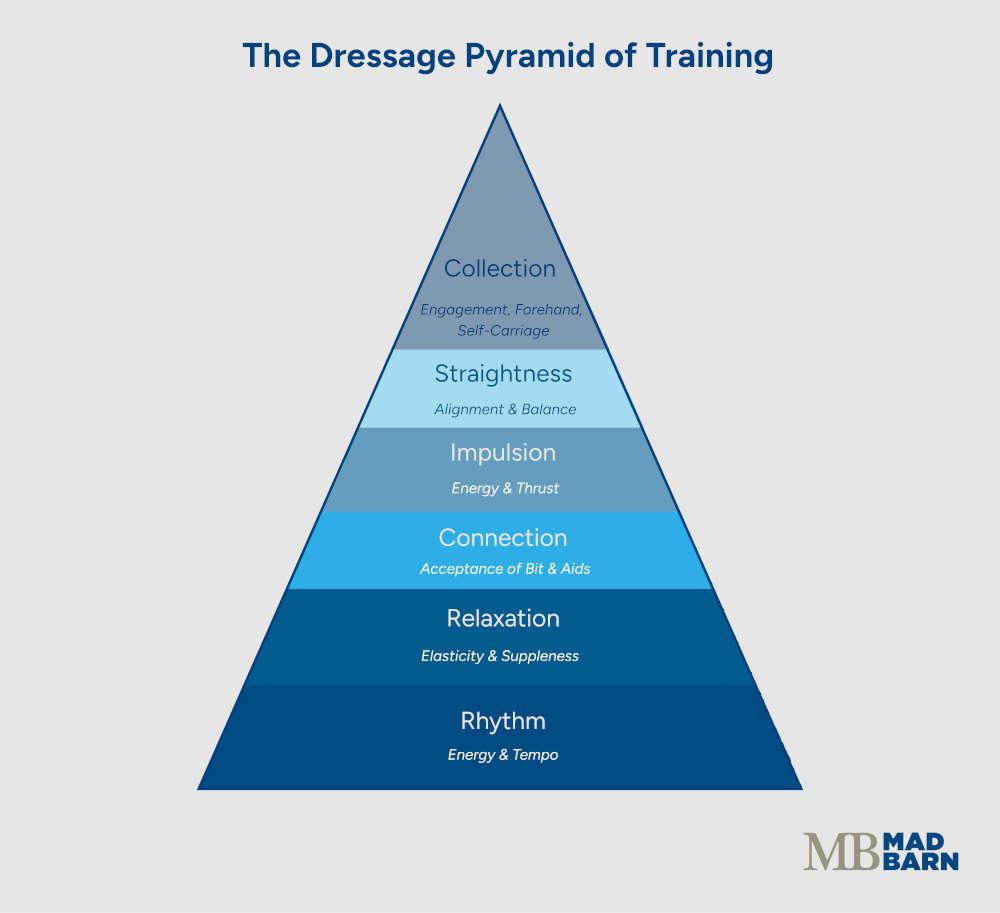
The movement itself then develops throughness, straightness, and early collection, the qualities that form the upper portion of the scale. Walk quality is the foundation for everything else.
Research on how training posture affects back mechanics in elite dressage horses shows that even the horse’s head and neck position during work produces measurable changes in sacral flexion and hindlimb movement, a reminder of how closely posture and engagement are linked. [8]
Prerequisites for the Turn on the Haunches
The turn on the haunches asks more of the horse than it appears to. Introducing it before the necessary foundations are in place tends to produce resistance, stiffness, or frustration on both sides of the saddle.
A Reliable Four-Beat Walk
The turn cannot compromise the quality of the walk. USDF training guidance for this movement states that the value of the exercise depends only on the quality of the walk. [1]
Horses who drag their hind legs, rush, show a lateral tendency, or lose regularity when asked for something new are not ready for the turn on the haunches.
If the walk is inconsistent, address it first through large circles, transitions between walk and trot, and work on long lines where the horse can settle into a clear rhythm. Any persistent irregularity in the walk is worth a veterinary conversation before adding a demanding collecting exercise on top of it.
Responsiveness to Lateral Aids
Before the turn can work, the horse must move readily away from the leg without bracing or running through the aids. Leg yield on a circle in trot is a particularly useful preparation.
Riding the horse on a 20-meter circle and asking it to step outward from the inside leg to the outside rein develops the kind of responsive, forward-seeking reaction that the turn on the haunches requires. [1]
Walk-to-trot and trot-to-halt transitions also support responsiveness. When the horse responds quickly and calmly to both driving and half-halting aids, the rider has the tools to shape the turn with precision.
Straightness & Basic Lateral Suppleness
A horse who is stiff through one side will struggle to bend correctly in both directions during the turn.
Biomechanical research shows that asymmetries in how the horse moves can arise from structural differences, habitual laterality, or compensatory patterns that develop over time. These asymmetries affect how the horse loads the limbs and organizes the stride. [9]
Addressing those asymmetries through systematic straightness work should come before introducing the demands of collection.
Shoulder-fore and shoulder-in at the walk develop the even lateral suppleness that makes both directions of the turn feel accessible. A horse who can maintain even contact, equal bend, and consistent rhythm through these exercises is well prepared to take on the full movement.
How to Ride a Turn on the Haunches
The aids for the turn on the haunches work as a coordinated sequence rather than as separate signals applied one at a time. No single aid does the job alone.
The rider’s task is to prepare the horse, initiate the turn with clear timing, and maintain rhythm and bend through every step until the movement is complete.
Preparation with Half-Halts
Preparation begins several strides before the turn.
Using half-halts, the rider shortens and activates the walk slightly, making the steps more engaged without losing forward energy. The goal is not a fully collected walk but a more attentive, lighter-in-front version of the medium walk. [1]
This preparation is where many turns go wrong before they begin. A horse who arrives at the turn flat, rushing, or inattentive will struggle to organize itself through the movement.
The Aids
Each aid in the turn on the haunches has a specific role. Together, they help the horse stay active, bent, balanced, and clear in the walk.
The aids used to successfully ride a turn on the haunches are: [1][7]
- Seat: The seat shifts inward toward the turn. Research on rider biomechanics shows that even subtle shifts in the rider’s pelvis produce measurable changes in how the horse loads its limbs and organizes its movement.
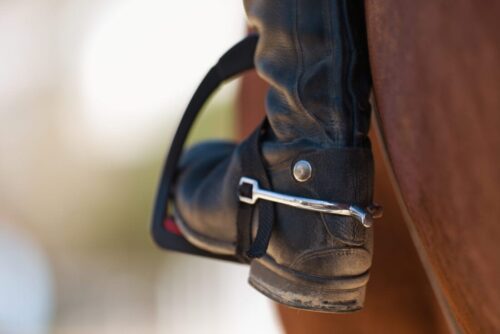
- Inside leg: The inside leg sits at or just behind the girth in a forward-driving role. It maintains activity and bend and, critically, prevents the inside hind leg from stepping sideways, which is one of the most serious faults of the movement.
- Outside leg: The outside leg sits behind the girth in a guarding role. It keeps the haunches from drifting outward and helps sustain energy and engagement through the arc of the turn.
- Inside rein: The inside rein leads the horse into the turn with a soft, guiding feel, creating slight flexion toward the direction of travel. It should guide rather than pull.
- Outside rein: The outside rein prevents excessive bend and allows the outside shoulder to follow the arc of the turn. It is the balancing rein; without it, the turn loses its shape and the horse loses balance.
These aids should feel coordinated, not stacked on top of one another. Riders can refine this communication by improving their own position and timing, especially through work on riding posture and consistent use of rider aids.
Exercises to Build the Turn on the Haunches
Building the turn on the haunches through progressive exercises gives horse and rider the repetitions they need without drilling a single movement into resistance. These exercises also help preserve the horse’s forward thinking, which is essential for a turn that stays active rather than stuck.

Quarter Turns in the Corner
Quarter turns are the best starting point for most horses.
Ride an active working trot down the long side, prepare the horse with half-halts before the corner marker, and transition to walk at the marker. Walk deeply into the corner, execute a quarter turn on the haunches, then transition back to trot at the end of the turn. [1]
The corner gives the horse a natural boundary and helps the rider feel the shape of the turn before asking for it in open space. The trot transitions before and after keep the horse active and thinking forward, which is exactly the quality the turn requires.
The Rectangle Exercise
From a 20-meter circle at the walk, change the shape to a rectangle and execute a quarter turn on the haunches at each corner. Ride the rectangle several times in one direction, then transition to trot on the circle and change rein before repeating. [1]
The rectangle provides repeated quarter turns within a shape that the horse can navigate predictably. It also highlights straightness after the turn, since the horse must return to a true, aligned walk after each corner.
Using Shoulder-Fore as Preparation
Riding a few steps of shoulder-fore before entering the turn positions the forehand, creates hindquarter engagement, and establishes the correct bend.
Equine physiology literature describes how brief periods of lateral exercise before a session can activate key stabilizing muscles and improve the horse’s postural readiness for more demanding movements. [10]
When the haunches tend to drift outward, combining shoulder-fore with a firm guarding outside leg going into the turn usually corrects the problem more effectively than trying to address it mid-movement.
Like other gymnastic exercises, the turn on the haunches should fit into a broader conditioning program that develops strength gradually and supports the horse’s long-term soundness.
Common Faults & How to Fix Them
Most problems with the turn on the haunches fall into a few recognizable patterns. Many faults that look like rider errors are actually signs of insufficient preparation or a horse who is not yet strong or supple enough for the movement.
Pivoting or a Stuck Inside Hind Leg
When the inside hind leg roots to the ground instead of stepping actively, the horse is bypassing the engagement of the haunches. This is one of the movement’s most serious faults because it signals the absence of collection. [1]
The fix is counterintuitive for many riders: make the turn larger, not smaller. A larger arc gives the inside hind leg room to step and keeps both hind legs moving.
Add more forward-driving inside leg and review whether the preparation actually engaged the walk before the turn began. [4]
Loss of Walk Rhythm
A walk that becomes lateral, hurried, or irregular during the turn has lost its training value. The turn is only as good as the walk within it.
Return to quarter turns and focus exclusively on maintaining a clear, marching four-beat walk from start to finish. A larger, rhythmically correct turn is always preferable to a smaller, tense one.
Haunches Swinging Out
When the quarters drift outward, the horse is evading the engagement of the inside hind. Keep the outside leg in its guarding position and apply it more actively if the quarters begin to move away from the line of the turn.
Using shoulder-fore for several strides before the turn also helps. If the problem is consistent in one direction, it often points to underlying stiffness on that side that needs to be addressed through straightness work rather than repeated turns.
Falling Through the Outside Shoulder
When the horse leans into or bulges through the outside shoulder, the turn loses shape and the horse tips out of balance. This is usually a sign that the outside rein is too passive or that the inside rein has too much tension, creating bend without the corresponding containment.
Rebalancing with a more active outside rein and checking that the inside rein is guiding rather than pulling usually resolves this quickly. If the horse consistently bulges outward in one direction, review the evenness of contact across all flatwork.
Stepping Backward
Any backward movement during the turn is a serious fault. [1] It indicates that the horse is resisting by shutting down forward energy in response to confusing or conflicting aids. A horse who steps backward is not ready for the movement in its current form.
Increase the forward-driving inside leg significantly and check that the outside rein is not blocking too strongly. Review walk-to-trot and trot-to-walk transitions to rebuild forward responsiveness before returning to the turn.
Table 2. Common turn on the haunches faults and corrections
| Fault | What it usually means | Best correction |
|---|---|---|
| Pivoting or stuck inside hind leg |
|
|
| Loss of walk rhythm |
|
|
| Haunches swinging out |
|
|
| Falling through the outside shoulder |
|
|
| Stepping backward |
|
|
How the Turn on the Haunches Is Judged
Knowing what judges look for helps riders train with sharper focus.
Judges evaluate the turn on the haunches by the same criteria they apply to every movement. The overall impression of ease and correct training carries as much weight as technical accuracy.
What Judges Are Looking For
Judges evaluate the regularity of the four-beat walk throughout, the quality of the bend toward the direction of the turn, the activity of the hind legs, and the fluency of the execution. [2] The turn should appear smooth and willing, with aids invisible to the observer and a horse that moves without resistance or evasion.
Size matters in a specific way. The hind feet should trace an arc of approximately one meter in diameter. A turn executed correctly at that diameter should receive full credit, even if it is larger than a walk pirouette. [4]
Judges do not penalize a correct turn at one meter simply because it is not as small as a pirouette.
Straightness after the turn is also evaluated. The horse should align parallel to the rail when returning to the track, with no drifting.
Scoring and Coefficient
The coefficient of 2 at Second and Third Level gives the turn on the haunches double the point value of a non-coefficiented movement. [4]
A poor turn costs points and can pull down the collective marks for impulsion, submission, and the rider’s correct and effective use of aids. A strong turn can lift all of those scores.
Building a Better Turn on the Haunches
The turn on the haunches is more than a required dressage movement. It is a practical test of whether the horse can stay rhythmic, supple, attentive, and active while beginning to carry more weight behind. When the movement is trained correctly, it helps riders develop the same qualities that support better balance, straighter work, and more advanced collection later on.
A correct turn should never feel like the horse is being spun around a planted hind leg. The inside hind must keep stepping, the walk must remain clear, and the forehand should travel around the haunches in a controlled but fluid arc. Making the turn slightly larger is often the better choice, especially for horses still developing the strength and coordination needed for collected work.
For the rider, the movement rewards careful preparation. Half-halts before the turn, a forward-thinking inside leg, a steady guarding outside leg, and balanced rein aids all matter. If the horse loses rhythm, swings the quarters out, falls through the shoulder, or steps backward, those faults usually point to a missing foundation rather than a need for stronger aids.
Training the turn on the haunches progressively through quarter turns, rectangles, shoulder-fore, and forward transitions keeps the exercise useful and fair to the horse. With patient repetition, the movement becomes a valuable gymnastic tool: one that improves responsiveness, shoulder freedom, hind-end engagement, and the rider’s timing in every part of the dressage work.
Frequently Asked Questions
Here are some frequently asked questions about riding a turn on the haunches:
A turn on the haunches is a dressage movement performed at the medium walk in which the horse moves the forehand around the hindquarters in a small, controlled arc. The horse bends slightly in the direction of travel while the forefeet cross forward and sideways. The inside hind leg should keep stepping actively rather than planting or pivoting. A correct turn stays fluid, rhythmic, and connected through light, consistent contact.
The difference between a turn on the haunches and a walk pirouette is mainly the degree of collection and the size of the turn. A turn on the haunches is ridden from the medium walk, and the hind feet may trace an arc of up to about one meter. A walk pirouette is performed from collected walk, with the inside hind leg stepping nearly on the spot. Trying to make the turn on the haunches too small often causes the inside hind leg to get stuck or the walk rhythm to deteriorate.
You should start introducing the turn on the haunches once your horse has a reliable four-beat walk, responds calmly to leg and rein aids, and has some experience with basic lateral work. Helpful prerequisites include leg yield, shoulder-fore, walk-trot transitions, and the ability to stay soft in both reins. The horse should move away from the leg without bracing, rushing, or losing rhythm. If the walk becomes irregular or tense when new exercises are introduced, strengthen the basics before adding the turn.
The aids for a turn on the haunches combine seat, legs, and reins in a coordinated sequence. The rider prepares with half-halts, shifts the seat slightly toward the direction of the turn, and uses the inside leg at or just behind the girth to maintain bend and forward activity. The outside leg guards behind the girth to prevent the haunches from swinging out. The inside rein guides the flexion, while the outside rein controls the outside shoulder and keeps the turn balanced.
You should start with quarter turns before asking for a full half turn on the haunches. Quarter turns give the horse a smaller, clearer task and help the rider develop the timing needed to coordinate the aids. They also make it easier to preserve the walk rhythm and correct mistakes before they become habits. Progress to the 180-degree half turn only when the quarter turn is consistent, active, and correct in both directions.
A horse's inside hind leg usually pivots instead of stepping when the turn is too small, the walk lacks activity, or the rider is not using enough forward-driving inside leg. The inside hind should step up and down actively rather than root to the ground. Making the turn slightly larger gives the hind leg room to keep moving. Reestablishing an active walk before the turn is often more effective than trying to correct the pivot once the horse is already stuck.
You can stop the haunches from swinging out by keeping the outside leg behind the girth in a clear guarding role. If the quarters begin to drift, the outside leg should become more active while the rider maintains bend and forward energy from the inside leg. Riding a few steps of shoulder-fore before the turn can also help place the shoulders and keep the haunches aligned. If the problem is worse in one direction, it may point to stiffness or unevenness that needs separate straightness work.
If your horse loses walk rhythm in the turn, make the exercise easier and return to a larger, simpler version. A correct turn on the haunches depends on a clear four-beat walk from start to finish. Go back to quarter turns, use transitions to refresh forward energy, and avoid making the turn smaller than the horse can handle. A larger turn with a regular walk is better training than a small, tense turn that becomes lateral or hurried.
Stepping backward during a turn on the haunches is a serious fault because it shows the horse has lost forward intent. It often happens when the aids are confusing, the outside rein blocks too strongly, or the horse is not prepared to stay active through the turn. The correction is to restore forward response with the inside leg and revisit basic walk-trot and trot-walk transitions. A horse that backs up in the movement is usually not ready for the turn in its current form.
The correct size for a turn on the haunches allows the hind feet to describe an arc of no more than about one meter in diameter. This size is appropriate for the movement and should not be confused with the much smaller walk pirouette. Judges expect the inside hind leg to keep stepping actively within that arc. A turn that is too small for the horse's strength often creates pivoting, tension, or loss of rhythm.
The half turn on the haunches is first required at Second Level, beginning with Test 2. It continues to appear through Third Level before developing into the half walk pirouette at Fourth Level. At these levels, the movement tests the horse's ability to maintain walk quality while beginning to carry more weight behind. It also tests the rider's preparation, timing, and control of the shoulders and haunches.
A coefficient of 2 for the turn on the haunches means the judge's score for that movement is doubled when calculating the final score. For example, a score of 7 becomes 14 points, while a score of 5 becomes 10 points. Because the movement carries extra weight at Second and Third Level, mistakes can be costly. A well-prepared, fluent turn can also be a valuable place to gain points.
Judges score the turn on the haunches by looking at the quality of the walk, the activity of the hind legs, the bend, the fluency of the turn, and the straightness afterward. The horse should remain willing, balanced, and on the bit without resistance. The inside hind leg must keep stepping, and the forehand should move around the haunches in a clear, controlled arc. A correct turn looks organized and easy rather than forced or overmanaged.
The turn on the haunches can be a useful training exercise even for horses that are not preparing for a dressage test. It helps develop shoulder mobility, sensitivity to the rider's leg and weight aids, and early collection. The movement also gives riders a practical way to test whether the horse can stay active, supple, and balanced in the walk. Used thoughtfully, it supports more advanced work without needing to drill the horse.
You should practice the turn on the haunches sparingly in one ride, focusing on a few high-quality attempts instead of repetition. Two or three good turns in each direction are usually more useful than drilling the movement. Too much repetition can make the horse anticipate, tense, or lose the purity of the walk. End the exercise when the horse gives a correct, active, and relaxed effort.
Summary
The turn on the haunches is a foundational dressage movement that develops early collection, shoulder freedom, responsiveness, and balance. When trained progressively, it helps horse and rider prepare for more advanced collected work while preserving the quality of the walk.
- A turn on the haunches is performed from medium walk with the forehand moving around the hindquarters
- The movement introduces collection without requiring the same degree of engagement as a walk pirouette
- Correct preparation depends on a clear four-beat walk, lateral responsiveness, straightness, and suppleness
- Quarter turns, rectangle exercises, shoulder-fore, and forward transitions help build the movement progressively
- Faults such as pivoting, loss of rhythm, drifting haunches, and stepping backward usually signal missing foundations
References
- Lesson Topic: Turn on the Haunches. USDF. 2012.
- Lesson Topic: Pirouette in Walk and Canter. USDF. 2012.
- Dressage Rules & Equipment. USEF. 2025.
- Rhodin. M. et al. The Effect of Different Head and Neck Positions on the Caudal Back and Hindlimb Kinematics in the Elite Dressage Horse at Trot. Equine Vet J. 2009.
- Byström. A. et al. The Movement Pattern of Horse and Rider in Different Degrees of Collection at the Trot. Equine Vet J. 2010.
- Clayton. H. M. et al. The Role of Biomechanical Analysis of Horse and Rider in Equitation Science. Vet J. 2017.
- Clayton. H. M. A Review of Biomechanical Gait Classification with Reference to Collected Trot, Passage and Piaffe in Dressage Horses. Animals (Basel). 2019.
- Clayton. H. M. Riders' Effects on Horses - Biomechanical Principles with Examples from the Literature. Animals. 2023.
- Ballou. J.Equine Physiology and Fitness. Horse Journals. 2022.
- Foy. J. How to Judge and Ride Turn on the Haunches and Walk Pirouettes. Dressage Today. 2023.