English

Pentoxifylline for horses is a prescription medication that veterinarians may use as part of a broader treatment plan for conditions involving poor microcirculation or inflammatory responses. In equine practice, it is most often discussed as an adjunct therapy rather than a first-line or stand-alone treatment.
Pentoxifylline may be considered for conditions such as cutaneous vasculitis, endotoxemia, navicular-region pain, selected hoof or skin concerns, and some reproductive conditions.
There is currently no marketed veterinary pentoxifylline product for horses in North America, so treatment may involve human tablets or a compounded preparation prescribed under veterinary supervision. Pentoxifylline is also regulated in equestrian sport, making veterinary guidance essential for dosing, monitoring, and competition withdrawal planning.
Keep reading to learn how pentoxifylline works, when veterinarians may use it, what safety precautions owners should understand, and how its regulatory status affects competition horses.
Pentoxifylline for Horses
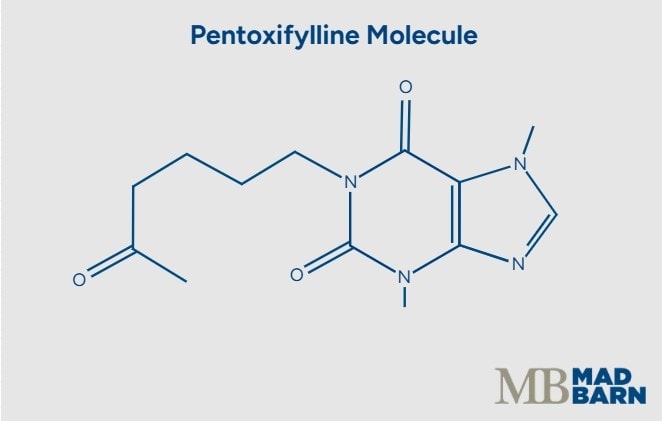
Pentoxifylline (sometimes abbreviated PTX) is a synthetic xanthine derivative related to caffeine and theophylline. In horses, veterinarians may prescribe it off-label as adjunctive therapy to help manage conditions such as: [1][2]
- Cutaneous vasculitis
- Endotoxemia
- Navicular disease
- Certain hoof or skin concerns
Laboratory studies show that pentoxifylline can increase red blood cell deformability, allowing cells to pass more easily through small blood vessels, and may also reduce blood viscosity, potentially improving microcirculation in select cases. [1][3][4]
Pentoxifylline is used less commonly in equine medicine than many standard medications, and responses can vary among horses. Some proposed effects, including reduced platelet aggregation, have not been demonstrated consistently in equine research. [1][5]
Available Forms
The U.S. Food and Drug Administration’s Center for Veterinary Medicine does not list any approved pentoxifylline products for horses.
Health Canada’s Drug Product Database lists currently marketed Canadian pentoxifylline products only for human use; previously marketed veterinary products for horses are no longer available. [2][6][7][8][9]
Forms that may be used under veterinary direction include: [1][2][6][7][8][9]
- Human products marketed in Canada: Apo-Pentoxifylline SR® and Jamp Pentoxifylline SR®
- Other human products no longer marketed in Canada: Trental®, Trental SRT®, Nu-Pentoxifylline-SR®, and Ratio-Pentoxifylline®
- Former veterinary products for horses: Navicon® and Navicon Pwr 2g® (Vetoquinol/Sterivet) were oral powders labelled for horses but are no longer marketed in Canada
- Compounded oral pastes or suspensions: These may be prepared by a compounding pharmacy for an individual horse
- Injectable solutions: These may be prepared for veterinary use in research or clinical settings but are not a routine barn option for owners
What's your top priority with your horse's health?

What's your top priority with your horse's health?
Drug Class: Hemorheologic & Immunomodulatory Agents
Pentoxifylline is classified as a hemorheologic agent, meaning it changes how blood flows, and an immunomodulatory agent, meaning it can alter immune system activity.
It belongs to the methylxanthine family of drugs, which also includes caffeine, naturally found in coffee and tea, and theophylline, found in tea. [1]
Other medications sometimes discussed for their effects on equine microcirculation or digital blood flow include vasodilators such as acepromazine and topical glyceryl trinitrate. [10]
Mechanism of Action
Pentoxifylline’s full mechanism of action is not completely understood. Its proposed effects include: [1][3][4]
- Increasing red blood cell flexibility by inhibiting phosphodiesterase within the cells
- Lowering blood viscosity by reducing plasma fibrinogen and supporting fibrinolytic activity
- Reducing inflammatory cytokine effects associated with elevated endotoxins, also through phosphodiesterase inhibition
Exercise studies in Thoroughbreds have shown improved red blood cell filterability, a measure of cell flexibility, after oral pentoxifylline treatment.
Filterability describes how easily red blood cells can deform and squeeze through very small openings, similar in size to the smallest blood vessels. Better filterability means the cells move through these narrow spaces more easily, which could support blood flow through the microcirculation.
Researchers suggested that improved red blood cell deformability could reduce resistance as cells pass through the very small capillaries of the lungs during intense exercise. In theory, this could lessen mechanical stress on pulmonary capillaries when blood flow and pressure are high, which is relevant because capillary stress is thought to contribute to exercise-induced pulmonary hemorrhage (EIPH). [3]
However, the study measured changes in red blood cell filterability, not whether pentoxifylline actually reduced the frequency or severity of EIPH. The proposed benefit therefore remains a possible mechanism rather than demonstrated clinical prevention.
Importantly, an equine whole-blood study found that pentoxifylline did not slow platelet aggregation as some human data had suggested. At clinically relevant concentrations, collagen-triggered aggregation began sooner, challenging the use of pentoxifylline primarily as an antiplatelet treatment in horses. [5]
Uses in Horses
There is currently no pentoxifylline product approved for use in horses by either the FDA or Health Canada. Health Canada previously authorized Navicon® oral powder for horses, but it is no longer marketed. [1][2][6][7][8]
Current North American product listings are for human sustained-release tablets, so their use in horses is extra-label (off-label). [1][2]
In veterinary medicine, extra-label use is permitted when a veterinarian determines it is appropriate for an individual animal and prescribes the medication within a valid veterinarian-client-patient relationship. This allows veterinarians to use approved human or animal drugs in a different species, dose, route, or condition when no suitable approved veterinary option is available.
Uses described in clinical handbooks reflect veterinary practice rather than approved indications for a currently marketed equine product.
Cutaneous Vasculitis & Related Skin Disease
Veterinarians may use oral pentoxifylline as adjunctive therapy for cutaneous vasculitis and related immune-mediated skin conditions when improved microcirculation or immunomodulation may support healing. Clinical responses have been described after courses lasting several weeks under veterinary monitoring. [1]
Pentoxifylline has also been discussed as an adjunct for equine pastern dermatitis when topical treatment and other immunomodulatory care have not resolved signs after approximately two weeks. Its use remains a veterinary decision and is not a stand-alone cure. [1]
Signs that may prompt evaluation for vasculitis or related dermatitis include: [1]
- Painful or warm skin lesions, crusting, or swelling
- Hair loss or pigment changes in affected areas
- Lameness or reluctance to move when the limbs or pasterns are involved
- Poor response to basic wound or crust care
These signs can have several causes, so diagnosis helps guide the treatment plan.
Endotoxemia
Endotoxemia is a dangerous systemic inflammatory state often associated with severe gastrointestinal disease or other infections. Bacterial cell-wall fragments called endotoxins circulating in the blood can drive fever, dullness, cardiovascular stress, and the release of inflammatory mediators. [4]
Pentoxifylline has been studied as adjunctive support to reduce inflammatory effects of endotoxin. In an experimental model, flunixin meglumine improved fever and some clinical signs more clearly than pentoxifylline alone. The combination produced effects that may have balanced selected changes better than either drug alone, but the study did not demonstrate a survival benefit. [4]
The combined use of pentoxifylline and non-steroidal anti-inflammatory drugs (NSAIDs) for endotoxemia has been explored with inconsistent results. A veterinarian must determine whether combination therapy is appropriate for the individual horse. [1][4]
Pentoxifylline is not a substitute for veterinary care, including fluids, pain management, surgery when indicated, or treatment of the underlying cause of endotoxemia. [4]
Navicular Disease & Podotrochlear Circulation
Navicular syndrome, also called podotrochlear syndrome, causes chronic forelimb pain involving the navicular bone and nearby soft tissues. Some treatment plans include pentoxifylline in an effort to improve local circulation. [1][5]
This use developed partly from human medicine where pentoxifylline has demonstrated efficacy in treating microthromboses (very small blood clots) in select cases. [5] However, equine platelet research does not support pentoxifylline as a reliable way to reduce platelet aggregation, and benefits for digital or laminar blood flow have not been demonstrated consistently in healthy horses. [10]
Signs that may accompany navicular-region pain include: [1]
- Forelimb lameness that may shift or worsen on hard ground
- A shortened or choppy stride
- Pointing a front foot or reluctance to turn tightly
- A positive response to diagnostic nerve blocks or imaging findings involving the podotrochlear apparatus
Laminitis Support
Laminitis involves painful separation of the tissues that attach the coffin bone to the hoof wall. The potential vascular, inflammatory, and enzyme pathways that may be impacted by pentoxifylline administration in cases of laminitis have all been investigated.
Laboratory vessel studies have demonstrated that pentoxifylline can dilate equine digital veins and has anti-inflammatory properties of interest, but oral administration has not reliably changed digital or laminar blood flow in healthy horses. Given this, clinical evidence for its use in laminitis remains uncertain. [10]
Placentitis
Some reproductive protocols include oral pentoxifylline for mares with placentitis, or inflammation of the placenta. The goal is to support placental oxygenation as part of a broader antimicrobial and hormonal treatment plan. [1] This use is extra-label and veterinarian-directed.
Exercise-Induced Pulmonary Hemorrhage (EIPH)
Exercise-induced pulmonary hemorrhage (EIPH) is bleeding that occurs in the lungs of some horses during strenuous exercise, particularly racehorses and other high-performance horses. It is thought to result when very high pressures in the pulmonary blood vessels contribute to stress and rupture of small capillaries in the lungs.
Pentoxifylline has been studied because its effects on red blood cell deformability may allow blood cells to move more easily through these small vessels and potentially reduce mechanical stress within the pulmonary circulation.
However, improved red blood cell deformability does not demonstrate that pentoxifylline prevents or treats EIPH in horses. [3]
Administration Routes
Pentoxifylline is most often administered to horses by the following routes: [1]
- Oral: Human extended-release tablets, which may sometimes be crushed and mixed as directed, or compounded oral formulations
- Intravenous: Injectable preparations used in research and some clinical settings
Giving pentoxifylline with food may reduce digestive upset. Do not crush human tablets, change the dose, or extend treatment without veterinary direction. Absorption and blood levels can vary among horses and may change over several days of treatment. [1]
Storage
Store pentoxifylline tablets in a well-closed container, protected from light and excessive moisture, at room temperature between 15 and 30°C (59 to 86°F). Keep the medication out of reach of children and animals. [1]
Avoid storing tablets in areas exposed to large temperature changes, direct sunlight, or high humidity. Keep them in their original or pharmacy-labelled container so the drug name, concentration, expiry date, and dosing instructions remain available.
Storage requirements may differ for compounded formulations, including flavored powders, capsules, or liquid preparations. Follow the storage and expiry instructions provided by the compounding pharmacy or veterinarian, including refrigeration requirements if specified.
Do not use pentoxifylline past its expiry date or if the medication shows unexpected changes in appearance, odor, or consistency. Ask your veterinarian or pharmacist how to dispose of expired or unused medication rather than giving it to another horse or saving it for future use.
Safety Warnings & Precautions
Use pentoxifylline only when a veterinarian determines that the potential circulatory or immunomodulatory benefits outweigh the risks for the individual horse. It is not a cure-all for laminitis, navicular disease, or skin conditions. [1][5][10]
Additional caution may be required in the following situations: [1][5]
- The horse receives NSAIDs, anticoagulants, or other drugs that affect bleeding or blood pressure
- Liver or kidney disease is present
- Surgery or acute vascular injury is planned or recent
Monitoring
Veterinary monitoring during a course of pentoxifylline may include the following: [1]
- Appetite, manure output, attitude, and comfort
- Changes in skin lesions or lameness scores, depending on the reason for treatment
- Heart rate and sweating after intravenous administration
- Whether the clinical response persists over days to weeks, because bioavailability may change in some horses
Contraindications
Contraindications are circumstances in which a medication should be avoided or used only with caution.
Pentoxifylline should generally be avoided or used only with close veterinary supervision in horses with the following conditions: [1]
- Known intolerance or hypersensitivity to pentoxifylline or other xanthines, such as theophylline, caffeine, or theobromine
- Cerebral or retinal hemorrhage
- Severe liver or kidney impairment
- A high risk of hemorrhage or concurrent use of strong anticoagulant or antiplatelet therapy
Safety in pregnancy has not been established fully. Pentoxifylline should be used in pregnant or lactating mares only when a veterinarian determines that the potential benefits outweigh the risks. [1]
Because equine data suggest that pentoxifylline may hasten the onset of collagen-triggered platelet aggregation, some clinicians use additional caution in surgical candidates or horses with acute vascular trauma when the intended treatment goal is to reduce clotting tendency. [5]

Side Effects
Oral pentoxifylline is generally well-tolerated in horses, but ongoing monitoring remains important. [1]
Possible side effects include: [1]
- Reduced appetite or digestive upset
- Excitement or nervousness
- After intravenous administration, a transient increase in white blood cells, muscle fasciculations (twitching), sweating over the shoulders and flanks, and a mild increase in heart rate
Rare effects reported in other species include dizziness, headache, or other cardiovascular effects; horses should be monitored for dullness, weakness, or unusual behavior. [1]
Acute Toxicity (Overdose)
Human overdose reports describe flushing, seizures, low blood pressure, unconsciousness, agitation, fever, drowsiness, digestive distress, and changes in heart rhythm. There is no specific antidote; treatment is supportive and may include gastrointestinal decontamination when appropriate. [1]
If you suspect that your horse received too much pentoxifylline, consumed another animal’s tablets, or had an adverse reaction, take the following steps:
- Move the horse to a quiet stall if it is safe to do so
- Do not give additional medications or home remedies unless directed by a veterinarian
- Do not attempt gastrointestinal decontamination, place a nasogastric tube, or perform rectal palpation
- Contact your veterinarian immediately, or call an emergency clinic if your regular veterinarian is unavailable
Seek help even if the horse appears healthy. Prompt care is especially important if the horse collapses, has a seizure, becomes severely dull, develops irregular breathing or uncontrolled bleeding, or cannot stand safely.
Drug Interactions
Reported or theoretical interactions with pentoxifylline include: [1]
- Antihypertensive drugs: May increase blood-pressure-lowering effects
- NSAIDs: Follow the veterinarian’s treatment plan rather than combining these drugs independently
- Platelet-aggregation inhibitors: Drugs such as aspirin or clopidogrel may increase bleeding risk
- Theophylline: Blood concentrations of theophylline may increase
- Warfarin and other anticoagulants: Concurrent use may increase bleeding risk and require closer monitoring
Regulatory Status & Legal Considerations
Pentoxifylline is a prescription medication. Health Canada’s Drug Product Database lists Apo-Pentoxifylline SR® and Jamp Pentoxifylline SR® as currently marketed human sustained-release tablets. Older human brands, including Trental®, are listed as cancelled post-market. [6][7][9]
Health Canada previously authorized Navicon® and Navicon Pwr 2g® veterinary oral powders labelled for horses. Those products are no longer available, and there is currently no marketed veterinary pentoxifylline product available in Canada.
The use of human tablets in horses is extra-label and requires a valid veterinarian-client-patient relationship and compliance with local prescribing rules. [1][2][6][7][8]
Racing regulators have long treated pentoxifylline as a restricted substance. Always check the current rules of the racing authority or federation governing the competition. [1]
Status in Competition
Under FEI rules, substances may be classified as Banned Substances, which are never permitted in a competition horse, or Controlled Medications, which are therapeutic substances that must not be present during an FEI event. For more information, see the guide to FEI Banned and Controlled Substances. [11]
Pentoxifylline appears on the 2026 FEI Equine Prohibited Substances List as a Controlled Medication with the classification “Vasoprotective.” It may have a legitimate therapeutic use, but it is prohibited during FEI competition and must clear the horse’s system before competition according to a veterinarian-planned withdrawal period. [11]
Pentoxifylline does not appear on the 2024 FEI List of Detection Times. [12] A detection time is a laboratory guide to how long a drug may remain detectable; it is not the same as a withdrawal time. When no detection time is published, the treating veterinarian must establish a cautious withdrawal plan based on the dose, route, individual horse, and an appropriate safety margin.
National federations and racing authorities may apply their own rules and testing thresholds. Always check the current FEI list and the regulations for your sport before treating a competition horse. [11][12]
Frequently Asked Questions
Here are some frequently asked questions about pentoxifylline use in horses:
Pentoxifylline is used in horses as an adjunctive treatment for conditions in which altered microcirculation or inflammatory signaling may contribute to disease. Veterinarians may prescribe it for cutaneous vasculitis, persistent pastern dermatitis, endotoxemia, navicular disease, placentitis, and selected hoof-related conditions. Its benefits vary by condition, and it is not considered a stand-alone cure for laminitis, lameness, or skin disease. [1][3][6]
Pentoxifylline is not currently marketed as an approved veterinary product for horses in the United States or Canada. Veterinarians may prescribe human sustained-release tablets or compounded formulations extra-label when they determine that treatment is appropriate. Former Canadian equine products such as Navicon® are no longer marketed. [1][8][9][10][11]
Pentoxifylline works by changing certain properties of blood flow and immune activity, although its full mechanism is not completely understood. It may make red blood cells more flexible, reduce blood viscosity, support clot breakdown, and decrease the effects of inflammatory cytokines associated with endotoxin. Equine research has not shown that it reliably prevents platelet aggregation, so it should not be viewed primarily as an anti-platelet medication in horses. [1][2][3][4]
Pentoxifylline may improve some aspects of circulation in horses by increasing red blood cell flexibility and reducing blood viscosity. Exercise studies have found improved red blood cell filterability, but oral treatment has not consistently increased digital or laminar blood flow in healthy horses. Whether these effects provide a meaningful clinical benefit depends on the horse's condition and response to treatment. [1][2][6]
Pentoxifylline may help horses with cutaneous vasculitis or persistent pastern dermatitis when impaired microcirculation or immune-mediated inflammation is involved. It is generally used as an adjunct to appropriate skin care and treatment of the underlying cause rather than as a stand-alone therapy. A veterinarian should evaluate painful lesions, swelling, crusting, hair loss, lameness, or skin disease that does not improve with basic care. [1]
Pentoxifylline is sometimes included in treatment plans for navicular disease in hopes of supporting circulation within the foot. However, equine studies do not establish it as a reliable anti-platelet drug or prove consistent improvements in digital blood flow. It should be considered a possible adjunct rather than a proven primary treatment for podotrochlear pain. [1][4][6]
Pentoxifylline is not a proven primary treatment for laminitis in horses. Its vascular and anti-inflammatory effects have attracted research interest, but oral administration has not reliably changed digital or laminar blood flow in healthy horses, and clinical benefits remain uncertain. Treating the trigger, controlling pain, providing hoof support, and following an appropriate rest plan remain central to laminitis management. [6]
Pentoxifylline may be used as adjunctive support for endotoxemia because it can affect inflammatory cytokine responses to endotoxin. Experimental research found that combining pentoxifylline with flunixin produced benefits for selected measurements, although a survival benefit was not established. Pentoxifylline does not replace fluids, pain control, surgery, or treatment of the disease causing endotoxemia. [1][3]
Pentoxifylline is usually given to horses by mouth using human sustained-release tablets or an oral formulation prepared by a compounding pharmacy. Intravenous administration has been described in research and clinical settings, but it is not a routine owner-administered treatment. The prescribed product, route, schedule, and treatment duration should be followed exactly. [1]
Pentoxifylline tablets may sometimes be crushed and mixed for oral administration when specifically directed by the prescribing veterinarian. Owners should not crush sustained-release tablets or change how a formulation is given without professional instructions because doing so may alter drug delivery. Administration decisions should account for the exact product and the individual horse's treatment plan. [1][9][10]
Pentoxifylline may be given with food when directed because food can help reduce digestive upset. The medication should still be administered according to the prescription label, especially when a compounded product or sustained-release tablet is used. Reduced appetite, manure changes, or other digestive problems should be reported to the veterinarian. [1]
Pentoxifylline side effects in horses can include reduced appetite, digestive upset, excitement, or nervousness. Intravenous administration may cause temporary sweating, muscle twitching, an increased heart rate, or a short-lived increase in white blood cells. Severe colic signs, collapse, breathing difficulty, bleeding, hives, facial swelling, or sudden behavioral changes require prompt veterinary attention. [1]
If a horse receives too much pentoxifylline, contact a veterinarian or emergency clinic immediately, even if the horse initially appears normal. Do not give additional medications or home remedies unless directed, and keep the horse in a quiet, safe location if possible. Collapse, seizures, severe dullness, abnormal breathing, uncontrolled bleeding, or an inability to stand safely are emergency warning signs. [1]
Medications that can interact with pentoxifylline include anticoagulants, platelet inhibitors, blood pressure medications, theophylline, and certain NSAIDs. Combining it with aspirin, clopidogrel, warfarin, or other drugs that affect clotting may increase bleeding concerns, while theophylline concentrations may rise. A veterinarian should review every medication and supplement the horse receives before treatment begins. [1]
Pentoxifylline should generally be avoided in horses with a known sensitivity to pentoxifylline or related xanthines, cerebral hemorrhage, or retinal hemorrhage. Close veterinary oversight is also needed for horses with severe liver or kidney impairment, a high bleeding risk, recent vascular trauma, or concurrent anticoagulant treatment. It should not be started without a veterinarian or used as a substitute for emergency or condition-specific care. [1][4]
Pentoxifylline has not been proven safe for pregnant or nursing mares. High doses have caused fetal harm in laboratory animal studies, and the drug and its metabolites can appear in milk. It should only be used when a veterinarian determines that the potential benefits outweigh the risks to the mare and foal. [1]
Pentoxifylline can be used for courses lasting several weeks in some horses, but long-term treatment requires veterinary monitoring. Absorption and bioavailability may change during continued administration, and the apparent benefit can fade in some horses. Appetite, manure, behavior, clinical response, other medications, and competition plans should be reviewed throughout treatment. [1]
If a pentoxifylline dose is missed, contact the prescribing veterinarian for instructions. Do not double the next dose unless the veterinarian specifically directs you to do so. Advice may depend on the formulation, dosing schedule, and reason the horse is receiving the medication.
Pentoxifylline is an FEI Controlled Medication classified as a vasoprotective drug, rather than an FEI Banned Substance. It may be used therapeutically under veterinary direction, but it must not be present in a horse during an FEI competition. National federations and racing authorities may apply different rules, so the current regulations for the horse's discipline must be checked before treatment. [5]
The withdrawal period for pentoxifylline must be determined by the treating veterinarian because the drug does not appear on the FEI List of Detection Times 2024. A laboratory detection time is not the same as a withdrawal time, and an appropriate safety margin must account for the dose, route, treatment duration, and individual horse. Competition owners should consult both their veterinarian and the current rules of the relevant federation or racing authority. [5][7]
Summary
Pentoxifylline is an extra-label prescription medication that veterinarians may use as adjunctive therapy for conditions involving impaired microcirculation or inflammation in horses.
- Pentoxifylline may improve red blood cell flexibility and alter inflammatory activity, but its clinical effects vary among horses
- Veterinarians may consider it for cutaneous vasculitis, endotoxemia, navicular-region pain, placentitis, and selected hoof or skin conditions
- Evidence does not consistently support pentoxifylline as an antiplatelet treatment or as a reliable way to improve digital or laminar blood flow
- Pentoxifylline is an FEI Controlled Medication and must not be present in a horse during FEI competition
References
- Budde. J. A. and McCluskey. D. M. Plumb's Veterinary Drug Handbook. 10th ed. Wiley-Blackwell. 2023.
- Vetoquinol N.-A. Inc. NAVICON Product Information. Health Canada Drug Product Database. 2001.
- Weiss. D. J. et al. Effects of Pentoxifylline on Hemorheologic Alterations Induced by Incremental Treadmill Exercise in Thoroughbreds. American Journal of Veterinary Research. 1996.
- Baskett. A. et al. Effect of Pentoxifylline, Flunixin Meglumine, and Their Combination on a Model of Endotoxemia in Horses. American Journal of Veterinary Research. 1997.
- Kornreich. B. et al. The Effects of Pentoxifylline on Equine Platelet Aggregation. Journal of Veterinary Internal Medicine. 2010.
- APO-PENTOXIFYLLINE SR Product Monograph. Health Canada Drug Product Database. 2025.
- JAMP Pentoxifylline SR Product Monograph. Health Canada Drug Product Database. 2023.
- NAVICON PWR 2G Product Information. Health Canada Drug Product Database. 1993.
- TRENTAL Product Monograph. Health Canada Drug Product Database. 2011.
- Mitchell. J. D. and Elliott. J. Towards a New Treatment for Equine Acute Laminitis: The Importance of Signalling Pathways. The Veterinary Journal. 2012.
- 2026 Equine Prohibited Substances List. Fédération Equestre Internationale. 2026.
- FEI List of Detection Times 2024. Fédération Equestre Internationale. 2024.