English

Caudal heel pain is one of the most common causes of lameness in horses. This complex condition affects the structures within the horse’s heel region, including the navicular bone, its associated ligaments, and the surrounding soft tissue. Its impact on equine mobility and overall well being makes early identification and management essential for horse owners and veterinarians alike.
Multiple factors contribute to the development of caudal heel pain, including conformation flaws, improper shoeing, excessive workload, or genetic predispositions. Breeds such as Quarter Horses, Thoroughbreds, and Warmbloods, which are commonly used in demanding disciplines, are particularly susceptible.
This article delves into the causes of caudal heel pain in horses. Whether you’re a rider, trainer, or equine health professional, this guide provides insight to help safeguard your horse’s health and maintain performance. Understanding this condition is the first step in ensuring long-term soundness and comfort for your equine companion.
Caudal Heel Pain in Horses
Caudal heel pain, also known as navicular syndrome or podotrochlear syndrome, is a very common cause of lameness in horses of all types and disciplines. [1] Estimates suggest that navicular syndrome accounts for up to one-third of all chronic front limb lamenesses in horses. [1]
Horses with caudal heel pain show signs of progressive lameness, loss of performance, and difficulty turning. [1]
Historically, veterinarians called this syndrome “navicular disease”, referring specifically to the navicular bone within the horse’s foot. Recent improvements in diagnostic imaging allowed veterinarians to evaluate the condition more thoroughly, demonstrating that the navicular bone is not always the affected structure. [1] Other structures in the hoof can also cause the horse’s pain, resulting in similar signs to horses with navicular disease. [1]
Basic Anatomy
The horse’s hoof is a complex structure with several moving parts designed to suspend the horse’s weight. The structures affected in caudal heel pain reside within the hoof capsule. [1] Key components relevant to caudal heel pain include: [1][2]
- Navicular bone
- Navicular suspensory apparatus
- Navicular bursa
- Deep digital flexor tendon (DDFT)
- Distal interphalangeal joint
 Illustration: Dr. Ana Mesa, PhD
 Navicular Bone
The navicular bone is a small, boat-shaped bone residing completely within the horse’s hoof capsule. [1] The bone sits immediately behind the distal interphalangeal joint, the joint between the coffin bone and the short pastern bone. [1]
It acts as a leverage point for the deep digital flexor tendon, which runs over the bottom of the navicular bone on its path to attaching to the coffin bone. [1] This reduces the effort required to bend the distal interphalangeal joint, improving efficiency of the horse’s movement.
Navicular Suspensory Apparatus
The navicular suspensory apparatus is made up of four ligaments: [1]
- Medial collateral sesmoidean ligament
- Lateral collateral sesmoidean ligament
- T ligament
- Impar ligament
The collateral sesamoidean ligaments run between the end of the pastern, cross the pastern joint, to the lateral and medial aspects of the navicular bone. [1] They help keep the navicular bone suspended near the distal interphalangeal joint. [1]
The T ligament is a small ligament between the short pastern bone, deep digital flexor tendon, and the navicular bone. [1] It also helps support the position of the navicular bone. [1]
Finally, the impar ligament runs between the bottom surface of the navicular bone to the coffin bone, attaching at the same location as the DDFT. This ligament helps stabilize the joint between the navicular bone and the coffin bone. [1]
Navicular Bursa
The navicular bursa is a small fluid-filled sac between the horse’s navicular bone and the deep digital flexor tendon. [1] It contains a small amount of lubricating fluid, which helps ensure smooth movement of the DDFT over the navicular bone. [1]
Deep Digital Flexor Tendon
The deep digital flexor tendon is one of the major tendons on the back of the horse’s leg. Its role is to flex the limb and stabilize it when standing still. [1]
The tendon begins high up on the horse’s leg and extends down the limb to attach to the coffin bone. [1] It uses the navicular bone as a leverage point to reduce the energy necessary to bend the coffin joint. [1]
Distal Interphalangeal Joint
The distal interphalangeal joint, also known as the coffin joint, is the joint between the coffin bone and the short pastern. [1] The joint is supported on either side by two short ligaments called the collateral ligaments, and four palmar ligaments on the back of the joint. [1] These ligaments hold the bones in place to prevent damage to the joint surfaces. [1]
Navicular Syndrome
Conditions affecting the navicular bone, the navicular suspensory apparatus, and navicular bursa are the most common cause of caudal heel pain in horses. [1][2] Veterinarians often refer to this condition as “navicular syndrome”. [2]
What's your top priority with your horse's health?

What's your top priority with your horse's health?
Causes
Studies suggest that navicular syndrome is a chronic, degenerative disease, where the tissues in the navicular area slowly deteriorate over time. [2] However, the triggers for this degeneration are currently unknown. [2]
There are three proposed theories regarding the trigger of navicular syndrome: [3]
- Blood clotting in the arteries supplying the navicular bone
- Continuous pressure between the DDFT and the navicular bone leading to degenerative changes over time
- A process similar to osteoarthritis
Of these, the osteoarthritis theory is currently the most accepted. [3] Studies of osteoarthritis in other joints suggest that arthritis develops either when there are abnormal stresses applied to normal cartilage, or normal stresses applied to abnormal cartilage. [1]
Causes of abnormal stress applied to normal cartilage include: [1]
- Traumatic injuries, including ligament or tendon damage
- Repetitive strain injuries
- Inflammation or infection of the joint capsule
- Concussive trauma in athletic horses
Causes of abnormal cartilage include: [1]
- Normal loss of cartilage integrity due to aging
- Abnormalities in cartilage structure present at birth
In both scenarios, the abnormality results in an imbalance in the forces applied to a tissue, resulting in damage to the bony structures. [3]
Studies of navicular syndrome show there are degenerative changes in the cartilage covering the navicular bone, supporting the arthritis theory. [3] Applying this theory to navicular syndrome, possible causes may include: [2]
- Abnormal shape of the navicular bone from birth
- Abnormal hoof conformation changing the forces applied to the navicular bone
- Normal aging changes in the integrity of the cartilage
- Traumatic injuries to the hoof causing damage to internal structures
- Repetitive, concussive injury in performance horses
- Inflammation or infection of the navicular bursa
Risk Factors
Although the precise cause of navicular syndrome is unknown, several studies identified factors that increase a horse’s risk of developing this syndrome. Risk factors may include: [1][3]
- Quarter Horse or Thoroughbred breeding
- Geldings
- History of navicular syndrome in the bloodline, particularly in Warmblood breeds
- Narrow, upright feet with contracted heels
- Horses with small hooves and large bodies
- Poor hoof care, including poorly fitted shoes
- Exercise on hard surfaces
Diagnosis
Diagnosis of navicular syndrome begins with a comprehensive lameness exam. [3] On this examination, the veterinarian evaluates the horse’s conformation and way of going, including observing them at the walk and trot. [3] They may also apply hoof testers to identify any pain in the hoof itself. [3]
Findings on a lameness exam that support a diagnosis of navicular disease include: [3]
- Short, choppy strides at the trot
- Lameness that is worse on a circle or when turning
- Lameness that is worse when trotting on a hard surface
- Pointing the front feet when standing
After performing this initial examination, the veterinarian proceeds to nerve blocks. This diagnostic test involves numbing nerves within the horse’s leg to narrow down the location causing the horse pain.
If the horse becomes sound after a nerve block, the lameness is likely located in the area that was numbed. [3] Most horses with caudal heel pain “block out” to a palmar digital nerve block, which numbs the caudal two-thirds of the foot. [3][4]
To confirm a diagnosis of navicular disease, X-rays, MRI, or CT scanning can identify changes in the navicular bone such as mineralization, bone loss, or enlarged vascular channels. [3]
Other Causes of Caudal Heel Pain
Caudal heel pain can also originate from the deep digital flexor tendon and the distal interphalangeal joint, although these cases are more difficult to diagnose. [2] Newer diagnostic imaging modalities such as MRI or CT scanning are usually necessary to diagnose these conditions. [2]
Deep Digital Flexor Tendonitis
Inflammation or injury to the deep digital flexor tendon can cause caudal heel pain without associated injury to the navicular bone. [2] Changes in the DDFT associated with caudal heel pain include: [2]
- Splitting of the tendon
- Abrasions on the tendon surface
- Injuries to the core of the tendon
Deep digital flexor tendonitis usually results from chronic strain injuries or a sudden traumatic injury. [2] Some horses may be predisposed to injury due to poor tissue structure within their tendon. [2]
Common locations for DDFT tendonitis within the hoof include: [1]
- The attachment point onto the coffin bone
- The segment running over the navicular bone
- The segment just before the navicular bone
Collateral Ligament Desmitis
Desmitis (inflammation) of the collateral ligaments of the distal interphalangeal joint can also cause caudal heel pain. [1] Damage to these ligaments can occur when moving on uneven surfaces, circling, or movements that cause sliding or twisting of the hoof. [2]
Low Ringbone
Other conditions affecting the distal interphalangeal (DIP) joint, such as arthritis, can also cause caudal heel pain. [1] Arthritis of the DIP joint is called low ringbone. [2] This is a degenerative condition resulting either from excess wear of the joint cartilage due to exercise, or natural depletion in the quality of joint cartilage with age. [2]
Horses may develop a hard ridge around their coronary band due to bone proliferation surrounding the joint. [2]
Hoof Imbalances
Some hoof imbalances can cause symptoms of caudal heel pain without affecting the internal structures. [1] However, if left untreated, biomechanical changes within the limb caused by the imbalance may predispose the horse to developing navicular syndrome or other injuries. [1]
Hoof imbalances that may play a role in the development of navicular syndrome include: [5]
- Long-toe, low-heel conformation
- Upright, boxy feet
- Tall, narrow feet

Treatment
Treatment of caudal heel pain depends on the underlying cause. [1] For disease affecting the navicular bone and immediately surrounding structures, the main management strategies are: [2][6]
- Trimming and shoeing adjustments
- Non-steroidal anti-inflammatory medications (NSAIDs)
- Bisphosphonates
- Surgical intervention
Trimming and Shoeing
The goal of trimming and shoeing adjustments in horses with caudal heel pain is to raise the heel, which reduces tension on the DDFT. [2] Common shoeing packages include wedge-heel shoes or egg bar shoes, which support the heel structure. [2]
Shoes with a rolled toe, which eases breakover, are the most common way to shoe a horse with navicular disease. There are many different ways to shoe a horse with caudal heel pain; your farrier will pick the best option.
NSAIDs
NSAIDs are a common pain medication used to treat lameness in horses. The most common NSAIDs in horses are phenylbutazone and firocoxib (Equioxx®). [2] These drugs interrupt the inflammatory processes that trigger pain and may help improve lameness in horses with caudal heel pain. [2]
Bisphosphonates
Bisphosphonates are a class of drugs that slow the rate of bone turnover. [2] These drugs may be useful in navicular syndrome, as they slow bone lysis (bone loss) within the navicular bone. [2] This may slow the rate of degeneration of the navicular bone, prolonging the useful lifetime of the damaged navicular bone. [2]
Surgical Interventions
Surgical interventions are a last resort for horses with caudal heel pain. The most common surgical intervention is a palmar digital neurectomy, which involves cutting the palmar digital nerve as it enters the hoof capsule. This eliminates sensation to the foot, reducing or eliminating lameness. [2]
Neurectomies are controversial in veterinary medicine, as the horse loses its ability to sense its feet and may be predisposed to injuries or infections. [2] Some horses develop rupture of the DDFT after a neurectomy, since they continue to use their injured foot which weakens the already compromised tendon. [2]
Nutrition
Meeting your horse’s mineral and vitamin requirements is essential for maintaining healthy hooves and bones, particularly in horses with caudal heel pain.
Proper hoof structure and function depend on adequate dietary intake of key nutrients, including amino acids, trace minerals, and biotin. Feeding a balanced diet with Mad Barn’s Omneity® mineral and vitamin supplement helps to support hoof growth and integrity.
Omneity® is formulated with a nutritionally effective level of biotin per serving, 100% organic trace minerals, complete B-vitamin fortification, digestive enzymes, and active yeast cultures. This comprehensive formula provides the building blocks for robust hoof growth, supports normal metabolic processes, and helps maintain digestive function.
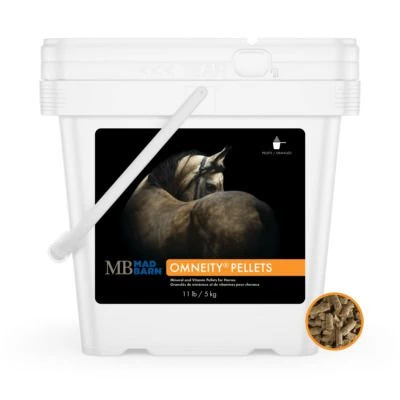
For tailored recommendations to support your horse’s hoof health, submit their diet online for a free evaluation. Mad Barn’s qualified equine nutritionists can help design a balanced feeding program based on your horse’s individual needs.
Frequently Asked Questions
Here are some frequently asked questions about caudal heel pain and navicular syndrome in horses:
Caudal heel pain is a broad term for heel-related lameness, while navicular syndrome refers to pain involving the navicular bone and closely associated structures. Caudal heel pain can also come from the deep digital flexor tendon, coffin joint, collateral ligaments, or hoof imbalance. This distinction matters because treatment depends on which structure is actually causing the horse’s pain.
Navicular syndrome is thought to develop when abnormal stress affects the navicular bone and surrounding tissues over time. Current research supports a process similar to osteoarthritis, where repeated strain, hoof imbalance, aging cartilage, trauma, or inflammation can contribute to degeneration. Some horses may also have inherited conformation or bone shape factors that increase their risk.
Early signs of caudal heel pain often include a short, choppy stride, reduced performance, and lameness that worsens on circles, turns, or hard ground. Some horses also point their front feet while standing to reduce discomfort in the heel region. Since caudal heel pain is usually progressive, mild changes in movement can become more obvious over time.
Caudal heel pain is usually diagnosed through a lameness exam, hoof tester evaluation, nerve blocks, and diagnostic imaging. A horse that improves after a palmar digital nerve block is likely painful in the back part of the foot. X-rays, MRI, or CT scans may then help identify changes in the navicular bone, tendons, ligaments, or nearby joints.
Treatment for navicular syndrome usually combines corrective trimming or shoeing with pain management and, in some cases, medication that affects bone turnover. Farriery changes often aim to raise the heel and ease breakover, reducing tension on the deep digital flexor tendon. NSAIDs, bisphosphonates, or surgery may be considered depending on severity and veterinary findings.
Corrective shoeing can help horses with caudal heel pain by improving hoof balance, supporting the heel, and reducing strain on painful internal structures. Common approaches include wedge-heel shoes, egg bar shoes, or rolled-toe shoes that make breakover easier. The best shoeing plan depends on the horse’s hoof shape, diagnosis, workload, and response to treatment.
Some horses are more at risk of navicular syndrome, especially Quarter Horses, Thoroughbreds, Warmbloods with a family history, and geldings. Conformation can also raise risk, including narrow upright feet, contracted heels, small hooves on a large body, or long-toe, low-heel balance. Poor hoof care and regular work on hard surfaces may add further strain.
Caudal heel pain is often managed rather than fully cured, especially when degenerative changes are already present. Many horses improve with early diagnosis, suitable farriery, workload adjustments, and veterinary treatment. Long-term soundness depends on the underlying cause, the amount of tissue damage, and how well hoof balance and pain are controlled over time.
Nutrition supports hoof and bone health in horses with caudal heel pain by helping meet key vitamin, mineral, amino acid, and biotin requirements. A balanced diet cannot replace veterinary treatment or corrective farriery, but it can support stronger hoof growth and normal tissue maintenance. Diet evaluation is useful when hoof quality, workload, or long-term soundness are concerns.
Veterinary care is needed when a horse shows persistent front-limb lameness, short choppy movement, worsening lameness on turns, or repeated discomfort on hard ground. Caudal heel pain can involve several internal hoof structures, and early evaluation helps identify the source before the condition progresses. Sudden or severe lameness should always be treated as urgent.
Summary
Caudal heel pain refers to any cause of lameness within the back portion of the horse's hoof.
- The most common structure affected in caudal heel pain is the navicular bone
- Other structures that may cause caudal heel pain include the deep digital flexor tendon and the distal interphalangeal joint
- Diagnosis of caudal heel pain requires a thorough lameness examination and diagnostic imaging
- Common treatments for caudal heel pain include trimming and shoeing changes, NSAIDs, and bisphosphonate medications
References
- Baxter. G. M., Ed., Adams and Stashak’s Lameness in Horses. Seventh edition. Wiley-Blackwell, Hoboken, NJ. 2020.
- Ross. M. W. and Dyson. S. J., Diagnosis and Management of Lameness in the Horse. 2nd ed. Elsevier Saunders, St. Louis, Mo. 2011.
- Waguespack. R. W. and Hanson. R. R., Navicular Syndrome in Equine Patients: Anatomy, Causes, and Diagnosis. Compend Contin Educ Vet. 2010.
- Dabareiner. R. M. and Carter. G. K., Diagnosis, Treatment, and Farriery for Horses with Chronic Heel Pain. Veterinary Clinics of North America: Equine Practice. 2003. View Summary
- Parkes. R. S. et al., An Investigation of Risk Factors for Foot-Related Lameness in a United Kingdom Referral Population of Horses. The Veterinary Journal. 2013. View Summary
- Coomer. R. et al., Current Concepts of Navicular Syndrome: Diagnosis and Treatment. In Practice. 2013.