English





![Top 17 Signs of Colic in Horses – [List]](/wp-content/uploads/2024/04/top-17-signs-of-colic-in-horses.jpg)
Colic is one of the most common equine emergencies, characterized by pain in the abdomen. [1] Some types of colic are life-threatening, requiring immediate veterinary intervention. [1]
Currently, colic is a leading cause of death in horses, with some studies indicating that it may be responsible for up to 28% of equine fatalities. [1][2]
It’s important for horse owners to familiarize themselves with common signs of colic so they know when their horse needs prompt medical intervention.
Studies show that rapid identification of colic symptoms improves the chance of a successful outcome, reducing the risk of mortality, and decreasing complications associated with colic surgery. [1]
If your horse is showing signs of colic, your veterinarian’s evaluation is critical to determining whether your horse needs life-saving surgery, or can be managed with medical treatments alone. [1]
Understanding how to accurately describe your horse’s symptoms can help your veterinarian make a treatment decision quickly, ensuring your horse receives critical care as fast as possible. [1]
Signs of Colic in Horses
Knowing the common signs of colic, your horse’s normal behavior, and the basics of horse health examination are important for early detection of colic. Prompt diagnosis and treatment are key to improving treatment outcomes. [1]
Since there are many different causes of colic with ranging severity, the symptoms can vary widely. How colic manifests depends on the condition, severity of disease, and how much pain the horse is in. [1]
In some cases, the timing of when an owner identifies symptoms may also impact interpretation, as horses with severe pain may show milder symptoms if they are exhausted after a period of colicking. [1]
Additionally, individual horses may show varying symptoms for the same condition because some horses are naturally more stoic. [1] These horses may exhibit mild symptoms despite being in severe pain. [1]
What's your top priority with your horse's health?

Enter your email to receive your store credit
Behavioral Symptoms
The behavioral manifestations of colic result from the horse’s abdominal discomfort. [1] Horses may display unusual behavior as they attempt to relieve pain, or when they become frustrated that their attempts to resolve the pain are unsuccessful. [3]
1) Depression (Lethargy)
Depression is a common symptom noticed by owners during a colic episode. [1] In horses, depression refers to the general feeling of discomfort and unease associated with an illness. [4]
Signs of depression in horses include: [1][4]
- Quiet, subdued demeanor
- Disinterest in their environment
- Ears pulled back or down
- Low head carriage
- Reluctance to move
- Reduced appetite
- Disinterest in drinking water
Depression may occur at the beginning of a colic episode, or it can indicate exhaustion after the horse experiences a prolonged period of pain. [1]
Some horses show depression as their primary symptom after a catastrophic, life-threatening event such as internal organ rupture. Rupture of the organ relieves the pressure buildup that causes pain. [5]
2) Flank Watching
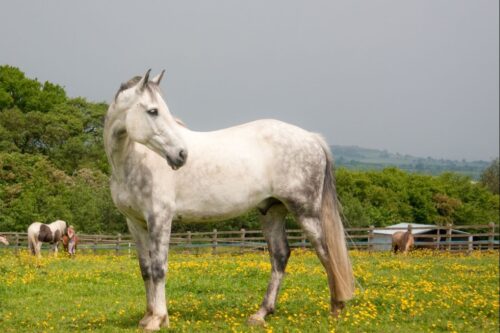
Horses with a painful abdomen may “flank watch”, or turn their head back to glance at their flanks. [1]
This symptom does not necessarily indicate the precise location of the horse’s pain, but shows that the horse is uncomfortable. [1]
3) Restlessness
Abdominal discomfort can cause horses to become restless, as they cannot find a comfortable position to rest in. [1]
Signs of restlessness in horses include: [3]
- Shifting weight between limbs
- Frequently changing activity between resting, standing, laying down, etc.
- Circling or pacing
- Nibbling at bedding or other non-food items
- Biting, mouthing, or rubbing against objects
- Staring off into the distance for long periods
- Frequently repositioning the body while laying down
Restlessness is most common in horses with mild pain. Horses who develop moderate to severe pain usually display more violent behaviors such as rolling. [1][6]
4) Grinding Teeth (Bruxism)
Teeth grinding refers to moving the jaws back and forth while tightly clenched, grinding the molars together. [3] This behavior produces a crunching, squeaking, or scraping sound as the teeth move against each other. [3]
Horses typically grind their teeth as an attempt to relieve the high amounts of stress and discomfort associated with moderate to severe colic. [1]
5) Unusual Postures
Horses with colic often adopt unusual postures as they try to relieve pressure or pain associated with their abdominal discomfort. [1]
Example postures include: [1][3]
- Standing stretched out: this position is similar to a urination posture
- “Dog-sitting”: the horse sits on its hindquarters with its chest elevated
- Crouching: the horse circles and buckles its knees as if to lie down, but does not
- Dorsal recumbency: lying on their back to try and reduce pressure in the abdomen
While in these postures, horses may groan, swish their tails, have their ears pointed backwards, and flank watch. [3]
6) Flehmen Response
The Flehmen response is curling of the upper lip. [1] Typically, horses perform this behavior to maximize their sense of smell, as it allows scents more direct access to the vomeronasal organ, the smelling organ. [3]
Horses with abdominal discomfort frequently show the Flehmen response. [1] Although the exact reason for this behavior is unknown, it is associated with mild to moderate discomfort. [1]

7) Pawing
Pawing is a common symptom of abdominal pain, referring to the horse scraping the ground with one of their forelimbs rhythmically. [1]
Horses with moderate abdominal pain paw frequently, while horses with more mild pain may only paw occasionally. [1]

8) “Tucking Up”
Abdominal pain often causes a “tucked up” appearance of the abdomen, as the horse tenses its abdominal muscles to try and relieve pain. [1]
Horses may also have a hollow appearing flank area and a hunched back. [3] This hollow appearance is often worse in horses who have been uncomfortable for a prolonged period, as the lack of feed and water ingestion makes them dehydrated and reduces their intestinal “fill”. [3]
9) Kicking the abdomen
Kicking at the abdomen refers to flexing a hindlimb so that the hoof or lower limb is brought towards the abdomen, and in some cases contacts the abdomen. [3]
This is typically a sign of moderate abdominal pain. [1]
10) Lying down
Horses experiencing discomfort in their abdomen often lay down in unusual positions or locations. [1][3] For example, horses may choose to lay down in high-traffic areas or on uncomfortable surfaces, and they may lay flat out (lateral recumbency) without sleeping. [3]
Horses laying down out of discomfort often groan, grind their teeth, tense their facial muscles, or quiver their lips as additional signs of pain. [3]
11) Rolling
Rolling is usually associated with a higher degree of pain than laying down. [1] Horses may roll violently when experiencing severe colic symptoms, and owners may be unable to prevent rolling episodes. [1]
Extremely painful horses may collapse suddenly rather than gently lowering themselves before rolling. [4] Some horses may also thrash on the ground by violently convulsing their body to try and relieve the source of pain. [3]
Physical Symptoms
Horse owners can identify some of the physical signs of colic on a basic horse health examination. Owners should be familiar with how to check a horse’s gum color, pulse, respiration (breathing) rate, and gastrointestinal sounds so they can evaluate the health of their animal.
12) Decreased gut sounds
Borborygmi (gut sounds) occur due to mixing of air and fluid in the large colon, producing a gurgling sound. [1] In some cases, a gastrointestinal abnormality causing colic symptoms may decrease intestinal motility, resulting in reduced borborygmi. [1]
Some conditions, such as colonic volvulus, cause a complete absence of borborygmi. [1] Horses with decreased or absent borborygmi have a significantly higher risk of requiring surgical intervention compared to horses with normal intestinal sounds. [5]
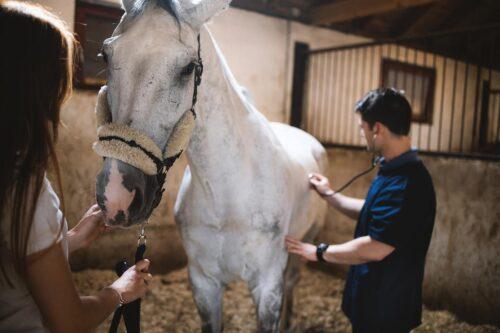
To listen to the gut sounds, owners can use a stethoscope on the horse’s flanks and lower abdomen. [1] Normal horses who have eaten recently usually have mixing sounds 2-4 times per minute, while horses who have an empty intestinal tract produce sounds approximately every 2-4 minutes. [1]
13) Rapid Breathing
Horses experiencing pain often increase their respiratory (breathing) rate. [1] Increasing the respiratory rate allows horses to take shallower breaths, which causes less movement of the abdominal organs and likely reduces pain. [1]
The normal respiratory rate for horses is between 8-12 breaths per minute. [1] Studies show that horses with very high respiratory rates, up to 30 breaths per minute, have a poorer chance of survival than horses with mildly elevated rates. [7][8]
Horse owners can measure their horse’s respiratory rate by watching their abdomen rise and fall with each breath, or by watching the horse’s nostrils flaring as they inhale. [1]
14) Sweating
Horses with severe abdominal pain often sweat profusely. [1] In most cases, the sweating occurs due to increased activity from rolling and restlessness, however horses who develop endotoxemia (bacterial toxins in the blood) may also sweat due to fever. [1]
15) Bloating
Some types of colic cause expansion of the large colon, giving the horse a bloated appearance when viewed from the front or from behind. [1] Many of the conditions that cause bloating are potentially life-threatening and require surgical intervention. [1]
In some cases, the side of the horse that the bloating affects can indicate the cause of colic. For example, distention of the cecum, the large fermentation vat of the intestinal tract, can cause a bloated appearance on the right side of the horse. [1]
Bloating affecting both sides of the horse may indicate large colon volvulus, twisting of the colon. [1]
16) Gum Color Changes
The horse’s gum color reflects the function of their circulatory system, or how well the horse’s heart is delivering blood to the tissues. [1] Several color changes can occur in the gums depending on the type of colic occurring: [1]
- Brick red gums can occur from dehydration or poor blood circulation
- Pale to white gums can occur if there is massive blood loss into the abdomen
- Blue gums indicate poor oxygenation of blood, likely due to abdominal distention preventing deep breathing
In addition, a dark blue “toxic line” around the teeth typically indicates endotoxemia.
Studies on colic case outcomes show that horses with gum color changes are significantly more likely to require euthanasia than colicking horses with a normal gum color. [7][9]
Horse owners should become familiar with the color of their horse’s gums, so that they can identify changes during illness. [1] The normal color of horse gums is pale to bright pink. [1] Some horses have patches of pigmented skin in their mouths, which is normal and present from birth.
17) Elevated Heart Rate
Almost all horses experiencing abdominal discomfort have a higher heart rate, however horses in severe pain can have extremely elevated rates. [1] Horses with life-threatening forms of colic may have heart rates of up to 120 beats per minute during their most painful periods. [1]
Studies show that horses with extremely elevated heart rates have a poorer chance of survival, showing how an elevated heart rate can reflect the severity of internal disease. [5][9][10]
Horse owners can measure their horse’s heart rate by using a stethoscope or by palpating the horse’s pulse. [1] The best location to take a heart rate using a stethoscope is the horse’s left armpit, as this is where their heart sounds are the loudest. [11]
To take a pulse, the facial artery, found at the intersection of the horse’s cheek and the bottom of their jaw, is the most easily accessible location. [11] Feeling gently in this area will reveal a rope-like structure under the skin, which can be gently compressed to feel for the horse’s pulse. [11]
Frequently Asked Questions
Here are answers to common questions about colic signs in horses:
The earliest signs of colic in a horse are often subtle and may include reduced appetite, fewer or drier manure piles, mild restlessness, flank watching, or a quiet, withdrawn attitude. These changes are easiest to recognize when you are familiar with your horse’s normal behavior and daily routine.
Yes, a horse can show mild signs of colic even when the underlying condition is serious. Some horses are naturally stoic and do not express pain clearly, while others may appear quiet or depressed after prolonged discomfort, which can mask the severity of the problem.
Colic signs in horses are considered more severe when behaviors escalate to repeated pawing, kicking at the abdomen, frequent lying down, rolling, sweating, rapid breathing, or a noticeably elevated heart rate. Worsening pain or increasing intensity of signs indicates a higher risk of a serious condition.
Lying down can occur with mild to moderate colic, but repeated attempts to lie down or violent rolling usually indicate significant abdominal pain. A horse that cannot remain standing comfortably or rolls uncontrollably should be treated as an emergency.
A veterinarian should be contacted as soon as a horse shows any signs of colic, even if they appear mild. Early assessment improves treatment outcomes and helps determine whether the condition can be managed medically or requires urgent intervention.
If you suspect your horse has colic, start by checking the heart rate, respiratory rate, gum color, gut sounds, and body temperature, and note any changes from your horse’s normal values. A normal resting heart rate is approximately 28–44 beats per minute, and an elevated rate often reflects increasing pain or more severe disease. Normal respiratory rate is about 8–12 breaths per minute, and rapid, shallow breathing is common in horses experiencing abdominal discomfort. Healthy gums should be pale to bright pink and moist; pale, brick red, blue, or dry gums are abnormal and may indicate poor circulation, dehydration, or shock. Gut sounds should be present on both flanks, and reduced or absent sounds can signal decreased intestinal movement. Normal rectal temperature is approximately 37.2–38.3°C (99–101°F); fever is not typical in many colic cases and may suggest inflammation or infection. Any abnormal findings should be communicated promptly to your veterinarian.
Summary
Colic refers to pain in the abdomen, which can result from a variety of conditions ranging from mild to life-threatening.
- Horse owners should be aware of the common symptoms of colic, their horse's normal behavior, and how to perform a basic horse health examination
- Rapid identification of colic symptoms and prompt treatment provides the best possible prognosis
- Some symptoms of colic, such as a high heart rate or absence of gut sounds, have a poorer prognosis for survival
- A veterinary examination is necessary for all horses showing signs of colic, even if the symptoms are mild
References
- Blikslager, A. T. et al., The Equine Acute Abdomen, Third edition. Hoboken, NJ: Wiley, Blackwell, 2017.
- Gillen, A. and Archer, C. D. Epidemiology of Colic. Veterinary Clinics of North America: Equine Practice. 2023. doi: 10.1016/j.cveq.2023.03.005. View Summary
- Torcivia, C. and McDonnell, S. Equine Discomfort Ethogram. Animals. 2021. doi: 10.3390/ani11020580. View Summary
- Sutton, G. A. et al. A Behaviour-Based Pain Scale for Horses with Acute Colic: Scale Construction. The Veterinary Journal. 2013. doi: 10.1016/j.tvjl.2012.10.008. View Summary
- Cook, V. L. and Hassel, D. M. Evaluation of the Colic in Horses: decision for referral.. Veterinary Clinics of North America: Equine Practice. 2014. doi: 10.1016/j.cveq.2014.04.001. View Summary
- Burrell, K. et al. Prospective Case Study of Critical Decision Making for Horses Referred for Treatment of Colic. Veterinary Record. 2023. doi: 10.1002/vetr.3615. View Summary
- Parry, B. W. et al. Prognosis in Equine Colic: A Study of Individual Variables Used in Case Assessment. Equine Veterinary Journal. 1983. doi: 10.1111/j.2042-3306.1983.tb01818.x. View Summary
- Farrell, A. et al. Development of a Colic Scoring System to Predict Outcome in Horses. Front. Vet. Sci. 2021. doi: 10.3389/fvets.2021.697589. View Summary
- Straticò, P. et al. Retrospective Study on Risk Factors and Short-Term Outcome of Horses Referred for Colic from 2016 to 2022. Veterinary Sciences. 2022. doi: 10.3390/vetsci9100545. View Summary
- Dukti, S. and White, N. A. Prognosticating Equine Colic. Veterinary Clinics of North America: Equine Practice. 2009. doi: 10.1016/j.cveq.2009.04.004. View Summary
- Reed, S. M. et al., Equine internal medicine, 3rd ed. St. Louis, Mo: Saunders Elsevier, 2010.