English




The Trakehner is a light warmblood breed originally from East Prussia. These horses excel in the Olympic disciplines of show jumping, eventing, and dressage thanks to their elegance and athleticism. Several Trakehners have represented their countries and won gold medals at recent Olympic Games.
Unlike many warmbloods, Trakehners have a closed studbook, meaning only crosses with select Arabians and Thoroughbreds are allowed. However, Trakehner bloodlines have significantly influenced several modern warmblood breeds.
The Trakehner breed is susceptible to many of the same health problems as other warmbloods, but their closed studbook also increases their risk of certain genetic diseases. Proper nutrition and management are important for keeping these horses healthy.
Even if your Trakehner isn’t winning gold medals, they deserve Olympic-quality care. Keep reading to learn more about the history, characteristics, health risks and nutritional needs of Trakehner horses.
Trakehner Horse History
Trakehners are one of the oldest riding horse breeds in Europe. Modern Trakehner breeding aims to preserve the breed’s 400-year history while continuing to improve their abilities as sport horses.
Origin
The Trakehner breed originated in Prussia, a historical region on the North European Plain. Old Prussian horses were small but hardy. When the Teutonic Knights conquered the area in the 14th century, they bred the native horses as military mounts. Prussians crossed native horses with various breeds from nearby regions until the Kingdom of Prussia was formed in 1701. [1]
In 1732, King Frederick William I used these horses to establish a stud farm in the East Prussian town of Trakehnen in modern-day Yasnaya Polyana, Russia. The Trakehnen stud became a state stud farm after his son, Frederick II, died in 1786. [1]
Imported Arabian and Thoroughbred horses significantly influenced breeding at the stud in the 19th century. The breeding program continued at Trakehnen when Prussia became part of Germany in 1871. [1]
Today, most modern Trakehners can trace their ancestry to the Thoroughbred stallion Perfectionist, who sired the Trakehner stallion Tempelhüter in 1905. [1]
East Prussian farmers brought their hardy mares to breed to the Trakehnen stallions, producing a new sure-footed, intelligent, and athletic horse breed.
Historic Use
Early breeding goals focused on producing cavalry horses for wartime that could also work on the local farms. East Prussian horses combined the size, spirit, and endurance of Thoroughbreds with the strength and stability of the native Old Prussian horses. [1]
By 1914, the East Prussian was a sought-after military horse. Thousands of horses from the region served in the German army during World War I. Breeding goals at the stud shifted to producing farm horses after the Treaty of Versailles limited Germany’s army in 1919. [1]
Heavier stallions were used to add more substance and bone to the breed, but the horses retained their characteristic refined appearance. They earned recognition as sport horses in the 1920s and 1930s, with Trakehners claiming multiple gold medals at the 1936 Berlin Olympic Games.
World War II nearly drove the breed to extinction. Soviet troops occupied the region and ordered local residents to evacuate in 1945, forcing stud workers to save the breed by sending the Trakehnen horses on a dangerous journey west.
The horses travelled across frigid conditions and frozen lakes without adequate food or shelter while the Soviets bombed refugee convoys. Only a small number of horses made it to safety in West Germany, reducing the population to approximately 50 stallions and 600 mares. [1]
What's your top priority with your horse's health?

Enter your email to receive your store credit
Breed Registry
In 1947, the East Prussian Studbook was dissolved and replaced by the Association of Breeders and Friends of the Warmblood Horse of Trakehner Origin, now known as the Trakehner Verband.
While other German breeds have home states that provide government funding, the Trakehner is considered a federal responsibility. The breed was only able to re-establish itself thanks to the determination of Trakehner Verband members and breeders.
The American Trakehner Association is the North American Trakehner breed organization officially affiliated with the Trakehner Verband.
| Breed Summary | |
|---|---|
| Breed Name | Trakehner |
| Breed Type | Warmblood |
| Origin | East Prussia |
| Breed Registry | Trakehner Verband; American Trakehner Association |
| Average Height | 15.3 – 16.3 hh |
| Common Coat Colors | Bay, black, gray, chestnut |
| Conformation | Elegant, noble head, large eyes, well-shaped neck, harmonious body, sculpted muscles, correct limbs, sloping shoulders, powerful croup |
| Common Uses | Dressage, show jumping, eventing, pleasure riding |
| Temperament | Friendly, intelligent, reliable, willing; sometimes sensitive |
| Best For | Amateur riders seeking an athletic English sport horse |
| Common Health Concerns | SCID, Lavender Foal Syndrome, Cerebellar Abiotrophy, dental problems, lameness, OCD, gastric ulcers |
Trakehner Breed Characteristics
The Trakehner Verband has maintained a closed studbook to preserve the breed’s unique characteristics. Arabians and Thoroughbreds are the only approved outcrosses which have helped shape their distinct type, temperament, and talents.
Today, Trakehners are often used to add outside blood and refinement to other warmblood breeds.
Conformation
Trakehners are tall horses, typically standing between 15.3 and 16.3 hands. Their conformation should reflect the historic Trakehner type with an elegant appearance, noble expression, well-defined head, large eyes, and well-shaped neck. [1]
The body should look large and harmonious, with sculpted muscles and correct, clearly defined limbs and joints. Sloping shoulders and powerful croups enable balance, thrust, and swing. Trakehners are known for their floating trot.
Only approved stallions that pass inspection and performance tests are permitted to breed. These strict inspections help maintain conformation standards and improve desirable traits in the breed. [2]
Colors
All colors are permitted in Trakehners, but unusual coloring is rare due to the closed studbook. Most Trakehners are:
- Bay
- Black
- Gray
- Chestnut
Temperament
The ideal Trakehner has a friendly, uncomplicated personality and a reliable work ethic. These horses are often intelligent and learn quickly. Although many Trakehners have calm temperaments, every horse is an individual. [1]
Some Trakehners competing in international sports have more sensitive personalities. Higher levels of Arabian and Thoroughbred blood can also make some Trakehners more spirited than other Warmbloods.
If you’re looking for a Trakehner, work with a trainer to ensure you find the right personality match for your skills and goals.
Disciplines
Trakehners are primarily bred to compete in the Olympic disciplines of dressage, show jumping, and eventing. Some Trakehner bloodlines are known for producing horses for specific disciplines.
Stallions are evaluated for their jumping ability at approvals and inspections, which has helped the breed succeed in the show jumping ring. Significant Thoroughbred influences contribute to the Trakehner’s endurance and talent for eventing.
The breed’s elegance and expressive movement are ideal for dressage. At the Paris 2024 Olympic Games, the Trakehner mare Dalera won team and individual gold medals with her rider Jessica von Bredow-Werndl. The pair also won gold at the Olympic Games in Tokyo 2020.
While they have the talent for competitive success, Trakehners are also excellent pleasure riding horses for amateur riders in any English discipline.
Trakehner Horse Health
Since most Trakehners are used as sport horses, they often struggle with health problems commonly found in other performance horses. Trakehners are also susceptible to genetic diseases inherited from Arabian horses.
Genetic Diseases
In 2012, the American Trakehner Association implemented a policy requiring all future approved stallions to undergo testing for autosomal recessive genetic diseases known to affect the breed.
Autosomal recessive conditions only develop when a horse inherits genetic mutations from both parents. Genetic studies report a strong increase in inbreeding in the Trakehner population in recent decades, which increases the risk of these genetic diseases. [6]
Trakehners are susceptible to conditions associated with Arabians due to the influence of Arabian bloodlines on the breed. In particular, they are at risk of severe combined immunodeficiency syndrome (SCID), lavender foal syndrome (LFS), and cerebellar abiotrophy (CA). [13]
Severe Combined Immunodeficiency Syndrome
Severe combined immunodeficiency syndrome (SCID) is a genetic disorder that results in an underdeveloped immune system incapable of producing antigen-specific immune responses. [3] Foals with SCID typically die from infection before they reach six months of age.
Lavender Foal Syndrome
Lavender foal syndrome (LFS) gets its name from the pale pink, silver, or lavender coats of affected foals. This condition is caused by a mutation in the color dilution gene, which also leads to severe neurological abnormalities.
Euthanasia is recommended if foals survive birth to limit suffering. [4]
Cerebellar Abiotrophy
Cerebellar Abiotrophy (CA) is an incurable, degenerative neurological condition. It is caused by a genetic mutation that leads to the degeneration and death of neurons in the cerebellum, the part of the brain responsible for coordination and balance.
Foals often present with ataxia (incoordination) and head tremors, but symptoms can vary. Most owners choose to euthanize affected foals before they become a danger to themselves and others. [5]
Health Problems
In addition to genetic disorders, Trakehners are prone to a range of health issues, including conditions common to all horses as well as some that are more frequently observed in this breed.
Arabian bloodlines influenced the Trakehner’s distinctive refined head. However, some Arabians and Trakehners have abnormally small mouths, which can cause their continuously growing teeth to erupt behind their jaw, leading to painful dental problems. [7]
Lameness due to musculoskeletal injury is a significant health concern for all sport horses, including Trakehners. Lameness and joint issues are some of the most common health issues in dressage, show jumping, and eventing horses. [8]
Developmental orthopedic disorders, such as osteochondritis dissecans, are common in large warmblood breeds. One study found fetlock OCD prevalence of up to 14.9% and stifle OCD rates of up to 10% in Thoroughbreds and Warmbloods. [9]
Trakehners with intense training and competition schedules have an increased risk of gastric ulcers due to increased stress. In one gastroscopy study, researchers identified ulcers in 56.5% of non-racing performance horses following a single competition event. [10]
Care & Management
Proper care and management can help keep your Trakehner healthy. While all horses deserve the best care possible, sport horses often need specialized management to help them perform at their best.
Work with a team of trusted professionals to develop a preventative wellness program for your Trakehner that includes the following:
- Veterinary Visits: Protect your Trakehner’s health with routine veterinary check-ups to identify potential issues early.
- Vaccinations: Follow your veterinarian-recommended vaccination schedule to protect your Trakehner against infectious diseases and maintain overall health.
- Dental Care: Trakehners, like some other breeds, may be prone to dental issues. Regular dental exams and teeth floating help maintain chewing efficiency and prevent discomfort caused by improperly aligned teeth.
- Parasite Control: Implement a strategic deworming program to minimize the risk of internal parasites.
- Farrier Care: Regular hoof care by a qualified farrier is essential for maintaining proper hoof balance and preventing lameness. Trakehners, often used in sport, benefit from attention to hoof angles and trimming to reduce stress on their legs and prevent injuries.
- Grooming: Daily grooming routines enhance the Trakehner’s natural elegance, promoting a glossy coat and healthy skin while helping to build a bond with your horse.
Scheduling lameness exams at least twice yearly can help catch early signs of injury in riding horses. Your veterinarian may recommend injections and other joint maintenance to give your Trakehner extra support, especially as they age or when competing at a high level.
While many performance horses live in stalls, prolonged confinement can have adverse mental and physical health effects. Give your Trakehner time to be a horse and provide daily turnout so they can exercise and graze freely.
These athletic, intelligent horses do best with regular exercise and consistent training. Work with your trainer and veterinarian to develop a tailored training program for your Trakehner.

Trakehner Horse Nutrition
A balanced, forage-based diet ensures your Trakehner receives everything they need to support optimal health and performance. Many sport horses can also benefit from extra nutritional support from supplements.
Weight Maintenance
Most Trakehners are easy keepers who easily maintain their weight and can quickly become obese when overfed. [14] However, some Trakehners with a high proportion of Thoroughbred blood can be hard keepers.
Monitor your horse’s body condition to assess whether their diet is providing the right amount of energy relative to their level of work. Like other breeds, Trakehners can develop equine metabolic syndrome, a disorder associated with insulin resistance and a higher risk of laminitis. [11]
Trakehners in light work can typically fulfill their energy and protein requirements on a forage-only diet. If your Trakehner is in moderate to heavy work, they may need additional calorie sources.
Forage
Consistent access to forage supports digestive health in Trakehners by allowing them to exhibit natural grazing behaviors. A 1,100 lb (500 kg) Trakehner should eat approximately 24 lb (11 kg) of hay daily.
Trakehners who gain weight quickly should be fed low-starch, low-calorie hay. A slow feeder can help slow consumption while providing free-choice hay. Performance horses in heavy work may need higher-quality hay to meet their increased energy and protein needs.
Consider supplementing your forage with alfalfa hay to support stomach health in Trakehners. The high calcium content of this forage acts as a buffer against stomach acid. [12]
Vitamins and Minerals
While access to good-quality forage will meet energy and protein needs of Trakehners at maintenance or in light work, hay alone doesn’t provide adequate vitamins and minerals. Feed a concentrated vitamin and mineral supplement to prevent nutritional deficiencies and balance your horse’s diet.
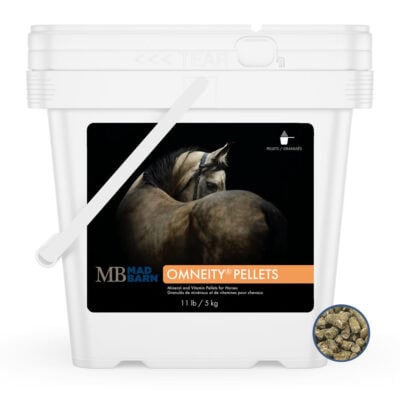
Mad Barn’s Omneity® is an all-in-one vitamin and mineral supplement designed to fortify a forage-based diet. Enriched with premium organic trace minerals and a nutritionally effective level of biotin per serving, it provides optimal nutritional support for all equines, including sport horse breeds like Trakehners.
Omneity is also formulated without added grains or sugars, making it an ideal choice for easy keepers who need to avoid excess calories that could lead to weight gain.
Feeding Recommendations
Feeding large volumes of grain-based feeds is a risk factor for gastric ulcers and colic in Trakehners. If your horse needs additional energy in their diet, consider fiber-based alternatives such as beet pulp or soy hulls.
Fat supplements are also a valuable source of concentrated calories for exercising horses. [12] Always make changes to your horse’s diet gradually and monitor for signs of digestive upset.
All horses need free access to clean, fresh water and loose salt. Exercising horses lose additional water and electrolytes through sweat. Add at least two tablespoons of plain, loose salt to your Trakehner’s daily ration to ensure sodium needs are met.
A balanced nutrition program is vital throughout your horse’s life, but it’s especially crucial for healthy skeletal development while your Trakehner is growing. Work with an equine nutritionist to design a diet appropriate for your horse’s age and activity level.
Sample Diet
The following sample diet is intended for a mature 1,100 lb (500 kg) Trakehner horse at maintenance (not exercising).
| Feed | Amount per day |
|---|---|
| Mid-Quality Hay (8% crude protein) | Free-choice |
| Salt | 30 g (2 tbsp) |
| Omneity® Pellets | 200 g (2 scoops) |
| Diet Analysis | |
| Digestible Energy (% of Req) | 119% |
| Protein (% of Req) | 127% |
| HC (ESC + starch; % Diet) | 8.9% |
Nutritional Supplements
After balancing your Trakehner’s diet, you can consider adding supplements for extra support.
- MSM helps maintain healthy connective tissue in exercising and older Trakehners. This natural joint supplement also supports collagen synthesis in growing horses.
- Visceral+ contains all-natural ingredients that help maintain stomach and hindgut health in Trakehners. Veterinarians recommend this gut supplement to keep sport horses feeling their best and competition-ready.
- W-3 Oil is an energy and essential fatty acid supplement that can be fed to Trakehners who need more dietary calories. The oil contains high levels of vitamin E and the omega-3 fatty acid DHA, which support muscle and joint health.
Want personalized feeding suggestions from our team of qualified equine nutritionists? Submit your Trakehner’s diet online for a free evaluation.
Frequently Asked Questions
Here are some frequently asked questions about Trakehner horses:
The Trakehner is a light warmblood horse breed that originated in East Prussia. Trakehner horses are known for their elegance, athleticism, and versatility, especially in English sport disciplines. Unlike many warmblood breeds, the Trakehner has a closed studbook with only select Arabian and Thoroughbred outcrosses permitted.
Trakehner horses are used primarily for dressage, show jumping, and eventing. Their athletic build and strong work ethic make them well suited to high-level sport. Trakehners are also used for pleasure riding and other English disciplines, especially by riders looking for an elegant and capable sport horse. Many Trakehner bloodlines are valued for both amateur and competitive performance.
Trakehner horses typically have a friendly and willing temperament. They are known for learning quickly, working reliably, and forming strong partnerships with their riders. Some Trakehners are more sensitive or spirited, especially those with stronger Arabian or Thoroughbred influence. As a result, this breed typically does best with consistent training and thoughtful handling.
Trakehner horses are tall, elegant warmbloods with a refined, noble appearance and athletic build. They typically have a well-defined head, large eyes, and a well-shaped neck. Their bodies are large and harmonious, with sculpted muscles, sloping shoulders, and a powerful croup. Trakehners also have correct, clearly defined limbs and joints that help promote soundness and athletic performance. Overall, their conformation gives them a polished, graceful appearance that reflects both refinement and strength.
The most common colors in Trakehner horses are bay, black, gray, and chestnut. Although all coat colors are permitted, unusual colors are relatively rare in the breed. Because the Trakehner has a closed studbook, the color range tends to remain fairly traditional.
Trakehner horses typically stand between 15.3 and 16.3 hands high. This gives them the size and scope expected of a modern sport horse while still maintaining a refined, athletic build. Their height, combined with strong conformation and expressive movement, contributes to their success in dressage, show jumping, and eventing.
Trakehner horses can live into their mid-20s or longer with good care. Lifespan depends on factors such as genetics, nutrition, workload, veterinary care, and overall management. Like many athletic breeds, Trakehners tend to do best when their health, soundness, and body condition are carefully maintained throughout life. Good preventive care can help support longevity and long-term performance.
Trakehner horses are not always the best choice for novice owners or beginner riders. They are intelligent, athletic, and sometimes sensitive, which means they usually do better with confident handling and consistent training. A well-matched Trakehner with the right temperament may suit some less experienced owners, but the breed is generally a better fit for riders with prior horse experience.
Trakehner horses are very good at jumping and have succeeded at high levels of show jumping and eventing. Their sloping shoulders and powerful hindquarters support scope, balance, and careful technique over fences. While many modern Trakehners are especially well known in dressage, the breed also has a strong reputation for jumping ability. This versatility is one reason Trakehners remain popular as sport horses.
Trakehners have a closed studbook to preserve the breed’s distinctive type, quality, and historical identity. Only select Arabian and Thoroughbred outcrosses are allowed, which helps maintain the traits that define the breed, such as their elegance, athleticism, and refinement. This stricter breeding system also sets the Trakehner apart from many other warmblood breeds with more open registries.
Trakehner horses are prone to some of the same health problems seen in other warmblood sport horses, along with a few inherited genetic conditions. Important concerns include severe combined immunodeficiency syndrome, lavender foal syndrome, cerebellar abiotrophy, dental abnormalities, lameness, joint issues such as osteochondritis dissecans, and gastric ulcers. Like other performance horses, Trakehners may also struggle with weight management, metabolic issues, or digestive problems if feeding and management are not well balanced. Careful breeding, regular veterinary care, and proper nutrition are important for reducing health risks.
Summary
The Trakehner is a refined, light warmblood horse breed originally developed in East Prussia and bred for athleticism, endurance, and elegance in Olympic disciplines such as dressage, show jumping, and eventing.
- The breed has a closed studbook, with only carefully selected Arabian and Thoroughbred outcrosses allowed, which preserves its distinct type but also increases the importance of genetic management.
- Trakehners typically stand 15.3 to 16.3 hands and are known for their noble expression, sloping shoulders, powerful hindquarters, and elastic movement, particularly a floating trot.
- They are intelligent, trainable horses with reliable work ethics, though individuals with higher proportions of Thoroughbred or Arabian blood may be more sensitive and spirited.
- Health considerations in these horses include inherited genetic disorders linked to Arabian bloodlines, such as SCID, CA, and LFS, as well as sport-related risks like lameness, OCD, dental issues, and gastric ulcers.
- Trakehners perform best on a balanced forage-first diet with careful energy management based on workload and proactive care to support joint, digestive, and overall health.
References
- Breeding Goal. Trakehner Verband. 2024.
- Preisinger, R. et al. Estimation of genetic parameters and breeding values for conformation traits for foals and mares in the Trakehner population and their practical implications. Livest Prod Sci. 1991.
- Bernoco, D. et al. Frequency of the SCID gene among Arabian horses in the USA. Anim Genet. 2002. View Summary
- Bierman, A. et al. Lavender foal syndrome in Arabian horses is caused by a single-base deletion in the MYO5A gene. Animal Genetics. 2010.
- Brault, L. et al. Inheritance of cerebellar abiotrophy in Arabians. Am J Vet Res. 2011.
- Tegan, R. et al. Population structure of the Trakehner Horse breed. Animal. 2009.
- Dixon, P. et al. A review of equine dental disorders. The Vet J. 2005.
- Murray. R. C. et al., Association of Type of Sport and Performance Level with Anatomical Site of Orthopaedic Injury Diagnosis. Equine Veterinary Journal. 2006.
- Naccache, F. et al. Genetic risk factors for osteochondrosis in various horse breeds. Equine Vet J. 2018.
- Harmann, A. et al. A preliminary investigation into the association between competition and gastric ulcer formation in non-racing performance horses. J Equine Vet Sci. 2003.
- Durham, A. et al. ECEIM consensus statement on equine metabolic syndrome. J Vet Intern Med. 2019.
- Andrews, F. Nutritional management of gastric ulceration. Equine Vet Ed. 2015.
- Policy for Genetic Disorders. American Trahkener Association. 2013.
- The Ideal Sport Horse. Trakehners International. 2012.