English

Back pain is a common yet often overlooked issue in horses, affecting their performance, behavior, and overall well-being. Studies show that up to 54% of sport horses and 90% of racehorses show signs of back issues. [1] Whether they are elite athletes, working horses, or beloved companions, equines rely on a strong, healthy back for movement, flexibility, and comfort.
Recognizing back pain in horses can be challenging, as their large back muscles make it harder to accurately assess the underlying bone structure. Potential clinical signs associated with back pain include poor performance, behavioral changes, and nonspecific lameness. [1]
If left unaddressed, back pain can progress, leading to compensatory issues in other parts of the body, which can affect multiple structures including the spine, limbs, neck, and overall posture.
Read on to learn more about the causes, signs, and treatment options for equine back pain. Whether you are a competitive rider, trainer, or horse owner, learning to recognize and address back pain is essential for your horse’s long-term health and happiness.
Equine Back Anatomy & Function
The horse’s back starts at their withers and extends down to their sacroiliac joint, the joint between their sacral lumbar vertebrae and the wings of the pelvis. [2]
Bones & Joints
The horse’s spine is made up of a stack of bones called vertebrae that protect the spinal cord, a bundle of nerves running from the brain through the entire spinal column. The vertebrae are padded by intervertebral discs. [2]
Like other mammals, the horse’s spine has different sections, running from the head down: [2]
- 18 thoracic (upper back) vertebrae
- 6 lumbar (lower back) vertebrae
- 5 sacral vertebrae
The five sacral vertebrae are fused together to form one structure called the sacrum. [2]
Each vertebra forms a joint with the vertebrae on either side of it. These joints are called intervertebral joints. [2] Other significant joints in the horse’s back include the sacroiliac joint, between their sacrum and the wings of the pelvis, and the lumbosacral joint, between the last lumbar vertebra and the sacrum. [2]
Muscles
On top of the vertebrae are several large muscles. Contraction of these muscles dips the horse’s back, lifting their head. [2] If only one side of the horse’s back muscles contracts, the spine bends in that direction, producing lateral flexion. [2]
The main epaxial (above the spine) muscles in the horse are: [2]
- Spinalis: Supports the vertebrae
- Longissimus dorsi: The strongest back muscle producing the highest level of back contraction
- Iliocostalis: Primarily has roles in lateral flexion
Horses can also arch their back in the opposite direction, raising their vertebrae to produce a rounded back. [2] Muscles used to round the back include psoas minor and major, rectus abdominis, and rectus oblique. [2] These muscles are hypaxial, located below the vertebral column.
Causes of Back Pain
Back pain in horses can result from injury or damage to any of the major back structures. Common causes of back pain include: [1][2][3]
- Impingement of the spinous processes (“kissing spine“)
- Vertebral fractures
- Arthritis of the intervertebral joints
- Muscle injury affecting either the epaxial or hypaxial muscles
- Arthritis of the sacroiliac joint
- Degeneration of the lumbosacral joint
- Non-medical conditions such as poor saddle fit, inadequate riding skills, or a lack of strength and fitness relative to workload
Of these, “kissing spine” is the most commonly diagnosed cause of equine back pain. [3] In this condition, the dorsal spinous processes, long bony projections off the top of the vertebrae, are too close together and may rub up against one another. [2] This results in bone irritation, bone thickening, or bone loss. [2]
In the most severe cases, the spinous processes overlap each other, causing further irritation. [2]
What's your top priority with your horse's health?

Enter your email to receive your store credit
Clinical Signs of Equine Back Pain
The clinical signs of back pain vary widely, however most horses show symptoms relating to poor performance or behavioral changes.
Signs of poor performance related to back pain may include: [4][5]
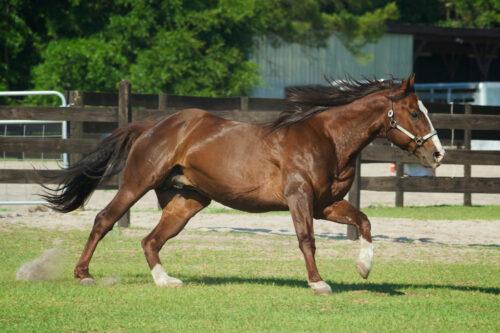
- Bunny hopping gait in the hind limbs
- Difficulty performing transitions between gaits
- Difficulty with sliding or stopping
- Changes in jumping style or performance, including refusing jumps
- Unwillingness to go forward under saddle or loss of impulsion
- Difficulty maintaining a canter lead or missing lead changes
- Difficulty bending
Commonly reported behavioral changes include tail swishing, aggressive behavior, girthiness or cinchiness, and kicking out under saddle. [4] Some horses may also show obvious forelimb or hindlimb lameness related to back pain. [4][5]
Diagnosis
Diagnosing the underlying cause of back pain requires a thorough investigation. Often, a complete workup requires specialized diagnostic tools to evaluate the deeper structures of the horse’s back, as these structures cannot be easily examined or palpated by a veterinarian. [2]
To start, the veterinarian evaluates the horse standing still. This usually involves assessing the horse’s musculature and overall symmetry. [3] Careful inspection of the hair can reveal white hairs or areas of hair loss indicating poor saddle fit. [3]
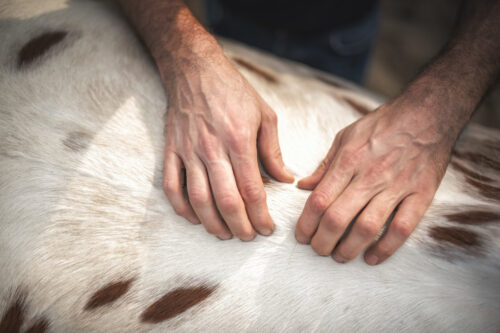
They also palpate the horse’s back to identify painful areas for further examination. Horses with back pain may dip their back, move away from the veterinarian, or kick out in response to palpation. [3]
Next, the veterinarian assesses the horse’s ability to move their spine. [3] This may involve lunging, tight circling, or bending the horse’s neck while standing. [3] Assessing their movement also allows the veterinarian to identify any forelimb or hindlimb lamenesses that may be present. [3] Some veterinarians may request that the horse is ridden or driven in harness if clinical signs only occur during performance. [2]
Once the veterinarian identifies back pain and any potentially related clinical signs, they proceed with specific diagnostic tests. Diagnostic tests may include: [3]
- X-rays
- Ultrasound
- Nuclear scintigraphy (“bone scan”)
- Numbing (“blocking”) tissues to look for changes in clinical signs
- Bloodwork to identify muscular conditions such as rhabdomyolysis
- Muscle biopsy
Treatment & Management
Treatment options for back pain vary depending on the cause of pain, required level of performance for the horse, and financial constraints. [6]

“Back pain in horses is often multifactorial, stemming from poor saddle fit, underlying lameness, muscle strain, or spinal abnormalities. Accurate diagnosis is key to developing an effective treatment plan. Early intervention can prevent compensatory issues and support long-term performance.”
— Dr. Jennifer Skaggs, DVMEquine Veterinarian
Veterinarians prefer to start with low-risk conservative treatment options. [6] In some cases, more invasive procedures, such as surgical intervention, may be required to treat the horse’s back pain.
Conservative Treatment
Conservative treatment options are non-surgical options that help relieve pain or slow the progression of disease. [6] Veterinarians combine many aspects of conservative management to develop a treatment plan for the individual horse. Options include: [6]
- Changing the horse’s exercise program
- Medications to relieve pain
- Local injections directly into the painful area to slow progression or relieve pain
- Complementary therapies such as physiotherapy, acupuncture, or chiropractic work
- Nutritional support for muscles and joints
Exercise Modification
Horses with back pain often benefit from a short period of rest from ridden exercise or work, allowing them to recover from any muscular or ligamentous strain. [6] Continued turnout in a paddock or pasture during this rest period is ideal to promote muscle relaxation. [6]
Once the horse returns to work, changing their exercise program to focus on muscle relaxation and strength helps prevent recurrence of back pain. [6] The exact changes necessary depend on the underlying condition. [6]
General recommendations include: [2][6]
- Encouraging the horse to work in a “long and low” frame, stretching over their back
- Using a progressive return-to-work program
- Ensuring an adequate warm-up period before doing heavy work
- Warming up in the canter before the trot, as the canter works one side of the back at a time
- Stretching exercises before and after training
Exercises that the horse previously found challenging, such as lead changes, sliding stops, or jumping, should be avoided until the horse’s back pain resolves completely. [6] Owners should also have their tack examined by a trained professional to ensure that it fits properly and is not exacerbating the horse’s pain. [6]
Medications
Systemic (whole body) medications can help relieve the horse’s pain, allowing them to participate in physiotherapy and other treatment modalities that promote recovery. [6] The most common medications used for back pain are non-steroidal anti-inflammatory drugs (NSAIDs) and muscle relaxants. [6]
Bisphosphonate medications, such as tiludronate, may help back pain cases where there is arthritis or other bony changes contributing to pain. [6] These drugs slow the rate of osteolysis, bone erosion, which can cause pain. [6]
While they may be effective, bisphosphonates are only labelled for navicular disease, so they must be prescribed for other uses at the discretion of the attending veterinarian.
Local Injection
Injecting medication into the problem area can help relieve pain and slow the progression of disease in some cases. [6]
Since horses have robust back musculature, many common sites of back pain are inaccessible for local injection. However, veterinarians can inject a large amount of diluted medication close to the painful structure, allowing the medication to spread naturally through the tissue to the target area. [6] This is called regional infiltration.
For some conditions, such as intervertebral arthritis, the veterinarian may be able to inject the medication directly into a joint space. [6] To properly position the needles, ultrasound is typically used to guide needle placement into or around the joint space. [2]
The most common medications used for local injections are corticosteroids, anti-inflammatory drugs that provide pain relief. [6] Some veterinarians also use sarapin, a pain reliever derived from plants, as an additional treatment for back pain cases. [6]
Complementary Therapies
Complementary therapies such as physiotherapy, acupuncture, and chiropractic may help relieve pain and restore normal function of affected back structures. [6]
Of these, physiotherapy is the most common for back pain, as it helps develop muscle strength and mobility to prevent recurrence of back injury. [6] These programs often include stretching exercises, core-strengthening exercises, and rehabilitation through a slow, progressive return-to-work program. [6]

Surgical Treatment
If conservative management is unsuccessful, some horses may be candidates for surgical treatment. Currently, there are only surgical treatment options available for impingement of the dorsal spinous processes (“kissing spine”). These surgeries attempt to reduce the degree of impingement (overlapping) between the bones, thus reducing pain and irritation. [6]
The two main surgeries for kissing spine are: [6]
- Ostectomy of the impinging spinous processes
- Desmotomy of the interspinous ligaments
Ostectomy
Ostectomy refers to the cutting of bone surgically. In this procedure, a bone or wire saw cuts away the portions of the spinous processes that overlap, restoring normal spacing between the processes. [6] For horses with multiple areas of overlap, surgeons usually only remove bone on alternating vertebrae to reduce the invasiveness of the procedure. [6]
This procedure can be performed under general anesthesia or standing sedation. [6] The procedure type depends on the surgeon’s preference, temperament of the horse, and financial limitations. [6]
After the procedure, horses require a 3 to 6 month rehabilitation period with controlled exercise and physiotherapy before they can start returning to work. [6] Studies show that horses have a high success rate after ostectomy, with one study reporting up to 72% of horses successfully returned to their previous level of performance. [6]
Desmotomy
Desmotomy is the surgical cutting of ligaments, in this case the interspinous ligaments that run between the vertebrae. [6] By cutting these ligaments, the dorsal spinous processes can move further apart when the horse flexes their back. [6] When combined with physiotherapy and rehabilitation, the gap between the spinous processes may widen over time, resolving the impingement. [6]
This procedure is less invasive, as it only requires a series of small incisions over the horse’s back while the horse is sedated. [6] After the surgery, horses require only 3 weeks of rest and 3 weeks of controlled exercise before they can start a return-to-work program. [6]
There have been few studies on the success rate of this procedure compared to ostectomy. However, one study comparing racehorses with kissing spine who received desmotomy with horses who received no treatment showed that 86% of the treated horses had improved performance compared to untreated horses. [7]
Prognosis
The prognosis for back pain depends on the underlying condition, severity of the condition, and treatment options available. Factors such as the discipline the horse competes in, the level of work, their individual pain tolerance, and their response to treatment can also affect prognosis.
In general, horses with progressive back conditions such as sacroiliac disease or intervertebral arthritis have a poor prognosis for long-term performance. Conditions with more treatment options available, like kissing spine, may have a better prognosis. [2]
Prevention
Many of the causes of equine back pain are not preventable, as they are linked closely to the horse’s individual conformation and underlying bone structure. General strategies for preventing back pain include:
- Ensuring proper fit of tack, particularly the saddle
- Encouraging the horse to move in a “long and low” frame, stretching and relaxing their back muscles
- Ensuring the horse is adequately conditioned for their level of work
- Slow and progressive warm-ups before performing complex movements
- Prompt recognition of the signs of back pain and poor performance for early treatment
- Regular veterinary assessment to identify early signs of lameness or other causes of poor performance
- Frequently body condition scoring the horse to ensure they are maintained at an ideal weight
- Providing a balanced diet with adequate protein, vitamins and minerals to support overall health
Following these management practices can help prevent and detect numerous health concerns, including back pain, promptly. Early detection maximizes the chance of a full recovery in many cases.
Frequently Asked Questions
Determining an appropriate treatment protocol for back pain requires a thorough investigation by a veterinarian. Once the underlying cause of the back pain is identified, your veterinarian can help you develop a treatment plan, including physiotherapy and exercises, to relieve your horse's pain and restore performance.
The most common signs of back pain in horses are poor performance, behavioral changes, and subtle lameness. Horses may have difficulty performing complex maneuvers, such as lead changes, sliding stops, or jumping. They may also become girthy, buck or rear under saddle, or have other changes in their demeanor.
In some cases, back pain can cause issues elsewhere in the horse's body. As the horse's gait and movement changes to compensate for their back pain, they may cause irritation or soreness in their other joints or muscles. These horses may show overt hindlimb or forelimb lameness. A thorough evaluation by a veterinarian is necessary to determine whether the lameness is due to an issue in the limb itself, or if it is secondary to back pain.
Summary
Back pain is a common condition affecting performance horses in all disciplines.
- Signs of back pain include poor performance, behavioral changes, and lameness
- Back pain may be due to bone, joint, or muscular conditions
- Non-surgical treatment options are the most common management strategy for back pain
- The prognosis for back pain depends on the underlying cause and the horse's response to treatment
References
- Domańska-Kruppa. N. et al., Advances in the Clinical Diagnostics to Equine Back Pain: A Review of Imaging and Functional Modalities. Animals. 2024.
- Ross. M. W. and Dyson. S. J., Diagnosis and Management of Lameness in the Horse. 2nd ed. Elsevier Saunders, St. Louis, Mo. 2011.
- Findley. J. and Singer. E., Equine Back Disorders 1. Clinical Presentation, Investigation and Diagnosis. In Practice. 2015.
- Marshall-Gibson. M. E. et al., Survey of Equine Veterinarians Regarding Primary Equine Back Pain in the United States. Frontiers in Veterinary Science. 2023. View Summary
- Riccio. B. et al., Two Multicenter Surveys on Equine Back-Pain 10 Years a Part. Frontiers in Veterinary Science. 2018.View Summary
- Findley. J. and Singer. E., Equine Back Disorders 2. Treatment Options. In Practice. 2016.
- Derham. A. M. et al., Performance Comparison of 159 Thoroughbred Racehorses and Matched Cohorts before and after Desmotomy of the Interspinous Ligament. The Veterinary Journal. 2019. View Summary