English








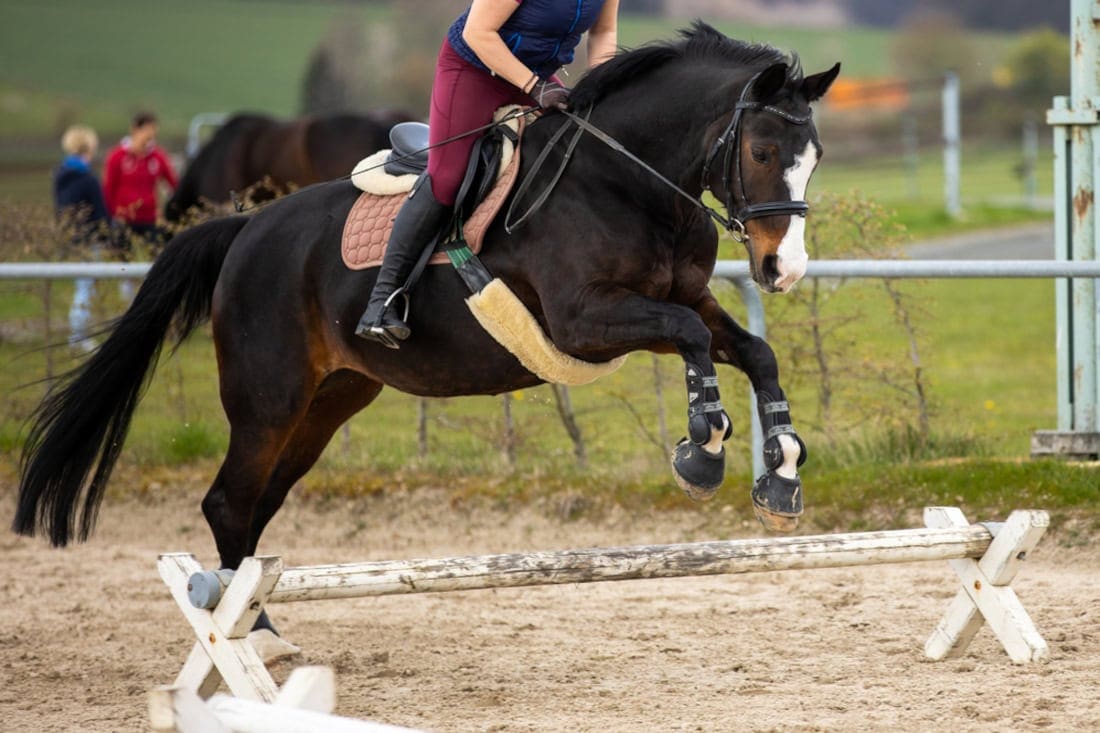
Cavalletti exercises, also spelled cavaletti, are a highly effective tool in horse training. Originally developed by renowned horseman Federico Caprilli and later popularized by German dressage master Reiner Klimke, cavalletti work involves training over small, evenly spaced poles on the ground. [1][2] These exercises can be adapted to benefit horses across all disciplines, from dressage and show jumping to eventing and even recreational riding.
Cavalletti work can help improve a horse’s strength, balance, and coordination. By engaging the core muscles and encouraging a steady rhythm, cavalletti exercises help develop suppleness and self-carriage without putting excessive strain on joints and tendons. They can also improve the rider’s skills, allowing them to develop a better feel for their horse’s movement and improve their ability to regulate pace and rhythm.
With simple adjustments — such as altering the height, spacing, or arrangement of poles — trainers can tailor exercises to target specific areas of development. Whether aiming to build strength, refine footwork, or improve transitions, cavalletti work provides a versatile and rewarding method for enhancing a horse’s overall performance.
Read on to explore the many ways cavalletti exercises can be incorporated into a training program, with practical tips and exercise variations to suit horses and riders at all levels.
Benefits of Cavalletti for Horses
Although cavalletti are most commonly seen in dressage and jumping barns, horses of all disciplines can benefit from these training exercises. Raised poles help improve the horse’s natural gait, build strength, and encourage the horse to engage their hindquarters. Other benefits include: [3]
- Introducing variety and reducing boredom for both horse and rider
- Improving proprioception (i.e. sure-footedness)
- Developing a consistent rhythm in the gaits
- Building stamina and endurance
- Practicing striding and rideability to jumps without needing to jump
The gait used for cavalletti exercises affects the main benefits of the exercise. Doing cavalletti at the walk is best for improving the horse’s posture and increasing the range of joint mobility. [4] Walking over cavalletti requires the horse to flex their stifle and hock joints and engage their flexor muscles, rather than relying on momentum from jumping off the ground to clear the obstacle. [4]
Trotting over cavalletti is best for improving cardiovascular and muscular conditioning. [4] By requiring the horse to regulate stride and rhythm, the horse’s muscle systems work together to produce a fluid, smooth movement. This can improve the quality of the horse’s gaits, even when cavalletti are not used. [4]
The canter requires the horse’s back muscles to relax and contract to rotate the horse’s pelvis. [4] Canter exercises can help “free up” the horse’s back by requiring these muscles to loosen, which can benefit horses who brace their necks or are stiff through their body. [4] With training, these muscles build strength and allow the horse to relax their posture in other gaits. [4]
Cavalletti are also a common component of rehabilitation after injury. Stepping over raised poles helps activate a horse’s full range of motion in their limbs, increasing joint flexion. [5] It also helps activate the abdominal and back muscles, improving strength and posture. [5] Most practitioners start a rehabilitation program using poles on the ground, then slowly incorporate raised poles or cavalletti as the horse builds strength and proprioception. [5]
Equipment
Cavalletti apparatuses are a wood or PVC pole attached to two supports that elevate the pole off the ground. Some cavalletti are a single unit with permanently attached supports, while others use unattached blocks or risers to support a jump pole. Either type is suitable for cavalletti exercises.
Cavalletti should be at least 15 – 20 cm (6 – 8 in) off the ground for optimal effect. [3] Many cavalletti can rotate to produce different height options. [3] Cavalletti should be no taller than 50 cm (20 in), which is a suitable height for canter work. [3]
Many riders choose to make their own cavalletti rather than buying a commercial product. A common design is a 4×4 post or round fence rail secured on either end by a thick sheet of plywood. [6] Attaching the rail offset from the center of the plywood allows the height of the rail to be adjusted by rotating the cavalletti. [6]
The most important features of a cavalletti set up are: [3]
- Durability of the poles: Poles should not split, shatter, or break if stepped on or knocked
- Weight: Poles should be heavy enough to resist light knocks or taps without moving. However, they should be mobile enough to move if a horse is in trouble
- Safety: Cavalletti should not be able to trap a hoof if the horse exits off to the side of the cavalletti. For this reason, many riders prefer unattached supports to reduce the risk of catching a hoof
Set cavalletti exercises in a relatively flat area with safe, consistent ground. [3] Avoid setting cavalletti in deep ground, as the combined effect of the deep surface and the effort needed to clear a cavalletti may increase the risk of injury to the tendons or ligaments. [3]
What's your top priority with your horse's health?

Enter your email to receive your store credit
Top 7 Cavalletti Exercises for Horses
Cavalletti exercises target a particular weakness in either the horse or rider. As horses and riders master certain exercises, the complexity can increase by increasing the height of the cavalletti, adjusting the distances between the cavalletti, or changing the horse’s gait.
Riders can also set cavalletti with alternating ground poles to reduce the complexity of the exercise. This allows the horse a moment of rest before the next raised effort, while still maintaining the rhythm and concentration required for the exercise.
Some cavalletti patterns can be used for lunging, often as part of a rehabilitation program or to build strength and stamina in young horses. [3] When incorporating cavalletti into these types of programs, start with poles on the ground and introduce cavalletti one at a time. As the horse successfully completes the exercise, add in additional cavalletti until the horse can complete the desired exercise.
Keep reading to learn how to set up and ride the top 7 cavalletti exercises for horses and riders of all levels.
1) Straight Line
Placing cavalletti in a straight line is ideal for improving the rhythm and quality of the horse’s gaits. It also helps improve straightness by encouraging riders and horses to go through the exercise in a straight line.
The spacing between the cavalletti depends on the gait and whether you are collecting or extending the gait. Riders and trainers should adjust the spacing between the cavalletti based on the individual horse’s stride length and level of training. General recommendations for distances are: [3]
- Walk: 0.75 m (2.5 ft)
- Trot: 1.3 m (4 ft)
- Canter: 2.7 m – 3.3 m (9 – 11 ft)
 Illustrated by: Dr. Madison Ricard, DVM, PhD, DACVP, PAS
 Adjusting the recommended spacing can help encourage a horse to collect or extend their gait. Also consider the height of the cavalletti, as increased height requires more upward movement from the horse, shortening their step. Use cavalletti around 15 – 20 cm (6 – 8 in) tall to start. As the horse and rider gain mastery, you can increase the height of the cavalletti to build more strength and stamina.
When cantered, a straight line of cavalletti requires the horse to “bounce“, or push off of their front limbs to clear the second obstacle. This differs from jumping, where the horse typically pushes off their haunches.
Many jumping riders use bounces as a component of gymnastic exercises to help discourage rushing and establish a consistent rhythm. [7] They also maximize the stretch-shortening cycle of the muscles, rapidly building strength. [8] Additionally, the bounce movement strengthens different muscles from typical jumping, allowing riders to produce a well-balanced horse.
2) Fan
Cavalletti placed in a fan shape help encourage the horse to lift their inside shoulder, preventing falling in and improving coordination through the turn.
Measure the distances between the cavalletti from the center of the obstacle to ensure the horse’s path has the correct spacing. If desired, you can ride towards the inside or the outside of the turn to promote collection or extension of the horse’s stride.
 Illustrated by: Dr. Madison Ricard, DVM, PhD, DACVP, PAS
 For advanced riders and horses, you can place two fans with different stride lengths on either end of a figure 8. [9] For example, have a trot stride fan on one side, and a canter stride fan on the opposite side.
Use cones or a pole to mark the center of the figure 8. [9] Ride the first circle at the appropriate gait, then make an accurate transition to the second gait over the center of the figure 8. This exercise challenges the rider’s accuracy, their ability to create a rhythm in multiple gaits, and requires strength and flexibility from the horse.
3) Circle
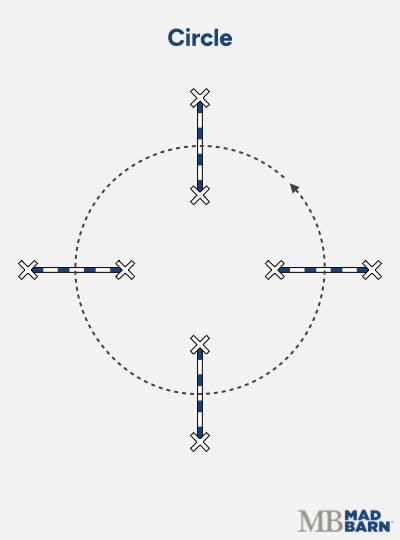
Placing cavalletti at different points on a circle can help jumping riders work on bend, striding, and riding a precise approach to a fence.
Start with one cavalletti on the circle and increase up to four cavalletti as horses and riders gain experience. You can increase the difficulty by making the circle smaller, leaving only 2-3 strides between each cavalletti. You can also combine a cavalletti fan with single cavalletti on a circle for added challenge.
 Illustrated by: Dr. Madison Ricard, DVM, PhD, DACVP, PAS
 4) Figure 8
Placing two cavalletti at a right angle allows you to make a figure 8 over the obstacles. Riders can use this exercise to work on riding accurate circles and developing the correct stride and pace out of a turn.
For the horse, this exercise can help to teach them lead changes and landing on the correct lead, as the slight “jump” over the cavalletti helps them coordinate changing their canter lead.
 Illustrated by: Dr. Madison Ricard, DVM, PhD, DACVP, PAS
 For more advanced horses and riders, a fan of cavalletti can be added to the top or bottom of the figure 8, challenging their accuracy, pace, and rhythm through the turn.

5) Serpentine
In a serpentine, the horse and rider make a serpentine where they go over a cavalletti during the straight portion of each serpentine loop. This encourages accuracy coming off the turn and straightness over the obstacle. When cantering, this set up can help teach horses to land on the correct lead coming off of a jump.
 Illustrated by: Dr. Madison Ricard, DVM, PhD, DACVP, PAS
 6) The X or Star
Setting four cavalletti in an X-shape is another versatile exercise for practicing straightness, balance, and turning. Riders can loop around and step over the cavalletti in a cloverleaf pattern, requiring a precisely ridden turn and a straight approach to the obstacle.
 Illustrated by: Dr. Madison Ricard, DVM, PhD, DACVP, PAS
 7) In & Out
Setting two cavalletti with 21 – 24 ft (6.4 – 7.3 m) between them produces a one-stride combination, commonly seen in show jumping courses. For inexperienced horses and riders, this exercise can help with seeing a distance and maintaining a regular pace and rhythm. The low height of the obstacle makes the exercise forgiving to mistakes the horse or rider may make.
 Illustrated by: Dr. Madison Ricard, DVM, PhD, DACVP, PAS
 For more advanced horses, or horses who tend to rush at obstacles, set two sets of canter cavalletti, separated by a one stride distance. The first set of canter cavalletti sets the pace and rhythm and discourages rushing. The one stride separation tests the horse and rider’s ability to maintain the pace and rhythm on their own, before challenging the second set of cavalletti.
Riders and trainers should adjust the spacing between the cavalletti based on the individual horse’s stride length and level of training.
Frequently Asked Questions
Here are some frequently asked questions about cavalletti work:
Cavalletti work helps improve the horse's balance, rhythm, and strength. They can also help riders learn to develop an accurate rhythm and pace.
Cavalletti work is very challenging for the horse and requires a lot of strength and stamina. Cavalletti work should not exceed more than 10 minutes twice a week or what is recommended by your veterinarian as part of a rehabilitation program. [10]
The gait you wish to ride determines the spacing between cavalletti. General recommendations for distances are: Walk - 0.75 m (2.5 ft); Trot - 1.3 m (4 ft); Canter - 2.7 m to 3.3 m (9 – 11 ft) [3]
Summary
Cavalletti exercises for horses are a versatile training and strengthening tool that can be a valuable addition to any equestrian training program.
- Cavalletti can help improve a horse's rhythm, balance, quality of gaits, and strength
- For riders, cavalletti exercises help with precision riding, developing a rhythm and pace, and building partnership with the horse
- Building cavalletti can be as simple as placing a jumping pole on a plastic block or "riser"
- Increasing the number of cavalletti, changing gaits, or combining exercises can help challenge more experienced horses and riders
References
- Fox, B. E., Caprilli - Just Another Cavalry Officer. US Horsemanship. 2015.
- Klimke. I., Cavalletti Training for Every Horse and Discipline. Practical Horseman. 2023.
- Klimke. I. and Klimke. R., Cavalletti for Dressage and Jumping: 4th Edition. J A Allen. 2018.
- Ballou. J., The Best Cavalletti Exercises for Walk, Trot, and Canter. Horse Journals. 2024.
- Kaneps. A. J., Practical Rehabilitation and Physical Therapy for the General Equine Practitioner. Veterinary Clinics of North America: Equine Practice. 2016. View Summary
- Madden. J., Make Your Own Cavalletti. Practical Horseman. Equine Network. 2010.
- Wofford. J. C., Gymnastics: Systematic Training for Jumping Horses. Interpet. 2001.
- Allen. L. and Dennis. D. R., 101 Jumping Exercises for Horse & Rider. Storey Publishing, LLC. 2002.
- Klimke. I., Cavalletti Training for Every Horse and Discipline. Practical Horseman. 2019.
- Klimke. R., Reiner Klimke & Cavalletti. Practical Horseman. 2020.