English












Viral infections are among the most common health challenges faced by horses, ranging from mild, self-limiting illnesses to severe, life-threatening diseases that spread rapidly through equine populations. Because many different viruses can affect horses, recognizing and correctly diagnosing these infections is essential for both individual horse care and broader herd health management.
Diagnosing viral infections in horses is not always straightforward. Many clinical signs, such as fever, lethargy, or weight loss, are nonspecific and may overlap with bacterial diseases or even non-infectious conditions. For this reason, veterinarians rely on a combination of clinical examination, history, and laboratory testing to arrive at a diagnosis.
Understanding which virus is involved has practical implications for treatment, prognosis, and prevention strategies. For example, confirming equine influenza may prompt immediate isolation protocols to reduce spread, while identifying equine herpesvirus may influence long-term management decisions due to the risk of recurrent outbreaks.
Keep reading to learn how viral infections are diagnosed in horses, highlighting common tests, their advantages and limitations, and how results inform veterinary decision-making.
Diagnosing Equine Viruses
Horses are susceptible to numerous viral diseases, causing clinical signs ranging from mild illness to fatality. Many viral diseases are also highly transmissible and can survive on surfaces, tack, and other equipment.
As a result, prompt diagnosis of viral infections is key to preventing the spread of disease and minimizing outbreaks.
Equine viral diseases where testing is critical for successful outcomes and/or safeguarding public health include: [1]
- Equine infectious anemia (EIA)
- Equine influenza virus (“flu”)
- Equine herpesvirus (EHV-1 and 4; known as “rhino”)
- West Nile virus (WNV)
- Eastern and Western equine encephalitis (EEE and WEE)
- Rabies
- Rotavirus
- Papillomavirus
- Equine hepacivirus
- Equine parvovirus
Clinical signs of viral infections can vary significantly depending on the body system affected. They are typically vague and do not indicate a specific disease, which means diagnostic tests are necessary to confirm which virus is affecting the horse.
Common signs of viral infection in horses include: [2]
- Fever, typically high
- Lethargy
- Reduced appetite
- Weakness
- Weight loss
- Unusual behaviors
- Uncoordinated movement (ataxia)
- Coughing
- Nasal discharge
Identifying the exact pathogen affecting a horse is key, as it not only helps with immediate treatment and management decisions, but also informs long-term herd health strategies, vaccination programs, and outbreak prevention.
What's your top priority with your horse's health?

Enter your email to receive your store credit
Sample Collection
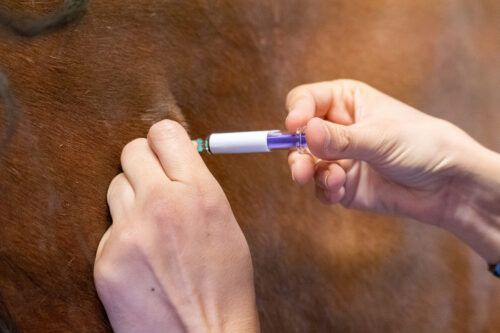
An important step in diagnosing viral infections in horses is collecting diagnostic samples, where the veterinarian obtains biological material for laboratory testing.
Sample collection varies depending on which viral infection the veterinarian suspects and the type of testing they want to perform. In general, it’s best to sample tissues directly impacted by the virus to maximize the chances of finding viral particles. [3]
Samples collected for viral testing and identification may include: [1][3][4]
- Blood
- Cerebrospinal fluid
- Nasal swabs
- Fecal samples
- Tissue samples, such as a liver biopsy or post-mortem samples
Many viral tests look for antibodies against the virus, rather than the virus itself. Diagnosticians typically use a blood sample for antibody testing rather than specific tissue samples. [3]
Collected samples must be preserved properly to ensure the virus survives until it reaches the diagnostic laboratory. This is particularly important for viral isolation testing, where live virus is grown in the laboratory. [3]
In general, samples should be kept cool during storage and transport. The diagnostic laboratory can provide your veterinarian information about proper collection and storage of viral samples.
Available Tests for Detecting Viruses
Modern laboratory techniques have greatly improved the ability to diagnose viral infections in horses. PCR testing, serology, antigen detection, and occasionally virus isolation provide valuable insights into whether a horse is currently infected, has been exposed in the past, or poses a risk of transmitting the virus to others.

“Testing for viral infections is essential for confirming a horse’s illness and safeguarding the wider equine community. Early detection through accurate testing helps guide effective management and reduces the risk of outbreaks.”
— Dr. Jennifer Skaggs, DVMEquine Veterinarian
These diagnostic tests aim to either identify the virus itself, fragments of the virus, or the body’s immune response to the virus.
The most common viral diagnostic tests used in equine medicine are: [3]
- Viral isolation
- Polymerase chain reaction (PCR)
- Histopathology
- Antigen testing
- Serology
Viral Isolation
Viral isolation is the gold standard for diagnosing viral infections. This test involves introducing a test sample into living cells, then monitoring for signs of viral infection in that cell population. [3]
The laboratory cell populations are typically cell cultures in a Petri dish, however diagnosticians may also use embryonated eggs or laboratory mice for diagnosis. [3]
The main benefit of viral isolation is it is a non-specific test. This means a wide array of viruses, even previously unknown strains, can be identified using this test. [3] It does not require the veterinarian or diagnostician to identify a specific virus they want to look for in the sample.
Although viral isolation is the ideal test, it has some downsides. It can take several days to weeks to report viral isolation results, as the viral infection requires time to establish and cause signs of infection before the laboratory can report their findings. [3]
Additionally, collection methods and transport of the test sample can also affect results. [3] Viral isolation is also expensive due to the costs associated with maintaining cell populations. [3]
Polymerase Chain Reaction (PCR)
Polymerase chain reaction (PCR) is a diagnostic test where small fragments of the viral genome are amplified (reproduced in massive amounts), allowing for diagnosis.
To perform this test, the diagnostician introduces a primer into the sample, a short fragment of genetic material known to match a specific virus. If the virus is present, the primer binds to its genome and can amplify. [3] If there is no match between the primer and sample, the amplification does not occur.
Once the PCR process is complete, diagnosticians use testing methods to identify the amount of replicated genetic material in the sample. If there is a large amount of genetic material that matches the virus in question, they can confirm the diagnosis. [3]
The main benefit of PCR is that is very quick to perform, typically only requiring 4 to 6 hours of laboratory time. [3] This means results can be returned within days of sample submission in most cases.
PCR is also a good option for identifying viruses that are challenging to isolate in the laboratory, such as: [3]
- Equine herpesvirus
- Equine influenza virus
- Rotavirus
It also is safer for lab personnel to perform PCR when testing for zoonotic diseases (diseases that can transmit between animals and humans). This is because there is no live virus produced during the PCR process, minimizing personnel exposure. [3]
For this reason, diseases such as West Nile virus and Eastern equine encephalitis virus are commonly diagnosed using PCR. [3]
The major disadvantage of PCR is that it is highly specific. To identify a virus, the correct primer must be introduced into the sample. [3] This means PCR only tests whichever viruses the veterinarian or diagnostician suspects may be present, and novel or untested viruses will not be identified.
Histopathology
Histopathology involves examining tissue samples under the microscope to identify changes associated with viral disease. Veterinary pathologists (veterinarians who study disease) can also use special types of stain to highlight viral particles within the tissue and confirm a diagnosis.
Although histopathology is an accurate diagnostic test, it requires submission of biopsy or necropsy samples. Given this, most histopathologic diagnoses are made post-mortem (after death), once a horse dies on its own or is euthanized. [3]
If a virus-affected tissue can be biopsied in the live horse, submission of that tissue can assist in diagnosis. However, biopsies are an invasive procedure, and not all viral diseases can be identified through biopsy. For example, viral diseases affecting the nervous system cannot be biopsied in the live animal.
Certain viral diseases can only be diagnosed on histopathology. For example, rabies has no antemortem (in the living animal) tests available, and diagnosis relies on histopathology exclusively.
Veterinarians must euthanize horses suspected of having rabies in most jurisdictions. Euthanasia allows for diagnostic testing on the brain to confirm the disease, and helps mitigate the spread of this highly infectious disease to people or other animals.
Antigen Testing
Antigen tests detect antigens, small compounds produced by the virus, within a sample. In these tests, the laboratory introduces antibodies against the virus into a sample. If the antibodies bind to a compound, it indicates that viral antigens are present in the sample.
Common equine diseases diagnosed through antigen testing include rotavirus and equine influenza virus. [3]
Antigen testing is quick to perform, and “stall-side” tests using this process are becoming more common. However, accurate diagnosis of disease requires the horse to be actively producing virus at the time of sample collection.
As such, there is a possibility of seeing false negative results from antigen testing. [3] These tests are also highly specific and may not be available for all viral diseases.
Serology
Serology identifies antibodies against the virus in the horse’s bloodstream or other body fluids. Diagnosticians use serology to diagnose viruses that do not grow well in a laboratory setting and may not be easily detectable using other testing types. [3]
Equine diseases commonly diagnosed through serology include: [3]
- West Nile virus
- Equine infectious anemia
- Eastern equine encephalitis virus
The Coggins test for equine infectious anemia is an example of a serologic test for a viral disease.
To perform serologic testing, the diagnostician introduces viral particles into the sample. If antibodies against the disease are present, changes in the sample such as blood coagulation or precipitation of material are detected. [3]
A positive result indicates there is a previous exposure to the virus. It does not necessarily indicate the virus is actively affecting the horse. For this reason, serology is typically used as a screening test to identify possible causes of disease.
If a horse is positive on serology, the veterinarian submits additional samples for antigen or viral testing to confirm the diagnosis. [3]

Interpreting Results
Diagnosing viral disease in horses can be challenging. [3] Most viral infections only produce a viremia (virus in the bloodstream) for a short period of time. [3] For testing methods that detect the virus directly, there must be a viremia present at the time of sample collection. This means false negative results can occur when using these methods. [3]
False negative results can also occur during serologic testing. The antibody response can take weeks to develop, meaning samples collected early in the viral infection will not show elevated antibody levels. [3]
The antibody response can also decline over time, so samples collected after the viral infection resolves may also show no antibody response. [3]
Antibody testing may also return a false positive if the horse has been previously vaccinated for the viral disease. [3] Antigen testing and PCR can also produce false positives if horses have been recently vaccinated using modified live vaccines. [3] There are specific tests, such as a MAC-ELISA, than can differentiate between previously vaccinated horses and an active infection.
A thorough understanding of the pathogenesis (process of disease development) of the virus is key to diagnosing viral disease in horses. [3]
Your veterinarian can work with diagnosticians to interpret the viral testing results in the context of the horse’s history, clinical signs, and other factors.
Frequently Asked Questions
Here are some frequently asked questions about diagnosing viral infections in horses:
Signs vary depending on the virus but may include fever, lethargy, poor appetite, coughing, nasal discharge, neurological changes, or weight loss. Some viruses cause mild illness, while others can be life-threatening.
Routine bloodwork (CBC, chemistry) may show signs of inflammation or immune response but does not identify the specific virus. Targeted diagnostic tests are required for confirmation.
PCR testing detects viral genetic material and is highly sensitive and specific. Serology measures antibodies to show past or current infection. Virus isolation can confirm infection but is less commonly used due to cost and time. Antigen detection tests may be available for certain viruses.
Turnaround times depend on the test and laboratory. Some PCR panels can return results within 24–48 hours, while virus isolation may take several days or longer.
Correct diagnosis helps guide treatment, biosecurity measures, and herd management decisions. Different equine viruses have different implications for contagiousness, prognosis, and prevention strategies.
Summary
Diagnosing viral infections in horses requires evaluating clinical symptoms alongside veterinary diagnostic testing to identify the specific virus and determine the best treatment and management plan.
- Common symptoms of equine viral infections include fever, lethargy, reduced appetite, nasal discharge, and neurological changes
- PCR testing and serology are the most widely used diagnostic methods; virus isolation is less common due to cost and time
- Turnaround times vary, with PCR results available in as little as 24 hours, while virus isolation may take several days
- Accurate identification of the virus is essential for guiding treatment, preventing disease spread, and managing herd health
References
- Pusterla. N. and Higgins. J. Interpretation of Equine Laboratory Diagnostics. Wiley-Blackwell, Hoboken, NJ. 2017.
- Reed. S. M. et al. Equine Internal Medicine. 3rd ed. Saunders Elsevier, St. Louis, Mo. 2010.
- Sellon. D. C. and Long. M. T. Equine Infectious Diseases. Second edition. Saunders/Elsevier, St. Louis, Missouri. 2014.
- Cavalleri. J.-M. V. et al. European College of Equine Internal Medicine Consensus Statement on Equine Flaviviridae Infections in Europe. Journal of Veterinary Internal Medicine. 2022.