English











Horses are intelligent and perceptive animals. With proper training, we can teach them to do all sorts of incredible things — from fun tricks to complex dressage movements — and the possibilities are almost endless.
The horse’s brain is very different from our own, which can sometimes make training challenging. To successfully teach our horses a new skill, we have to understand how they learn.
There is no shortage of training methods out there, but many of them go against the principles of equine learning theory, which describe how the horse’s brain works during learning. With so much controversy surrounding certain methods, it can be hard to know where to start.
In this article, we explore the mental framework of how horses learn, and how you can apply this knowledge to your own training practices. By understanding how the horse takes in new information and makes decisions, you can create a harmonious environment that makes learning enjoyable for both you and your horse.
What is Learning Theory in Horses?
Our horses are constantly learning from every interaction they have with us, even when we aren’t trying to train them.
Learning theory is a framework that describes how horses absorb, process and retain information when they are learning. These processes can be influenced by cognitive, emotional and environmental factors, as well as the horse’s past experiences with learning and training.
The core principles of learning theory apply to all creatures great and small — even single-celled organisms have demonstrated basic learning capabilities. [1]
Motivation, Stress & Distress in Learning
Motivation has a significant impact on how quickly and effectively a horse learns. For example, a hungry horse is more motivated to learn a task where food is the reward than a horse who has just eaten.
When motivation levels are too high, the horse may become stressed or frustrated if they can’t find the answer quickly, which can distract them from further learning. However, a horse who has no motivation will also learn poorly, since they don’t have any desire to engage with the task at hand. [2]
A highly motivated and frustrated horse may show signs like pawing, tension, or repeatedly offering different behaviors in an attempt to find the right answer, while a poorly motivated horse may appear disengaged or slow to respond.
Optimal learning often occurs when motivation is balanced — enough to engage the horse, but not so much that it causes distress. In some cases, this state can involve eustress, or ‘positive stress,’ which helps drive focus and problem-solving without overwhelming the horse. Mild levels of positive stress can push the horse to try new behaviors and look for answers to their trainer’s questions, helping them learn more effectively.
However, trainers must be careful not to push past their horse’s stress threshold, where the horse moves into a state of distress (negative stress). Distress causes fear and anxiety, and reduces learning abilities.
When monitoring your horse’s level of stress, remember that not all horses display their stress externally. A horse who looks calm may still be struggling. Research shows horses who appeared calm and obedient had similar internal stress levels to horses who showed reactive and fearful behavior during frightening tasks. [3]
Trainers should consider the individual personality and needs of their horse when developing a training program and have a plan to adjust if necessary.
Learning Abilities of the Horse
Learning abilities in horses can be broken down into eight “levels,” ranked from least to most complex: [4]
| Complexity Level | Description | Example |
|---|---|---|
| 1. Habituation | Learning not to respond to a repeated, non-threatening stimulus | A horse stops reacting to the loud sound of a tractor driving past after hearing it several times |
| 2. Classical conditioning | Responding to a new stimulus that is paired with a familiar stimulus | Horses get excited for dinner time when they hear the feed room door open |
| 3. Operant conditioning | Performing a certain behavior to achieve a desired outcome or avoid an undesired outcome | The horse performs a trick to get a treat |
| 4. Chaining responses | Performing a sequence of responses for reinforcement/reward | The horse performs a series of movements for a treat |
| 5. Concurrent discrimination | Identifying the difference(s) between two or more similar objects | Horses can tell the difference between a triangle and a square |
| 6. Concept learning | Identifying and categorizing stimuli or objects based on common characteristics | Grouping otherwise unrelated objects by color |
| 7. Conditional concepts | Understanding that one situation depends on another, even if the situations are not closely linked in space or time (If XYZ… then ABC) | Understanding that if you forget to wear sunscreen on a sunny day, then you might get sunburned by the end of the day |
| 8. Bi-conditional concepts | Logical reasoning and understanding that the reverse of a situation can also be true | Understanding reasoning such as “A triangle is a shape with three sides and a three-sided shape is a triangle” |
Horses have reliably demonstrated learning abilities up to the level of concurrent discrimination (level 5/8). [5] Some preliminary research suggests that horses may be capable of concept learning (level 6/8), though other studies suggest horses use simpler mental processes to achieve the same end result as concept learning. [6][7][8]
There is no scientific evidence that horses can understand conditional or bi-conditional concepts (levels 7 and 8). These types of learning are too complex for horses to process since the equine brain is not capable of higher reasoning.
Types of Learning
The ways horses learn can be divided into two categories: non-associative and associative learning. Both types of learning can be active or passive processes.
Non-associative learning changes a horse’s level of reaction to one stimulus (i.e., a sight, sound, object or experience). This category includes habituation and sensitization.
Associative learning creates mental links between stimuli and behavioral responses. This category includes classical and operant conditioning, which are defined as: [5]
- Operant Conditioning: Behaviors are influenced by the consequences that follow them, such as rewards or punishments.
- Classical Conditioning: A neutral stimulus becomes associated with a naturally occurring stimulus, eventually eliciting a similar response on its own. The most famous example of classical conditioning is “Pavlov’s Dog,” where the researcher (Pavlov) conditioned dogs to salivate at the sound of a bell.
Social learning in horses
Social learning happens when one animal learns something from another. This can be a survival strategy for many species. Social interactions can influence animal behavior in multiple ways: [5]
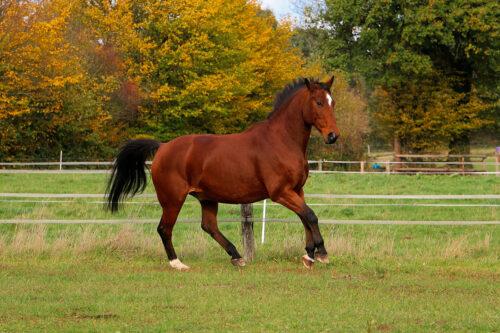
- Social facilitation of behavior: One horse begins performing a natural, innate behavior after another horse nearby performs it. For example, when one horse starts running in the paddock and the rest of the herd begins to run around with them.
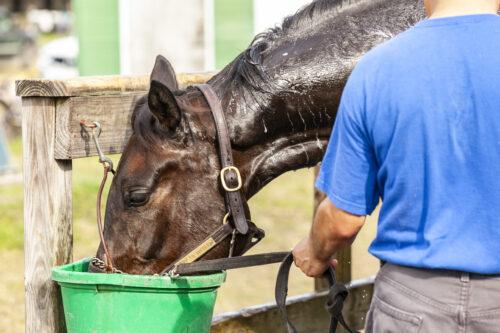
- Stimulus (local) enhancement: One horse draws another horse’s attention to an opportunity. For example, the sound of a horse eating out of a bucket alerts other horses there is a bucket of food nearby, so they come to eat with them.
- True social learning: Happens when one animal learns a new task just from watching another animal complete it.
Scientists are divided about whether or not horses are capable of true social learning. Most researchers have not found evidence of this kind of learning ability in horses. [15][16][17]
Social learning in horses may only happen in biologically relevant situations, like navigating frightening situations with other horses, or foals learning about human interactions from watching their dams. [5] However, there is very little conclusive research on the subject at this time.
What's your top priority with your horse's health?

What's your top priority with your horse's health?
Factors that Influence Learning & Training
Just like people, every horse is unique. There are many individual factors that influence how easily a horse learns, or how quickly a new skill can be trained, including: [4][5][9][11][12][13]
- Individual learning ability: Like people, some horses naturally learn faster than others. Genetics may play a role in determining equine cognitive capabilities and overall intelligence.
- Trainer knowledge and skill: A horse can only learn as well as their trainer can teach. Trainers whose cues and reinforcements are clear, consistent and properly timed provide an optimal learning environment. Riders or trainers whose cues are less refined or poorly-timed may struggle teaching their horse new skills.
- Horse personality: Horse personalities can vary widely, influenced by factors like breed and age. Recent studies suggest that a horse’s personality can affect both how well the horse learns and the mental processes that the horse uses to learn. Personality may also influence how external stressors influence learning.
- Horse conformation and physical ability: A horse’s highest possible level of training is often determined by physical traits. A horse with atrophied muscles or very poor conformation may never be able to perform physically challenging movements like piaffes or pirouettes, regardless of how smart and trainable they are.
- Horse health and soundness: Much like humans, a horse’s health and comfort influences how they think and feel. Illness and injury can cause discomfort, stress and distraction, which may make it harder for a horse to focus and learn. Soundness issues can also limit a horse’s physical capabilities, hindering some training possibilities.
- Horse history: Horses who are traumatized or unfamiliar with humans may find training stressful or frightening, making it harder for them to learn. Alternatively, horses who have had positive experiences with humans and training may be more willing to engage with new tasks and challenges, making learning a quicker and easier process.
- Overall management: The horse’s major welfare needs are free movement, foraging opportunities and socialization with friends, sometimes referred to as the 3 Fs. Horses who do not have sufficient access to these opportunities may not learn as effectively as those receiving appropriate management.
- Equine emotional state: Fear, frustration, or excitement can significantly impact a horse’s ability to learn. For example, a horse that is fearful may struggle to focus on a task, while a horse that is calm and relaxed may be more open to learning.
- Control and predictability: Horses feel more secure and focused when they can anticipate outcomes, which helps reduce distress, frustration, and boosts motivation. Clear, consistent cues and a stable environment foster better engagement and effective learning.
Finally, the physical environment where you train a horse can also influence learning. Training in unfamiliar, isolated areas where the horse can’t see their friends could cause them to be afraid or reactive, negatively impacting their learning. Conversely, training in familiar, open areas where your horse can see their friends can promote relaxation and have a positive impact on learning.
Other environmental factors such as footing, weather and air temperature can impact the horse’s stress levels and physical comfort, further influencing their learning abilities in the moment.
Learning, Training & Equine Welfare
When training your horse, it’s important to make sure you don’t overestimate or underestimate their intelligence and learning abilities.
People who underestimate their horse’s intelligence may end up viewing their horse in a negative light. This may create frustration and resentment during training, risking unfair or abusive behavior towards the horse.
In contrast, people who overestimate their horse’s intelligence risk setting standards their horse cannot live up to. If the horse fails to learn quickly enough, trainers might assume they are being naughty and disobeying on purpose.
Overestimating intelligence can also result in delayed punishment when the trainer falsely assumes the horse knows what they did wrong. This can cause fear, negatively affecting welfare and hindering learning.
Avoiding Anthropomorphism
Anthropomorphism occurs when we ascribe human characteristics and reasoning to animals. Anthropomorphizing a horse’s intentions, thoughts and behavior makes it difficult for trainers to communicate with their horses effectively.
A general rule to help avoid anthropomorphism is never use a more complicated explanation for your horse’s behavior when there is a reasonable, less complicated explanation. [14]
For example, if a horse bucks when asked for a canter, an anthropomorphic explanation might refer to the horse’s intent as similar to a human’s. The rider might make a remark like “She is being so lazy today! She’s trying to convince me to stop riding so she can go take a nap.”
This explanation assumes the horse is able to think far into the future and plan to change her outcomes. This type of reasoning requires learning abilities that include conditional and bi-conditional concepts (learning levels 7 and 8). As previously mentioned, horses have not demonstrated this level of ability.
Instead, trainers should look for a simpler, non-anthropomorphic explanation. A more informed response to this behavior might be “She is having a gut reaction to pain or frustration. Maybe her saddle doesn’t fit, or she’s sore from playing in the field.”
This explanation assumes a direct link between an event and a behavioral response, with no ulterior motives or planning. It’s also important for handlers and trainers to investigate the root cause of behavior before making inferences and drawing conclusions, rather than ascribing an anthropomorphic explanation to the behavior. In some cases, owners may need help from a qualified professional, like a veterinarian or equine behaviorist, to help determine the underlying cause of certain behaviors.

Ethological Challenges in Horse Training
During training, your horse may show resistance, stress or behavioral challenges that you can’t identify the cause of. When this happens, it’s important to consider how training and riding asks horses to act against many of their natural instincts. [5]
While training, we ask horses to leave their social group and come into an isolated space such as an arena or barn. This takes them away from the safety of the herd as well as their access to food, water and shelter, which can be a stressful experience.
We also ask horses to navigate unnatural obstacles and environments, and enter small, dark spaces they would normally avoid — such as trailers and stalls. The use of tack and equipment such as bits, nosebands, spurs and crops can also present physical and emotional challenges that horses have not evolved to cope with naturally.
In fact, the mere concept of allowing a rider to sit on their back goes against the horse’s basic survival instincts, as humans are predators while horses are prey animals.
Training with compassion and understanding the emotional complexity horses experience during training can empower your horse to navigate these challenges and feel confident in new situations. This helps create trust between horse and trainer, and reduces stress and anxiety in horses, enhancing their learning capabilities and subsequent trainability.
Changing Perspectives in Horse Training
Many trainers promote concepts of “dominance” or being the “herd leader” when discussing horse training methods. However, these concepts assume a much higher level of learning capability and cognitive processing than horses are capable of.
Dominance-based training operates on the outdated and incorrect assumption that horses have a fixed dominance hierarchy within their social groups, rather than the dynamic and flexible hierarchy that is commonly accepted by researchers today. [5]
The International Society for Equitation Science recommends against conceptualizing horse training methods using dominance or leadership-based concepts, instead promoting methods based in learning theory that recognize the horse’s natural way of thinking and learning. [18]
Rather than asking the horse to see you as another member of their herd, try to acknowledge the differences between you and them in terms of behavior and cognitive abilities. This can help facilitate clear and effective communication between horse and trainer.
Learning Theory & the Modern Equestrian
While understanding learning theory is key to effective riding and training, most equestrians have limited knowledge about it. As a result, many struggle to apply learning theory effectively, including professionals.
Studies have found that professional riders, coaches and amateur riders alike all struggle to describe basic concepts of learning theory. [19][20][21] One study only saw correct responses from 2.8% of respondents. [19]
An inability to define learning theory doesn’t necessarily mean respondents are using the methods incorrectly. However, if equestrians can’t effectively describe how their horses learn and think, this may point to a welfare concern across the industry.
When working with a horse, every moment we spend together can heighten or dull their responses to the world around them. With a proper understanding of learning theory, riders can better understand how they may be influencing their horse and have some control over what the horse learns next.
Frequently Asked Questions
Here are some frequently asked questions about how horses learn:
Learning theory is a framework used to explain how horses learn and process new information. It is based on the work of human psychologists and animal behavior scientists.
Horses should be trained with clear and consistent cues and properly timed reward delivery or release of pressure. By understanding learning theory, trainers can set realistic expectations for their horse's development without over- or underestimating their horse's abilities.
Learning theory is not a single training tool, but a set of principles to help understand how the horse thinks and processes. There are specific types of learning included in learning theory that can be classified as "training tools." These include habituation, sensitization, classical conditioning and operant conditioning.
A trainer or rider with a working knowledge of learning theory is able to set their horse up for a successful, low-stress training experience thanks to a holistic understanding of how their horse thinks. This may then lead to improved equine welfare for the horse(s) under their care.
While humans and horses don't speak the same language and have very different body language and facial cues, a trainer with a strong understanding of learning theory can become very effective at communicating with their horse in a way that makes sense to both of them.
Summary
Learning theory is a framework that trainers and riders can use to understand how their horse takes in and processes new information. A horse's learning abilities will be influenced by their mental and physical capabilities, trainer, past experiences and learning environment.
- Individual horses may respond differently to training due to a variety of physical, emotional and environmental factors that influence learning
- Manageable levels of positive stress can enhance learning via increased motivation, but trainers must be careful this doesn't escalate to distress or frustration
- Horses can differentiate between similar objects, but are incapable of higher order learning that requires logic, reasoning or understanding of abstract concepts
- Avoid overestimating or underestimating your horse's intelligence, as it can lead to unfair treatment or abuse
- Avoid oversimplifying behavior and always consider consulting a professional for a more accurate assessment
References
- Dussutour. A., Learning in Single Cell Organisms. Biochemical and Biophysical Research Communications. 2021.
- Olczak. K. et al., Motivation, Stress and Learning — Critical Characteristics That Influence the Horses' Value and Training Method — A Review. Annals of Animal Science. 2016.
- Squibb. K. et al., Poker Face: Discrepancies in Behaviour and Affective States in Horses during Stressful Handling Procedures. Applied Animal Behaviour Science. 2018.
- Gagné. R. M., The Conditions of Learning. Holt, Rinehart and Winston. 1970.
- McGreevy. P. et al., Equitation Science. 2nd ed. John Wiley & Sons Ltd., Chichester, West Sussex, UK. 2018.
- Sappington. B. F. and Goldman. L., Discrimination Learning and Concept Formation in the Arabian Horse. Journal of Animal Science. 1994. View Summary
- Hanggi. E. B., Categorization Learning in Horses (Equus Caballus). Journal of Comparative Psychology. American Psychological Association, US. 1999.
- Gabor. V. and Gerken. M., Horses Use Procedural Learning Rather than Conceptual Learning to Solve Matching to Sample. Applied Animal Behaviour Science. 2010.
- González. F. J. N. et al., Dumb or Smart Asses? Donkey's (Equus Asinus) Cognitive Capabilities Share the Heritability and Variation Patterns of Human's (Homo Sapiens) Cognitive Capabilities. Journal of Veterinary Behavior. 2019.
- Williams. J. and Tabor. G., Rider Impacts on Equitation. Applied Animal Behaviour Science. 2017.
- Sackman. J. E. and Houpt. K. A., Equine Personality: Association With Breed, Use, and Husbandry Factors. Journal of Equine Veterinary Science. 2019. View Summary
- Lansade. L. et al., Personality and Predisposition to Form Habit Behaviours during Instrumental Conditioning in Horses (Equus Caballus). PLOS ONE. Public Library of Science. 2017. View Summary
- Valenchon. M. et al., Stress Modulates Instrumental Learning Performances in Horses (Equus Caballus) in Interaction with Temperament. PLOS ONE. Public Library of Science. 2013. View Summary
- Morgan. C. L., An Introduction to Comparative Psychology, New Ed., Rev. Walter Scott Publishing Co, London, England. 1903.
- Lindberg. A. C. et al., Effects of Observational Learning on Acquisition of an Operant Response in Horses. Applied Animal Behaviour Science. 1999.
- Clarke. J. V. et al., Effects of Observational Learning on Food Selection in Horses. Applied Animal Behaviour Science. 1996.
- McVey. A. et al., Social Learning in Horses: The Effect of Using a Group Leader Demonstrator on the Performance of Familiar Conspecifics in a Detour Task. Applied Animal Behaviour Science. 2018.
- International Society for Equitation Science (ISES), ISES Position Statement on the Use/Misuse of Leadership and Dominance Concepts in Horse Training. 2017.
- Warren-Smith. A. K. and McGreevy. P. D., Equestrian Coaches Understanding and Application of Learning Theory in Horse Training. Anthrozoös. Routledge. 2008.
- Brown. S. M. and Connor. M., Understanding and Application of Learning Theory in UK-Based Equestrians. Anthrozoös. Routledge. 2017.
- Luke. K. L. et al., Does a Working Knowledge of Learning Theory Relate to Improved Horse Welfare and Rider Safety?. Anthrozoös. Routledge. 2023.