English








Horses are expressive animals, and one of their most distinctive types of body language is the flehmen response. Sometimes called lip curling or the “horse laugh,” this behavior is more than just a curious display. It reflects a highly specialized sensory mechanism that horses use to detect chemical signals in their environment.
Horses use the flehmen response to engage the vomeronasal organ, a unique sensory organ that helps them analyze pheromones and other scent-based information in their surroundings. The flehmen response allows horses to gather details about the reproductive status and emotional state of herd mates in addition to detecting new animals and objects.
Understanding the flehmen response provides insight into equine communication, reproduction, health, and welfare. Observing when and how a horse exhibits this behavior can reveal clues about their sensory world, emotional well-being, and the subtle ways they interact with their environment.
Keep reading to learn more about lip curling in horses, including when and why it occurs, what physiological processes are at work, and what it can tell owners about their horse’s health and environment.
The Flehmen Response in Horses
The flehmen response is familiar to horse owners and caretakers everywhere. Also referred to as lip curling, “smiling” and the “horse laugh,” this term refers to behavior where a horse curls back their upper lip, stretches out the head and neck, and inhales deeply. [1]
This posture exposes the gums and teeth, giving the appearance of a dramatic grimace. While it may look amusing to human observers, the behavior serves an important biological function.
Horses use the flehmen response to direct scent molecules into a specialized sensory structure known as the vomeronasal organ (VNO), or Jacobson’s organ. This organ lies above the hard palate and connects to the nasal cavity through small ducts behind the incisors. [1]
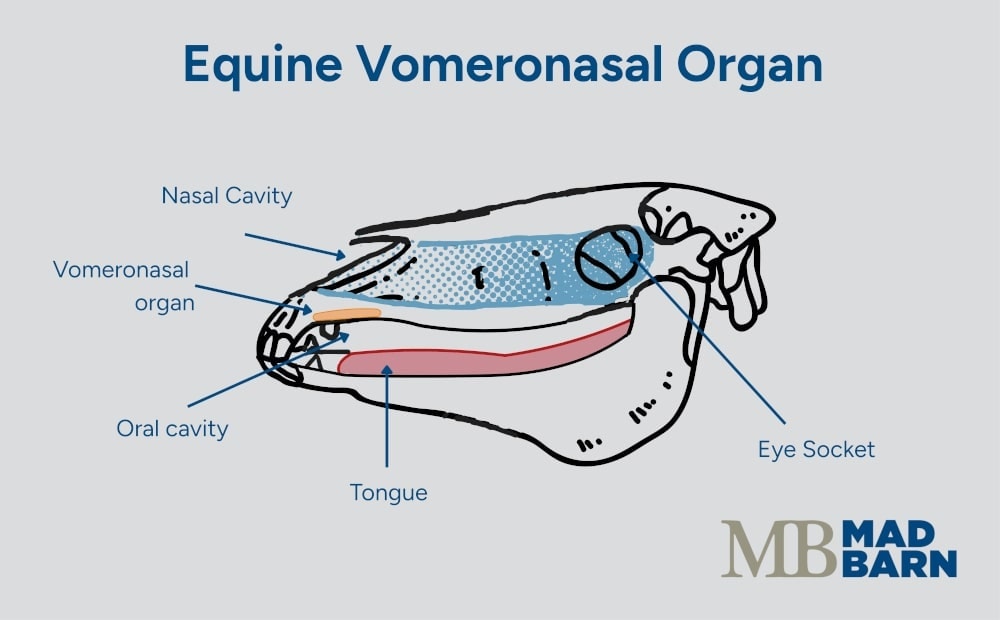
Unlike the main olfactory system, which detects airborne odors, the VNO specializes in identifying heavier, non-volatile compounds such as pheromones, hormones, and other chemical cues present in bodily secretions like urine, feces, or saliva.
By curling the lip and creating negative pressure in the nasal passages, the horse directs movement of these chemical signals toward the vomeronasal organ. Once activated, the VNO sends information directly to areas of the brain involved in instinctive and reproductive behaviors. [1]
This pathway bypasses conscious smell perception, meaning the horse does not process the signal in the same way as ordinary scents. In essence, the flehmen response is not merely a curious or comedic expression but a sophisticated chemosensory tool.
It enables horses to gather crucial information about their environment, the reproductive status of other horses, and even social or territorial cues. [1]
Flehmen Response in Other Species
The flehmen response is not unique to horses. Domestic species such as cats, goats, and cattle display similar lip curling, often in reproductive or social contexts. Bulls and rams frequently use flehmen responses when investigating the urine of females to determine reproductive status. [2][3][4]
Among wild animals, the behavior is even more striking. Elephants raise their trunks to collect chemical cues before transferring them to the vomeronasal organ, while giraffes are known to taste the urine of females and then perform the flehmen gesture.
In big cats such as lions and tigers, the iconic grimace is an essential part of courtship and territory assessment. [2][3][4]
This widespread occurrence across both herbivores and carnivores underscores the evolutionary importance of vomeronasal chemoreception, highlighting its role in survival, reproduction, and social organization throughout the animal kingdom.
Table 1. Summary of mammalian flehmen responses
| Species | Reasons for flehmen response |
|---|---|
| Stallions (horses) | Detecting estrus in mares |
| Bulls and rams | Assessing female reproductive status via urine |
| Domestic cats | Investigating scent marks or mating cues |
| Lions and tigers | Courtship and territorial marking |
| Giraffes | Tasting female urine to evaluate fertility |
| Elephants | Using trunk to deliver pheromones to vomeronasal organ |
What's your top priority with your horse's health?

What's your top priority with your horse's health?
Equine Flehmen Responses
The flehmen response is a chemosensory behavior that enables horses to detect and analyze chemical cues in their environment. This behavior plays roles in social communication, reproduction, and the detection of novel or aversive odors.
Recognizing the different contexts in which lip curling occurs can help owners and handlers distinguish normal behavioral responses from those that may indicate discomfort or an underlying medical issue.
Communication
Horses rely on chemical cues to gather information from their environment, and the flehmen response is one mechanism used to process these signals.
Unlike cats, which possess a well-developed vomeronasal pumping mechanism, horses rely more heavily on external gestures to investigate chemical cues in their environment. Lip curling is one such visible signal. [4][5]
When a horse curls their lip, the action is not only an internal sensory process but also an external display that can be interpreted by other animals and humans. Within a herd, one horse’s flehmen may draw the attention of others, cueing them to investigate the same stimulus.
This behavior reinforces social cohesion and group awareness, particularly when novel scents or potential threats are involved. [4][5]
For humans, the visible grimace serves as a useful marker. A stallion displaying flehmen near a mare communicates his interest and arousal. A gelding curling his lip when introduced to a new environment indicates active exploration. Even foals showing flehmen toward their dam’s milk or bedding can be understood as engaging in sensory learning. [4][5][6]
Reproduction
Among all classes of horses, stallions use the flehmen response the most. During the breeding season, a stallion investigates the urine or genital secretions of mares to determine estrus status. Flehmen enables the stallion to detect pheromones and hormones that indicate when a mare is receptive to mating. [5][7]
In managed breeding programs, handlers often elicit this behavior artificially by presenting stallions with urine-soaked cloths or allowing them to approach a mare under controlled circumstances.
A strong flehmen response indicates the stallion has recognized signs of estrus and is likely prepared to breed. This method is not as reliable as veterinary diagnostics, but is commonly used by experienced breeders. [5][7][8][9]
The flehmen response can also help maintain safety when handling breeding stallions. A lip curl in the presence of mares often accompanies arousal and distraction, which handlers can use to ensure overall safety protocols are followed as needed during breeding or turnout situations.
Maternal Behavior
Although mares display the flehmen response less frequently than stallions, the behavior can also occur in females. A mare may curl her lip while investigating her newborn foal, particularly when licking or sniffing amniotic fluids.
This behavior likely supports maternal recognition, enabling the mare to imprint on the chemical profile of her foal. [10][11][12]
Flehmen responses can also occur in mares during foal heat or subsequent estrous cycles. While less dramatic than in stallions, these responses may play a role in social signaling and reproductive communication within a herd.
Mares may use the flehmen response to communicate their hormonal states to male and female herd mates alike. [4][10][11][12]
Flehmen Responses in Foals
Foals often show the flehmen response within hours of birth. After nursing or when exploring their dam, they may pause, curl the upper lip, and draw in air. This early behavior appears to serve several purposes. [4][13]
It may support olfactory learning, allowing foals to memorize the unique scent profile of their dam. This chemical recognition strengthens the mare–foal bond, ensuring the foal remains oriented toward their mother for nourishment and protection. [4][13]
Flehmen in foals may also serve a developmental role, giving young horses early practice using the sensory-motor pathways involved in vomeronasal organ activation. By experimenting with lip curling, foals learn to use the same sensory system that will later guide them in social and reproductive contexts. [4][13]

Flehmen Response & Pain
While the flehmen response is a normal part of equine behavior, in certain contexts it can be a warning sign of illness. Horses may curl their lips not only in response to reproductive or environmental stimuli but also when experiencing discomfort or pain.
Recognizing the difference is essential for equine welfare.
Colic
Horses experiencing abdominal pain (colic) often curl their lips repeatedly, sometimes in combination with pawing, rolling, or flank watching. In these cases, flehmen responses are part of the pain response rather than curiosity or reproductive signaling.
Contact your veterinarian if your horse is showing signs of colic.
Dental issues
Sharp enamel points, fractured teeth, or mouth ulcers can all cause irritation that horses may express using the flehmen response. Horses may also curl their lips after encountering bitter or unfamiliar tastes, such as certain medications or toxic plants.
Monitoring whether flehmen coincides with chewing difficulties, excessive salivation, quidding, or head shaking can help differentiate oral pain from normal exploratory behavior.
Gastric Ulcers
Horses with gastric ulcers may demonstrate intermittent flehmen responses, particularly after eating or during periods of stress.
Ulcers are particularly common in performance horses, and repeated lip curling may point to stomach discomfort, especially if accompanied by weight loss, girthiness, or reduced appetite.
Toxicity
Exposure to toxins, whether in plants, contaminated feed, or environmental chemicals, may also provoke lip curling in horses.
In these cases, the behavior could represent both an investigative response and an attempt to cope with unpleasant sensations. Similarly, strong chemical odors, such as fly sprays or disinfectants, can trigger lip curling in otherwise healthy horses.
Distinguishing Painful vs. Healthy Flehmen Responses
For owners and caretakers, the challenge lies in interpreting context. Flehmen responses after smelling urine, encountering a new feed, or during breeding activities are to be expected. On the other hand, lip curling accompanied by signs of pain, distress, or illness should raise concern.
Key signs that equine lip curling may be a sign of pain include:
- Repeated or prolonged behavior without an obvious environmental stimulus
- Presence of colic signs such as sweating, restlessness, or rolling
- Presence of signs of dental issues such as eating difficulties, weight loss, or changes in appetite
- Presence of respiratory signs, such as nasal discharge or labored breathing
If you are unsure if your horse’s flehmen responses are a sign of pain, work with your veterinarian to investigate. Prompt veterinary assessment can help identify the underlying cause and prevent more serious complications.
Frequently Asked Questions
Here are some frequently asked questions about the flehmen response in horses:
Horses curl their lips after smelling urine because they are engaging the vomeronasal organ to detect pheromones and reproductive hormones. This behavior is called the flehmen response, and helps stallions and other horses assess whether a mare is in heat.
No, the flehmen response is not always a sign of pain in horses. Most often, it is a normal behavior associated with reproductive or social investigation. However, if it occurs repeatedly or alongside signs of discomfort, it can indicate pain.
Not necessarily. Geldings sometimes use the flehmen response when encountering strong odors, unusual feeds, or after taking oral medications. If it happens frequently or in combination with distress signs, consult a veterinarian.
The flehmen response in horses is most often linked to investigating smells or hormones. However, some horses may show a flehmen response when experiencing abdominal discomfort, including colic. If it occurs with other signs such as pawing, rolling, or looking at the flank, contact your veterinarian.
Summary
The flehmen response, also known as "horse laughing," is a natural behavior that plays an important role in how horses interpret their world. By activating the vomeronasal organ, horses can detect pheromones, hormones, and other subtle chemical signals in their environment.
- Owners and caretakers can use observations of their horses' flehmen responses to help guide management decisions
- Stallions use the flehmen response to assess estrus status in mares
- Mares may display it after foaling or when exposed to certain scents
- Foals frequently show the behavior shortly after birth and during nursing
- Geldings sometimes perform the flehmen response when investigating scents or in response to new flavors or odors
- The flehmen response can be a sign of pain, especially if it is accompanied by other signs of discomfort, including sweating, rolling, grinding teeth, and changes in appetite
References
- Horses Have A Highly Developed Sense of Smell. Iowa State University Extension and Outreach Equine Science.
- Atkinson. G. Understanding Flehmen in Big Cats. Grant Atkinson. 2013.
- Serayder. K. What Is the Flehmen Response in Cats?. PetMD. 2023.
- Crowell-Davis. S. L. Flehmen. Compendium Equine. 2008.
- Waring. G. H. Horse Behavior. 2nd ed. Noyes Publishing, Norwich, N.Y. 2003.
- Lee. K.-H. et al. Histological and Lectin Histochemical Studies of the Vomeronasal Organ of Horses. Tissue and Cell. 2016.
- Stahlbaum. C. C. and Houpt. K. A. The Role of the Flehmen Response in the Behavioral Repertoire of the Stallion. Physiology & Behavior. 1989.
- Weeks. J. W. et al. Preliminary Study of the Development of the Flehmen Response in Equus Caballus. Applied Animal Behaviour Science. 2002.
- Marinier. S. L. et al. Flehmen Behaviour in the Domestic Horse: Discrimination of Conspecific Odours. Applied Animal Behaviour Science. 1988.
- Guarneros. M. et al. The Underexplored Role of Chemical Communication in the Domestic Horse, Equus Caballus. Journal of Veterinary Behavior. 2020.
- thal, Database Record Viewer. Horse Side Vet Guide. 2014.
- Houpt. K. A. Formation and Dissolution of the Mare–Foal Bond. Applied Animal Behaviour Science. 2002.
- Thal. D. Foal Or Newborn Grinding Teeth Or Curling Lip . Horse Side Vet Guide. 2018.