English
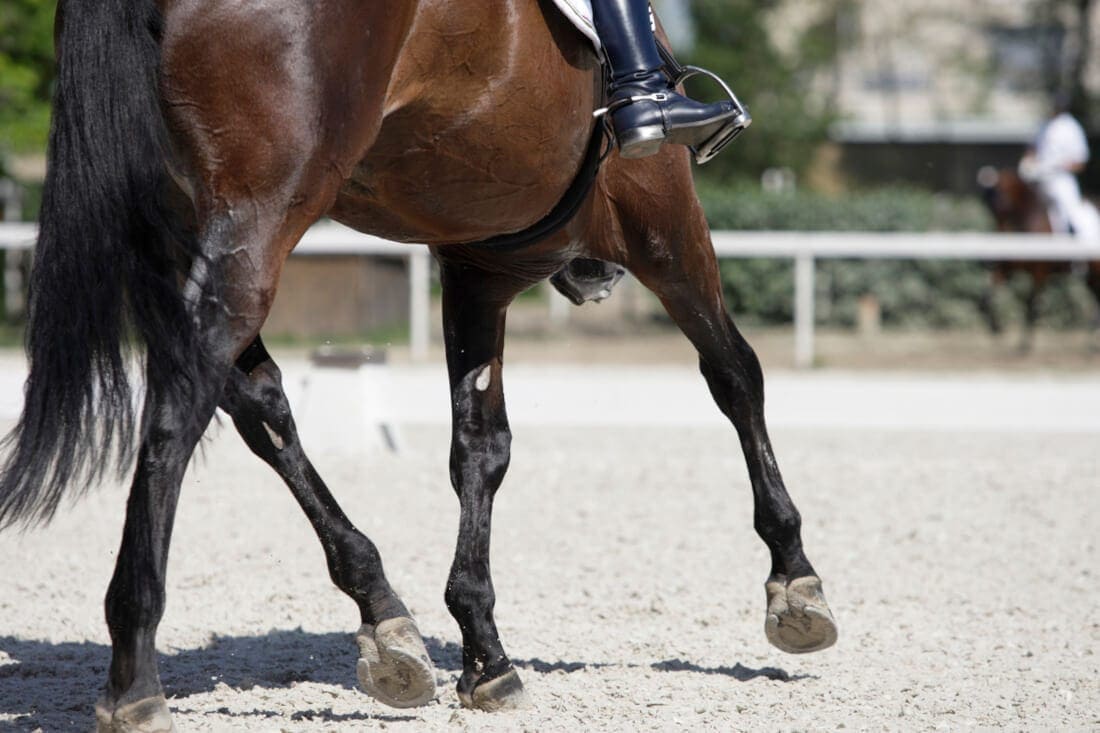
Horse chestnuts, sometimes called castors or night eyes, are small, rough patches of skin commonly found on a horse’s legs. These structures have long attracted interest due to their distinctive appearance and uncertain origin.
Leg chestnuts serve no known function today, but they are thought to be evolutionary remnants from historical equids. Ergots, smaller calloused growths near the fetlocks, are related but have a separate anatomical history.
Horse leg chestnuts are harmless and vary widely in size and shape between breeds and individual horses. Keeping them clean and gently exfoliating any loose skin can help prevent cracking or irritation, supporting overall skin health.
Read on to learn more about the science, care, and evolutionary background of horse leg chestnuts, so you can better understand these unusual features of equine anatomy.
Horse Leg Chestnuts
Horse chestnuts (also known as castors or night eyes) are rough, thickened patches of skin located near the horse’s knees and hocks. [1] These distinct markings are a normal feature of the horse’s body. They are not associated with any health problems or medical concerns. [2]
However, since the chestnut continues to grow slowly throughout the horse’s lifetime, owners sometimes peel away the outer layers to flatten the area and give the leg a neater, more groomed appearance. [2]
Chestnuts found on the front legs are typically oval in shape and are usually around 2 inches (5 cm) long. [1] Chestnuts located on the hind legs have a similar appearance to those on the front, but they are generally a bit smaller in size and somewhat narrower. [1]
Origin
The structure known as the chestnut has been studied for decades in an effort to determine its anatomical nature and evolutionary origin.
Earlier theories suggested that the chestnut was an evolutionary remnant from early equids such as Eohippus, a predecessor of the modern horse that lived about 50–55 million years ago. Eohippus and other ancestral equids had multiple toes on each foot instead of a single hoof. As horses evolved, it was believed that the extra toe shrank and lost function, eventually presenting as what we now call the chestnut. [2]
Another historical explanation proposed that the chestnut was a remnant of a scent gland, based on similarities in location to glands found in other quadrupeds such as deer. [3]
However, current evidence indicates that the chestnut is neither a reduced digit nor a scent gland. Instead, it is now widely accepted as a vestigial carpal pad, also known as a wrist pad. [4][5][6]
In many quadrupeds, the carpal pad is located just above the wrist (carpus) on the front limbs and acts as a shock absorber during movement. Evidence suggests this was also the case in early equine species. [4][5][6]
As horses evolved and their limb structure adapted for speed and endurance over open ground, the carpal pad no longer served a function in locomotion. As a result, it gradually reduced in size and prominence, eventually becoming what we now recognize as the chestnut. [4][5][6]
What's your top priority with your horse's health?

What's your top priority with your horse's health?
Ongoing Inquiry
In the modern horse, the chestnut has no known purpose. While the carpal pad theory is currently the widely accepted explanation of its origin, there is evidence that the original structure may have played a larger role in the horse’s physiology.
More recent research shows that chestnuts contain nerve fibers and Ruffini endings, which are sensory receptors responsible for detecting pressure and skin stretch. [7]
This suggests that chestnuts may once have played a role in sensory perception, even though they no longer serve any known function in modern horses. Their persistent nerve structures hint at a time when these features may have contributed more directly to the animal’s interaction with its environment. [7]
An interesting side note is that there is a curious synonym for the horse chestnut: “night eyes.” This term appears to come from folklore suggesting these features helped the horse see in the dark. [2]
Horse Identification
Some studies have found that the shape of each individual horse’s chestnuts is completely unique. It has been demonstrated that no two horses have identical or even similar outlines around their chestnuts. This supports the idea that chestnuts can serve as a reliable form of identification, much like fingerprints in humans. [2][8]
Given this, some breed registries have adopted the practice of collecting and using chestnut images to identify individual horses. [2]

Horse Leg Chestnuts vs. Ergots
Recent anatomical findings reveal that chestnuts share significant structural and biological similarities with ergots. Research shows that the tissue structure of the chestnut is nearly identical to that of enlarged ergots.
Both chestnuts and ergots are made of keratinized skin tissue that has become thick, tough, and dry. [7]
They are both considered vestigial structures and both contain sensory nerve endings from the horse’s evolutionary past. [7] That said, preliminary research suggests that the ergot may play a small role in equine leg physiology, while no comparable function has been found for chestnuts. [7]
Function
Chestnuts and ergots are found in different positions on the horse’s body, which suggests they served different functions in the ancestral equid species.
While chestnuts appear to be vestiges of carpal pads, ergots are believed to correspond to the middle portion of the three-lobed foot pads seen in these other species. [1][4]
Location
The location of these two features is also distinct and can be used to tell them apart. Chestnuts are typically found on the inner side of the horse’s legs, specifically near the knees on the front legs and near the hocks on the back legs.
In contrast, ergots are located lower down on the limb, just beneath the fetlock joint. [1]
Anatomy
Chestnut and ergot tissues also have different degrees of penetration into the horse’s leg. Ergots are usually firmly attached to the ligament in the horse’s lower leg at the fetlock joint.
Chestnuts, on the other hand, are superficial, callous-like patches of skin that can often be peeled or trimmed without causing discomfort to the horse. [7]
Appearance
In addition to location, the size and shape of chestnuts and ergots further distinguish the two. Chestnuts are considerably larger in size than ergots, sometimes as much as four times larger, and they tend to have an oval shape.
Ergots, on the other hand, are typically smaller and rounder, making them easily identifiable compared to chestnuts. [1]
Grooming
Ergots should be checked by a farrier on a regular basis. They may need to be trimmed using a blade.
Chestnuts can usually be peeled without the aid of a blade. They can be kept soft with the help of petroleum jelly or baby oil. [2]
Breed Differences in Chestnut Presentation
In most horse breeds, chestnuts are present on all four legs and are considered a standard anatomical feature. [1]
In some breeds, particularly those descended from North African lines such as Arabians, hind chestnuts are frequently absent. This absence is normal for these breeds and is not considered a defect. [1]
In some individual horses, chestnuts may be present on only one or two legs rather than all four. [2] Some horses may be born without chestnuts on their front legs, but this is considered a rare anatomical variation. [1]
A few horse breeds are known to lack chestnuts entirely. These include: [2]
- Caspian ponies
- Icelandic horses
- Banker horses
How to Groom Horse Leg Chestnuts
Unlike ergots which require trimming, chestnuts usually only need to be peeled back occasionally to keep them flat and clean-looking. [2]
Follow these steps to keep your horse’s chestnuts looking their best: [2]
- Wet the chestnut by pressing a damp cloth or gauze to the area for 30 – 60 seconds. Working with wet chestnuts is often easier as they are softer.
- Using a fingernail or other instrument, gently scrape the softened chestnut. Razors or blades should not be necessary and can hurt the horse if the flesh under the chestnut is damaged.
- Do not twist the chestnut as this can cause pain or bleeding.
- Apply petroleum jelly, hoof moisturizer, or baby oil between peelings to help keep the chestnuts soft and looking good.
It’s important to note the process of peeling chestnuts should be painless. If the horse responds by shying away or otherwise signaling pain, the procedure should be stopped immediately.
In addition, the chestnut should not bleed when it is being peeled. If it does, this is an indication that it is too dry. Apply petroleum jelly, hoof moisturizer, or baby oil if the surface is particularly hard. If you need guidance on how to groom your horse’s chestnuts safely and effectively, consult with your farrier or veterinarian.
Frequently Asked Questions
Here are some frequently asked questions about horse chestnuts:
Horse chestnuts are thickened patches of skin that develop on the inner legs near the knees and hocks. These structures are a normal part of equine anatomy and are not linked to disease or injury. Chestnuts grow slowly over time and vary in size and shape between horses, with front leg chestnuts often measuring around 2 inches (5 cm) in length.
Horse chestnuts do not serve a known purpose in modern equine physiology, though they are considered vestigial structures. Research suggests they originated as carpal pads that once helped absorb shock during movement. Despite having no clear function today, chestnuts still contain nerve endings, indicating they may have played a sensory role earlier in equine evolution.
Horse chestnuts and ergots are related structures made of keratinized tissue, but they differ in location and form. Chestnuts are found higher on the leg near the knees and hocks, while ergots sit below the fetlock joint. Ergots are smaller and more firmly attached, whereas chestnuts are larger, more superficial, and can often be gently peeled.
Horse chestnuts do not require removal, as they are harmless and part of normal anatomy. Some owners choose to peel away loose outer layers for cosmetic reasons, especially as the tissue thickens over time. Grooming is optional and should be done carefully, avoiding cutting tools that may damage the underlying skin or cause discomfort.
Grooming horse chestnuts involves softening the tissue and gently removing loose layers to keep the area smooth. Pressing a damp cloth against the chestnut for 30 to 60 seconds helps loosen the surface. Peeling should be done with a fingernail rather than a blade, and applying petroleum jelly or baby oil can help maintain softness between grooming sessions.
Horse chestnuts rarely cause discomfort, as they are superficial and not connected to deeper structures. Problems may arise if the tissue becomes excessively dry, cracked, or handled too aggressively during grooming. Signs such as bleeding or sensitivity suggest the area should be softened and left to recover before further attention.
Horse chestnuts have unique shapes and patterns for each individual, making them useful for identification. Studies show that no two horses share identical chestnut outlines, similar to fingerprints in humans. Some breed registries use chestnut images as part of official identification records to distinguish between individual animals.
Chestnut presence varies between horses, though most have them on all four legs. Certain breeds, particularly those with North African ancestry such as Arabians, may lack chestnuts on the hind legs. Some horses may also be missing chestnuts on one or more legs, and a few breeds are known to lack them entirely.
The term night eyes refers to a traditional name for horse chestnuts based on folklore. This nickname comes from the belief that these structures helped horses see in low light conditions. No scientific evidence supports this idea, and the term persists mainly as a cultural reference rather than a functional description.
Summary
Horse chestnuts are thick, dry patches of skin located near a horse's knees and hocks. Although they no longer serve a clear biological function, they are a natural and harmless part of equine anatomy.
- Chestnuts are rough, oval-shaped skin growths that appear near the knees and hocks and slowly grow throughout the horse's life
- Though similar in structure and origin, chestnuts and ergots differ in size, shape, location, and how they attach to the leg
- Some breeds, particularly those of North African descent, may naturally lack hind chestnuts or have fewer chestnuts than usual
- Once believed to be remnants of extra toes or scent glands, chestnuts are now understood to be vestigial carpal pads from the horse's evolutionary ancestors
- Because the shape of chestnuts is unique to each horse, they can be used similarly to fingerprints for identification purposes
- Chestnuts require minimal care and can be gently peeled to maintain a smooth, clean look; regular softening helps prevent cracking or discomfort
References
- Ridgeway. W. The Origin and Influence of the Thoroughbred Horse. Cambridge, University Press. 1905.
- Henry. M. Why Do Horses Have Chestnuts and Ergots on Their Legs?. Saddle Up. 2023.
- Funnell. R. Horses Have A Crusty Remnant Of Evolution Stuck To Their Legs. IFLScience. 2022.
- Dyce. K. et al. Textbook of Veterinary Anatomy. Saunders Elsevier. 2010.
- Baxter. G. M. Ed. Adams and Stashak's Lameness in Horses. Seventh edition. Wiley-Blackwell, Hoboken, NJ. 2020.
- Ross. M. W. and Dyson. S. J. Diagnosis and Management of Lameness in the Horse. 2nd ed. Elsevier Saunders, St. Louis, Mo. 2011.
- Lusi. C. M. and Davies. H. M. S. The Connectivity and Histological Structure of the Equine Ergot—A Preliminary Study. Journal of Equine Veterinary Science. 2017.
- Bihuncová. I. et al. The Effect of the Size and Shape of Chestnuts on the Identification of Horses. Acta Universitatis Agriculturae et Silviculturae Mendelianae Brunensis. 2013.