English





![Basic Health Check for Horse Owners: [Veterinarian-Backed How-To Guide]](/wp-content/uploads/2025/01/at-home-health-check-for-owners.jpg)
Regular health checks are a key component of maintaining your horse’s well being, performance, and longevity. Comprehensive health checks allow for early detection of illness, injury, or discomfort, allowing for prompt veterinary treatment and better long-term health outcomes.
Every horse owner should be able to examine their horse for signs of illness or injury. Many common health problems show early symptoms that a keen observer can identify on a basic health check.
Health checks can also assist in emergency situations by providing your veterinarian with critical information before they arrive at your farm.
Performing a horse health check is simple and takes less than 5 minutes. This guide — written and approved by our team of qualified veterinarians — walks you through each step to ensure you have the knowledge and confidence to perform a health check on your own horse.
Basic Health Check for Horses
A basic health check provides key insight into your horse’s physiological and behavioral status. Observing a horse’s general appearance, demeanor and movement can reveal early indications of discomfort and illness.
Monitoring vital signs including temperature, heart rate, and respiration, helps identify fever, stress, or pain. In addition, assessing hydration and gut sounds can help identify the risk of colic or other gastrointestinal issues.
Signs of redness, discharge, or swelling in the eyes, ears, and nostrils may point to respiratory, allergic or infectious concerns, and leg and hoof checks are also vital for detecting early lameness, inflammation, or hoof problems such as cracks or abscesses.
Taken together, these observations provide a concise yet reliable snapshot of a horse’s overall health, guiding prompt and effective care.
Equipment
A horse health check requires very little specialized equipment. Ideally, you should have the following items in your tack box: [1]
- Watch with a second hand or a clock app on your phone
- Thermometer
Additional equipment that can be helpful includes: [1]
- Stethoscope
- Penlight
- Hoof pick
- Lubricant for thermometer
What's your top priority with your horse's health?

Enter your email to receive your store credit
Step 1: Observation
The first step of a horse health check involves observing them in their environment. Ideally, the horse should be loose in an open space, such as a paddock or stall. Observing them outside of the influence of handling allows for the most accurate assessment of their demeanor. [1]
Carefully consider each of the following attributes as you observe the horse: [1]
- General appearance
- Attitude and demeanor
- Posture and movement
- Respiratory effort
- Eating, drinking, urination, and defecation
General Appearance
The horse’s overall appearance can often provide clues regarding their underlying health. From a distance observe the following features: [1]
- Quality of the hair coat
- Length of hair coat
- Signs of recent sweating, like damp or curled hair
- Quality of the hooves
- Any wounds or drainage
- Swelling of the limbs, chest area, or sheath
| Urgency | Observation |
|---|---|
| Safe Healthy Horse |
|
| Caution Seek Veterinary Care ASAP |
|
| Urgent Seek Emergency Veterinary Care |
|
Attitude & Demeanor
The horse’s attitude and demeanor can indicate a systemic (whole body) problem.
| Urgency | Observation |
|---|---|
| Safe Healthy Horse |
|
| Caution Seek Veterinary Care ASAP |
|
| Urgent Seek Emergency Veterinary Care |
|
Posture & Movement
Horses often change their posture and movement in response to pain or injury, to reduce strain on the injured area.
| Urgency | Observation |
|---|---|
| Safe Healthy Horse |
|
| Caution Seek Veterinary Care ASAP |
|
| Urgent Seek Emergency Veterinary Care |
|
 Sawhorse Stance Illustration: Dr. Ana Mesa, PhD
 Respiratory Effort
Some horses change their breathing patterns around humans, so observation from a distance is an important component of the health check. Ideally, your observation should occur when the horse has been resting for a long period, so that recent exercise does not influence their breathing rate or pattern.
| Urgency | Observation |
|---|---|
| Safe Healthy Horse |
|
| Caution Seek Veterinary Care ASAP |
|
| Urgent Seek Emergency Veterinary Care |
|
Eating, Drinking, Urinating & Defecating
Often one of the first signs of illness in horses is changes in their eating, drinking, urinating, or defecating patterns. [2] Horse owners should be familiar with their horse’s normal daily routines, so that they can identify changes promptly. [2]
| Urgency | Observation |
|---|---|
| Safe Healthy Horse |
|
| Caution Seek Veterinary Care ASAP |
|
| Urgent Seek Emergency Veterinary Care |
|
Step 2: The Head
After haltering the horse, you can proceed with a hands-on examination. Performing this examination consistently each time ensures that you will not miss any important details. [1]
One strategy for ensuring a consistent examination is to begin at the head, carefully move down one side of the body to the tail, then continue from the tail back up the opposite side to the head.
Components of the head examination include: [1]
- General appearance of the head
- Examination of the eyes and nose, especially if the eyes are bulging, sunken, blood shot, or seem disengaged
- Evaluation of the mouth, including assessment of the gums and capillary refill time
- Palpating the facial pulse
General Appearance
The horse’s head contains many structures, including the sinuses, lymph nodes, salivary glands, muscles, and bone. Changes in the horse’s head shape may indicate problems with one or more of these structures. [1]
Evaluating the symmetry of the head is one way to quickly identify structural changes, as long as only one side is affected. More careful observation is necessary if both sides of the head have changed shape. [1]
| Urgency | Observation |
|---|---|
| Safe Healthy Horse |
|
| Caution Seek Veterinary Care ASAP |
|
| Urgent Seek Emergency Veterinary Care |
|
Eyes
Horses have very large eyes that protrude from their head, putting them at risk of injury. Quickly identifying eye abnormalities is crucial to preserving vision, as many conditions that affect the eye can rapidly cause blindness if left untreated.
There are several components to a thorough eye examination: [1]
- General appearance: Look for evidence of squinting, swelling around the eye, and cloudiness or color changes within the eye. Examine for changes in the eyeball shape, including increased or decreased size.
- Ocular secretions: Look for signs of discharge from the eyes, and determine the color and consistency if present.
- Vision assessment: Perform a menace response test. Move your hand towards the horse’s eye without creating an air current or touching the eyelashes to see if they blink or squint.
| Urgency | Observation |
|---|---|
| Safe Healthy Horse |
|
| Caution Seek Veterinary Care ASAP |
|
| Urgent Seek Emergency Veterinary Care |
|
Nose
Horses cannot breathe through the mouth, so the nostrils are an important area to examine during a horse health check. You can also use a penlight to look up into the horse’s nostril to check for abnormalities. Horse owners should evaluate: [1]
- Air flow: Air should come out of both nostrils when the horse breathes. You can assess this by holding your hand in front of each nostril. The smell of the horse’s breath should also be assessed.
- Nasal secretions: Look for signs of nasal discharge, including the color and consistency of any secretions present.
- Nostril flaring: Horses breathing hard or who are struggling to breathe may flare (or dilate) their nostrils wider than a normal, resting horse.
You can also assess the horse’s breathing rate by watching their nostrils. Ensure that the horse is not actively sniffing, as this will falsely increase the perceived breathing rate. [2] Count the number of breaths over 15 seconds, then multiply by 4 to get the breathing rate per minute.
| Urgency | Observation |
|---|---|
| Safe Healthy Horse |
|
| Caution Seek Veterinary Care ASAP |
|
| Urgent Seek Emergency Veterinary Care |
|
Mouth
Horses have large, elongated heads and small mouths, which makes most of their oral cavity inaccessible to horse owners. However, careful assessment of the accessible parts of the mouth, such as the gums, can provide information about the horse’s overall health.
Components of the oral examination include: [1][2][3]
- Moisture: The moistness of the gums is an indication of the horse’s hydration status.
- Gum color: The color of the gums can indicate cardiovascular problems, blood infections, liver disease, and other conditions. Owners should also examine the gums for any injuries or ulcers on the surface. The presence of patches of small, pinpoint red dots also require prompt veterinary assessment.
- Capillary refill time: Capillary refill time (CRT) assesses cardiovascular function. To evaluate CRT, press one finger on the horse’s gums until the tissue turns white and release. Time how long it takes for the tissue to return to its previous color.
- Oral odors: Oral odors can indicate dental disease, sinus infections, and other conditions.
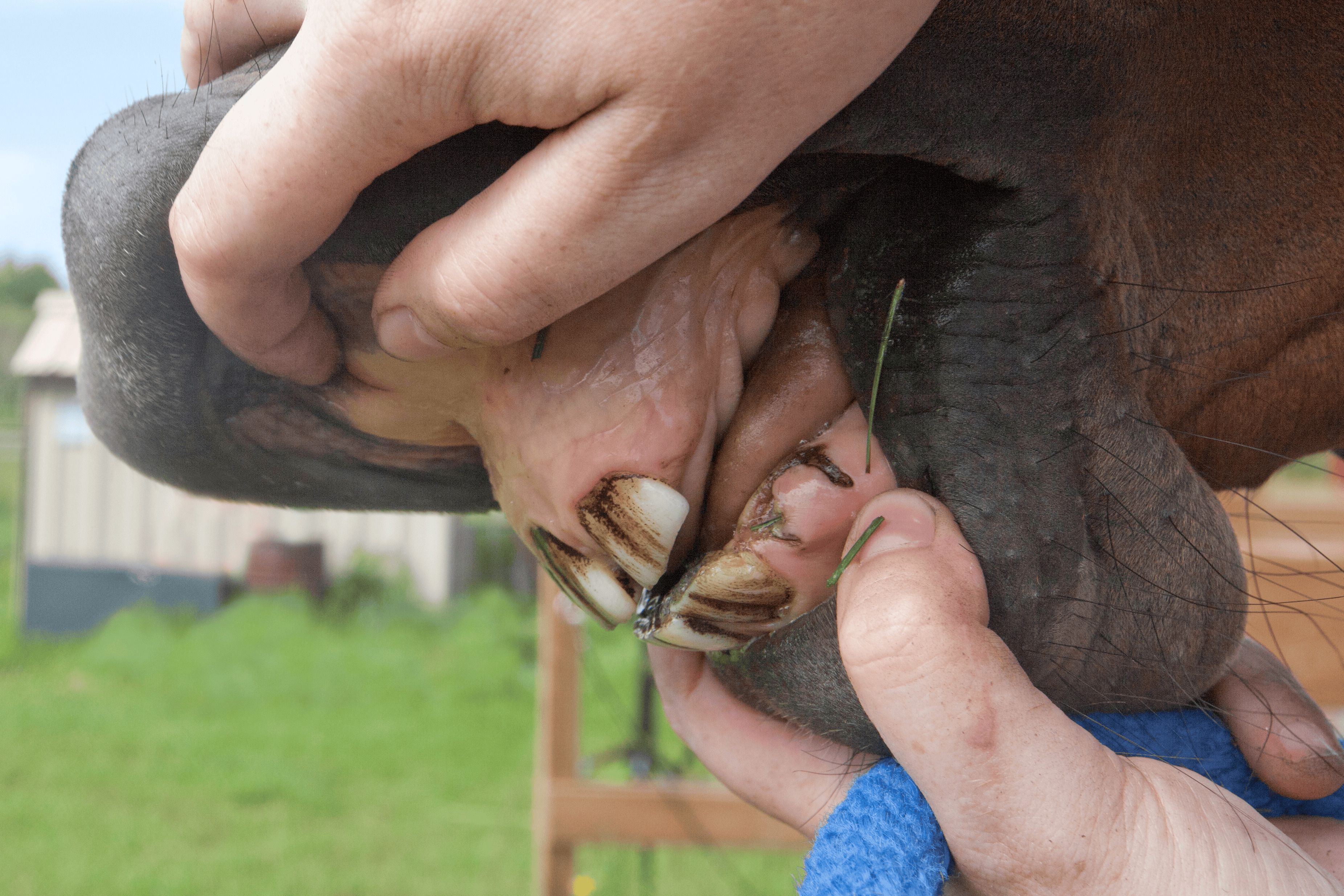 Note: the above horse is a juvenile and had a missing baby incisor at the time this photo was taken
Photo: Dr. Madison Ricard, DVM, PhD, DACVP, PAS
| Urgency | Observation |
|---|---|
| Safe Healthy Horse |
|
| Caution Seek Veterinary Care ASAP |
|
| Urgent Seek Emergency Veterinary Care |
|
Facial Pulse
The large arteries running on the surface of the head are an easily accessible location to take the horse’s pulse. Horse owners can use these locations to determine their horse’s heart rate if they do not have a stethoscope. [2]
The most common artery to take a facial pulse is the facial artery, just below the horse’s jaw. To find the facial artery, run your fingers along the junction between the horse’s cheek and their jaw bone. Near the indentation of the cheek, a pencil-width, rope-like structure can be felt under the skin. Place your fingers over this structure to feel the pulse. [1]
 Facial Pulse Check
Once you have found the horse’s pulse, use a watch with a second hand or other timer to count the number of pulses you feel over a period of 15 seconds. [1] Multiply this number by 4 to determine the horse’s pulse rate.
Alternatively, you can use an equine heart rate monitor if you have one available at your farm.
| Urgency | Observation |
|---|---|
| Safe Healthy Horse |
|
| Caution Seek Veterinary Care ASAP |
|
| Urgent Seek Emergency Veterinary Care |
|
Step 3: The Neck
After finishing assessment of the head, move to one side of the horse’s neck. The neck is an ideal location to assess the horse’s hydration and cardiovascular status via the jugular veins.
Hydration
Perform a “skin tent” to assess hydration status and identify dehydration. To perform this test, pinch an area of skin on the neck in front of the shoulder with your thumb and forefinger. Release the pinch and time how long it takes for the skin to lay flat again. [1]
 Skin Tent Check
It’s important to note skin elasticity is not the best indicator of hydration status in horses. Skin elasticity varies across individuals and declines with age. The mouth and mucous membranes are a more reliable indicator of hydration status.
| Urgency | Observation |
|---|---|
| Safe Healthy Horse |
|
| Caution Seek Veterinary Care ASAP |
|
| Urgent Seek Emergency Veterinary Care |
|
Jugular Veins
The jugular veins are large vessels on either side of the neck. They are found in the jugular groove, the indent between the bulk of the neck and the location of the trachea. Assessing the jugular veins can help identify cardiovascular health concerns.
The time it takes for the jugular veins to fill when compressed is a crude indicator of heart function. To fill the jugular veins, use your fingers to flatten the vein near the horse’s shoulder. [1] The vein will start to fill with blood and become more visible along the length of the horse’s neck. Time how long it takes for the vein to fill completely. [1]
 Jugular Fill Check
While examining the jugular veins, also look for a jugular pulse. If there is fluid accumulation in the jugular vein, the artery’s pulsation can cause a pulsing appearance in the jugular vein. Fluid accumulation in the jugular vein can indicate poor drainage of the vessel due to cardiac issues.
To evaluate for a jugular pulse correctly, the horse must have its head held up above its heart. It is normal to see a jugular pulse if the horse has its head down.
| Urgency | Observation |
|---|---|
| Safe Healthy Horse |
|
| Caution Seek Veterinary Care ASAP |
|
| Urgent Seek Emergency Veterinary Care |
|
Step 4: The Limbs
After finishing at the neck, evaluate the front limb next to you. Repeat this step for each limb as you encounter them during your examination. Evaluate the following features of each limb: [1]
- General appearance
- Hoof appearance
- Hoof temperature
- Digital pulses
- Swelling
- Lacerations
- Changes in skin texture
- No major differences in appearance between legs
- No signs of heat or pain
- Tendons prominent and well-defined
General Appearance
Examine the leg to ensure there are no bumps, lumps, wounds, or swellings. Run your hand down the leg to assess for areas of increased heat, which can indicate inflammation, or a pain response from the horse. [1]
| Urgency Guideline | Observation |
|---|---|
| Safe Healthy Horse |
|
| Caution Seek Veterinary Care ASAP |
|
| Urgent Seek Emergency Veterinary Care |
Hoof Appearance
Assess the hoof specifically. Look at the external hoof wall to see if there are any signs of cracking, chipping, hoof rings, or other abnormalities. Pick up the foot and clean it out, then assess for any foreign objects penetrating into the sole, foul odors, or other changes. [1]
| Urgency | Observation |
|---|---|
| Safe Healthy Horse |
|
| Caution Seek Veterinary Care ASAP |
|
| Urgent Seek Emergency Veterinary Care |
|
Hoof Temperature
Horse hooves often increase in temperature during painful hoof conditions like laminitis or hoof abscesses. To check your horse’s hoof temperature, place your hand over the hoof. It can be helpful to compare to another hoof on the same horse to see if the temperature is increased. [1]
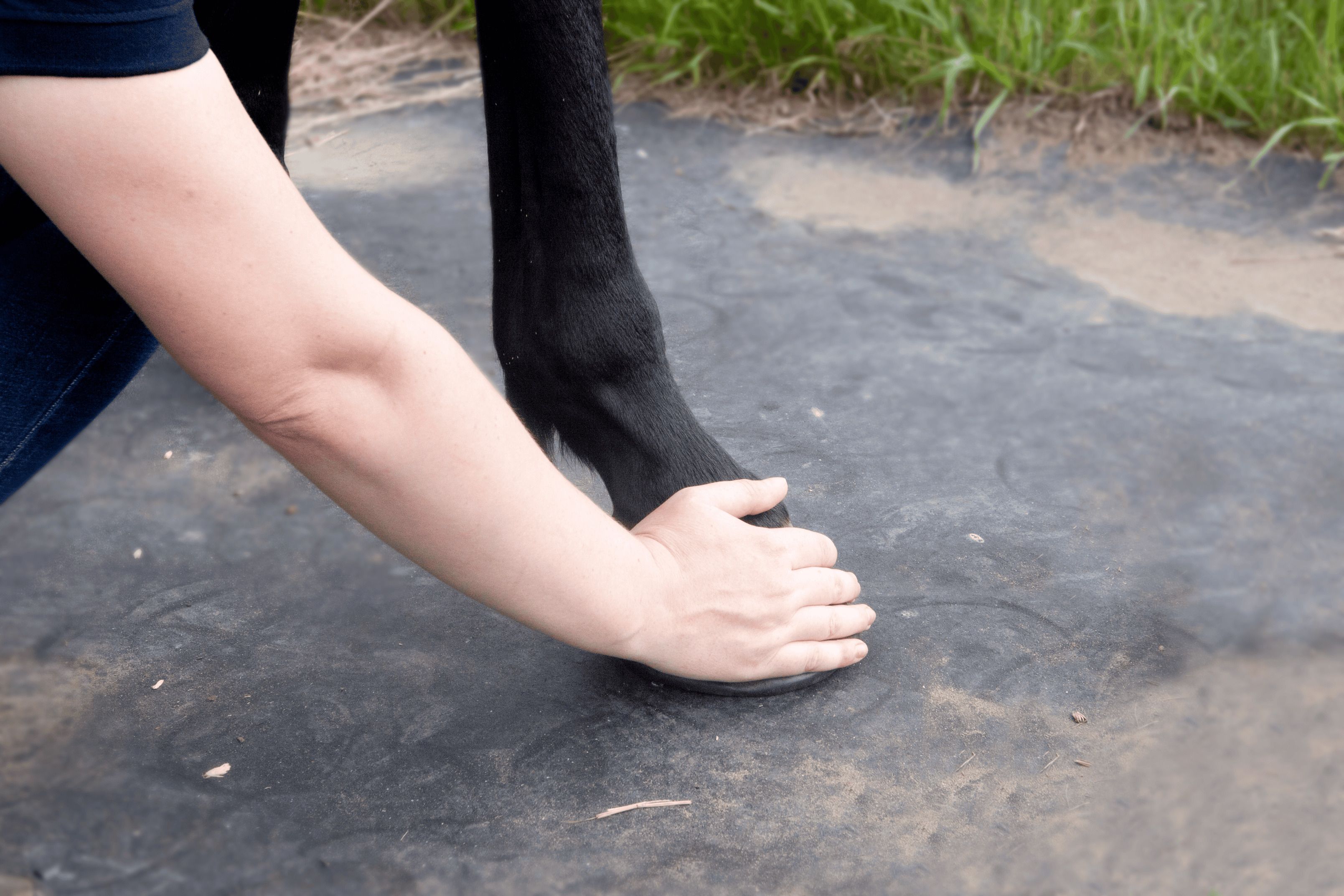 Hoof Temperature Check
There may be differences in hoof temperature if one side of the horse’s body has been in direct sunlight before the examination. If you are unsure, move the horse to a shaded area and check again once they have had time for their external hoof temperature to stabilize.
| Urgency | Observation |
|---|---|
| Safe Healthy Horse |
|
| Caution Seek Veterinary Care ASAP |
|
| Urgent Seek Emergency Veterinary Care |
|
Digital Pulses
The digital pulses can also help identify painful hoof conditions, such as laminitis. In response to inflammation and pain, blood flow to the hooves increases, resulting in a stronger pulse.
To find the digital pulses, use your fingers to find a pencil-width, rope-like structure under the skin at the back of the fetlock. After finding the artery, hold your fingers in place to feel for the pulse’s strength. Make sure to use a light touch and practice when your horse is healthy so you are more likely to notice any changes if they are having issues. You can also compare pulse strength with the horse’s other legs to identify a problematic hoof.
 Digital Pulse Check
| Urgency | Observation |
|---|---|
| Safe Healthy Horse |
|
| Caution Seek Veterinary Care ASAP |
|
| Urgent Seek Emergency Veterinary Care |
|
Step 5: The Chest
The horse’s chest contains two major organs: the heart and the lungs. Careful assessment of these structures is an important part of any health check.
For a basic health check, assessing the horse’s pulse and breathing rate is sufficient. These assessments are covered under the head portion of the examination. However, some owners find it easier to count heart rate and breathing rate using a stethoscope.
Heart Rate
To measure the horse’s heart rate, place your stethoscope in their left armpit area. The ideal location is directly under the point of the elbow. [1] You may have to pull back on the head of the stethoscope slightly to ensure that there is enough room for the stethoscope diaphragm to move.
In deep chested or overweight horses, it can be hard to reach the heart from a neutral standing position. If needed, you can ask the horse to step forward slightly or pull the front leg forward to gain better access to this target area.
 Heart Rate Check with Stethoscope
Note that 3 or 4 beats may be heard when listening with a stethoscope. When counting heartbeats, only count the loudest one.
| Urgency | Observation |
|---|---|
| Safe Healthy Horse |
|
| Caution Seek Veterinary Care ASAP |
|
| Urgent Seek Emergency Veterinary Care |
|
Breathing Rate
There are two main locations where you can assess breathing rate using a stethoscope: over the lungs and over the trachea. You can also watch the horse’s flanks rise and fall as an alternative to using a stethoscope.
To listen to the trachea, place your stethoscope on the horse’s windpipe approximately halfway up the neck. [1] Tracheal sounds are typically louder and easier to hear than lung sounds.
 Breathing Check over Trachea
To listen over the lungs, place your stethoscope between two ribs of the horse, approximately halfway down their ribcage and halfway up their body. [1] Listen carefully, as lung sounds are typically very quiet.
 Breathing Check over Lung
| Urgency | Observation |
|---|---|
| Safe Healthy Horse |
|
| Caution Seek Veterinary Care ASAP |
|
| Urgent Seek Emergency Veterinary Care |
|
Step 6: The Abdomen
The abdomen contains the horse’s very large digestive system. Painful conditions of the abdomen, spleen, liver, kidneys, ovaries and bladder are very common and present themselves as colic. Evaluating the digestive system’s borborygmi (gut sounds) may help horse owners identify subtle signs of colic early.
Borborygmi (gut sounds)
Listening to the horse’s gut sounds is safest using a stethoscope. However, many horse owners simply press one ear against their horse’s side to listen for borborygmi. It is important to keep safety in mind if you choose to do this, as horses experiencing abdominal pain are more likely to kick out.
When listening for borborygmi, there are four main locations to assess:
Right and left paralumbar regions: The region between the horse’s hip and the start of the ribs, high up on the horse’s abdomen
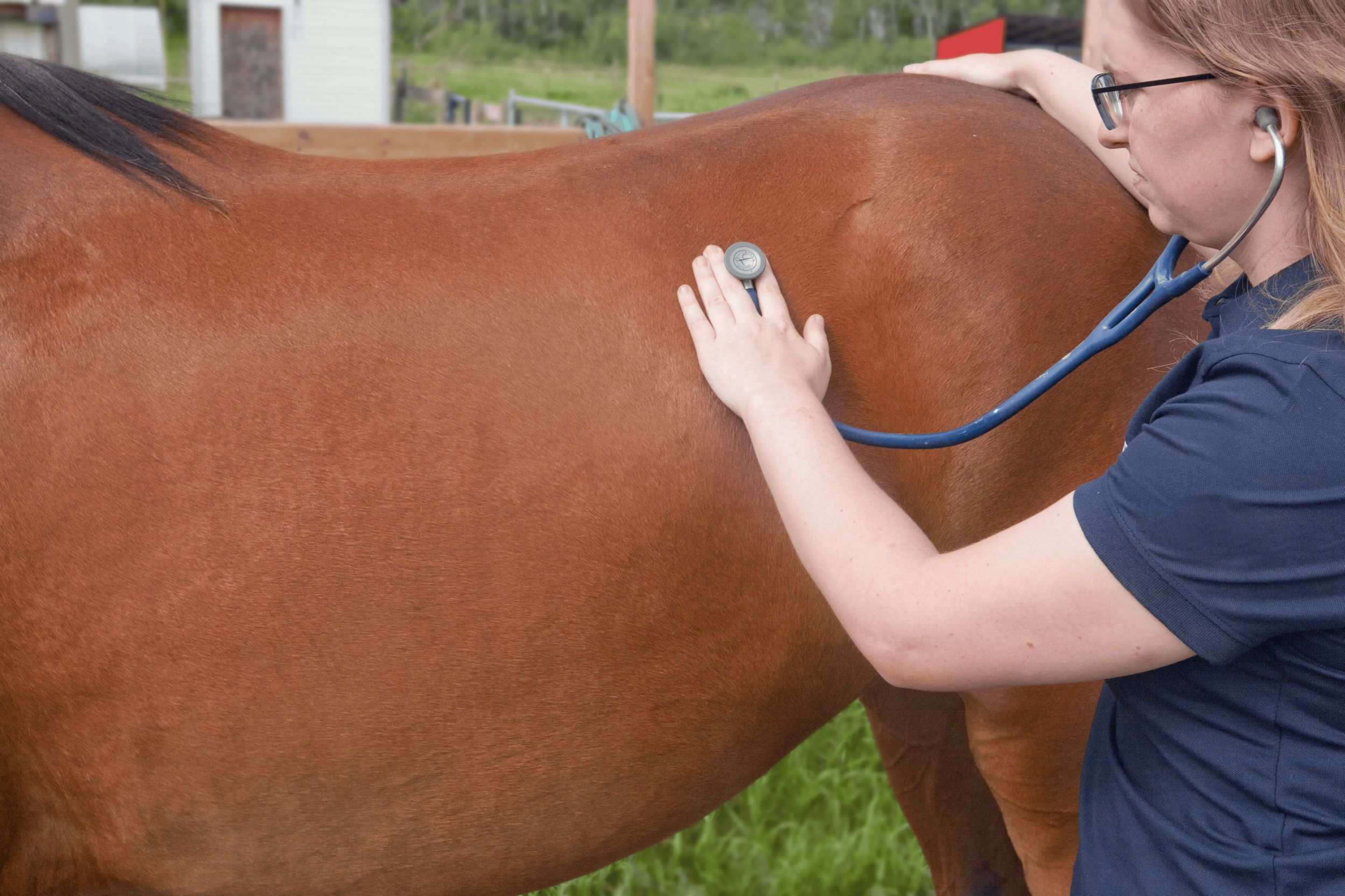 Gut Sounds Check over Paralumbar Region
Right and left flanks: The main portion of the horse’s abdomen, just in front of the stifles
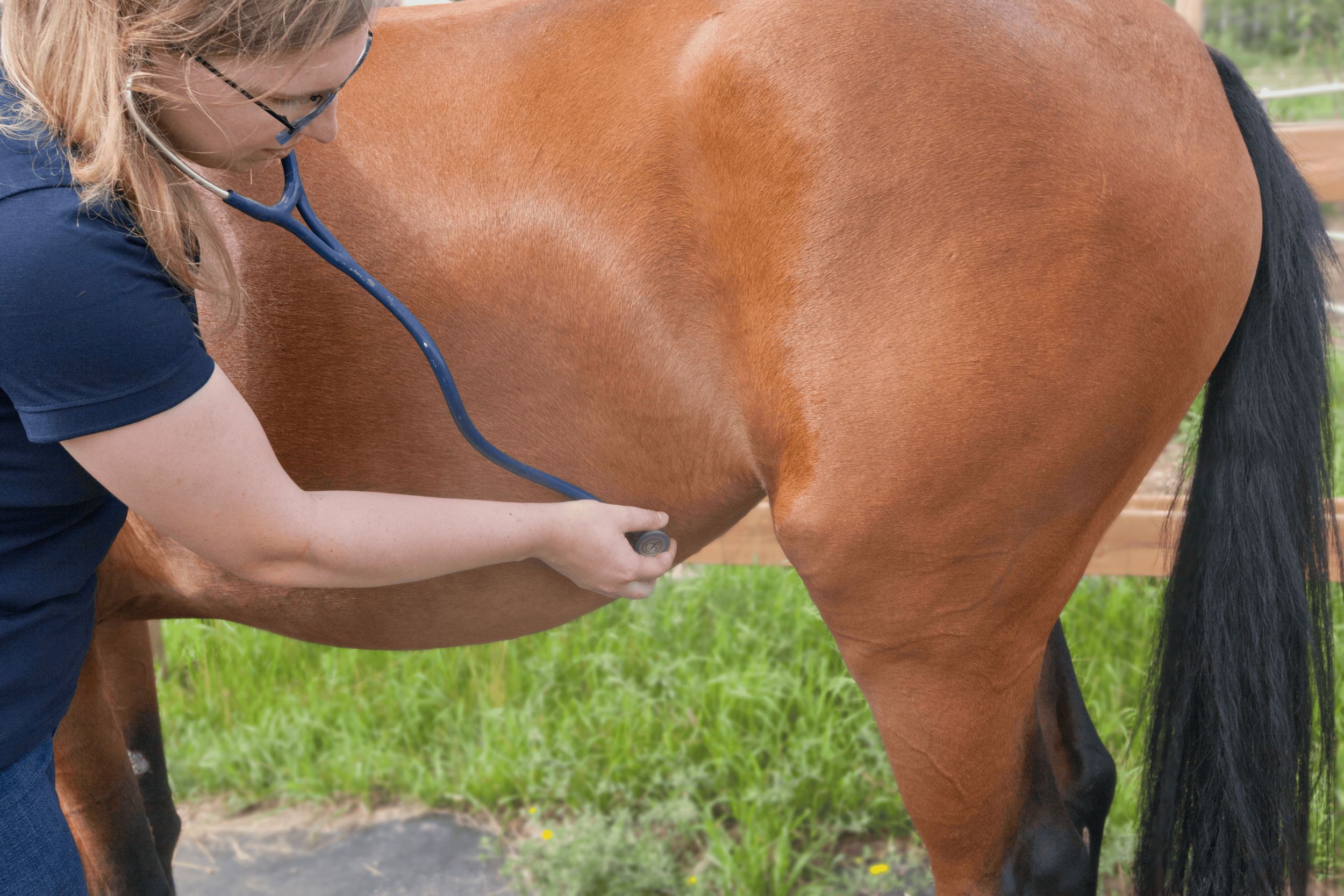 Gut Sounds Check over Flank
Listen carefully to these locations for 1-2 minutes each. Borborygmi sound like rumbling or bubbling within the horse’s intestinal tract. Note the frequency of gut sounds and their intensity. Horse owners should listen to their horse’s normal borborygmi to establish a baseline.
On the right paralumbar area, there is a second type of borborygmi to listen for. This sound comes from the junction between the intestines, cecum and colon, and sounds like a high-pitched rumbling resembling the sound of water flushed down a pipe. [1] Veterinarians call this noise an ileocecocolic flush. [1]
Table 1. Healthy equine gut sounds reference guide
| Urgency | Observation |
|---|---|
| Safe Healthy Horse |
|
| Caution Seek Veterinary Care ASAP |
|
| Urgent Seek Emergency Veterinary Care |
|
Step 7: The Tail
Before you move from the abdomen to the tail, remember to look at the hind limb closest to you. Repeat the assessment in Step 4 for this leg. The main assessment in the tail area is taking the horse’s rectal temperature. Visually, it is helpful to observe if there are any signs of diarrhea or water standing on the horse’s hind end.

Rectal Temperature
To take a rectal temperature, you will need a thermometer and a lubricant. If you do not have a lubricant, spitting on the end of the thermometer is a suitable replacement.
Stand next to the horse’s hind leg, facing away from their head. This puts you in the safest position if the horse kicks during the temperature reading. Use one hand to gently pull the horse’s tail to one side. Some horses resist this and may clamp their tail down. Continue to gently move the horse’s tail out of the way.
Use your free hand to place the thermometer in the horse’s rectum. Guide the tip of the thermometer towards the side of the horse’s rectum, not directly in the middle. This avoids taking a temperature reading of their feces rather than their body temperature.
 Rectal Temperature Check
For traditional mercury thermometers, hold the thermometer in place for 1 minute. [3] However, mercury thermometers are not recommended as they carry a risk of breaking while in use. If there is no other option, make sure you have the mercury thermometer attached to a line so you can remove it easily if it gets lodged out of reach during measurement.
Digital thermometers typically beep once the reading is complete.
| Urgency | Observation |
|---|---|
| Safe Healthy Horse |
|
| Caution Seek Veterinary Care ASAP |
|
| Urgent Seek Emergency Veterinary Care |
|
Step 8: Repeat!
You should have successfully worked down one side of your horse. Now, repeat the steps in reverse, working your way back towards your horse’s head.
Once you get back to the head, you have successfully completed the horse health check! Make a note of any caution flags you identified during your examination and book a veterinary appointment as soon as possible. If you found any urgent flags, immediately call your veterinarian for emergency assistance, as these findings may be life-threatening.
Include these daily horse health checks alongside other, less frequent evaluations — such as regular body condition scoring — to ensure your horse remains at a healthy weight.
Message from an Equine Veterinarian
Having the tools and knowledge to perform a daily health check is an important part of your horse’s overall health plan. Identifying small changes through careful observation allows for early identification of health problems and better long-term outcomes. By investing time in these health checks, owners can help ensure their horses lead healthy, happy, and active lives.
Although basic health checks are an important tool for horse owners and caretakers, it’s important to note that checking your horses at home is not a substitute for veterinary care. All horses require regular veterinary check-ups, including vaccinations and guidance about deworming protocols.
In addition, staying up-to-date with routine basic care, dental work and farriery care are cornerstones of robust equine management.
Frequently Asked Questions
Here are some frequently asked questions about Basic Horse Health Check:
A basic health check is a quick, five-minute evaluation owners can make of their horse's current health status. By examining a horse's vital signs and way of going, owners and caretakers can detect health problems early, leading to better outcomes. A basic health check is not a substitute for regular veterinary care.
Horses with signs of colic require prompt veterinary assessment. Move the horse to a safe area and call your veterinarian if one of your horses has signs of colic. Make sure you have given the horse and stall (if applicable) a full assessment before calling the veternarian. Hand walk the horse until the veterinarian arrives if you are able to do so.
In some cases, yes. Dangerously high heart rate, breathing rate, and body temperature may be noted on a health check. Severe lameness, bleeding, or changes in gum color may also appear on a basic check. However, a basic check is not a substitute for veterinary intervention. Any horse with signs of colic requires prompt veterinary evaluation.
Summary
A daily, five-minute health check helps horse owners catch problems early, assess urgency, and give veterinarians clear, useful information.
- Observe your horse for changes in attitude, posture, movement, breathing effort, appetite, water intake, and manure consistency.
- Check the head for eye, nose, and mouth abnormalities, including discharge, gum color/moisture, and slow capillary refill.
- Take key vital signs including pulse, breathing rate, and rectal temperature to identify pain, fever, or emergencies.
- Assess your horse's hydration, circulation, and limbs by checking gums, skin tent, jugular fill, leg heat/swelling, digital pulses, and hooves.
- Contact your veterinarian promptly for abnormal findings and immediately for severe lameness, breathing distress, extreme temperature, or signs of colic.
References
- Costa. L. R. R. and Paradis. M. R., Manual of Clinical Procedures in the Horse. Wiley Blackwell, Hoboken. 2018.
- Greene. E. A. and Mastellar. S. L., Knowing What Is Normal for Your Horse. University of Arizona Cooperative Extension. 2022.
- King. A. and Ecker. G., The Horse Health Check: A Systematic Method of Examination. Equine Guelph.
- Accidental Hypothermia in the Horse: A Review for Emergency Responders. Technical Large Animal Emergency Rescue. 2011.